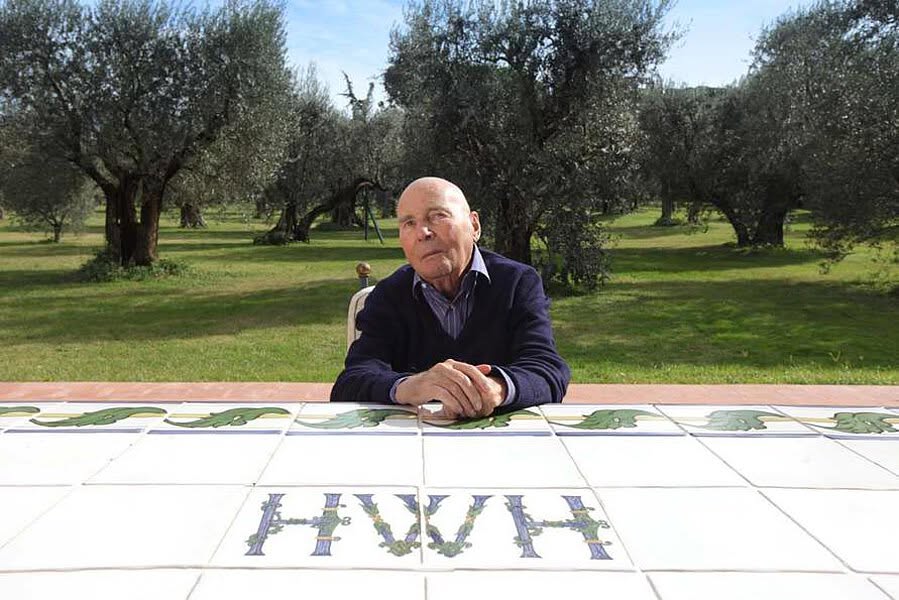
The first time I encountered Hans Werner Henze’s music, I think it was “The English Cat,” one of a series of Deutsche Welle operas relayed by WFMT out of Chicago. I thought, what the hell is this?
Since then, as a crazed record collector, I’ve accumulated a fair amount of Henze’s music on recordings. Also, as a classical music radio host, I’ve actually had to listen to some of it, in order to learn if there was anything he composed that wouldn’t frighten the horses (or the cats, for that matter), when it came time to mark his birthday anniversaries.
First, I unearthed his totally innocuous, charming even, “Telemanniana,” after Baroque master Georg Philipp Telemann (the title gives it away). Hardly characteristic, but it serves its purpose.
Then I got my hands on the Deutsche Grammophon recording – a 2-CD set – of his ballet “Undine,” a musical telling of Fouqé’s fantastic tale of star-crossed love between a water nymph and a mortal. The score is so eclectic, if you think you don’t like it, hang in there, because in a few minutes, it’s going to turn into something else. I mean, it’s modernist, but it’s not just some gray miasma.
Less congenial for weekday radio, perhaps, is “The Bassarids,” after Euripides’ “The Bacchae,” although it seems to be musically and dramatically effective. I’m just not going to blindside anyone at work with a two-and-a-half-hour opera (for as much as I would relish conveying the synopsis, with its frenzied dismemberment and severed head). The English libretto, by W.H. Auden and Chester Kallman, explores the conflict between Pentheus, King of Thebes (representative of human rationality and emotional control) and the god Dionysus (unbridled passion). The work scored Henze one of his greatest successes.
Henze himself was a very interesting character. His father was a teacher at a progressive school in Germany who somehow fell under the sway of Nazi propaganda, so that he enrolled his older boys (including Hans) as Hitler Youth! Naturally, this led to some friction in the family. You have to hand it to the old man, though. Eventually, he came around to the fact that Hans was never going to be a Nazi ideologue and became supportive of his musical studies. Then Dad rejoined the army (he was a World War I veteran) and died on the Eastern front. Toward the end of the war, Hans was conscripted, interrupting his studies, and he served as a radio operator until he was captured by the British.
Post-war, he attended the Darmstadt New Music Summer School, soaking up a lot of contemporary music, and became immersed in avant-garde techniques. He began experimenting with serialism.
Then the Sadler’s Wells Ballet visited Hamburg, and he started writing music for the stage. He found work conducting a ballet company in Wiesbaden, and his output includes a dozen ballets.
While he was still in his 20s, he decided he’d had enough of Germany, which he found boorish and intolerant and was full of traumatic memories. He took an advance from his publisher and beat it to Italy, settling for a few years on the island of Ischia, where he was welcomed by fellow expats William Walton and his wife, Susana.
Musically, Henze was always curious, seeking, assimilating, and adapting – he had a questing intellect and a Protean output – but he was also true to himself. And it frequently got him into trouble. He was a homosexual in a much less tolerant era. His embrace of communism also proved controversial. He wrote pieces honoring Ho Chi Minh and Che Guevara. When he placed a red flag on stage during a performance of his Guevara requiem, “The Raft of the Medusa,” the effect proved so incendiary that a riot broke out.
His later works were less inflammatory, though he continued to be inspired by political and social themes. His musical language traversed the paths of serialism, atonality, neoclassicism, Italian and Arabic influences, jazz, and even some rock and popular music.
In 2005, he suffered a nervous breakdown, during which he barely spoke, and for two months he refused to eat. Then suddenly he recovered, and his partner of some 40 years, Fausto Moroni, died of cancer. Henze himself died in Dresden in 2012 at the age of 86.
He was a prominent composer in his day, but I’m not sure how much of his music is being played now. Today is the 100th anniversary of his birth, so listen up.
———
“Telemanniana”
“Undine”
Teaser for “The English Cat”
“The Bassarids”
Leave a Reply