Tag: Ballets Russes

  • Lord Berners: Eccentric Genius and Musical Wit

    Lord Berners: Eccentric Genius and Musical Wit

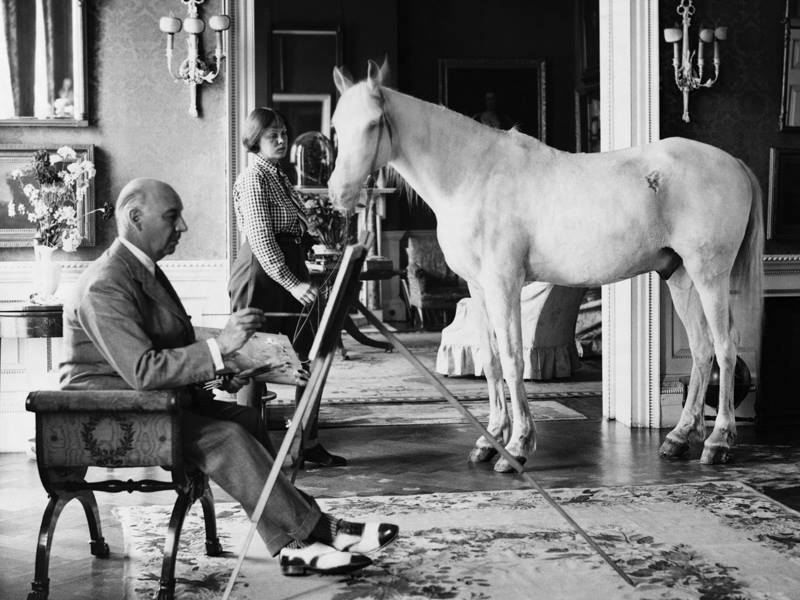
    He kept a clavichord in the back seat of his Rolls Royce. A pet giraffe roamed the grounds of his estate. He invited a horse to his indoor tea parties. He constructed a 100-foot folly tower, “just to annoy the neighbors.”

    Today is the birthday of Gerald Hugh Thyrwitt-Wilson, 14th Baron Berners (1883-1950), whose enduring reputation is as one of England’s great eccentrics. More than likely, he was perfectly sane, as sane as you or I, but that sanity was leavened by a highly cultivated sense of the absurd.

    A multitalented individual, Berners’ fortune allowed him the luxury to indulge his whims and enthusiasms. He wrote wry and entertaining books, he became a painter (he included moustaches in his portraits, whether the sitter had one or not), and he composed some thoroughly delightful music.

    His most famous work is “The Triumph of Neptune,” one of only two ballets commissioned from English composers by the Ballets Russes. The work became a great favorite of Sir Thomas Beecham, who made multiple recordings of it.

    I hope you’ll join me for music by Lord Berners. His will be among the birthday anniversaries we’ll observe today, between 4 and 7 p.m. EDT, on WWFM – The Classical Network and wwfm.org.


    PHOTO: Berners, no doubt contemplating the placement of a moustache
  • Ballets Russes: English Music for the Stage

    Ballets Russes: English Music for the Stage

    We don’t know for sure when he was born (he was baptized on April 26, 1564), but April 23 is the day the world has chosen to celebrate Shakespeare.

    Rather than pummel you with more music inspired by the Bard, I thought I would take a circuitous approach, this Sunday night on “The Lost Chord,” and present Constant Lambert’s 1924-25 ballet, “Romeo and Juliet.” Do not go into it expecting the star-cross’d lovers of Shakespeare’s immortal tragedy. Lambert’s version takes a look at a ballet company. In the process of preparing an adaptation of the play, the two leads fall in love. They flee a rehearsal, and are glimpsed eloping in an aeroplane!

    Lambert was only 20 years-old when he wrote the music, which is cheeky and burlesque, evocative of commedia dell’arte and perhaps influenced by contemporaneous displays of joie de vivre by composers of the Parisian collective, Les Six.

    “Romeo and Juliet” was one of only two ballets commissioned from English composers by Serge Diaghilev for his Ballets Russes. The other was “The Triumph of Neptune,” written in 1926 by Gerald Hugh Tirwhitt-Wilson, 14th Baron Berners.

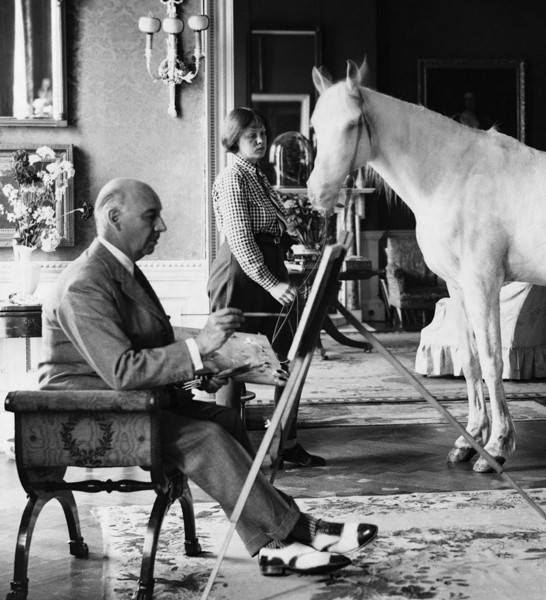
    Berners was an exemplar of a certain tradition of English eccentricity, in which a lord might invite a giraffe to an outdoor tea party or a horse would be given license to roam the indoors to mingle with his guests. His garden was full of paper flowers, his dogs wore pearl necklaces, and he built a hundred foot folly tower, allegedly just to annoy the neighbors.

    Berners was gifted in so many areas – as a composer, of course, but also as a writer (his stories and autobiographical musings have been brought back into print) and a painter (he loved to include mustaches in his portraits, whether the sitter had one or not). He liked ballet best of all, since it allowed him to write the scenarios and design the backdrops, in addition to composing the music.

    “The Triumph of Neptune” is Berners’ best-known piece. In this instance, it was Sacheverell Sitwell who devised the scenario, which sprang from their mutual enchantment with 19th century theatrical prints. An English sailor is shipwrecked en route to Fairyland. He is saved by Britannia, who dances a hornpipe. He returns home in spirit form, to find his wife carrying on with a well-dressed villain. But all ends happily, as he is turned into a prince and marries Neptune’s daughter.

    The choreography was by George Balanchine, and the work became a great favorite of Sir Thomas Beecham.

    I hope you’ll join me for “England à la Russe” – music written by English composers for the Ballets Russes – this Sunday night at 10:00 EDT, on WWFM – The Classical Network and at wwfm.org.


    PHOTOS: Berners paints a horse; Lambert pushes a car

  • Ida Rubinstein: Scandalous Muse & Lost Masterpieces

    Ida Rubinstein: Scandalous Muse & Lost Masterpieces

    The actor and dancer Ida Rubinstein specialized in strong, often sultry heroines. A remarkable figure, this sugar heiress from a family of Ukrainian Orthodox Jews essentially willed herself onto the Parisian stage, where her acting ability and natural magnetism more than compensated for her limited ability as a dancer.

    She was welcomed into the Ballets Russes in 1909, where she assumed the roles of Cleopatra and Scheherazade. Later, for her own company, she introduced Ravel’s “Bolero” and Stravinsky’s “Le Baiser de la fée” (“The Fairy’s Kiss”).

    She gained notoriety for her often racy sensuality, stripping naked in the “Dance of the Seven Veils” in a production of Oscar Wilde’s “Salome” in 1908. As a woman and a Jew, she scandalized for assuming the title role in Gabriele d’Annunzio and Claude Debussy’s “The Martyrdom of Saint Sebastian” in 1911.

    This Sunday night on “The Lost Chord,” we salute Rubinstein with music that supported two of her lesser-known characterizations.

    In 1924, she appropriated the symphonic variations “Istar,” by Vincent d’Indy. Originally composed in 1896, the subject was a natural fit for the Rubinstein image, with the Assyrian goddess of love and war descending into the underworld to rescue her lover. Along the way, she passes through seven doors. At each door, she removes a piece of jewelry or an article of clothing, until, as she passes through the last, she stands unadorned. So does the music arrive finally at a complete statement of the theme, turning the usual structure of theme and variations on its head to suit the narrative.

    We’ll also hear “Sémiramis,” from 1934. This time Rubinstein is an Assyrian queen with insatiable carnal appetites. The music was by Arthur Honegger, and the instrumentation is quite striking: female narrator, vocal soloists, five-part mixed chorus, with orchestra including double bass clarinet, saxophone, two harps, two pianos, celesta, and two ondes Martenot – electronic keyboard instruments sounding very much like a couple of theremins.

    This was the fifth commission the composer was to receive from Rubinstein. The sixth and last brought forth his magnum opus, “Jeanne d’Arc au Bûcher” (“Joan of Arc at the Stake”).

    “Sémiramis” was not a success, and the work remained unpublished during Honegger’s lifetime. In particular, a 15 minute monologue toward the climax, written by Paul Valéry, took all the air out of the room. This spoken interlude has been omitted from the recording we’ll hear of the piece’s first modern performance in 1992.

    I hope you’ll join me as we celebrate Ida Rubinstein – “Ida Danced All Night” – this Sunday night at 10 ET, with a repeat Wednesday evening at 6; or that you’ll listen to it later as a webcast at wwfm.org.

    PHOTO: Diaphanous dancer Ida Rubinstein as Semiramis

  • Diaghilev’s Lost English Ballets

    Diaghilev’s Lost English Ballets

    Serge Diaghilev, impresario of the Ballets Russes, commissioned some of the most enduring ballet scores of the 20th century, from composers such as Claude Debussy (“Jeux”), Maurice Ravel (“Daphnis and Chloe”), Manuel de Falla (“The Three-Cornered Hat”) and especially Igor Stravinsky (“The Firebird,” “Petrushka” and “The Rite of Spring”).

    Less well known is the fact that he approached two Englishmen to write music for his famed and influential company.

    This Sunday night on “The Lost Chord,” we’ll be listening to works by Constant Lambert and Lord Berners – both figures so diverse in their interests, and possessing such outsized personalities, that it isn’t really possible to do either justice in the time allotted.

    Lambert was a brilliant polymath. In addition to his considerable talents as a composer, he was a conductor, arranger, and writer, as well as the lover of Margot Fonteyn. Alas, alcoholism and workaholism conspired with undiagnosed diabetes to hasten his demise at the age of 45.

    His ballet, “Romeo and Juliet,” presented as a play-within-a-play, turns Shakespeare’s tragedy of star-crossed lovers on its head, with the leads falling hard in a backstage romance with happier results. Lambert would go on to greater things, but the ballet is undeniably an impressive piece of work for a 20 year-old.

    Similarly, Lord Berners’ interests lay all over the place, but his was a much more relaxed character. Unfailingly productive as a composer, a painter and a writer, he never lost sight of the fact that his life would be his magnum opus. And Berners lived well.

    Furthermore, his fortune ensured that he would never be taken to task for any of his whimsical behavior. This included having a 140-foot folly tower constructed on his estate (partly to annoy the neighbors) and inviting a horse to his indoor tea parties.

    Berners wrote novels, painted portraits (always certain to include a moustache, whether the sitter had one or not), and composed a respectable amount of music, especially for the ballet.

    For the Ballets Russes, he wrote “The Triumph of Neptune,” which became a great favorite of Sir Thomas Beecham. Sacheverell Sitwell provided the scenario, which concerns a sailor who is shipwrecked en route to Fairyland, and George Balanchine supplied the choreography.

    I hope you’ll join me for “England à la Russe,” tonight at 10 ET, with a repeat Wednesday evening at 6, or that you’ll listen to it later as a webcast at http://www.wwfm.org.

    PHOTO: Berners, no doubt contemplating the placement of a moustache

Tag Cloud

Aaron Copland (92) Beethoven (94) Composer (114) Film Music (117) Film Score (143) Film Scores (255) Halloween (94) John Williams (185) KWAX (228) Leonard Bernstein (99) Marlboro Music Festival (125) Movie Music (132) Opera (197) Philadelphia Orchestra (86) Picture Perfect (174) Princeton Symphony Orchestra (106) Radio (86) Ralph Vaughan Williams (85) Ross Amico (244) Roy's Tie-Dye Sci-Fi Corner (290) The Classical Network (101) The Lost Chord (268) Vaughan Williams (101) WPRB (396) WWFM (881)

DON’T MISS A BEAT

Receive a weekly digest every Sunday at noon by signing up here


RECENT POSTS