Tag: Béla Bartók

  • Bluebeard’s Enduring Myth & Bartók’s Castle

    Bluebeard’s Enduring Myth & Bartók’s Castle

    Like any myth worth its salt, the disturbing fairy story of Duke Bluebeard embeds itself in the recesses of the unconscious, only to color and confirm subterranean anxieties or perceived truths about the wider world.

    The best-known version of the story is the one by Charles Perrault, set down in the 17th century. Perrault’s popular retellings of Little Red Riding Hood, Cinderella, The Sleeping Beauty, and Puss in Boots served to codify these timeless folk tales for the modern age.

    Bluebeard as an archetype informs the characterizations of so many of the tortured antiheroes of the Gothic novel – the mysterious and brooding nobleman who lives in a dank castle of many chambers that surely contain their share of skeletons, be they literal or figurative.

    Sometimes Bluebeard really is the menace of Perrault, the volatile madman who lives in a house full of corpses. At others (as in “Jane Eyre”), he is a tragic hero who harbors a guilty secret that cuts him off from all happiness, love, and normalcy. Only gradually do the heavy doors grind open on rusty hinges to reveal their truths. The chambers are like the dark corners of his psyche, vulnerabilities he holds close, to the point of near-destruction or even beyond. Only understanding and acceptance have the power to alter his world.

    That said, sometimes Bluebeard really is a murderous creep who’s all about control and over-the-top cruelty.

    And what about his bride, named Judith in Béla Bartók’s opera, “Bluebeard’s Castle?” Is her curiosity a liberating force or a destructive one? The parable of fatal curiosity extends back through the Biblical stories of Lot’s wife and Eve and the Classical myths of Pandora, Eurydice, and Psyche.

    The tale positively drips with allegory. If there is anything that is clear about the Bluebeard story, it’s that it would take two very special people to make this unusual relationship work. There’s no way any outside observer would ever, ever, EVER understand.

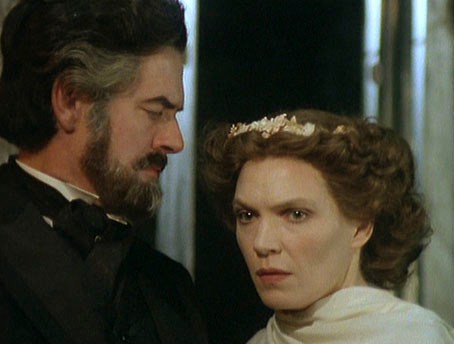
    On Béla Bartók’s birthday, I stumbled across this 1988 film of “Duke Bluebeard’s Castle.” It’s not sung in the original Hungarian. English-speaking viewers may find that a plus; anyone else, I think, will find compensation in its atmosphere and insight.

    In whatever language, the music is still terrific. Happy birthday, Béla Bartók!

  • Ernő Dohnányi A Forgotten Hungarian Genius

    Ernő Dohnányi A Forgotten Hungarian Genius

    While Béla Bartók is respected as the foremost Hungarian composer of the 20th century, Ernő Dohnányi, until recently, has been subject to neglect, at least in proportion to his significance. Sure, Bartók and his friend, Zoltán Kodály, were at the forefront of the whole nationalist movement, traipsing around the countryside in order to document authentic folk traditions before they were swallowed up forever by industrialization. But as director of the Budapest Academy of Music and music director of the Budapest Philharmonic Orchestra, Dohnányi would exert as much influence over his country’s musical development as that of his folk music-mad friends and contemporaries

    Unfortunately, he would become the target of character assassination campaigns after World War II, in which he was painted as a Nazi sympathizer. Dohnányi was investigated and cleared several times by the U.S. Military Government, and in fact has been defended as a forgotten hero of Holocaust resistance, since it was through his administrations that countless Jewish musicians survived. Also, between the wars, he went to bat for Kodály, a leftist, by refusing to fire him from the Budapest Academy. As a result, Dohnányi too lost his position, albeit temporarily. Nevertheless, he continued to be eyed with suspicion, and his slandered reputation never fully recovered.

    Equally fatal is the fact that much of his music bears a more cosmopolitan stamp than that of the Hungarian composers of his era that are now so celebrated. His composition teacher, the German-born Hans von Koessler (known in Hungary as János Koessler), was a cousin of Max Reger. Of course, Koessler also taught Bartók and Kodály. But Dohnányi was perfectly happy nestled in the world of Brahms. For his international career, he assumed the name Ernst von Dohnanyi.

    I’ve always been partial to Sir Malcolm Sargent’s recording of Dohnanyi’s gorgeous Serenade in F sharp minor, with the London Symphony Orchestra. Unfortunately, the sound file doesn’t seem to be posted anywhere. For as much as I appreciate the existence of this CD, the performance is a comparatively weak substitute – in my humble opinion, of course:

    In the meantime, nice to have discovered this live performance of Dohnanyi’s best-known piece, the “Variations on a Nursery Tune,” with André Previn conducting. The soloist is the Brazilian pianist Cristina Ortiz, cute as a button. The piece has its share of “inside” musical jokes, but the best one must be the agonizingly portentous build-up to the pianist’s first entrance – here complete with a stroll through the cemetery, beneath the chilly gaze of an ominous medieval castle!

    Furthermore, the entire orchestra appears to be dressed as Captain Kirk.

    Happy birthday, Ernő Dohnányi. Energize!


    PHOTO: Dohnányi (left), boldly taking the train with Bartók

  • Bartók Goodman Contrasts Happy Birthday

    Bartók Goodman Contrasts Happy Birthday

    If you want to talk about a study in contrasts, how about Hungarian master Béla Bartók and America’s “King of Swing,” Benny Goodman?

    Goodman’s musical training was classical (he took lessons at the local synagogue and with Chicago Symphony clarinetist Franz Schoepp). But he really caught fire when playing with dance bands. His early influences were New Orleans jazz clarinetists who worked in Chicago.

    He shot to prominence during the Big Band era, but with the decline of swing, he decided to return to his formal studies, this time with English clarinetist Reginald Kell. Goodman developed a lot of bad habits in the intervening years, and he had to rebuild his technique basically from scratch.

    Although a worldwide celebrity who had achieved enormous success, Goodman missed the classics and longed for a little mainstream respectability. Since he was by then in a position to do so, he took up performing and recording Mozart and Weber, and he commissioned or played new works by Copland, Bernstein, and Stravinsky, among others.

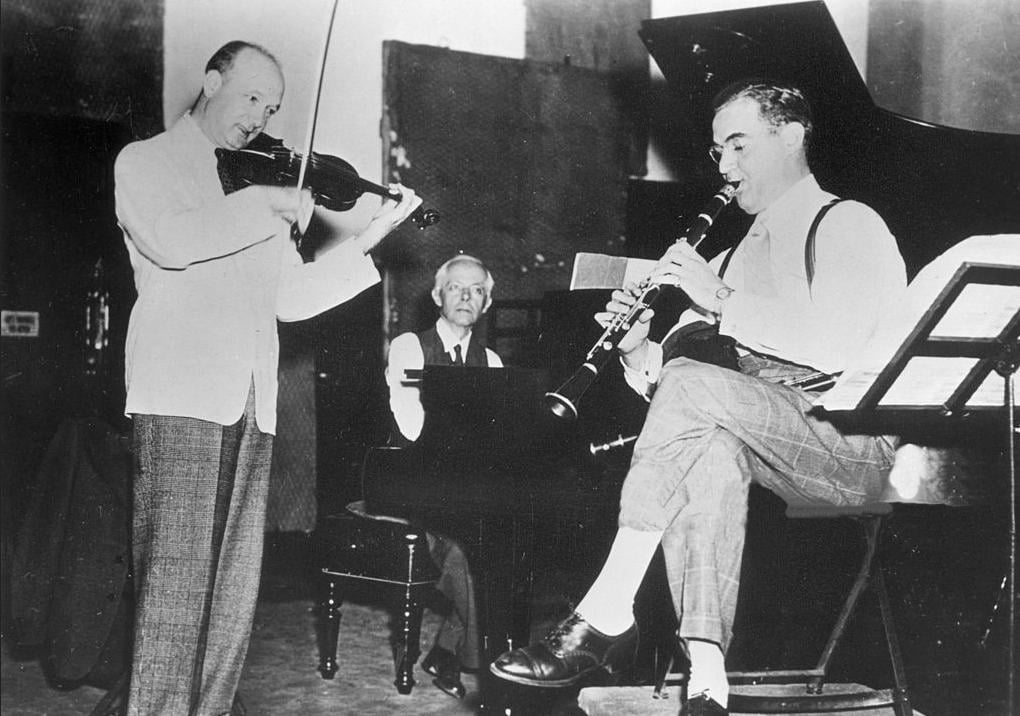
    One of these was Béla Bartók, whose birthday it is today. Bartók composed “Contrasts” in 1938, on a Goodman commission. This trio for clarinet, violin, and piano is a raw, fascinating work, inspired by Hungarian and Romanian dance melodies. It contains passages of bitonality and frenzied scordatura (a deliberate mistuning, or alternate tuning, of the violin). Goodman recorded the work, with violinist Josef Szigeti and the composer at the piano.

    Not your glass of pálinka? By way of “contrast,” check out Bartok’s ballet-pantomime “The Wooden Prince,” composed in 1914-17. Much less frequently performed than his subsequent succès de scandale, “The Miraculous Mandarin,” composed in 1918-24, this musical fairy tale for large orchestra bears the influences of Debussy and Strauss, and yes, Wagner too.

    Never understood why it’s not heard more often. Just because it doesn’t have quite the bite of the composer’s mature masterworks doesn’t mean it isn’t worthwhile.

    https://www.youtube.com/watch?v=vYEijXHFY1w

    From the King of Swing to “The Wooden Prince,” happy birthday, Béla Bartók!


    PHOTO: Bartók at the piano, bookended by Szigeti and Goodman

  • Bartók’s Adirondack Escape Creative Revival

    Bartók’s Adirondack Escape Creative Revival

    When you’re displaced, ailing, and demoralized, sometimes the best thing you can do is just get away.

    How tranquility and birdsong of the Adirondacks revitalized the creative spirit of Béla Bartók:

    https://www.adirondackalmanack.com/2020/12/history-matters-bartoks-birds.html

    Lots more about Bartók’s cabin at Saranac Lake (since restored):

    https://localwiki.org/hsl/Bartok_Cabin

    His Piano Concerto No. 3 (bird song influence particularly strong in the second movement, around 11:58):

  • Ahmed Adnan Saygun Turkish Coffee Composer

    Ahmed Adnan Saygun Turkish Coffee Composer

    There is a Turkish proverb: “Coffee should be black as Hell, strong as death, and sweet as love.”

    The music of Ahmed Adnan Saygun is very good coffee indeed. Saygun (pictured, right) rode a wave of Turkish nationalism to become his country’s foremost composer in the Western classical tradition. Perhaps best remembered abroad as an associate of Béla Bartók (pictured, left), Saygun was a prominent ethnomusicologist, but also an important educator and cultural administrator.

    This Sunday night on “The Lost Chord,” savor an hour of his sometimes sweet, often astringent, always rewarding music, including a selection of “Etudes on Aksak Rhythms” (1964), his Suite for Violin and Piano (1956), and the Piano Concerto No. 1 (1951-57).

    The refreshments are guaranteed to be aromatic, bold, and rich, on “Turkish Toughie,” this Sunday night at 10:00 EDT, on WWFM – The Classical Network and wwfm.org.

Tag Cloud

Aaron Copland (92) Beethoven (95) Composer (114) Film Music (119) Film Score (143) Film Scores (255) Halloween (94) John Williams (185) KWAX (229) Leonard Bernstein (99) Marlboro Music Festival (125) Movie Music (134) Opera (198) Philadelphia Orchestra (86) Picture Perfect (174) Princeton Symphony Orchestra (106) Radio (87) Ralph Vaughan Williams (85) Ross Amico (244) Roy's Tie-Dye Sci-Fi Corner (290) The Classical Network (101) The Lost Chord (268) Vaughan Williams (102) WPRB (396) WWFM (881)

DON’T MISS A BEAT

Receive a weekly digest every Sunday at noon by signing up here


RECENT POSTS