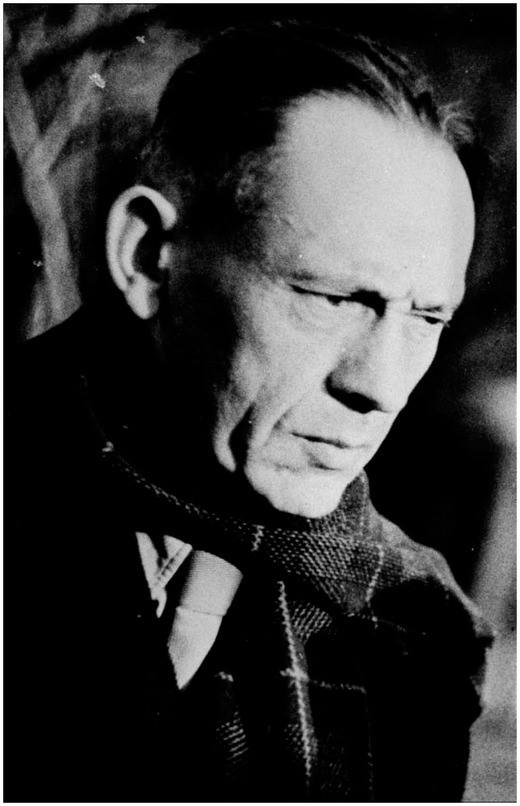
Hungry for Hungarian music? Give László Lajtha a shot.
A forgotten colleague of Béla Bartók and Zoltán Kodály, Lajtha (pronounced “Loy-tah”) too busily collected and transcribed folk music from the Hungarian countryside prior to World War I.
Later, he was appointed Director of Music for Hungarian Radio, Director of the Museum of Ethnography, and Director of the Budapest National Conservatory. He was summarily removed from all three posts and his passport confiscated by the Communist regime after remaining in the West too long while at work on the film score to a British screen adaptation of T.S. Eliot’s “Murder in the Cathedral” (which went on to win the Grand Prix at the Venice Film Festival in 1951). He hadn’t even provided a film score in the truest sense, instead composing three concert works (the Symphony No. 3, the Orchestral Variations, and the Harp Quintet No.2), which were excerpted in the film.
Anyway, he was awarded the Kossuth Prize in 1951 for his achievements as a folk researcher. At least that’s something. I devoted my life to Hungarian music, and all I got was this lousy t-shirt.
Today is the birthday of Béla Bartók (1881-1945), considered, alongside Franz Liszt, to be the greatest composer Hungary ever produced. In fact, he was one of the most important composers of the 20th century.
Bartók had a gift for absorbing the music of the villages and the countryside of Central and Eastern Europe and filtering it through his own distinctive sensibility. His was a musical nationalism very much of his time and far removed from the 19th century model as exemplified by composers like Mikhail Glinka and Bedřich Smetana.
He was one of the first to take a scientific approach to the collection and classification of folk music. His absorption of indigenous techniques led to the breakdown of diatonic harmony, which had dominated western art music for centuries, and opened up a world of possibility for those who followed. He also loved eerie dissonances, which he often employed as a backdrop to nature sounds and desolate melodies.
Bartók wrote music of varying degrees of difficulty, from a listener perspective, ranging from the opulence of his early Richard Strauss-influenced orchestral works, to the primitive savagery of his percussive piano writing, to the edgy dissonance of his six landmark string quartets, to the sweeping synthesis of Western art music and European folk music in mature masterworks like his “Concerto for Orchestra.”