Vernon Duke (né Vladimir Dukelsky) was born in what is now Belarus on this date in 1903. In Kyiv, he studied composition under Reinhold Gliere. He left the USSR in 1920, traveling to New York, where he was befriended by George Gershwin. In fact, it was Gershwin who suggested a name-change to something a bit more comprehensible to American audiences. (Gershwin himself was born Jacob Gershowitz.)
For a time, Duke ping-ponged back and forth to Europe, where he fulfilled a commission by Serge Diaghilev (for the ballet “Zephyr and Flora”). The work impressed Sergei Prokofiev, and the two became fast friends. Dukelsky’s Symphony No. 1 was given its premiere in Paris, under Serge Koussevitzky, on the same program as excerpts from Prokofiev’s “The Fiery Angel.”
Around the same time, Duke began contributing material to musical comedies in London. This laid the groundwork for a return to New York in 1929. There, he continued to composed “serious” works, while insinuating himself into the Broadway scene. A number of his songs – “April in Paris,” “Autumn in New York,” “Taking a Chance on Love,” “I Can’t Get Started” – have since become standards.
When Gershwin died in 1937, Duke stepped in to complete his unfinished score for “The Goldwyn Follies,” for which he contributed a couple of ballets (choreographed by George Balanchine) and the song, “Spring Again.” His greatest success came in 1940, with the Broadway show, “Cabin in the Sky.”
Here’s a rare concert broadcast of his Symphony No. 3:
A number of his concert works have been recorded in recent years, including this Piano Concerto for Arthur Rubinstein:
His Cello Concerto, performed by Samuel Magill, then of the Metropolitan Opera Orchestra:
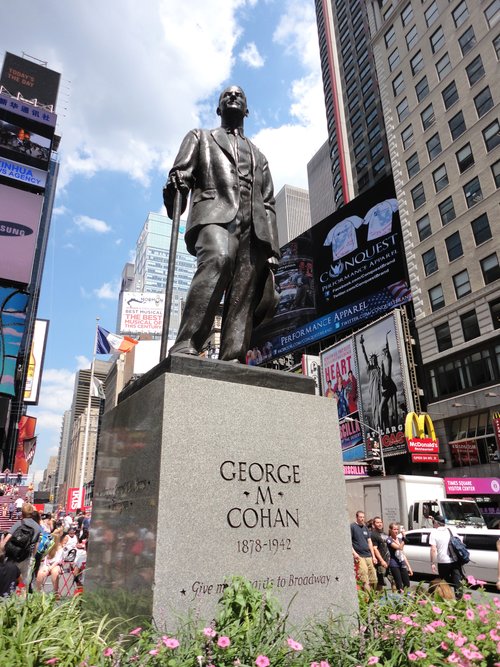
Of course, everyone knows that Broadway luminary George M. Cohan was born on the Fourth of July.
Except he wasn’t. This was one Yankee Doodle Dandy who was actually born on July 3rd.
Cohan was born in Providence, Rhode Island, on this date in 1878, but he and his family always maintained he was a Yankee Doodle Boy.
Cohan was tied to the theater from childhood. He first appeared on stage as a violinist at the age of 8. Later, he became famous for his wisecracks and eccentric dancing.
He could be quite temperamental in his youth – a trait he apparently tamed – more than once declaring himself “through with the theater.” If he felt particularly ill-used, he was known to walk out on a performance.
He also became a prolific tin pan alley songsmith, displaying a rare gift. His songs were noted for their clever lyrics and catchy melodies, and a number of them remain immediately recognizable, including “Give My Regards to Broadway,” “It’s a Grand Old Flag,” “Over There,” “Mary is a Grand Old Name,” “Always Leave Them Laughing When You Say Goodbye,” and of course “The Yankee Doodle Boy.”
But it soon became apparent he was not just a song and dance man. In fact, he became regarded as the most versatile figure in American theater. From 1904 to 1920, with his friend and business partner Sam H. Harris, he produced over 50 Broadway musicals, plays, and revues. He pioneered the “book musical,” with his songs serving a dramatic story. He was also noted for his stirring, flag-waving finales.
But it wasn’t all about simply pleasing the crowd in his own vehicles. He also earned plaudits for his performance in Eugene O’Neill’s “Ah, Wilderness!”
Cohan himself was a playwright and also a theater owner. For a time, he and Harris owned Chicago’s Grand Opera House, which in 1912 became known as George M. Cohan’s Grand Opera House. In 1926, it was renamed the Four Cohan’s Theatre. It reverted to the Grand Opera House with its sale to the Shubert family in 1928.
So many of Cohan’s songs are still so well known, I suppose in part because of the Cagney movie (“Yankee Doodle Dandy,” released in 1942), but also because we used to sing them in school, and heard them at parades, and they’re just good solid tunes from a more innocent age that allowed one to be proud and uncomplicated.
Cohan did live to see the film, by the way. “My God,” he commented of Cagney’s performance, “what an act to follow.” The Academy thought so too, as Cagney was honored with an Oscar for Best Actor. The film also won the Academy Award for Best Picture.
Cohan’s obituary in the New York Times described him as perhaps the greatest song and dance man in Broadway history. FDR awarded him the Presidential Medal of Freedom, and Deems Taylor, president of ASCAP and a composer himself, described him as a genius. He died of abdominal cancer in 1942 at the age of 64.
Cohan wasn’t the only American icon to claim the Fourth of July as his birthdate. Louis Armstrong also celebrated the anniversary of his birth on July 4th. The truth is he didn’t know when he was born, so he and his manager selected Independence Day. What could be more American than that? It wasn’t until the 1980s, well after Armstrong’s death, in 1971, that a researcher discovered Satchmo’s baptismal records and learned that his authentic birthdate was August 4, 1901.
You know who WAS born on the Fourth of July? ME!
For the record, if I didn’t know when I was born, I would have chosen Halloween.
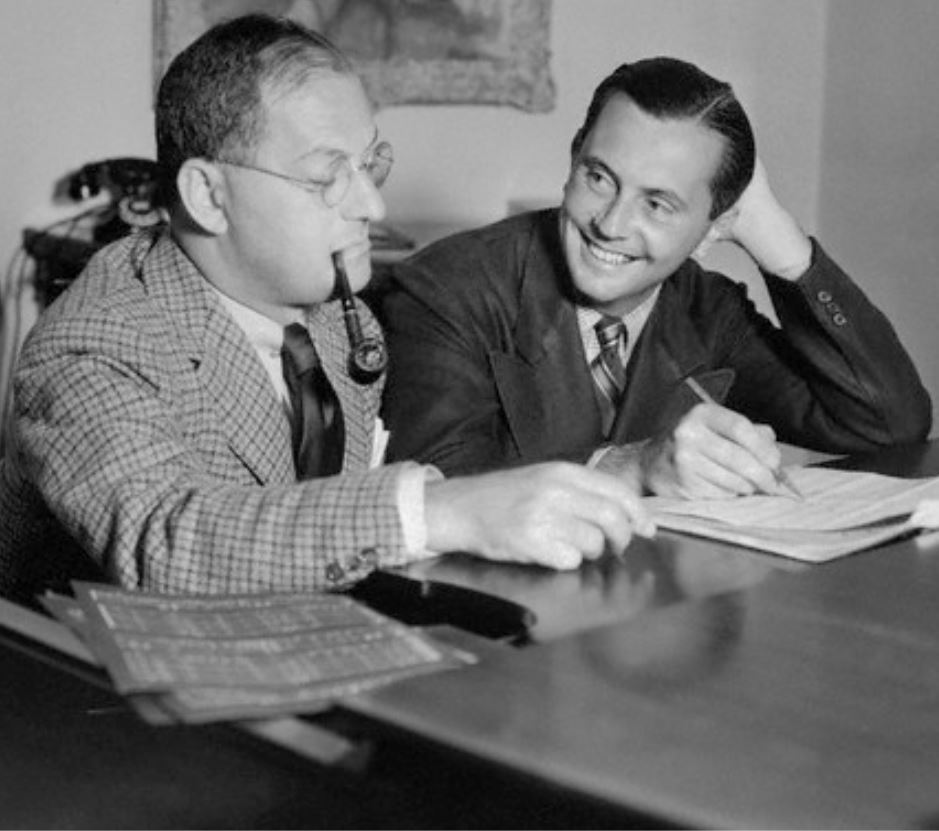
There is an interesting subgenre of the Broadway musical that owes its existence to some of classical music’s most shameless melodists. And it is largely attributable to the team of Robert Wright and George Forrest.
Wright and Forrest, who were lifelong partners, both professionally and personally, knew a good tune when they heard one, and they were quick to appropriate the most insinuating of them as threads to be woven into the tapestries of some rather enduring musicals.
Perhaps the most famous of these is “Kismet” (1953), which draws on the seductive lyricism of Alexander Borodin. I’m sure you’re familiar with its hit tunes, “Baubles, Bangles and Beads” and “Stranger in Paradise.”
But there was also “Gypsy Lady” (1946) after Victor Herbert, and “Anya” (1965) after Rachmaninoff. Most ambitious of all was “Magdalena” (1948), a collaboration with Brazil’s still (at the time) very-much-alive and irrepressible Heitor Villa-Lobos.
Wright and Forrest owed much to Edwin Lester, impresario of the Los Angeles Civic Light Opera, who first commissioned a number of these, which were presented as operettas. LACLO also revived works by of Sigmund Romberg, Victor Herbert, and Oscar Straus. The organization made its debut in 1938 with a revival of “Blossom Time,” a 1916 Viennese pastiche operetta after the music of Franz Schubert.
Wright and Forrest were natural choices to retool “The Great Waltz,” after Johann Strauss II, which they did for a 1949 production by LACLO. This is the version that was used for a 1970 London stage revival and a 1972 motion picture remake.
The original musical was conceived by Hassard Short, who also directed “Carmen Jones,” after Bizet, in 1943. (For once, Wright and Forrest had nothing to do with it.) Moss Hart wrote the original book. The lyrics were by Desmond Carter. This in turn was adapted from a 1930 pastiche operetta by Erich Wolfgang Korngold and Julius Bittner, “Waltzer aus Wien” (“Waltzes from Vienna”). A film adaptation from 1938 sported a screenplay and new lyrics by Oscar Hammerstein. The two films, which focus on different periods of Strauss’ life, are actually quite distinct.
But before Wright and Forrest’s work on any of these came “Song of Norway” (1944), after Edvard Grieg, who was born on this date in 1843. The team cannily recognized that one hummable melody after another virtually poured from the sleeves of Norway’s most famous composer, whose music must have been very much in the air during his centenary.
The show is a fictionalized account of the lives of three childhood friends: Grieg, his sweetheart Nina Hagerup, and the “poet” Rikard Nordraak. In reality, Nordraak was also a composer – in fact the composer of Norway’s national anthem! – but presumably, to keep it clear for American audiences, there was room in Bergen and Troldhaugen for only one.
“Song of Norway” was a hit on Broadway and ran for 860 performances. George Balanchine provided the choreography for the original production. The dancers were members of the Ballet Russe de Monte-Carlo, including Maria Tallchief, who married Balanchine during the show’s run.
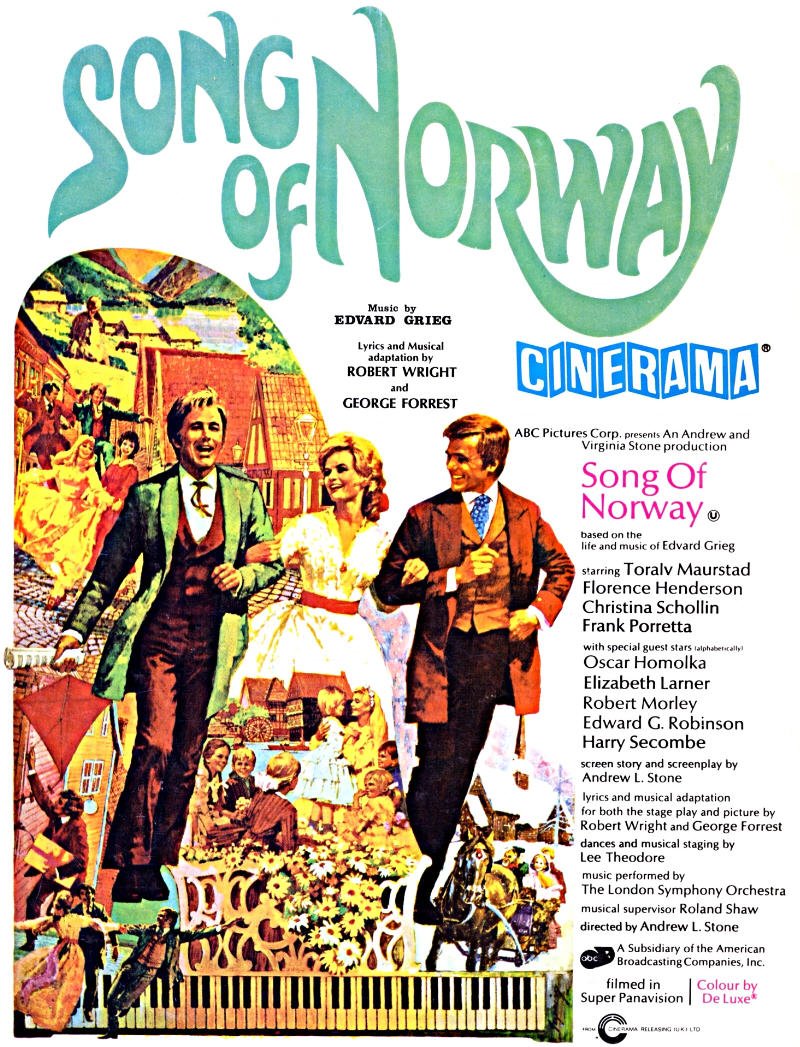
A film was announced for 1950, but didn’t materialize for another 20 years. Florence Henderson, by then a familiar presence in American living rooms as Mrs. Brady on “The Brady Bunch,” played Nina. Grieg was portrayed by Norwegian actor Toralv Maurstad, and Nordraak was played by American tenor Frank Porretta. Porretta retired from the stage in his early 40s, but not before leaving an indelible mark on American opera. He spent the second half of his career as choir director at St. John’s Church in Darien, Connecticut.
A transparent attempt to capitalize on the popularity of “The Sound of Music,” the film of “Song of Norway” did not succeed. It did, however, give Edward G. Robinson another unlikely opportunity to play a Norwegian, 25 years after “Our Vines Have Tender Grapes.”
Here are the opening credits, restored, and in their proper aspect ratio. I suppose if you’re going to give it a chance, this is the way it should be seen. That’s pianist John Ogdon on the soundtrack.
But perhaps you’re satisfied with a muddy, cropped, substandard TV print – even though the film was originally presented in theaters in Cinerama.
A condensed version on radio, brought to you by the American railroad!
In real life, Nordraak met Grieg in Copenhagen in 1864, and the two became fast friends. For a time, Nordraak had resigned himself to a career in business at the behest of his father, but gradually his musical interests prevailed. Grieg encouraged him to join him in forging a Norwegian national sound. Sadly, the following year, Nordraak was studying abroad when he was stricken by tuberculosis. He died in Paris at the age of 23.
Due to his early demise, he composed only about 40 pieces, many of them songs, works for male choir, and piano works. He also wrote incidental music for a play, “Mary Stuart in Scotland.” Interestingly, Grieg was of Scottish descent, on his father’s side. His great-grandfather settled in Norway in 1770.
Nordraak, “Scherzo Capriccio”
Nordraak, “Purpose” from “Mary Stuart in Scotland”
Nina sings Nordraak’s “Holder du af mig” (“If you love me”) in 1889. She was 43 or 44 at the time. It’s possible that that’s Grieg himself at the keyboard.
Wright and Forrest were always credited equally as composer-lyricists, but it was really Forrest who worked with the music. ”Kismet” earned them a Tony Award for Best Musical in 1954, and in 1995 they were honored with an ASCAP Foundation Richard Rodgers Award.
Grieg compositions that were used in “Song of Norway” include the Piano Concerto in A minor (“Prelude & Legend”), the “Norwegian Dance No. 2” (“Freddy and His Fiddle”), the Violin Sonata No. 2 and “Waltz” from the “Lyric Pieces” (“Now”), “Wedding Day at Troldhaugen” (“Strange Music”), “One Balmy Summer Eve” from “Five Poems,” Op.26, and Scherzo in E from the “Lyric Pieces” (“Midsummer’s Eve”), and “I Love You” from “Melodies of the Heart,” Op.5.
The fjords are alive with the sound of Edvard Grieg! Happy birthday to Norway’s most-beloved composer!
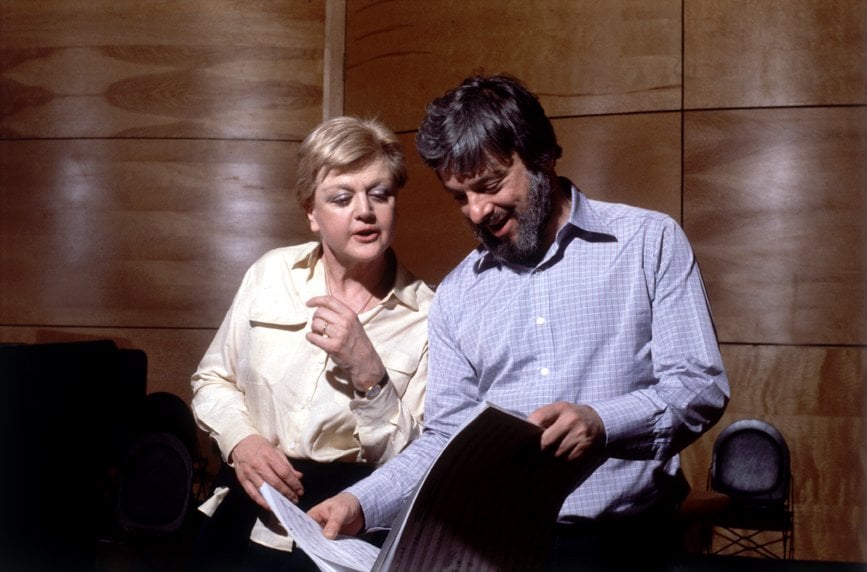
Tragedy tonight! Broadway legend Stephen Sondheim has died.
The composer and lyricist credited with having reinvented the American musical was the recipient of every major honor, including nine Tony Awards, an Academy Award, eight Grammy Awards, a Pulitzer Prize, a Laurence Olivier Award, and a 2015 Presidential Medal of Freedom.
Sondheim’s passing occurs only two weeks before Steven Spielberg’s “West Side Story” is set to introduce him to a whole new generation of fans. He was only 27 when he collaborated with Leonard Bernstein and Arthur Laurents on the original 1957 production.
It was the beginning of a storied career that included music and lyrics for “A Funny Thing Happened on the Way to the Forum,” “Company,” “Follies,” “A Little Night Music,” “Sweeney Todd: The Demon Barber of Fleet Street,” “Sunday in the Park with George,” and “Into the Woods.” He also provided the words for Laurents’ “Gypsy,” with music by Jule Styne.
Following an early mentorship with Oscar Hammerstein II – whom he had known since the age of 10, since Hammerstein turned out to be his best friend’s father – he fell in with Princeton University’s total serialist Milton Babbitt, whom he described as “a frustrated show composer.” It was an unlikely pairing, but the two clicked. Together, they dissected everything from Rodgers and Hart to Mozart.
Sondheim’s uncanny facility with words – imbued with virtuosic wit, insight, and humanity – frequently added up to more than just a stunt lyric. In any case, he always regarded himself foremost as a composer. His revitalizing approach to the American musical theater made him the most revered and influential composer-lyricist of the second half of the 20th century.
I note that today would have been the 95th birthday of American composer Lee Hoiby. Hoiby, a disciple of Gian Carlo Menotti, wrote a lot of vocal music and received particular acclaim for his operas. However, I first discovered him through an old recording of his Piano Concerto on the CRI label.
Hoiby, born in Madison, Wisconsin, in 1926, studied at the University of Wisconsin with pianists Gunnar Johansen and Egon Petri. (His early ambition had been to become a concert pianist.) Then he struck out for California, where he studied at Mills College with Darius Milhaud. In San Francisco, he worked with a number of musicians whose thinking was decidedly outside-the-box, including Rudolf Kolisch, brother-in-law of Arnold Schoenberg, and Harry Partch.
It’s interesting, therefore, that his own music would wind up being so traditional. Chalk it up to further studies with Menotti at the Curtis Institute of Music in Philadelphia. It was Menotti who introduced Hoiby to opera, instilling in him a life-long love of the human voice. Hoiby was employed as an assistant on the Broadway debut productions of Menotti’s “The Consul” and “The Saint of Bleecker Street” (the latter of which earned his teacher a Pulitzer Prize). Menotti would produce Hoiby’s first opera, “The Scarf” (1958). Eight more would follow. The most highly-regarded of these is perhaps his Tennessee Williams adaptation, “Summer and Smoke” (1971).
Hoiby also had a powerful champion in Leontyne Price, who introduced many of his best-known arias and songs. He claimed Franz Schubert as an important influence. “What I learned from Schubert came from a long, deep and loving exposure to his songs. A lot happens on a subconscious level, so it’s hard to verbalize, but what I think his songs taught me have to do primarily with the line, the phrasing, the tessitura, the accentuations of speech, the careful consideration of vowels, the breathing required, and an extremely economical use of accompaniment material, often the same figure going through the whole song.”
Interestingly, Hoiby’s Julia Child opera – or perhaps monodrama – “Bon Appetit!” (1986) was streamed only weeks ago by Opera Philadelphia, with Jamie Barton as “The French Chef.”
Then this week, wholly by coincidence, I happened to revisit a DVD I had picked up perhaps 15 years ago of a production of “The Taming of the Shrew,” performed by the American Conservatory Theater of San Francisco in 1976. Lo and behold, the incidental music is by Lee Hoiby!
The production is robust, Rabelaisian (influenced by commedia dell’arte, actually), and it moves like lightning. In this season of perpetually inclement weather, perhaps it would make for a pleasant diversion. I guarantee it will charm your socks off. And it is introduced by the late Hal Holbrook (with cigarette, no less).
Furthermore, it features Mark Singer as Petruchio, in a performance of astounding physicality. Indeed, it’s a wonder that any of the actors have enough breath to speak their lines. Singer went on to notoriety in the 1980s, when he singlehandedly sustained cable TV through incessant repeats of his breakout feature, “The Beastmaster.”
Watch “The Taming of the Shrew” here, and see if you don’t owe me a debt of thanks. And note Hoiby’s contribution.