For some people, being a master in one field, it seems, just isn’t enough. This Sunday night on “The Lost Chord,” we’ll hear works by three successful composer-painters.
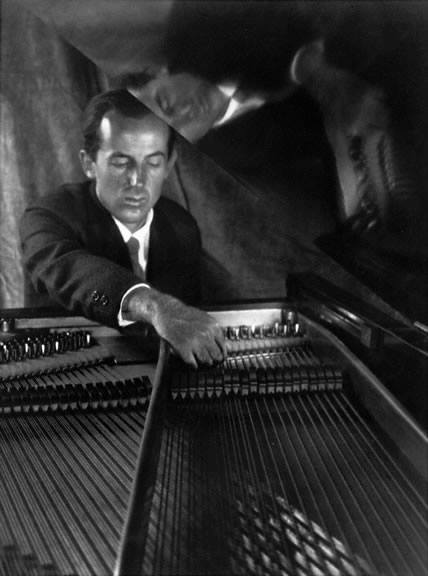
Carl Ruggles (1876-1971), a friend of Charles Ives, lived 95 years. The cantankerous American modernist was the creator of a handful of meticulously-crafted, uncompromising works. His complete, authorized output amounts to four times the length of an LP side. We know this, because Michael Tilson Thomas recorded just about everything as part of a two-LP set, issued on the Columbia Masterworks label back in 1980.
Ruggles’ method was described by musicologist Charles Seeger as “dissonant counterpoint,” a system wherein all the traditional rules of counterpoint are reversed, so that dissonance, rather than consonance, is the norm. The very practice smacks of contrarianism!
Not surprisingly, he was beloved by Ives. When someone had the audacity to boo a work by Ruggles at a concert given in 1931, Ives berated the critic as a sissy. “Why can’t you stand up before fine, strong music like this, and use your ears like a man?” he challenged.
In addition to his activities as a composer, Ruggles created hundreds of paintings. They were deemed successful enough that he was invited to hang shows and even sold many of his canvases.
His musical composition “Sun-Treader” was inspired by Robert Browning’s poem, “Pauline” – in particular the line, “Sun-treader, light and life be thine forever!”
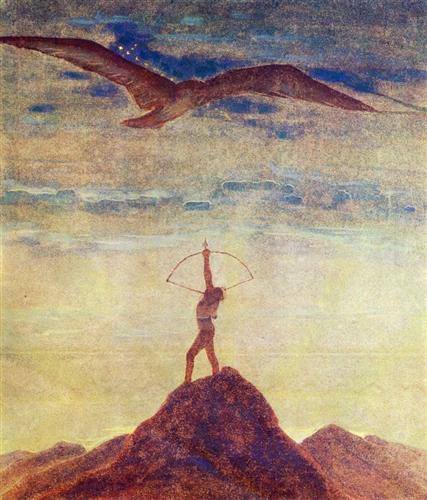
In contrast to Ruggles, a gifted dilettante who tossed off paintings in an afternoon, Mikalojus Čiurlionis (1875-1911) is considered every bit as important a painter as he was a composer.
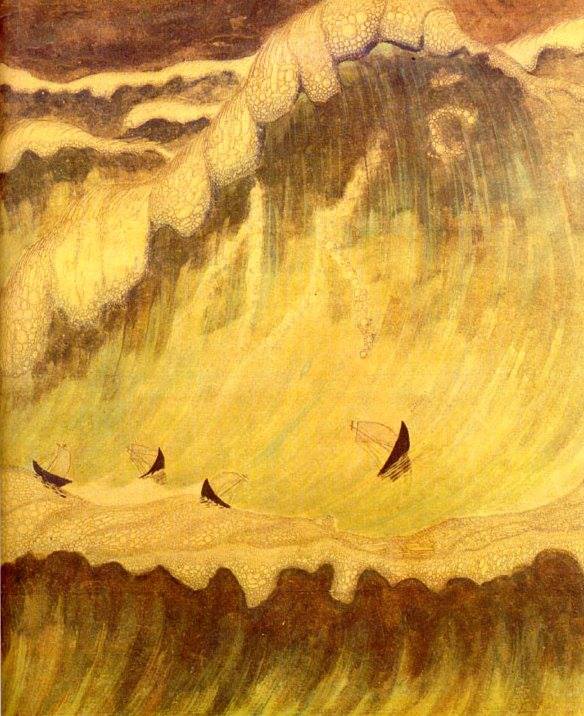
In his 35 years, Čiurlionis managed to compose about 400 pieces of music and paint about 300 canvases. A pioneer of abstract art in Europe, he was an exemplar of the symbolist and art nouveau movements, a representative of the fin de siècle epoch, and a major figure in Lithuanian culture. Interestingly, Čiurlionis was also a synesthete; that is to say, he perceived colors and music simultaneously. We’ll hear his vibrant symphonic poem, “The Sea.”
Lyonel Feininger (1871-1956), on the other hand, is known almost exclusively as a visual artist. Born and raised in New York, he moved to Germany at the age of 16. There, he became a leading practitioner of German Expressionism and the Bauhaus. With the rise of the Nazis in the 1930s and the party’s campaign against modern art, Feininger was driven out of Germany, and after 50 years returned to the United States, where he met with great success.
Feininger had no formal music studies, beyond a few years of violin lessons. Regardless, he composed thirteen fugues (with extant sketches for a fourteenth). These, he wrote by ear, with the music of Johann Sebastian Bach being an undisguised influence. Feininger claimed that the influence of Bach was equally evident in his paintings.
Prepare to see double this week. It’s an hour of music by ambidextrous artists. Join me for “Fixtures at an Exhibition,” this Sunday night at 10:00 EDT, on WWFM – The Classical Network and wwfm.org.
“Sonata of the Sea: Finale” (1908), by Mikalojus Čiurlionis