Tag: Carl Ruggles

  • Cowell Ruggles American Mavericks

    Cowell Ruggles American Mavericks

    At the risk of instigating a slap fight between two of America’s foremost musical mavericks, I salute both Henry Cowell (1897-1965) and Carl Ruggles (1876-1971) on their shared birthday.

    Actually, the two were good friends. Their circle of “ultra-modernists,” as they were dubbed, must have been swollen with cake this time of year. (Colin McPhee’s birthday anniversary is on March 15.) The surfeit of sugar made them all the more volatile, I’m sure.

    Cowell pioneered the use of atonality, polytonality, polyrhythms, and non-Western modes. He was employing tone clusters (chords made up of adjacent keys on the chromatic scale, often played with a fist or forearm) in his keyboard music before Béla Bartók.

    His experiments with aleatory (chance elements) and the “string piano” (reaching inside the piano to play the strings) influenced generations of composers. He was an autodidact who adopted established musical techniques only as he felt he needed them.

    Cowell was so bad-ass that when he was sent to San Quentin on a “morals” charge, he kept right on churning out music at his usual prolific pace. He taught his fellow inmates and organized a prison band. There’s got to be a movie in this, the musical equivalent of “The Shawshank Redemption.”

    That said, Cowell did not emerge from the experience unscarred. His later works take a more conservative tack. No longer was he quite as radical, either musically or politically. It is his music from this era that is usually deemed radio-safe.

    Cowell and Carl Ruggles were two-fifths or the “American Five,” which also included John J. Becker, Wallingford Riegger and Charles Ives. Ives was a good friend of both, supporting Cowell’s experimentation before he himself became well-known.

    He famously defended Ruggles by leaping to his feet, following a performance of “Men and Mountains,” to confront a heckler with, “You g**d*** sissy! When you hear strong, masculine music like this, get up and use your ears like a man.” This would likely be received even less favorably today than it was then. But these guys existed before political correctness.

    In fact, Ruggles was so incorrect, he eventually alienated even Ives. Even so, Ives was seemingly the only one of Ruggles’ acquaintances never to be on the receiving end of his ire.

    Ruggles disdained music theory and composed by ear, painstakingly, through trial and error. He did adhere to a kind of dissonant counterpoint. Because of his perfectionism, he left only ten authorized works. He found it to be much less labor-intensive to paint. Over the course of his lifetime, he sold hundreds of his paintings. (Curious to see some? Google is your friend.)

    There’s no question that Ruggles was a world-class S.O.B., but he did manage to leave behind some fascinating, even breathtaking music.

    Happy birthday to two American originals.


    Henry Cowell, “The Banshee,” for string piano:

    Carl Ruggles, “Men and Mountains”:


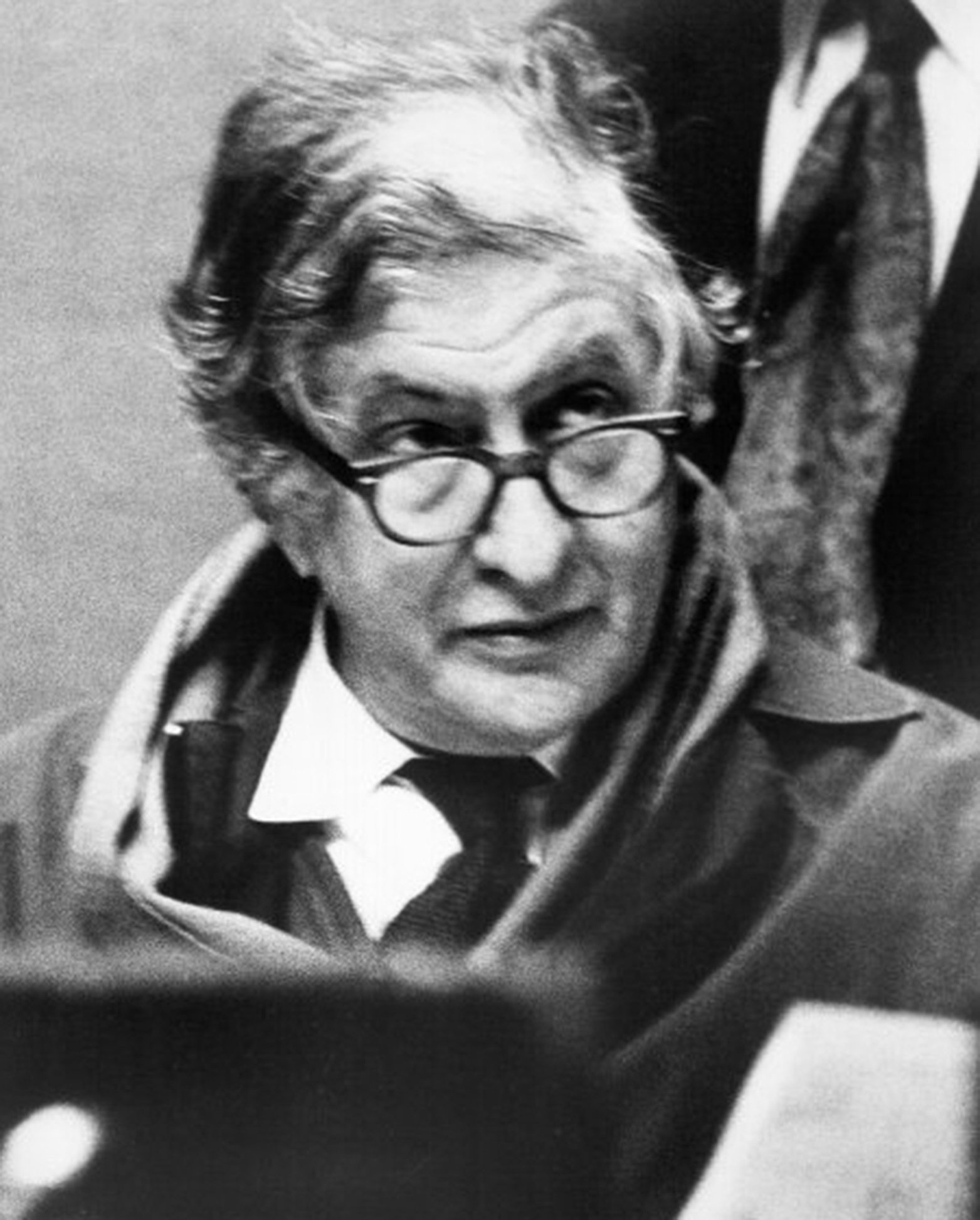
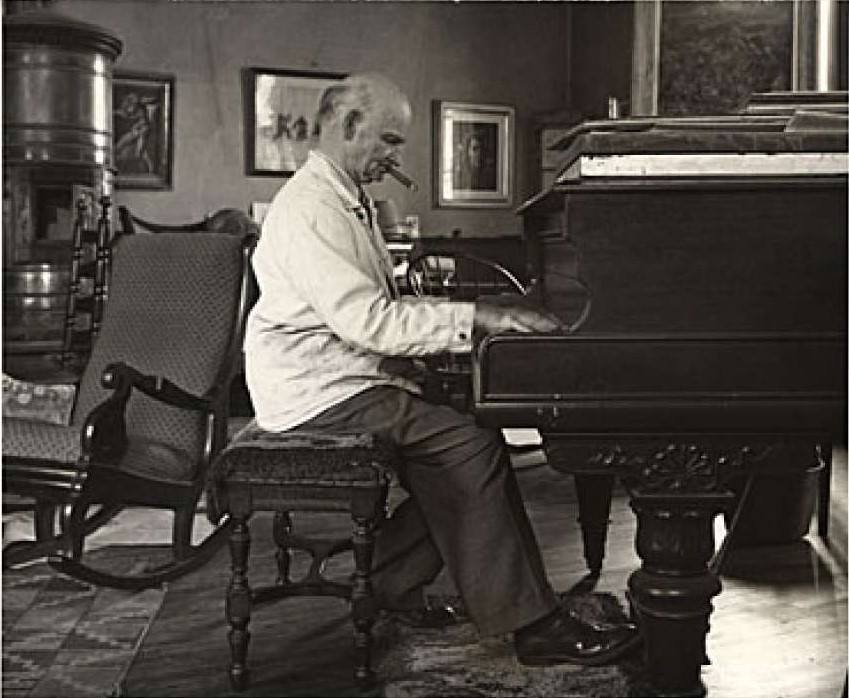
    IMAGES: (left) Henry Cowell and friend; “The Sun Treader (Portrait of Carl Ruggles)” by Thomas Hart Benton

  • Herrmann Ruggles Maverick Composers

    Herrmann Ruggles Maverick Composers

    The only composer crankier than Carl Ruggles was probably Bernard Herrmann. Everyone recognizes Herrmann as the genius film composer he was, but whenever he was in front of an orchestra, he made it his mission to champion works by neglected composers.

    Ruggles, the cantankerous American modernist, was the creator of a handful of meticulously-crafted, uncompromising works. His complete, authorized output can be accommodated on two LPs. We know this, because Michael Tilson Thomas recorded just about everything for the Columbia Masterworks label in 1980.

    Ruggles’ method was described by musicologist Charles Seeger as “dissonant counterpoint,” a system wherein all the traditional rules of counterpoint are reversed, so that dissonance, rather than consonance, is the norm. The very practice smacks of contrarianism!

    Not surprisingly, Ruggles was beloved by Charles Ives. When someone had the audacity to boo one of Ruggles’ works at a concert given in 1931, Ives berated the critic as a sissy: “Why can’t you stand up before fine, strong music like this, and use your ears like a man?!”

    Ruggles also created hundreds of paintings. In contrast to the agonizing process of composition, his paintings were usually tossed off in an afternoon. They were deemed good enough that he was invited to hang shows and even sold many of his canvases.

    Ruggles died in 1971, about three months after this Herrmann interview was broadcast. He was 95 years-old.

    Herrmann got his start in the medium of radio in 1934, when he was hired as a conducting assistant at CBS. It wasn’t long before he was providing original music and serving as musical director of its resident orchestra. Among his duties there was providing incidental music for Orson Welles’ Mercury Theatre broadcasts. In fact, he was in front of the orchestra for possibly radio’s most notorious hour, Welles’ hysteria-inducing adaptation of “The War of the Worlds.”

    As would ever be the case, Herrmann did nothing by halves. Then only in his 20s, he possessed an encyclopedic knowledge of both music and literature, and filled his programs with works by Ives, Henry Cowell, Gian Francesco Malipiero, Alexander Gretchaninov, Nikolai Myaskovsky, Hermann Goetz, Joachim Raff, Niels Wilhelm Gade, Richard Arnell, Lord Berners, Edmund Rubbra, and countless others. Even Schoenberg and Webern could be heard over CBS during those years.

    Herrmann had known Ives personally since he was in his teens. He had discovered the composer’s “114 Songs” in the New York Public Library and was instrumental in shopping them around, even introducing them to Aaron Copland.

    He was also unfailingly outspoken. Once, when CBS president William S. Paley balked at one of his proposals, Herrmann snapped, “You’re assuming the public is as ignorant about music as you are.” That’s just the kind of guy Herrmann was. Totally tactless, but usually right. After that, he was given near-unlimited freedom over musical programming at CBS.

    It had always been Herrmann’s ambition to be recognized as a great conductor. Leopold Stokowski was his hero. While he never realized that ambition, it was not for want of trying.

    During the conversation at the link above, Herrmann draws an unexpected connection between Ruggles and “Moby Dick.” Herrmann was an enormous admirer of Melville’s magnum opus, setting it as a cantata in 1936-38, also predating his career in film. It was given its debut at Carnegie Hall in 1940, with Sir John Barbirolli conducting the New York Philharmonic. Herrmann dedicated the work to Ives.

    So as to leave you with a bit of Herrmann’s film music, here’s one of the composer’s personal favorites, and another piece that breathes the sea air – his score for the 1947 film “The Ghost and Mrs. Muir.”

    Happy birthday, Bernard Herrmann. Would it kill you to smile on your special day?

  • Composer Painters: Art & Music Collide

    Composer Painters: Art & Music Collide

    For some people, being a master in one field, it seems, just isn’t enough. This Sunday night on “The Lost Chord,” we’ll hear works by three successful composer-painters.

    Carl Ruggles (1876-1971), a friend of Charles Ives, lived 95 years. The cantankerous American modernist was the creator of a handful of meticulously-crafted, uncompromising works. His complete, authorized output amounts to four times the length of an LP side. We know this, because Michael Tilson Thomas recorded just about everything as part of a two-LP set, issued on the Columbia Masterworks label back in 1980.

    Ruggles’ method was described by musicologist Charles Seeger as “dissonant counterpoint,” a system wherein all the traditional rules of counterpoint are reversed, so that dissonance, rather than consonance, is the norm. The very practice smacks of contrarianism!

    Not surprisingly, he was beloved by Ives. When someone had the audacity to boo a work by Ruggles at a concert given in 1931, Ives berated the critic as a sissy. “Why can’t you stand up before fine, strong music like this, and use your ears like a man?” he challenged.

    In addition to his activities as a composer, Ruggles created hundreds of paintings. They were deemed to be successful enough that he was invited to hang shows and even sold many of his canvases.

    His musical composition “Sun-Treader” was inspired by Robert Browning’s poem, “Pauline” – in particular the line, “Sun-treader, light and life be thine forever!”

    In contrast to Ruggles, a gifted dilettante who tossed off paintings in an afternoon, Mikalojus Čiurlionis (1875-1911) is considered every bit as important a painter as he was a composer.

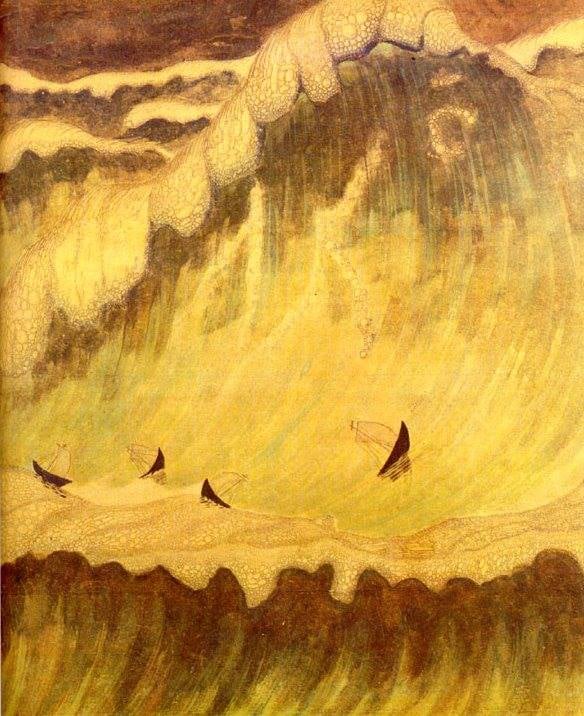
    In his 35 years, Čiurlionis managed to compose about 400 pieces of music and to paint about 300 canvases. A pioneer of abstract art in Europe, he was an exemplar of the symbolist and art nouveau movements, a representative of the fin de siècle epoch, and a major figure in Lithuanian culture. Interestingly, Čiurlionis was also a synesthete; that is to say, he perceived colors and music simultaneously. We’ll hear his vibrant symphonic poem, “The Sea.”

    Lyonel Feininger (1871-1956), on the other hand, is known almost exclusively as a visual artist. Born and raised in New York, he moved to Germany at the age of 16. There, he became a leading practitioner of German Expressionism and the Bauhaus. With the rise of the Nazis in the 1930s and the party’s campaign against modern art, Feininger was driven out of Germany, and after 50 years returned to the United States, where he met with great success.

    Feininger had no formal music studies, beyond a few years of violin lessons. Regardless, he composed thirteen fugues (with extant sketches for a fourteenth). These, he wrote by ear, with the music of Johann Sebastian Bach being an undisguised influence. Feininger claimed that the influence of Bach was equally evident in his paintings.

    Prepare to see double this week. It’s an hour of music by ambidextrous artists. Join me for “Fixtures at an Exhibition,” this Sunday night at 10:00 EDT, on WWFM – The Classical Network and wwfm.org.


    “Sonata of the Sea: Finale” (1908), by Mikalojus Čiurlionis

  • Carl Ruggles’ Sun-Treader on WWFM

    Carl Ruggles’ Sun-Treader on WWFM

    If I said March would be going out like a lamb, I’d be lion! Get ready for the ecstatic dissonances of Carl Ruggles’ “Sun-Treader.”

    “Sun-Treader” kicks off tonight’s edition of “The Lost Chord,” an hour of music by composers who were also devoted painters (and one visual artist who also happened to compose).

    That’s “Fixtures at an Exhibition,” this Sunday night at 10:00 EDT, on WWFM – The Classical Network and wwfm.org.


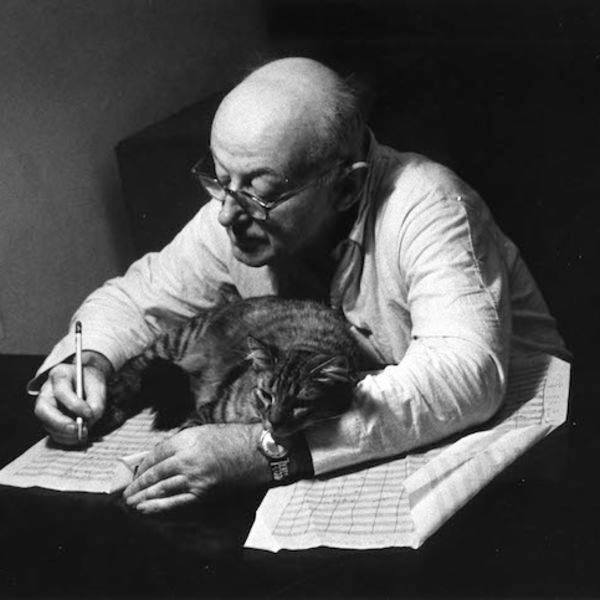
    Ruggles with a cigar and three of his paintings (left to right): “Flowers,” “The Church,” and “Forebodings.”

  • Composer Painters Music and Art

    Composer Painters Music and Art

    For some people, being a master in one field, it seems, just isn’t enough. This Sunday night on “The Lost Chord,” we’ll hear works by three successful composer-painters.

    Carl Ruggles (1876-1971), a friend of Charles Ives, lived 95 years. The cantankerous American modernist was the creator of a handful of meticulously-crafted, uncompromising works. His complete, authorized output amounts to four times the length of an LP side. We know this, because Michael Tilson Thomas recorded just about everything as part of a two-LP set, issued on the Columbia Masterworks label back in 1980.

    Ruggles’ method was described by musicologist Charles Seeger as “dissonant counterpoint,” a system wherein all the traditional rules of counterpoint are reversed, so that dissonance, rather than consonance, is the norm. The very practice smacks of contrarianism!

    Not surprisingly, he was beloved by Ives. When someone had the audacity to boo a work by Ruggles at a concert given in 1931, Ives berated the critic as a sissy. “Why can’t you stand up before fine, strong music like this, and use your ears like a man?” he challenged.

    In addition to his activities as a composer, Ruggles created hundreds of paintings. They were deemed successful enough that he was invited to hang shows and even sold many of his canvases.

    His musical composition “Sun-Treader” was inspired by Robert Browning’s poem, “Pauline” – in particular the line, “Sun-treader, light and life be thine forever!”

    In contrast to Ruggles, a gifted dilettante who tossed off paintings in an afternoon, Mikalojus Čiurlionis (1875-1911) is considered every bit as important a painter as he was a composer.

    In his 35 years, Čiurlionis managed to compose about 400 pieces of music and paint about 300 canvases. A pioneer of abstract art in Europe, he was an exemplar of the symbolist and art nouveau movements, a representative of the fin de siècle epoch, and a major figure in Lithuanian culture. Interestingly, Čiurlionis was also a synesthete; that is to say, he perceived colors and music simultaneously. We’ll hear his vibrant symphonic poem, “The Sea.”

    Lyonel Feininger (1871-1956), on the other hand, is known almost exclusively as a visual artist. Born and raised in New York, he moved to Germany at the age of 16. There, he became a leading practitioner of German Expressionism and the Bauhaus. With the rise of the Nazis in the 1930s and the party’s campaign against modern art, Feininger was driven out of Germany, and after 50 years returned to the United States, where he met with great success.

    Feininger had no formal music studies, beyond a few years of violin lessons. Regardless, he composed thirteen fugues (with extant sketches for a fourteenth). These, he wrote by ear, with the music of Johann Sebastian Bach being an undisguised influence. Feininger claimed that the influence of Bach was equally evident in his paintings.

    Prepare to see double this week. It’s an hour of music by ambidextrous artists. Join me for “Fixtures at an Exhibition,” this Sunday night at 10:00 EDT, on WWFM – The Classical Network and wwfm.org.


    “Sonata of the Sea: Finale” (1908), by Mikalojus Čiurlionis

Tag Cloud

Aaron Copland (92) Beethoven (95) Composer (114) Film Music (119) Film Score (143) Film Scores (255) Halloween (94) John Williams (185) KWAX (229) Leonard Bernstein (99) Marlboro Music Festival (125) Movie Music (134) Opera (198) Philadelphia Orchestra (86) Picture Perfect (174) Princeton Symphony Orchestra (106) Radio (87) Ralph Vaughan Williams (85) Ross Amico (244) Roy's Tie-Dye Sci-Fi Corner (290) The Classical Network (101) The Lost Chord (268) Vaughan Williams (102) WPRB (396) WWFM (881)

DON’T MISS A BEAT

Receive a weekly digest every Sunday at noon by signing up here


RECENT POSTS