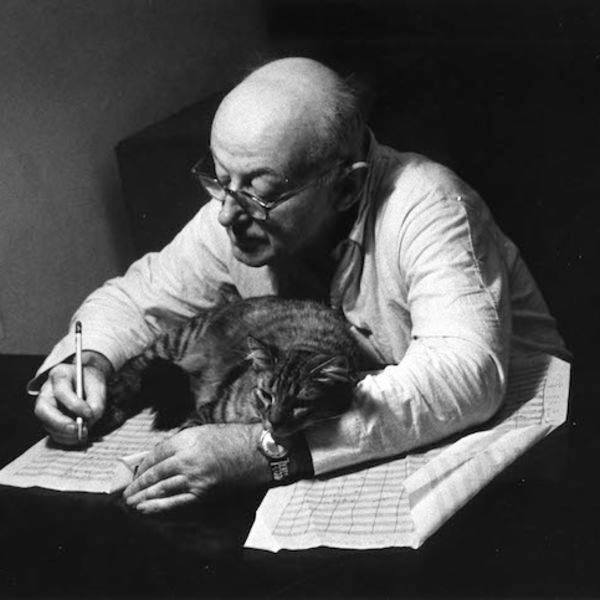
At the risk of instigating a slap fight between two of America’s foremost musical mavericks, I salute both Henry Cowell (1897-1965) and Carl Ruggles (1876-1971) on their shared birthday.
Actually, the two were good friends. Their circle of “ultra-modernists,” as they were dubbed, must have been swollen with cake this time of year. (Colin McPhee’s birthday anniversary is on March 15.) The surfeit of sugar made them all the more volatile, I’m sure.
Cowell pioneered the use of atonality, polytonality, polyrhythms, and non-Western modes. He was employing tone clusters (chords made up of adjacent keys on the chromatic scale, often played with a fist or forearm) in his keyboard music before Béla Bartók.
His experiments with aleatory (chance elements) and the “string piano” (reaching inside the piano to play the strings) influenced generations of composers. He was an autodidact who adopted established musical techniques only as he felt he needed them.
Cowell was so bad-ass that when he was sent to San Quentin on a “morals” charge, he kept right on churning out music at his usual prolific pace. He taught his fellow inmates and organized a prison band. There’s got to be a movie in this, the musical equivalent of “The Shawshank Redemption.”
That said, Cowell did not emerge from the experience unscarred. His later works take a more conservative tack. No longer was he quite as radical, either musically or politically. It is his music from this era that is usually deemed radio-safe.
Cowell and Carl Ruggles were two-fifths or the “American Five,” which also included John J. Becker, Wallingford Riegger and Charles Ives. Ives was a good friend of both, supporting Cowell’s experimentation before he himself became well-known.
He famously defended Ruggles by leaping to his feet, following a performance of “Men and Mountains,” to confront a heckler with, “You g**d*** sissy! When you hear strong, masculine music like this, get up and use your ears like a man.” This would likely be received even less favorably today than it was then. But these guys existed before political correctness.
In fact, Ruggles was so incorrect, he eventually alienated even Ives. Even so, Ives was seemingly the only one of Ruggles’ acquaintances never to be on the receiving end of his ire.
Ruggles disdained music theory and composed by ear, painstakingly, through trial and error. He did adhere to a kind of dissonant counterpoint. Because of his perfectionism, he left only ten authorized works. He found it to be much less labor-intensive to paint. Over the course of his lifetime, he sold hundreds of his paintings. (Curious to see some? Google is your friend.)
There’s no question that Ruggles was a world-class S.O.B., but he did manage to leave behind some fascinating, even breathtaking music.
Happy birthday to two American originals.
Henry Cowell, “The Banshee,” for string piano:
Carl Ruggles, “Men and Mountains”:
IMAGES: (left) Henry Cowell and friend; “The Sun Treader (Portrait of Carl Ruggles)” by Thomas Hart Benton
Leave a Reply