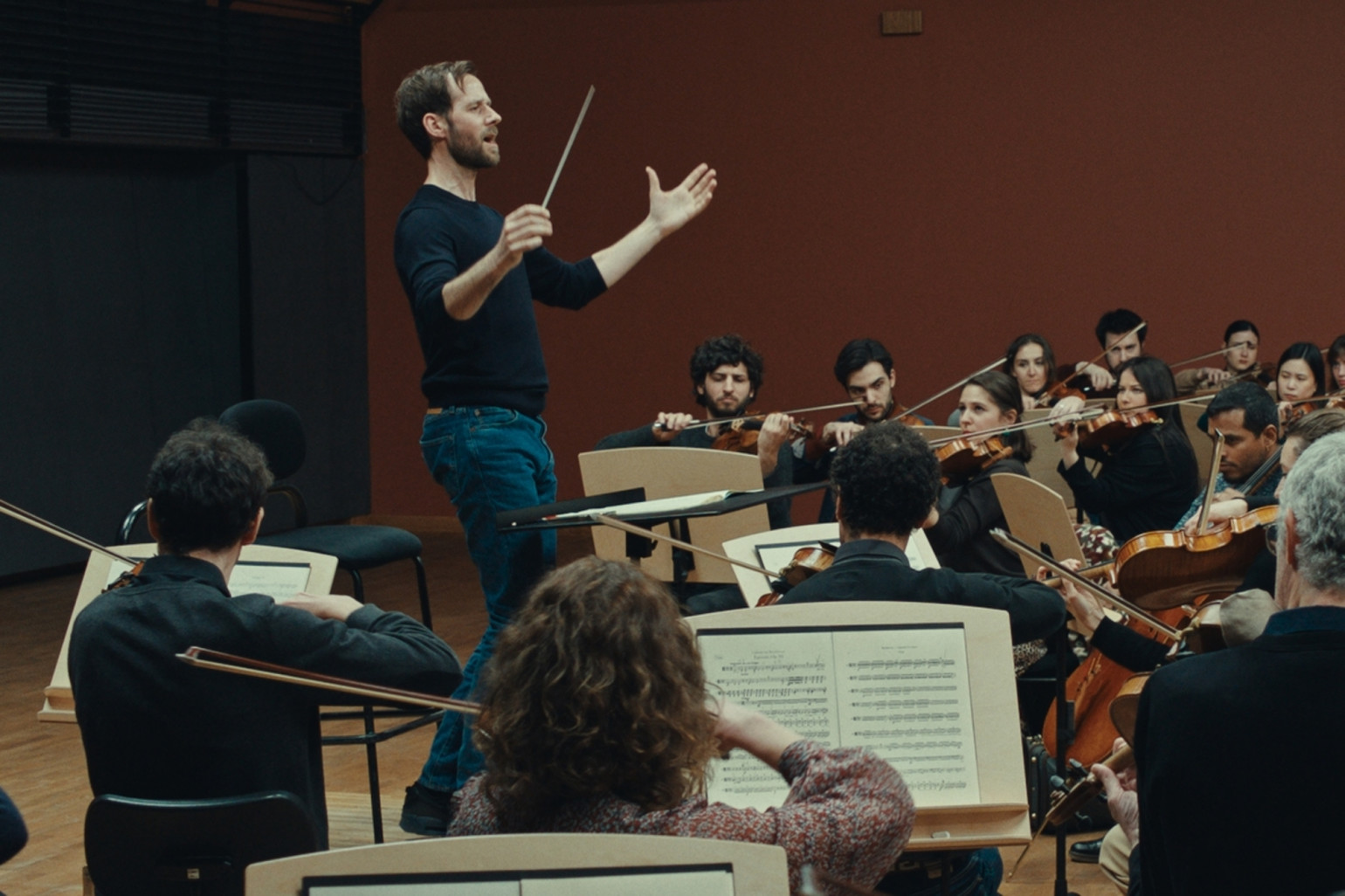
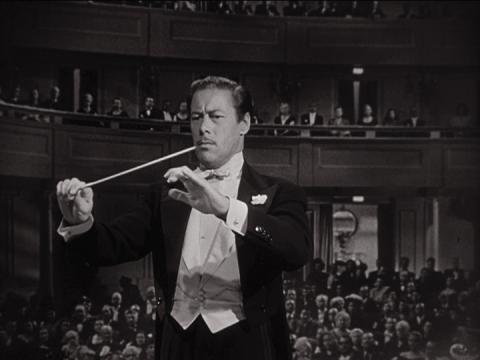
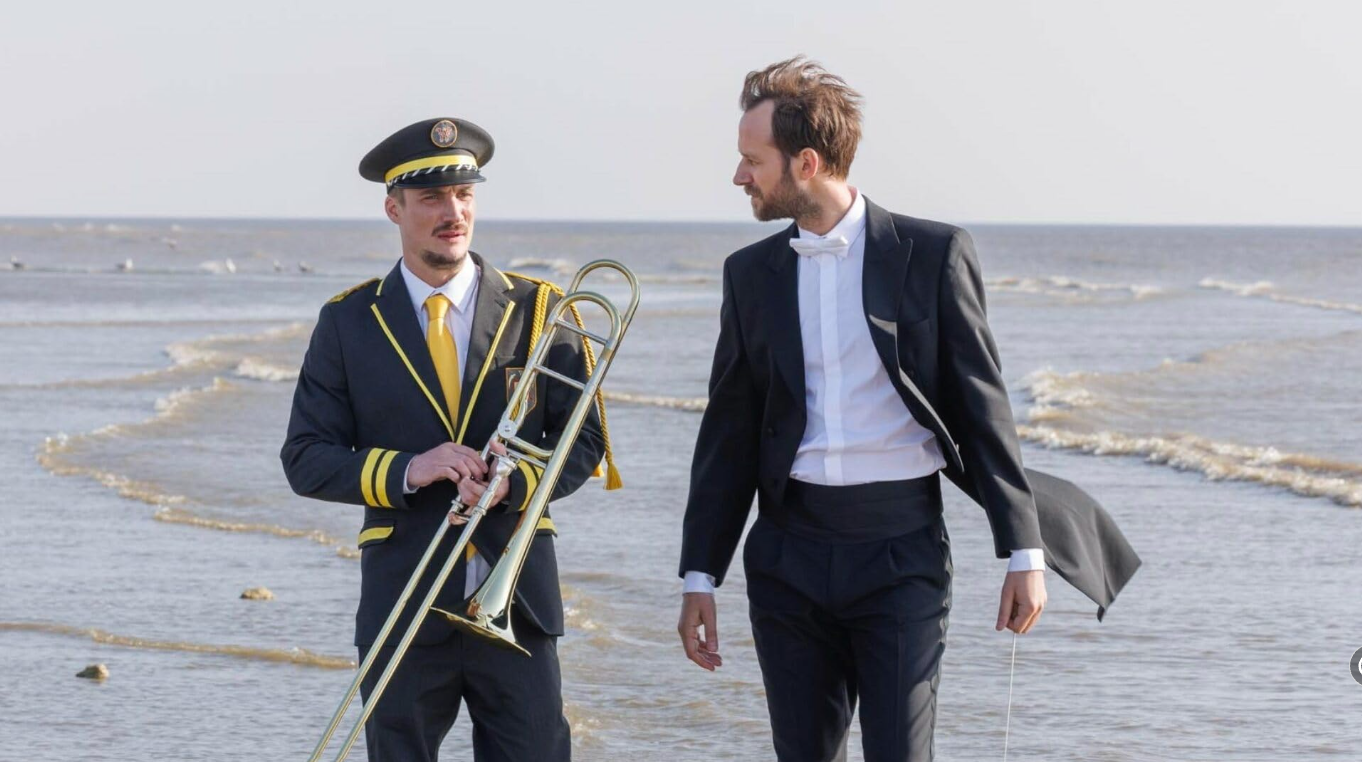
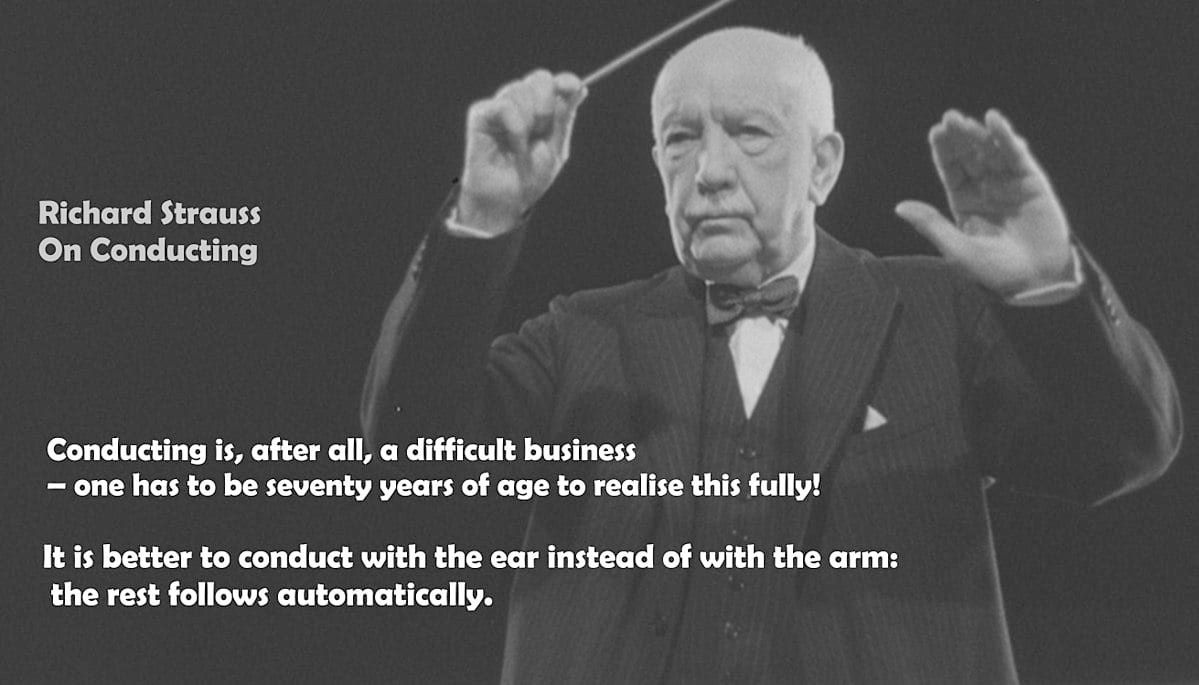
In yesterday’s post – my impressions of the French film “The Marching Band” (now in theaters) – I made some complimentary observations about actor Benjamin Lavernhe’s baton technique. His has to be one of the more convincing portrayals of a conductor on the podium. One of the worst that springs immediately to mind, because I rewatched it only fairly recently, is Rex Harrison’s in the Preston Sturges’ ”Unfaithfully Yours,” who to me seems stiff and metronomic. Any of you movie-loving classical music aficionados care to weigh in with your nominations for most passable or cringeworthy conducting on film?
What a delightful surprise this was! My ideal condition for seeing a movie is knowing next to nothing about it, and I walked into this one cold. It’s a French film, released here in the U.S. as “The Marching Band,” which I know is not a direct translation of the original title, “En Fanfare.” There’s not a lot to spoil in the basic premise, but I will be as vague about it as possible in stating that it is about two brothers, adopted into separate families at birth, who are brought together in adulthood only to discover a surprising connection through music.
If this were made in England, I could see it becoming a quirky art house hit along the lines of “Brassed Off,” with which it shares certain elements in common. But it is French, after all, so the whimsy is a little more restrained, and the drama a little more vérité (by which I mean, literally, truthful, as opposed to anything related specifically to the style of cinema).
I walked in anticipating the focus would be on the brothers’ relationship and wholly expected the musical elements to be subservient to the drama. So often movies about classical music just don’t get the “music” and the process of creating and performing music right. I have to say, in this case, it mostly did. And there was enough Beethoven, Mozart, Mahler, Debussy, and Ravel to keep me happy.
I didn’t know who any of the actors are, but the lead, Benjamin Lavernhe, who plays an internationally recognized conductor of symphony orchestras, is very good. I looked him up, and he is predominately a stage actor, associated with classical theater (his screen credit explicitly links him to the Comédie-Française), from Euripides through Racine, Shakespeare, and Molière, to Chekhov. The most recent playwright on his resume in Bertolt Brecht. For all that, he turns in a remarkably naturalistic and easygoing charismatic performance.
Classical music people will be relieved to know that, for once, this is a movie in which an actor conducting doesn’t look like he just took a few lessons. Lavernhe is comfortable with a baton, and his bearing and technique transcend pantomime to be wholly convincing.
The other brother is played by Pierre Lottin, who has the less showy, and perhaps more difficult role, since so much of it is internalized. His character hasn’t enjoyed the same advantages as Lavernhe’s, nor does he share his constructive attitude. He’s tamping down a lifetime of hurt and disappointment, and the struggle, the suppressed emotion, can be read in his eyes. Despite himself, he finds himself opening up to his long-lost brother. But his wounds are too close to the surface, and he keeps retreating back into his shell. Interestingly, Lottin is best known in France for a series of successful comedies (the “Les Tuche” series), but here he gives a good dramatic performance.
Remarkably, the director and screenwriter, Emmanuel Courcol, is not a musician, nor did he have any formal musical training, but his family instilled in him a lifelong passion for classical music. He certainly has the right instincts in terms of finding good coaches and the right actors to commit to the training.
Lavernhe is a far more convincing conductor, and character, than Cate Blanchett’s Lydia Tár. And he comes across as a real person, as opposed to an egotistical, condescending sociopath (though unquestionably problematic conductors do exist!). It’s nice to see a music director portrayed as something other than a “Seinfeld” maestro caricature for a change.
The only part that screamed “movie” for me was the ending, which at first I found a touch contrived, though it undeniably packs an emotional punch, to the extent that it teeters on the brink of sentiment. But after I left the theater, I thought about it for a while, and I realized, though in the moment it may have been a lot to swallow and certainly seemed a little more heart-on-the-sleeve than the rest of the film, it was still within the realm of plausibility. But it is something more along the lines of what you might expect from one of those British charmers like “Brassed Off,” “The Full Monty,” “Calendar Girls,” or “Kinky Boots.” Don’t go into it expecting that kind of movie. It’s not. Unless perhaps filtered through a Gallic sensibility.
At least it lands more convincingly than Richard Dreyfuss’ painful “American Symphony” that mars “Mr. Holland’s Opus.” “The Marching Band” doesn’t tidy everything up with its spoonful of sugar, but it delivers enough of an uplift to send you out of the theater feeling you had just experienced something worthwhile.
No guns. No superheroes. No CGI. No Hans Zimmer. Just a good, solid, human movie, that will also have you thinking about the old question of nature versus nurture, as music will out!
I’m sure we’ve all wondered what we’d do if we found ourselves living under a totalitarian regime. Would we speak out against injustice and atrocity, even if it meant arrest or execution? Would we flee, even if it meant never seeing our homes or loved ones again? Or would we keep our heads down, hoping not to be denounced, and pray for better days?
I don’t think any of us who haven’t actually lived through it can understand the fear, the courage, and the sacrifices that were experienced every day by those who remained in Hitler’s Germany. So try not to be too hard on Wilhelm Furtwängler, indisputably one of the greatest conducting talents of the 20th century.
Furtwängler, who succeeded Arthur Nikisch and Richard Strauss as director of Germany’s finest orchestras – including, most notably, the Berlin Philharmonic, from 1922 to 1945 and again from 1952 to 1954 – remained in Germany throughout the National Socialist regime.
Widely perceived as politically naïve, Furtwängler engaged in a dangerous game with the Third Reich, arguing vociferously in favor of Jewish musicians within his orchestra, those who could be considered his rivals (Bruno Walter, Otto Klemperer), and even those who were long dead (Joseph Joachim, Felix Mendelssohn). He went so far as to threaten to tender his resignation should the Nazis insist on the removal of Jews from the cultural sphere. Goebbels complained, “Can you name me a Jew on whose behalf Furtwängler has not intervened?”
Either he possessed an accurate grasp of his own worth to German culture, or he didn’t realize how close he trod to the flame. Himmler wanted to send him to a concentration camp. Goebbels and Göring were in favor of concessions. Encouraged, the conductor felt himself to be a force for positive change. But of course, he was just being played. The Nazi racial policies remained in place and the situation only grew worse.
What Furtwängler didn’t seem to realize was that he was being used as a propaganda tool, held up to the world as a paragon of Teutonic superiority. Wishing to appease one of the country’s most visible artists, the authorities allowed Jews to remain in the Berlin Philharmonic, though privately they grumbled about Furtwängler lacking “national sentiment.”
Revealingly, Furtwängler never joined the Nazi Party. He refused to conduct Nazi anthems, and while he retained a semblance of authority he would not appear in halls adorned with swastikas. He did not give the Nazi salute, even in his private dealings with Hitler. He rejected the Führer’s gifts and was able to get around shaking his hand by always having a baton at the ready. It was only after getting into a shouting match with Hitler himself that Furtwängler realized the enormity of the struggle. When Hitler finally was able to engineer a handshake, the Nazi photographers were all over it.
In 1934, he publicly declared Hitler an “enemy of the human race” and referred to the political situation in Germany as a pigsty. He conducted Hindemith’s “Mathis der Maler,” which had been banned by the Nazis on account of the composer’s allegedly “degenerate” (modernist) tendencies. The concert created a sensation and triggered a political firestorm. Furtwängler was forced to resign from his artistic posts, and the authorities seized the opportunity to Aryanize the Berlin Philharmonic. Fortunately, Furtwängler had already found positions for most of the Jewish personnel in foreign orchestras.
He was told that if he himself were to leave the country, he would never be allowed back in. Not wanting to be separated from his family, he decided to remain. What followed was a years-long game of cat-and-mouse between the conductor and the Reich. Furtwängler was publicly granted privileges, while penalized in ways never apparent to the foreign press. It was only through political sleight-of-hand that the Reich could get anything worthy of pro-German propaganda out of him.
With the rise of an opportunistic young conductor by the name of Herbert von Karajan, Furtwängler became marginalized. Karajan did everything for himself; Furtwängler had done everything for the sake of culture and humanity.
It’s so easy for biographical details to get in the way of a proper appreciation of Furtwängler’s art. For him, music was something that existed beyond the notes on the page and involved active, subjective intervention on the part of the conductor in order to be realized. More than most, a Furtwängler interpretation rises and falls on the strength of the performer.
“He once said to me that the most important thing for a performing artist was to build up a community of love for the music with the audience, to create one fellow feeling among so many people who have come from so many different places and feelings. I have lived with that ideal all my life as a performer.”
— Dietrich Fischer-Dieskau
Happy birthday, Wilhelm Furtwängler.
One of the great performances of the Schumann 4th
Brahms, Symphony No. 3
Bruckner, Symphony No. 5
Nazi 9th: fiery Beethoven for the Führer’s birthday in 1942, complete with swastika banners and Goebbels handshake
Richard Strauss will probably always be remembered, first, as the composer of Dionysian tone poems, employing opulent, even hedonistic orchestration, and for the turbulent, angst-ridden operas “Salome” and “Elektra.”
But when it came to conducting, he took a decidedly Apollonian stance. His technique might best be described as no-nonsense. Some have even remarked on his looking bored. George Szell suggested Strauss often just wanted to get a performance over with, so that he could get out and go to a card game.
(Szell, by the way, wound up conducting the first half of the premiere recording of Strauss’ “Don Juan” in 1917, on account of the composer oversleeping.)
Here are Strauss’ “Ten Golden Rules for the Album of a Young Conductor,” set down in 1927:
Remember that you are making music not to amuse yourself, but to delight your audience.
You should not perspire when conducting. Only the audience should get warm.
Conduct “Salome” and “Elektra” as if they were by Mendelssohn: fairy music.
Never look encouragingly at the brass, except with a brief glance to give an important cue.
But never let the horns and woodwinds out of your sight. If you can hear them at all, they are still too strong.
If you think that the brass is now blowing hard enough, tone it down another shade or two.
It is not enough that you yourself should hear every word the soloist sings. You should know it by heart anyway. The audience must be able to follow without effort. If they do not understand the words, they will go to sleep.
Always accompany the singer in such a way that he can sing without effort.
When you think you have reached the limits of prestissimo, double the pace.
If you follow these rules carefully, you will, with your fine gifts and your great accomplishments, always be the darling of your listeners.
In 1948, Strauss wrote of Number 9, “Today I should like to amend this: take the tempo half as fast.”
Some of his suggestions may seem as if they’re tongue-in-cheek, but the idea to lighten the textures makes a whole lot of sense when you consider just how overblown these works can be, and how impossible to hear the singers.
Strauss recorded most of his orchestral works over the last two decades of his life. A few of these were captured on film.
See for yourself if Strauss follows his own advice, or, if as Szell, suggests, all he’s really thinking about is playing cards.
“Till Eulenspiegel’s Merry Pranks”:
With commentary by Szell, his one-time assistant:
“Allerseelen” (“All Souls’ Day”), with a glimpse of lederhosen!
There must be something to all that aerobic exercise and immersion in beautiful music. Otherwise, why would so many conductors live to such a ripe old age? The occupation must be second, in terms of promoting longevity, only to President of the United States (but the presidency ages you faster).
Join me this morning on WPRB, as we celebrate the 90th birthday of conductor Michael Gielen. Gielen is best known for being the one-time music director of the Cincinnati Symphony Orchestra and, especially, the Southwest German Radio Symphony Orchestra, which he led from 1986 to 1999, and with which he has been associated ever since. Gielen, who is also a composer, had a particular knack for deciphering complex and contemporary scores, but he also lent interesting insights into music of the Romantic era. We’ll listen to some of his performances of fin-de-siècle masters Franz Schreker and Gustav Mahler.
While we’re at it, we’ll continue along these lines, with appreciations of 90 year-old maestros Herbert Blomstedt (born July 11, 1927) and Serge Baudo (born July 16, 1927). We’ll also hear recordings by notable nonagenarians who passed within the last year or so, including Stanislaw Skrowaczewski, Georges Prêtre, Louis Frémaux, and Sir Neville Marriner. Then we’ll fill in around the edges with late-career performances by Sir Adrian Boult (who lived to be 93) and Leopold Stokowski (95).
Join me for recordings by this nonet of nonagenarians (and perhaps a few more), this Thursday morning from 6 to 11 EDT, on WPRB 103.3 FM and wprb.com. We tap the wisdom of the ages, on Classic Ross Amico.