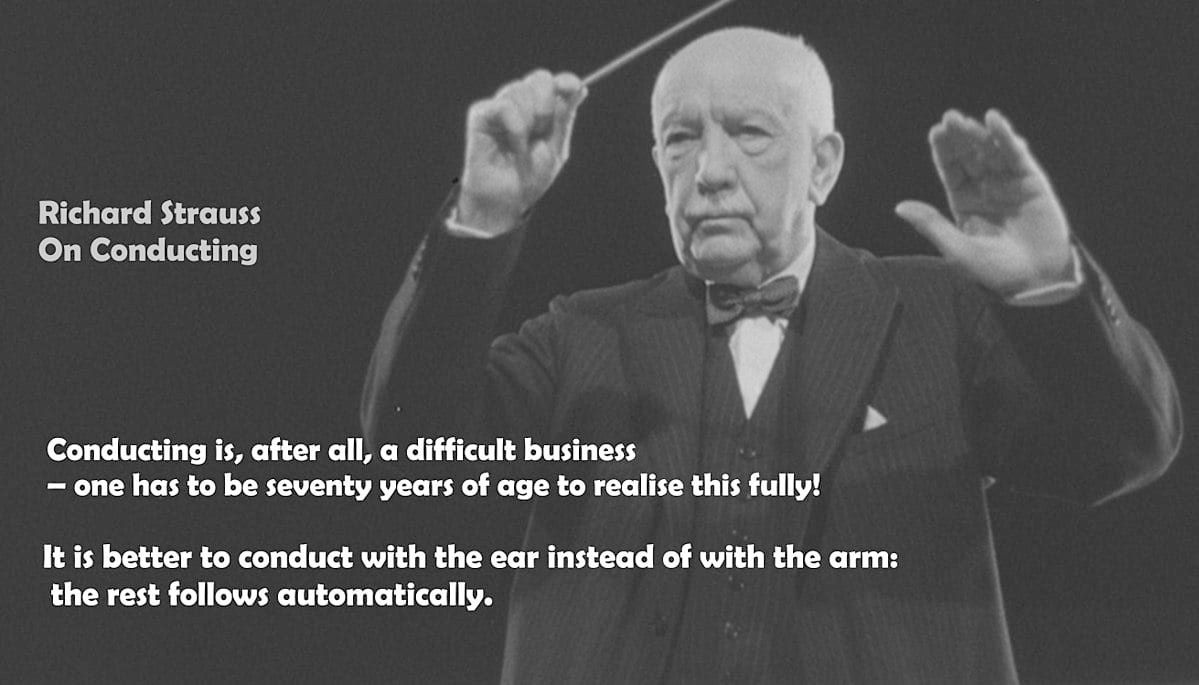
Richard Strauss will probably always be remembered, first, as the composer of Dionysian tone poems, employing opulent, even hedonistic orchestration, and for the turbulent, angst-ridden operas “Salome” and “Elektra.”
But when it came to conducting, he took a decidedly Apollonian stance. His technique might best be described as no-nonsense. Some have even remarked on his looking bored. George Szell suggested Strauss often just wanted to get a performance over with, so that he could get out and go to a card game.
(Szell, by the way, wound up conducting the first half of the premiere recording of Strauss’ “Don Juan” in 1917, on account of the composer oversleeping.)
Here are Strauss’ “Ten Golden Rules for the Album of a Young Conductor,” set down in 1927:
- Remember that you are making music not to amuse yourself, but to delight your audience.
- You should not perspire when conducting. Only the audience should get warm.
- Conduct “Salome” and “Elektra” as if they were by Mendelssohn: fairy music.
-
Never look encouragingly at the brass, except with a brief glance to give an important cue.
-
But never let the horns and woodwinds out of your sight. If you can hear them at all, they are still too strong.
-
If you think that the brass is now blowing hard enough, tone it down another shade or two.
-
It is not enough that you yourself should hear every word the soloist sings. You should know it by heart anyway. The audience must be able to follow without effort. If they do not understand the words, they will go to sleep.
-
Always accompany the singer in such a way that he can sing without effort.
-
When you think you have reached the limits of prestissimo, double the pace.
-
If you follow these rules carefully, you will, with your fine gifts and your great accomplishments, always be the darling of your listeners.
In 1948, Strauss wrote of Number 9, “Today I should like to amend this: take the tempo half as fast.”
Some of his suggestions may seem as if they’re tongue-in-cheek, but the idea to lighten the textures makes a whole lot of sense when you consider just how overblown these works can be, and how impossible to hear the singers.
Strauss recorded most of his orchestral works over the last two decades of his life. A few of these were captured on film.
See for yourself if Strauss follows his own advice, or, if as Szell, suggests, all he’s really thinking about is playing cards.
“Till Eulenspiegel’s Merry Pranks”:
With commentary by Szell, his one-time assistant:
“Allerseelen” (“All Souls’ Day”), with a glimpse of lederhosen!
Happy birthday, Richard Strauss.
Leave a Reply