Tag: Curtis Institute of Music

  • Give a Hand for Gary Graffman

    Give a Hand for Gary Graffman

    Piano legend Gary Graffman has died.

    Graffman had a powerful start as part of Columbia Records’ stable of American pianists that also included Leon Fleisher and Eugene Istomin, and he made some fantastic recordings with George Szell and Leonard Bernstein, until, like Fleisher, a hand injury drove him into semi-retirement as a performer.

    Graffman was instrumental in resurrecting works in the left-handed repertoire, a number of them commissioned by pianist Paul Wittgenstein, who lost his right arm during the First World War. In particular, Graffman was a champion of the works composed for Wittgenstein by Erich Wolfgang Korngold, and I was fortunate (and thrilled) to be able to hear him play these pieces in Philadelphia at a time when they were not widely available on recordings. It’s so easy now to take for granted how spoiled for choice we are in this day of exhaustive recordings and internet access to them. In particular, I got to know Korngold’s Suite for Two Violins, Cello and Piano Left-Hand from Graffman’s concert performances (although it was Fleisher who made the definitive recording of the piece).

    I also attended the world premiere of Ned Rorem’s Piano Concerto for the Left Hand (his fourth piano concerto) at Philadelphia’s Academy of Music, which was recorded live and released on New World Records. Rorem always was a miniaturist at heart, or that is my impression, so even when working in larger forms, as here, it was not unusual for him to construct them out of smaller individual components. The concerto consists of eight brief movements, as opposed to three epic statements in the grand German tradition. The outer movements employ kind of a twelve-tone “scat” – the way it’s handled, it’s not going to leap out and clap you on the ears as “twelve tone music” – but at its core, the concerto shares a French sensibility that might appeal to anyone who enjoys the music of Francis Poulenc. It’s an attractive piece, and I’ve played it on the radio many times.

    It’s one of several works for left hand composed specifically for Graffman. In 1996, William Bolcom wrote a concerto, “Gaea,” for Graffman and Fleisher to perform together. In 2001, Graffman gave the premiere of “Seven Last Words,” by Curtis alum Daron Hagen.

    Graffman’s recording of “Rhapsody in Blue” has enjoyed an especially lucrative existence, thanks to its use in Woody Allen’s “Manhattan.” It’s turned up in numerous film and television productions ever since.

    Graffman found a second career as an influential teacher and administrator at the Curtis Institute of Music, where he joined the faculty in 1980 and became its director in 1986. In 1995, he also became Curtis’ president. He served in all three capacities – teacher, director, and president – for the next 21 years. I never lived more than a few blocks from Curtis, and I was a frequent concertgoer (also, my girlfriend at the time worked there), so of course I saw him all the time. What I didn’t see was his behind-the-scenes instruction of super-pianists like Lang Lang and Yuja Wang, who went on to stunning careers. Graffman’s own teachers included Isabelle Vengerova, Rudolf Serkin, and, informally, Valdimir Horowitz.

    Graffman’s wife, Naomi, predeceased him in 2019. Their marriage spanned some 67 years. Although I did not know them personally, beyond the exchange of a sentence or two at a reception, they seemed like a lovely couple.

    Graffman’s death unexpectedly conjures another era for me. Suddenly, I feel very far away from my 20s.

    Gary Graffman died yesterday at the age of 97. R.I.P.

    ———

    Graffman performing the rarely-heard Prokofiev Piano Concerto No. 4 – another Wittgenstein commission, but never played by him.

    ———

    PHOTO: André Previn, Ned Rorem, and Gary Graffman rehearse Rorem’s Piano Concerto for Left Hand and Orchestra

  • Joan Lippincott Legendary Organist Remembered

    Joan Lippincott Legendary Organist Remembered

    Somehow, I am the last to learn of the passing of Joan Lippincott. But just in case I’m not, Lippincott, who was so much a part of the fabric of the local music community, as a student and later a professor of organ at Westminster Choir College and the Curtis Institute of Music and, for a time, principal organist at Princeton University, died on May 31 at the age of 89.

    Here’s an appreciation, with reminiscences and an obituary, shared by one of her former students.

    Legendary Joan Lippincott

    And another, from current University Organist at Princeton University, Eric Plutz.

    https://www.facebook.com/photo/?fbid=10163013703036215&set=a.155434051214

    Over the years, I played her recordings for the Gothic Records label on my radio shows. R.I.P.

  • Hugh Sung Pianist Sci-Fi Fan

    Hugh Sung Pianist Sci-Fi Fan

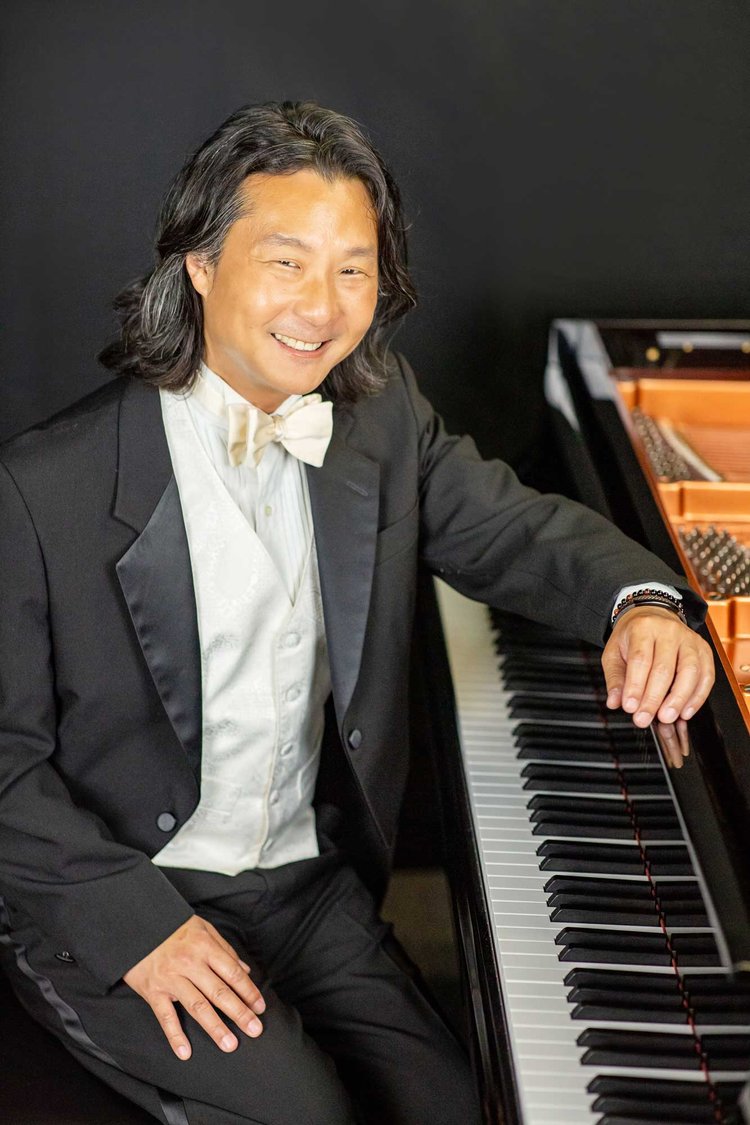
    Last night, pianist Hugh Sung was kind enough to join Roy and me on Roy’s Tie-Dye Sci-Fi Corner to share his dual enthusiasms for music and science fiction. Despite the facts that I’ve worked in classical music and lived in Philadelphia for over 30 years, and Hugh studied and worked often within several blocks of me, at the Curtis Institute of Music, we never actually met until a year or two ago, when Roy introduced us at his church, where Hugh serves as music director!

    So it was great to be able to spend a little time with him and to hear just a bit about his experiences at Curtis, especially with his teachers, the long-lived Eleanor Sokoloff (who died in 2020 at the age of 106!), who I used to wave to every morning as I walked my dog, and Jorge Bolet, world-famous for, among other things, his recordings of Franz Liszt. Hugh himself has made innumerable recordings and has accompanied musicians from the legendary (Aaron Rosand and Julius Baker) to the contemporary (Hilary Hahn and Jasmine Choi). During the course of the show, he also talks about some technological innovations he devised to assist classical performers in the digital age.

    His love of science fiction reaches back to his childhood and obviously continues in the present, as evidenced by some of the videos he’s made of sci-fi and fantasy themes, often with his wife, pianist Madalina Danila. In fact, it was one of those videos that got the show yanked last night from Facebook, for alleged copyright violation, but you can still view it complete on YouTube, by following the link.

    Ha! Totally missed out on this! Hugh’s also a foodie. Poke around his website for more fun.

    https://hughsung.com/plates

    His arrangement of “Black Coffee,” played with Philadelphia Orchestra principal flutist Jeffrey Khaner

    Thanks for the visit, and the music, Hugh Sung!

  • Samuel Barber Combed for Absorbing New Biography

    Samuel Barber Combed for Absorbing New Biography

    I do much of my reading in bed, in the hour or two before lights-out, frequently beneath drooping eyelids and interrupted by intervals of nodding; so it can take me a while sometimes to get through a book. In this case, it took me five or six weeks, probably, but they were unquestionably pleasurable ones, passed in the company of one of America’s greatest composers.

    If you’re at all interested in American art music of the mid-20th century, I’m confident you too will enjoy Howard Pollack’s exhaustive biography “Samuel Barber: His Life & Legacy,” issued last month by University of Illinois Press.

    The book has to be the culmination of years of research – of the 686 numbered pages, 118 are devoted to footnotes and index – yet the content is often astonishingly up-to-date, with references to performances, recordings, and even YouTube content so recent, it would seem as if it couldn’t possibly have been included by the time the book went to press.

    It’s also pleasant to find people I’ve known or worked with drifting in and out of the narrative. For instance, I had no idea that Karl Haas, longtime host of the radio series “Adventures in Good Music,” was responsible for commissioning Barber’s “Summer Music.” Nor did I realize the series began in 1959!

    Another radio personality, David Dubal, now host of “The Piano Matters,” but then music director of New York’s WNCN, preempted the station’s regularly-scheduled programming to broadcast an hour of Barber’s music in the afternoons during the composer’s final days, and Barber listened.

    And H. Paul Moon, who I have interviewed on the air a couple of times about his film projects, and now count among my concertgoing companions and friends, is acknowledged for his lovely, award-winning documentary, “Samuel Barber: Absolute Beauty.” Paul also receives credit for assisting the author in compiling the book’s photographs.

    Of course, Barber had many important connections to the Philadelphia area, having attended and taught at the Curtis Institute of Music and had many of his works, including a few premieres, played by the Philadelphia Orchestra. He also exhibited a lifelong affection for his birthplace of West Chester, PA – which, as a small-town Pennsylvania boy myself, I find relatable and touching.

    Barber was buried in West Chester in 1981, next to a gravesite held vacant for Gian Carlo Menotti, his friend, frequent collaborator, and romantic partner of decades. The two met during their student days at Curtis. Menotti would be buried in Scotland, but the West Chester would-be grave is marked by a headstone that reads, as per Barber’s request, “To the Memory of Two Friends.”

    Pollack’s biography is successful not only in expanding the reader’s knowledge of the composer’s sizeable and varied output – more varied than one might suspect on the evidence of his most frequently played works – but also in conveying a real sense of the man, who could be patrician and impeccably turned out, often aloof in public, with a waspish sense of humor, but also warm and supportive to his friends. And even, on occasion, unexpectedly whimsical. He once remarked that because of his fondness for soup, his coffin should be pelted with croutons. At his burial service, his friends took him up on it.

    There is also a charming anecdote earlier in the book, about how once Barber was attempting to get something straightened out with a utility company. In an unorthodox method of identity confirmation, the phone representative asked the composer to sing a few bars of his “Sure on This Shining Night.” Barber later remarked, “I’m afraid I sounded nervous. I had never sung for the telephone company before.”

    Pollack’s writing is everything it should be: lucid, informative, and engrossing. There’s nothing to jerk a reader out of the narrative (save perhaps the frequent use of “tellingly,” which after a while becomes endearing). One doesn’t have to be a specialist to get something out of the book, and it is frequently an enjoyable read, though I grant that some chapters will be more compelling than others, depending on the depth of one’s devotion to Barber’s music. The chapters of purely biographical and historical interest are especially absorbing. One will learn a lot, unquestionably, as even I have.

    With so many interviews and so much information to assimilate, I really don’t know how Pollack does it. I only just finally got around to reading his Copland bio, “Aaron Copland: The Life and Work of an Uncommon Man,” this past November, and the book, which was released over twenty years ago, is equally praiseworthy. And he’s done similar service for Marc Blitzstein, John Alden Carpenter, George Gershwin, Walter Piston, and lyricist John LaTouche. This guy deserves every award he’s ever received.

    You’ll find more about Pollack’s latest here:

    https://www.press.uillinois.edu/books/?id=c044908&fbclid=IwAR0SmvR30-NX6u9uOQ3pLmGMGmj-5VdJfCmN4vacoghLqEpZrRl1FSg_-IY


    80 years ago today, Barber’s “Commando March,” written while he was serving in the U.S. Army Air Force, received its first performance in Atlantic City, with the Army Air Force Technical Training Command Band under the direction of the composer. Hear it performed at the link by “The President’s Own” U.S. Marine Band:

    Barber’s final work, and one of his loveliest – the trunk of an oboe concerto he was too ill to complete – the “Canzonetta,” first performed posthumously in 1981:

    “Sure on This Shining Night,” frequently heard in an arrangement for choir, here sung by a baritone, as it would have been by Barber himself to the telephone company:

    “Summer Music,” commissioned on the recommendation of Karl Haas:

    “Samuel Barber: Absolute Beauty”

    https://samuelbarberfilm.com/

  • Ned Rorem at 95: Celebrating a Musical Genius

    Ned Rorem at 95: Celebrating a Musical Genius

    It’s hard to believe that Ned Rorem is 95 years-old.

    For decades, it seemed as if Rorem was classical music’s answer to Dick Clark, America’s oldest teenager. I often saw him, on the streets of Philadelphia, at the AIA Bookstore, at Borders, and at the Curtis Institute of Music, where he taught, back in the ‘90s. Rorem was in his 70s at the time, but he looked like he couldn’t have been any more than 50.

    To celebrate his birthday, and to tie in with Gary Graffman’s 90th birthday earlier this month, we’ll hear Rorem’s Piano Concerto for Left Hand and Orchestra (1991). The work was recorded in concert at Philadelphia’s Academy of Music, with Graffman the soloist, and the Curtis Symphony Orchestra under the direction of André Previn. (If you listen carefully, you may hear me applauding at the end.)

    Typical of Rorem’s concertos, the work defies the customary “classical” three-movement structure. Instead, the composer serves up eight movements, bookended by two passacaglias. Material from the opening, which resembles a kind of scat singing, recurs at various points throughout the piece.

    At his most reflective, I think, Rorem betrays his formative years in Paris. Though they certainly both followed their own distinctive muses, there is something in Rorem’s uncluttered lyricism that often reminds me of Poulenc with an American accent. The concerto also calls to mind (my mind, anyway) Olivier Messiaen, with its ecstatic dissonances.

    Rorem’s genius for the “miniature” – eight short movements, as opposed to three epic statements in the great German tradition – is also reflected in his work as an art song composer and an unusually candid diarist. Rorem has expounded on his predilection for all things French on numerous occasions. “The world is divided into two aesthetic styles: French and German,” he notes. “The color red is German. The color blue is French. Men are German, women are French. Japan is French, and China is German. German art is known for being profoundly superficial, and French art, for being superficially profound. I am French. If you disagree with my analysis, then you are German.”

    Rorem’s concerto will be among my featured works this afternoon between 2 and 4 p.m. Prior to that, I hope you will join me for chamber music by Brahms, Dvořák, Liszt, and Mendelssohn, on today’s Noontime Concert, in performances from the Lake George Music Festival.

    The music is forever young. You don’t have to be Ned Rorem to hold the secret of youth, from 12 to 4 p.m. EDT, on WWFM – The Classical Network and wwfm.org.


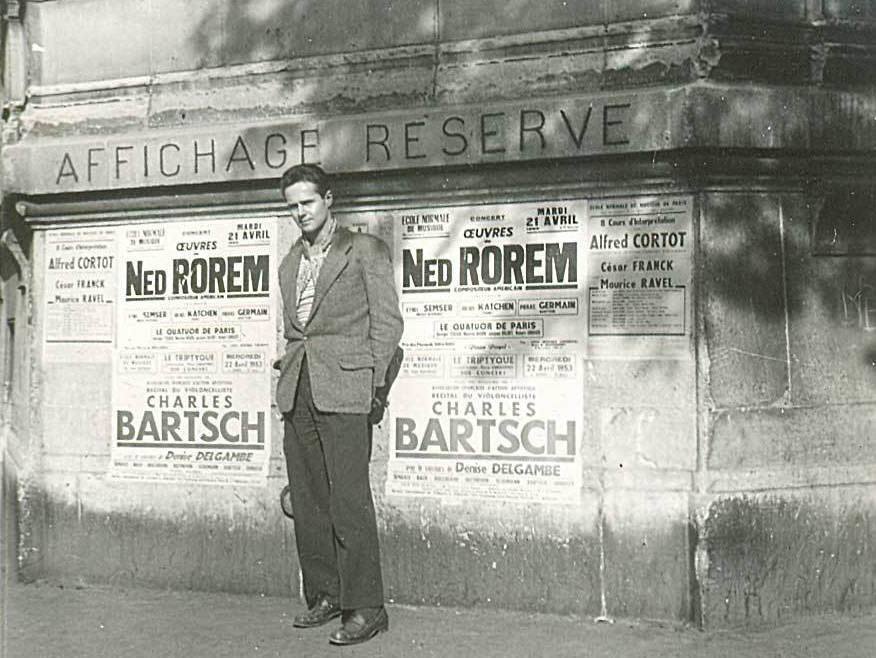
    PHOTO: Rorem in Paris, 1953

Tag Cloud

Aaron Copland (92) Beethoven (94) Composer (114) Film Music (116) Film Score (143) Film Scores (255) Halloween (94) John Williams (185) KWAX (228) Leonard Bernstein (99) Marlboro Music Festival (125) Movie Music (131) Opera (197) Philadelphia Orchestra (86) Picture Perfect (174) Princeton Symphony Orchestra (106) Radio (86) Ralph Vaughan Williams (85) Ross Amico (244) Roy's Tie-Dye Sci-Fi Corner (290) The Classical Network (101) The Lost Chord (268) Vaughan Williams (99) WPRB (396) WWFM (881)

DON’T MISS A BEAT

Receive a weekly digest every Sunday at noon by signing up here


RECENT POSTS