Tag: Danish composer

  • Per Nørgård, Influential Danish Composer, Dies at 92

    Per Nørgård, Influential Danish Composer, Dies at 92

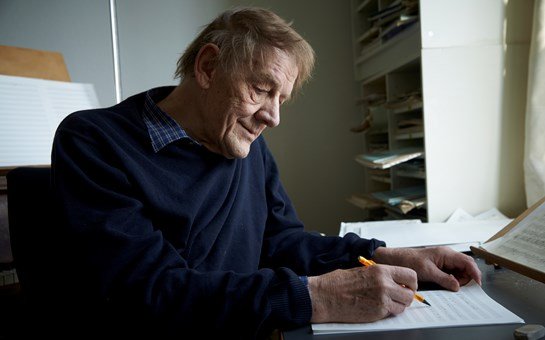
    The prolific Danish composer Per Nørgård has died. In all, the creator of some 400 works, he leaves eight symphonies, six operas, ten concertos, assorted choral works, chamber music (including ten string quartets), and works for solo instrument. Nørgård emerged from the dominant musical influences of the region – Carl Nielsen and Jean Sibelius, mainly, but also that of his teacher, Vagn Holmboe – to immerse himself in central European modernism.

    In 1959, he discovered the infinity series, a serial method from which he developed unifying structural elements in much of his subsequent work. His Symphony No. 3 was the first to apply the method for the integration of melody (such that it is), harmony, and rhythm. “Voyage into the Golden Screen” is considered a landmark of spectral composition. Among his music written for film is that for the international success “Babette’s Feast.”

    By some, he was regarded as the foremost living Nordic composer. All the same, his is probably not the music you’ll want to take with you for your morning commute. It can be an interesting listen in quieter, more introspective moments. That said, I had an extra CD of his Symphonies Nos. 2 & 4 and, like Robert Louis Stevenson’s bottle imp, I couldn’t give it away. You have to give the guy credit for steadfastly following his own muse.

    He is not to be confused with the Finnish composer Pehr Nordgren, who died in 2008. Nørgård was 92 years-old.

    R.I.P.


    “Gennen Torne” (“Through Thorns”) for harp, flute, clarinet, and string quartet – the same combo used for Ravel’s “Introduction and Allegro” (2003)

    Symphony No. 1 – right out of the gate, subtitled “Austera” (“Austere”), undeniably Scandinavian (1953-55)

    “Voyage into the Golden Screen” (1968)

    Symphony No. 3 (1972-75) with chorus

    Symphony No. 8 (2010-11)

    Live performance of the work, with Nørgård acknowledging the orchestra and applause at the end

    Interview with the composer (in Danish), with charming interludes of him performing his juvenilia at the piano, illustrated by cartoons he drew as a kid
  • Leif Kayser: Composer, Priest, & Organ Master

    Leif Kayser: Composer, Priest, & Organ Master

    Leif Kayser was certainly a multifaceted individual. This week on “The Lost Chord,” we’ll listen to some of his music, of course, but we’ll also talk about his many roles.

    Born in Copenhagen on 1919, Kayser began his studies at the Royal Danish Academy of Music in 1936. In Stockholm, he studied composition with Hilding Rosenberg and conducting with Tor Mann. In 1941, he made his debut as a pianist, in Copenhagen, and as a conductor, in Gothenburg.

    As a composer, he emerged as one of Denmark’s most promising young symphonists. However, following theological studies in Rome, Kayser was ordained in 1949. He largely abandoned concert music – but you can’t keep a good composer down.

    Over time, he began to write for the organ and gradually he produced another symphony. He served as pastor and organist of St. Ansgar Roman Catholic Cathedral until 1964. Then he left the Church to marry and to teach at his alma mater, the Royal Danish Academy of Music.

    Kayser died in 2001. He is still regarded as one of the leading organ composers of Denmark.

    We’ll hear one of Kayser’s gorgeous symphonies, from 1939. That will be prefaced by “Caleidoscopio,” a work for flute and organ, composed between 1974 and 1976. After a brief introduction, it gradually becomes apparent that the piece is constructed as a series of reflections on the familiar chorale “Von Himmel hoch.” Interesting that a former Catholic priest would write variations on a chorale associated with Martin Luther!

    But, like Whitman, Kayser contained multitudes, as composer, organist, pianist, conductor, priest, husband, and teacher. I hope you’ll join me for “Kayser Roles,” on “The Lost Chord,” now in syndication on KWAX, the radio station of the University of Oregon!


    Clip and save the start times for all three of my recorded shows:

    PICTURE PERFECT, the movie music show – Friday at 8:00 PM EST/5:00 PM PST

    SWEETNESS AND LIGHT, the light music program – ALL NEW! – Saturday at 11:00 AM EST/8:00 AM PST

    THE LOST CHORD, unusual and neglected rep – Saturday at 7:00 PM EST/4:00 PM PST

    Stream them, wherever you are, at the link!

    https://kwax.uoregon.edu/


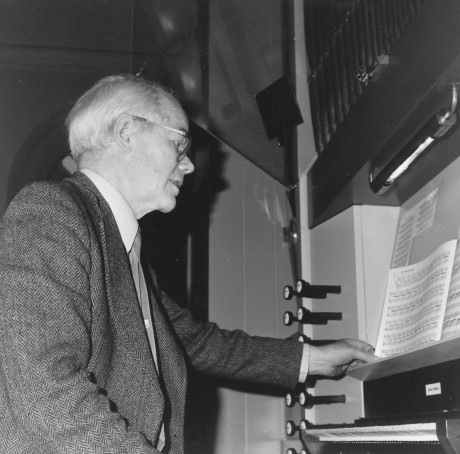
    PHOTO: Kayser pulls out all the stops

  • Rued Langgaard Eccentric Genius Rediscovered

    Rued Langgaard Eccentric Genius Rediscovered

    Even by composer standards, Rued Langgaard (1893-1952) was a little bit of a strange bird. Despite a promising start – born to musical parents, a precocious childhood, meetings with major conductors, and a symphony performed by the Berlin Philharmonic – his personal and creative eccentricities worked against him.

    Langgaard followed his personal muse deep into the realm of late Romanticism at a time when most of the musical world was exploring modernist territory. Though he was given a state grant at 30, he failed to secure a permanent job until the age of 46, as an organist at the cathedral in Ribe, the oldest town in Denmark – which somehow seems appropriate for this most anachronistic of Danish outsiders.

    An eccentric, shabby figure with wild hair, Laangaard died in Ribe 13 years later, in 1952, just shy of his 59th birthday, still largely unrecognized as a composer.

    His reputation would not begin to gain traction for another 16 years. In all, he composed over 400 works, including 16 symphonies – which bear evocative titles such as “Yon Hall of Thunder” and “Deluge of the Sun” – and an opera, “Antikrist.”

    It was in 1968 that no less a personage than György Ligeti found himself on a jury alongside Danish composer Per Nørgård. In this capacity, he examined a large number of new scores by Scandinavian composers. Unbeknownst to his fellow jurors, Nørgård had slipped in the score of Langgaard’s “Music of the Spheres.” Ligeti became captivated by what he found. When the ruse was revealed, he exclaimed, with a twinkle in his eye, “Gentlemen, I have just discovered that I am a Langgaard epigone!”

    Langgaard had anticipated some of the technical aspects – tone clusters, layers, and so forth – which would appear in Ligeti’s avant garde experiments of the 1960s, in works such as “Atmosphères.”

    I hope you’ll join me for “Rued Awakenings,” music of Rued Langgaard, including “Music of the Spheres,” on “The Lost Chord,” this Sunday night at 10:00 EST, on WWFM – The Classical Network and wwm.org.

  • Per Nørgård at 90 Exploring the Danish Composer

    Per Nørgård at 90 Exploring the Danish Composer

    Not everything Per Nørgård composes is calculated to be a crowd-pleaser, but he did lighten things up a bit for portions of his score to “Babette’s Feast.” The Danish feature attained international popularity and an Academy Award for Best Foreign Language Film in 1988.

    Nørgård has been following his idiosyncratic, often arcane muse in the concert hall for decades, from the Nordic symphonism of Sibelius and Vagn Holmboe (his teacher) to the avant garde experimentation of the 1960s and even feints into proto-minimalism.

    “Voyage into the Golden Screen” (1968) employs an evolving variation technique the composer describes as an “infinity series,” a method of serializing melody, harmony, and rhythm. It’s been compared to fractal geometry. If you want to learn more about it, google “Nørgård infinity series.” Regardless of the technique, the music needs to speak for itself, and I think if you stick with it you might agree that it pays off. But maybe you have to be in the right mood. Just don’t go into it expecting Schubert!

    https://www.youtube.com/watch?v=Ty1fjlN2kuc

    From a later period, here’s his Violin Concerto No. 2 “Borderlines” (2002). Nørgård describes the opening movement as “endlessly questing” – much like the composer himself.

    And in case you think Nørgård lacks the ability to charm, check out “Dream Play” (1975), deceptively simple at the start, but soon wandering into some unexpected places.

    Finally, here’s his Symphony No. 6 “At the End of the Day” (1998-99). The composer declared this would be his last symphony – then went on to write two more!

    Not the stuff to listen to for a pick-me-up, maybe, but it certainly does have its place. Happy birthday, Per Nørgård, 90 years-old today.

  • Exploring Nordic Classical Music Nørholm & Sandström

    Exploring Nordic Classical Music Nørholm & Sandström

    “A symphony must be like the world,” Gustav Mahler once famously declared, “It must embrace everything.”

    Turning that on its head, “the world” becomes a useful metaphor for classical music itself, since the realm music occupies is so broad, so deep, and so varied, it’s impossible for any one of us to possess more than a passing familiarity with even the tiniest fraction of its immeasurable mysteries. That’s part of what I find so appealing. The frontiers are limitless; the content inexhaustible. You can travel as far outside the standard repertoire as your legs or ears will carry you, or you can dig deeply into a symphony by Mozart or Beethoven to marvel at the tiniest cells of their creation.

    It’s fortuitous, perhaps, that Mahler made his observation while on a walk with Jean Sibelius, the All-Father of Nordic music.

    Every once in a while I’ll note the obituary of some vaguely familiar musician, and it will spur me to check out what I can of his or her recorded output. In the case of Danish composer Ib Nørholm, who died on Sunday at the age of 88, his was a name I distantly recollected, probably from a rich vein of LPs, numbering in the hundreds, I inherited back in the days when I ran a used book business in Philadelphia.

    I was remiss in not exploring any of his works, that I can recall, until only this past week. A pupil of Vagn Holmboe, Nørholm composed 13 symphonies. So far, I have listened to Numbers 4, 5 & 9. Number 4, subtitled “Decreation,” is interesting, in that its avant-garde gloss – complete with quasi-sprechtstimme, possibly aleatoric chorus – can’t obscure the work’s Sibelian pedal tones. The recording, on the Kontrapunkt label, also features the composer reciting poetry (in Danish) in the symphony’s final movement.

    Number 5, subtitled “The Elements,” is twelve-tone, and I suppose a little on the severe side, but for anyone with a predilection for the austerity of a certain vein of Nordic music, surprisingly listenable.

    But it is Number 9 that hits the sweet spot for me. Here Nørholm has settled in with a new lyricism, and he feels totally comfortable in his own skin. Not being familiar (as yet) with the rest of his output, this is what I would recommend as a good starting point.

    On the same day, the music world lost Swedish composer Sven-David Sandström. I gather he is mostly known for his works for voice. Perhaps this would be more to your liking:

    Sandström was 76 years-old.

    Neither of these works may be your cup of vodka. But if you clear your head, close your eyes, and just go with them, you may be surprised to discover that you actually find the music rewarding. As a certain quotable Dane once remarked, “There are more things in heaven and Earth, Horatio, than are dreamt of in your philosophy.”


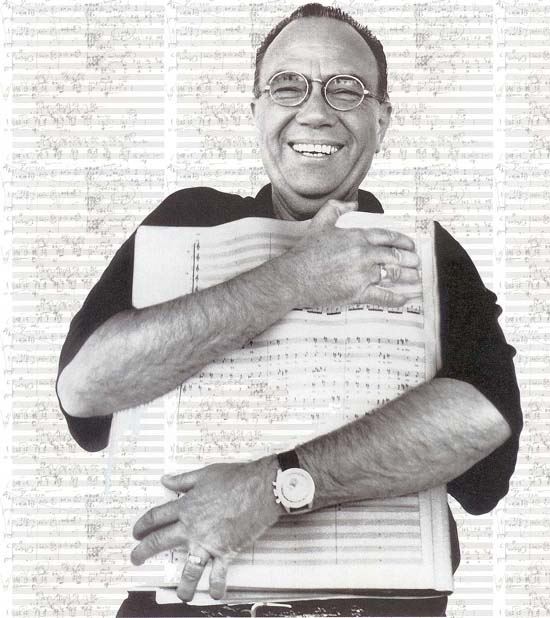
    PHOTO: Sven-David Sandström embraces music

Tag Cloud

Aaron Copland (93) Beethoven (95) Composer (114) Film Music (126) Film Score (143) Film Scores (255) Halloween (94) John Williams (189) KWAX (229) Leonard Bernstein (101) Marlboro Music Festival (125) Movie Music (141) Mozart (87) Opera (203) Philadelphia Orchestra (89) Picture Perfect (174) Princeton Symphony Orchestra (107) Radio (87) Ross Amico (244) Roy's Tie-Dye Sci-Fi Corner (290) The Classical Network (101) The Lost Chord (268) Vaughan Williams (103) WPRB (396) WWFM (881)

DON’T MISS A BEAT

Receive a weekly digest every Sunday at noon by signing up here


RECENT POSTS