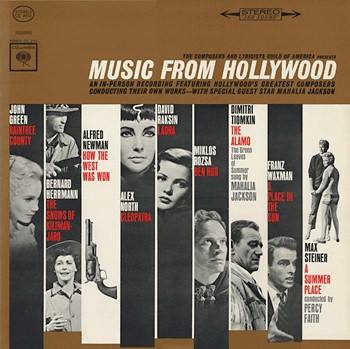
Thanks to his unusual longevity and abundant wit, film composer David Raksin was, for years, the mouthpiece of a faded era, the man to whom historians and journalists would turn when seeking a well-turned quote or anecdote about his long-past contemporaries of the Golden Age of Hollywood.
Raksin was born in Philadelphia on this date in 1912. This week on “Picture Perfect,” we’ll celebrate the occasion by revisiting some of his music written for the silver screen.
Raksin received his early musical training from his father, who played in concert bands and theater orchestras, and was also a member of the Philadelphia Orchestra. The younger Raksin formed his own dance band, taught himself orchestration, and put himself through the University of Pennsylvania by playing gigs. After graduation, he went to New York, where he played and sang with a number of ensembles and worked as an arranger.
It was pianist Oscar Levant who brought him to the attention of his friend, George Gershwin. Gershwin was so impressed with Raksin’s arrangement of “I Got Rhythm,” that it wasn’t long before the boy from Philadelphia was orchestrating for musical theater and receiving invitations to Hollywood.
While Raksin would go on to compose all sorts of music, for the stage and concert hall, he is best recognized as a composer for film. He wrote over 100 film scores in all, and 300 scores for television. He was twice nominated for an Academy Award – for “Forever Amber,” in 1947, and “Separate Tables” in 1958.
Raksin’s haunting theme for the noir classic “Laura” (1944), after lyrics were added by Johnny Mercer, became a sensation. It’s said that during the composer’s lifetime it was the second most-recorded song in history, behind only Hoagy Carmichael’s “Stardust.”
Raksin’s first Hollywood job, believe it or not, was working for Charlie Chaplin. Chaplin hired Raksin to assist him on the score for his last silent film, and one of the most famous, “Modern Times” (1936). “Modern Times” had actually been conceived as a sound picture (it would have been Chaplin’s first), but he soon realized that his “Little Tramp” would lose his universal appeal, should the character be allowed to talk. So he reverted to his usual silent format, though punctuated by evocative sound effects and one notable gibberish song.
Chaplin exercised close control over every aspect of his productions, right down to more-or-less composing the music. He had experience as a violinist and cellist, who had practiced sometimes four to six hours a day. He had good musical instincts and a certain melodic fecundity, which, with the help of his orchestrators, he would use to underscore his feature films.
Raksin later revealed it was he who had essentially scored “Modern Times,” with Chaplin whistling tunes and asking him to make them fit the action.
Such close and exacting supervision could be a challenge for Chaplin’s collaborators. Raksin was actually fired once, after only a week and a half, though quickly rehired. When the music director, Alfred Newman, stormed out of one of the recording sessions, Raksin refused to take up the baton in his stead, which led to further acrimony. The rift was eventually mended, and decades later Raksin would recollect his work on “Modern Times” as some of the happiest days of his life.
The recording we’ll hear was conducted by none other than Carl Davis, who on occasion served a similar function, as when he collaborated with Paul McCartney on his “Liverpool Oratorio.” Davis, a prolific film composer himself, died yesterday at the age of 86.
As was the case with “Laura,” the love theme from “Modern Times” was later outfitted with lyrics, and became a popular standard as “Smile,” attracting countless vocal artists, including Nat King Cole. Again, what cohesion there is to the film score is largely thanks to Raksin.
Although Raksin had taught himself a great deal, he did receive instruction from Harl McDonald at the University of Pennsylvania, Isadore Freed in New York, and later Arnold Schoenberg in Los Angeles.
At times he found himself frustrated when dealing with the musical ignorance of Hollywood producers. He was fond of relating a story about having finally found one that was musically literate. The producer claimed he didn’t want anything “Hollywood” for his film, but rather “something different, really powerful – like ‘Wozzeck.’”
Raksin, elated, invited the producer to dinner at his home. As the two were conversing over drinks, the producer remarked suddenly, “What’s that crap you’re playing?” “That crap,” Raksin responded, “is ‘Wozzeck.’”
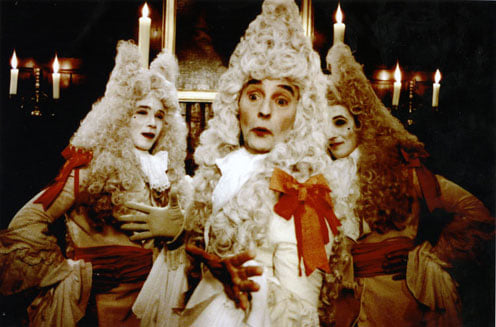
For “The Man with a Cloak” (1951), a story influenced by elements drawn from the life and stories of Edgar Allan Poe, Raksin slyly worked twelve-tone elements into his score – one of the first instances of a composer having done so for a Hollywood film. A few years later, Leonard Rosenman would take modernistic techniques to a whole other level. Raksin employs the language of the Second Viennese School in scenes featuring the Poe character, who in the film goes by the name of his fictional creation, Dupin. The character is given a leitmotif consisting of a tone row made up of the notes E-D-G-A and D-flat (which could be read as “Re”), effectively revealing the identity of Dupin as Edgar, right in the music. For all that, the score retains its accessibility and manages to wed the language of Schoenberg to the necessities of Hollywood storytelling.
The film, based on a novel of John Dickson Carr, had quite a cast: Joseph Cotten, Barbara Stanwyck, Louis Calhern, Leslie Caron, and even Jim Backus.
We’ll conclude the hour with one of Raksin’s greatest scores, that for “The Bad and the Beautiful” (1952), Vincent Minelli’s extraordinarily cynical view of Hollywood. Kirk Douglas plays a character Raksin must have known well: a ruthless producer who uses and abuses everyone around him. The film, which also stars Lana Turner, Walter Pigeon, and Dick Powell, won a whole slew of Oscars, including one for Gloria Graham as Best Supporting Actress.
Raksin died in 2004, at the age of 92. His music was beautiful, but never bad. I hope you’ll take an hour to sample some of it with me on Raksin’s birthday, on “Picture Perfect,” music for the movies, now in syndication on KWAX, the radio station of the University of Oregon!
Keep in mind, KWAX is on the West Coast, so there’s a three-hour difference for the Trenton-Princeton area. Here are the respective air-times of my recorded shows (with East Coast conversions in parentheses):
PICTURE PERFECT, the movie music show – Friday on KWAX at 5:00 PACIFIC TIME (8:00 PM EDT)
THE LOST CHORD, unusual and neglected rep – Saturday on KWAX at 4:00 PACIFIC TIME (7:00 PM EDT)
Stream them here!
https://kwax.uoregon.edu/