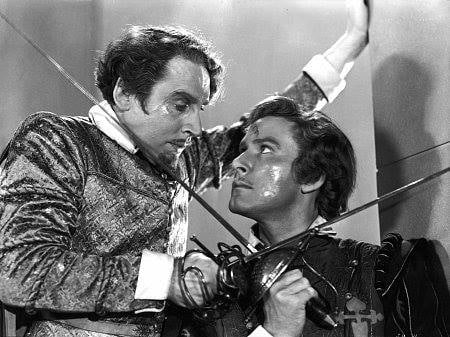
May 29 marks the birthday of one of my favorite composers: Erich Wolfgang Korngold (1897-1957). Thanks to a steady diet of Errol Flynn films, Korngold will forever be a part of the soundtrack to my life.
Korngold went from being one of Europe’s most astounding musical prodigies – his works admired by Mahler, Strauss and Puccini, and championed by Schnabel, Weingartner and Klemperer – to becoming one of Hollywood’s transformative film composers. He is a link from Old World opulence to New World fantasy, his music gracing a number of Warner Brothers’ classic historical adventures.
The best ones starred Flynn, and this week on “Picture Perfect,” we’ll hear music from “The Sea Hawk” (1940) and “The Adventures of Robin Hood” (1938), as well as the mostly forgotten “Another Dawn” (1937). Flynn stars alongside Kay Francis and Ian Hunter (who would go on to play Richard the Lionheart in “Robin Hood”) in this love triangle involving pilots in a British desert colony.
The film may be an obscurity to all save classic movie buffs, but Korngold thought enough of his music that he salvaged the main title as the opening theme of his Violin Concerto, premiered by Heifetz in 1947.
It was an invitation from theatrical impresario Max Reinhardt that brought Korngold to Hollywood in the first place, for a cinematic adaptation of “A Midsummer Night’s Dream” (1935). The film stars James Cagney, Dick Powell and Olivia de Havilland, in her big screen debut, with Mickey Rooney an irrepressible Puck.
For the project, Korngold adapted the famous incidental music of Felix Mendelssohn, interweaving material from Mendelssohn’s symphonies and orchestrating some of the “Songs without Words.” Even so, the music bears the composer’s unmistakable stamp, as you’ll hear in the opening number, lifted from the “Scottish Symphony,” but infused with plenty of Korngoldian swagger.
I hope you’ll join me, as the playlist is all-Korngold this week on “Picture Perfect,” music for the movies, now in syndication on KWAX Classical Oregon!
Happy birthday, EWK!
——-
Clip and save the start times for all three of my recorded shows:
PICTURE PERFECT, the movie music show – Friday at 8:00 PM EDT/5:00 PM PDT
SWEETNESS AND LIGHT, the light music program – Saturday at 11:00 AM EDT/8:00 AM PDT
THE LOST CHORD, unusual and neglected rep – Saturday at 7:00 PM EDT/4:00 PM PDT
Stream them, wherever you are, at the link!
https://kwax.uoregon.edu
Tag: Errol Flynn
-
Double Your Pleasure on “Picture Perfect”
This week on “Picture Perfect,” we’re seeing double.
James Stewart plays Scottie Ferguson, a traumatized police detective who becomes obsessed with the woman he loves – and loses – in Alfred Hitchcock’s “Vertigo” (1958). Kim Novak portrays both the enigmatic beauty and her spitting image, who Ferguson, rather creepily, attempts to mold. Bernard Herrmann wrote the hypnotic score.
Krzysztof Kieślowski’s “La double vie de Véronique”/“The Double Life of Véronique” (1991) depicts parallel characters living in Poland and France who are mysteriously linked, both of them played by Irène Jacob. The performance(s) earned Jacob an award for Best Actress at the Cannes Film Festival. The music, which plays a significant role in the actual plot, is by Zbigniew Preisner.
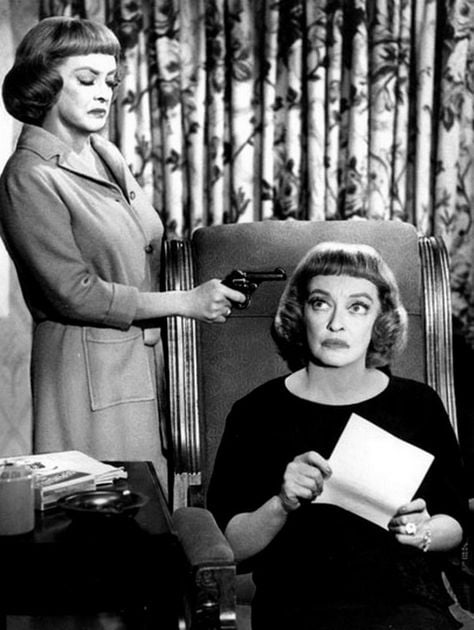
For the second time in her career, Bette Davis gets a chance to play an evil twin in “Dead Ringer” (1964). The first was in the 1946 good twin-bad twin melodrama, “A Stolen Life.” When asked what the difference was between the two performances, Davis quipped, “About 20 years.” “Dead Ringer” was directed by her longtime friend and “Now, Voyager” co-star Paul Henreid. The music is by André Previn, whose score employs a stock-in-trade sinister harpsichord, yet when he comes to write the love theme, he manages to whip up one hell of a tribute to Erich Wolfgang Korngold.
Korngold scored a number of Davis’ films in the 1940s, though he is principally remembered for his work on the swashbucklers of Errol Flynn. To capitalize on Flynn’s star-making performance in “Captain Blood,” Warner Brothers produced a big screen adaptation of Mark Twain’s Tudor switcheroo, “The Prince and the Pauper” (1937). Flynn steals the show as Miles Hendon, the devil-may-care guardian of Prince Edward and Tom Canty, Edward’s mirror image, played by real-life twins Bobby and Billy Mauch. If you’re a Korngold fan, or an enthusiast of violin concertos, you may recognize some of the music. Korngold recycled the theme for use in the last movement of his Violin Concerto, championed by Heifetz and others.
Double your pleasure with an hour of doppelgangers, twins, and dual identities, on “Picture Perfect,” music for the movies, now in syndication on KWAX Classical Oregon!
——–
Clip and save the start times for all three of my recorded shows:
PICTURE PERFECT, the movie music show – Friday at 8:00 PM EST/5:00 PM PST
SWEETNESS AND LIGHT, the light music program – Saturday at 11:00 AM EST/8:00 AM PST
THE LOST CHORD, unusual and neglected rep – Saturday at 7:00 PM EST/4:00 PM PST
Stream them, wherever you are, at the link!
https://kwax.uoregon.edu -
Robin Hood Movie Adaptations Ranked
You might think me a “bold rascal” or a “saucy fellow” or perhaps even a “Saxon cockerel” this week on “Picture Perfect,” as I offer my highly-opinionated assessments of four screen adaptations of the Robin Hood legends.
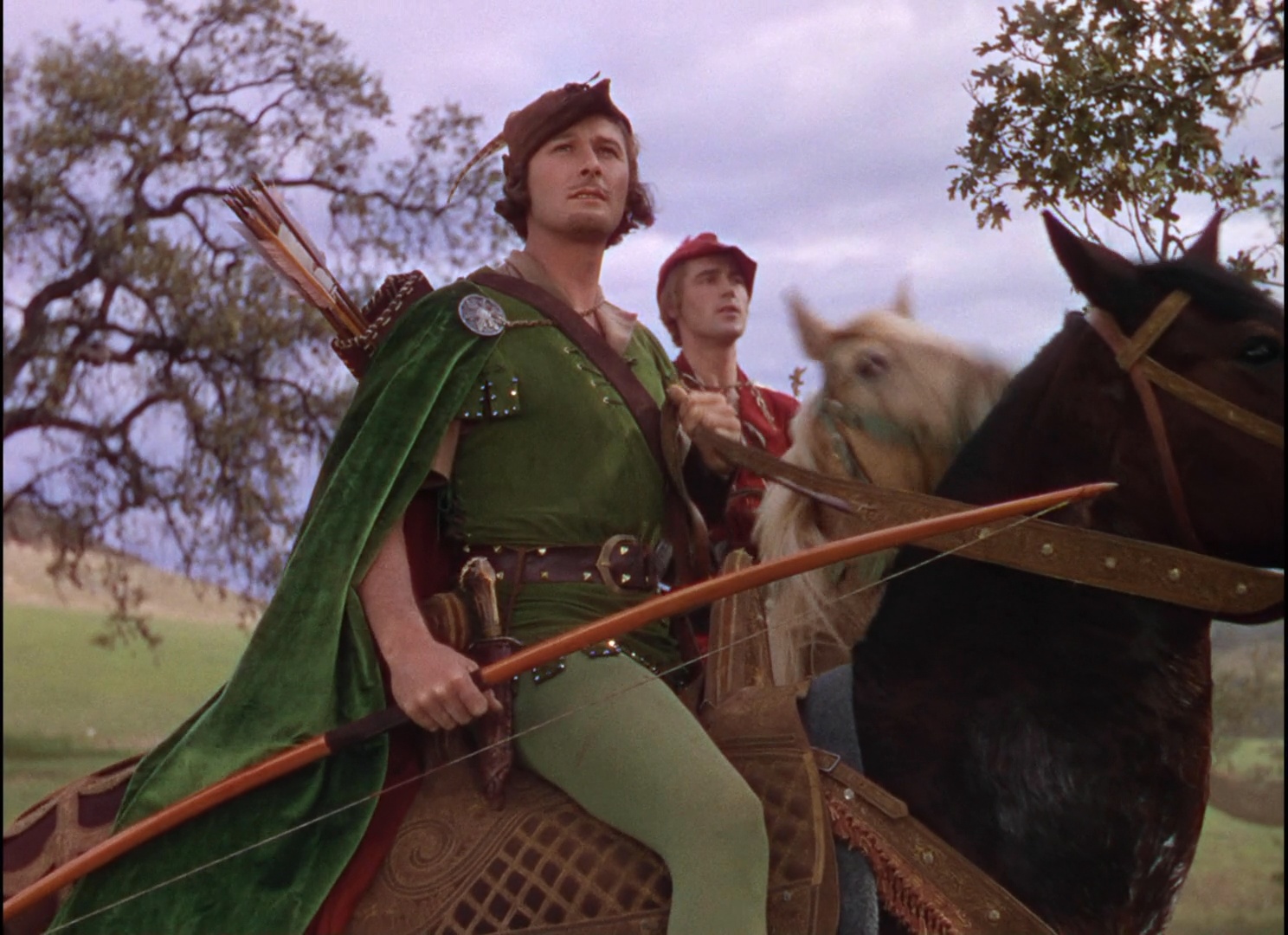
We’ll begin with “The Adventures of Robin Hood” (1938), directed by Michael Curtiz, taking over from William Keighley. One of the all-time Technicolor classics, its stellar cast includes Errol Flynn, Olivia De Havilland, Basil Rathbone, Claude Rains, Alan Hale, Eugene Pallette, Melville Cooper, and many, many others – a veritable who’s who of classic movie actors. Everything about it – the screenplay, the production design, the buoyant tone, the stylish choreography – is as a Robin Hood film should be. That includes, not least of all, its Academy Award-winning music by Erich Wolfgang Korngold.
While Flynn will always be the definitive Robin Hood, we’ll consider another very interesting take on the character, which in my opinion doesn’t quite come off, in Richard Lester’s revisionist meditation, “Robin and Marian” (1976). Sean Connery plays a middle-aged Robin who returns from the crusades to rekindle his romance with Maid Marian, played by Audrey Hepburn, and to settle his account, once and for all, with the Sheriff of Nottingham, played by Robert Shaw. Again, you can’t beat the cast, which also includes Nichol Williamson, Richard Harris, and Denholm Elliot.
The elegiac tone is precisely what Lester was aiming for. The story is both a meditation on the beloved Robin Hood characters in middle age AND a melancholy reflection on the passage of time. However, the screenplay, by James Goldman, of “The Lion in Winter” fame, probably could have been a little more inventive, despite an ending that hues closer to the actual legends. It’s undoubtedly a moving film, but somehow it leaves one feeling rather grim.
There was some tension between the director and producer, Ray Stark, as to whether the film should be an artistic statement or hew more closely to the mainstream. Initially composer Michel Legrand was engaged to write the music. Lester found the results agreeable, but Stark did not. At the very least, Stark wanted a more insinuating love theme, as a concession to the audience. So John Barry was brought on board to write a replacement score. Out of necessity, Barry had to do so very quickly. But Barry being Barry, he was able to fulfill Stark’s objective and infuse the story with some memorable musical heartache.
At least there was some attempt at poignancy and philosophical provocation in “Robin and Marian.” By contrast, there was little reason to resurrect the legends for “Robin Hood: Prince of Thieves” (1991). Little reason, that is, unless they were going to make it GOOD.
The project seemed doomed from the start, with Kevin Costner cast as the lead. I have nothing against Costner, who made a string of very fine movies in the 1980s, culminating in his multiple Oscar-winner, “Dances with Wolves,” in 1990. But by no stretch of the imagination is he a believable Englishman. Pile on the grit and ramp up the violence, add a superfluous witch, forget to put in the FUN, and what’s left is a soul-numbing experience.
Alan Rickman brings the film sporadically to life with his lunatic update of Basil Rathbone. But the salt-and-pepper buddy approach, Morgan Freeman as Robin’s sidekick, and a battle-hardened Maid Marian, played by Mary Elizabeth Mastrantonio, don’t really ring true for the 12th century, although I suppose they are pretty characteristic of the 1990s – and the 2020s, now that I think about it. This Robin Hood truly was a prince of thieves. I certainly wished I had my two-and-a-half hours back.
I thought the score was pretty lackluster too, but having endured another 30 years of modern movies since then, the music for “Robin Hood: Prince of Thieves” has come to sound like a veritable classic. The score is credited to composer Michael Kamen, who had the assistance of no less than 15 orchestrators. There’s no question the theme is rousing. Like most of the elements of the film, however, I found myself questioning whether it is really appropriate. Judge for yourself.
We’ll wrap things up on firmer ground with an adaptation of Sir Walter Scott’s classic novel “Ivanhoe” (1952), in which Robin Hood, Friar Tuck, and of course Richard the Lionheart play important supporting roles. The film stars Robert Taylor, Elizabeth Taylor (no relation), Joan Fontaine, and the usually supercilious, but here somewhat sympathetic, George Sanders. The fine score is by three-time Academy Award-winner Miklós Rózsa, who of course is best remembered for having composed the music for such epic films as “Quo Vadis,” “Ben-Hur,” and “King of Kings.”
May I obey all your commands with equal pleasure, sire! We’ll make it our mission to fight for the rich and deprecate the poor (movies, that is), as we plunder the legends of Robin Hood, on “Picture Perfect,” now in syndication on KWAX, the radio station of the University of Oregon!
Remember, KWAX is on the West Coast, so there’s a three-hour difference for those of you listening in the East. Here are the respective air-times for all three of my recorded shows (with East Coast conversions in parentheses):
PICTURE PERFECT, the movie music show – Friday on KWAX at 5:00 PM PACIFIC TIME (8:00 PM EASTERN)
SWEETNESS AND LIGHT, the light music program – ALL NEW! – Saturday on KWAX at 8:00 AM PACIFIC TIME (11:00 AM EASTERN)
THE LOST CHORD, unusual and neglected rep – Saturday on KWAX at 4:00 PM PACIFIC TIME (7:00 PM EASTERN)
Stream all three, at the times indicated, by following the link!
Robin is a bold rascal:
-

Sabatini Swashbucklers on WWFM
Though Rafael Sabatini’s popularity may have faded somewhat over the decades, in his day the Italian-English writer might have been regarded as the heir apparent to Alexandre Dumas. His bestselling novels are full of romance and derring-do. However, unlike Dumas, I’m not sure if any of his books have really endured in the consciousness of the wider public.
His memory is kept alive principally through film adaptations of his works. And why not? His incident-filled pages seem tailor-made for the silver screen. Film adaptations of “Scaramouche,” “The Sea Hawk” and “Captain Blood” were all made during the silent era. A long-lost John Gilbert classic adapted from Sabatini’s “Bardelys the Magnificent” has only recently been rediscovered. Several of these, of course, were remade, more or less, to even greater success during the era of talking pictures.
This week on “Picture Perfect,” we’ll hear Erich Wolfgang Korngold’s music for the Errol Flynn classics “Captain Blood” (1935) and “The Sea Hawk” (1940). The former provided Flynn with his breakout role; the latter actually has nothing at all to do with Sabatini’s original plot, despite the writer’s prominent onscreen credit.
We’ll also enjoy Alfred Newman’s rollicking main title music for the pirate opus “The Black Swan” (1942), which starred Tyrone Power, and one of Victor Young’s most rousing and melodically inventive scores, for “Scaramouche” (1952), which featured Stewart Granger in probably the best swashbuckler of the 1950s.
Polish up those seven-league boots and don your gaudiest plumage. We’ll set sail with movies inspired by the novels of Rafael Sabatini on “Picture Perfect,” this Saturday evening at 6:00 EDT, on WWFM – The Classical Network and wwfm.org!
-
Tudor Movie Music on Picture Perfect
This week on “Picture Perfect,” it’s an hour of tunes for the Tudors.
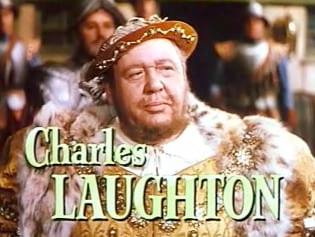
We’ll hear selections from “Young Bess” (1953), with Jean Simmons as the future Elizabeth I. The colorful and entertaining cast also includes Stewart Granger, Deborah Kerr, and most notably Charles Laughton, who reprises his memorable characterization of Henry VIII. Laughton was honored with an Academy Award for Best Actor for playing Henry in the 1933 film, “The Private Life of Henry VIII.” Miklós Rózsa’s score conjures the era of the great MGM Technicolor spectacles.
By the time of the events portrayed in “Mary, Queen of Scots” (1971), Elizabeth already wears the crown, albeit uneasily, due to the perceived threat of her first cousin once removed. Vanessa Redgrave is Mary and Glenda Jackson is Elizabeth, with a supporting cast that includes Timothy Dalton, Nigel Davenport, Patrick McGoohan, Trevor Howard, and Ian Holm. As seems to be the custom in dramatic interpretations of the historical events, the film features several fictitious encounters between the queens, even though in reality the two never met. The poignant score is by John Barry.
“Anne of the Thousand Days” (1969) tells the story of Henry’s doomed second wife, Anne Boleyn. This time Richard Burton plays the king. Anne is played by Genevieve Bujold. Despite mixed reviews, the film was nominated for ten Academy Awards and recognized for its exceptional costumes. Among the other nominees was Georges Delerue for his period-flavored music.
Finally, in a lighthearted change of pace from all the intrigue and execution, we turn to a big screen adaptation of Mark Twain’s “The Prince and the Pauper” (1937). Set in the time of Prince Edward (later Edward VI), Twain’s novel plays on the conceit that the heir apparent, at some point, becomes confused with a commoner, who happens to bear an uncanny resemblance to him.
Top-billed Errol Flynn is really a supporting player as the devil-may-care Miles Hendon, who throws in his lot with the scraggly-looking prince, though he hardly believes his claims. Though it would still be a year until the release of “The Adventures of Robin Hood,” Flynn was already well on his way to becoming the screen’s quintessential swashbuckler, thanks to his turn in “Captain Blood” (1935). He easily dominates the film, and it’s a treat to see him duel with his old pal Alan Hale.
Montagu Love plays Henry VIII, though he’s upstaged by a scheming Claude Rains as Edward Seymour, the Earl of Hertford. Composer Erich Wolfgang Korngold follows Flynn all the way, his music full of swagger and fun.
Help yourself to a joint of mutton, and hang on to your heads! It’s time for the Tudors, on “Picture Perfect,” music for the movies, this Saturday evening at 6:00 EDT, on WWFM – The Classical Network and wwfm.org.
Tag Cloud
Aaron Copland (93) Beethoven (95) Composer (114) Film Music (144) Film Score (143) Film Scores (255) Halloween (94) John Williams (195) KWAX (229) Leonard Bernstein (104) Marlboro Music Festival (125) Movie Music (159) Mozart (90) Opera (212) Philadelphia Orchestra (89) Picture Perfect (174) Princeton Symphony Orchestra (109) Radio (88) Ross Amico (244) Roy's Tie-Dye Sci-Fi Corner (290) The Classical Network (101) The Lost Chord (269) Vaughan Williams (105) WPRB (397) WWFM (881)