Tag: Errol Flynn

  • Don Juan Swashbuckling Film Scores on WWFM

    Don Juan Swashbuckling Film Scores on WWFM

    “The sword is not for a traitor… YOU’LL DIE BY THE KNIFE!!”

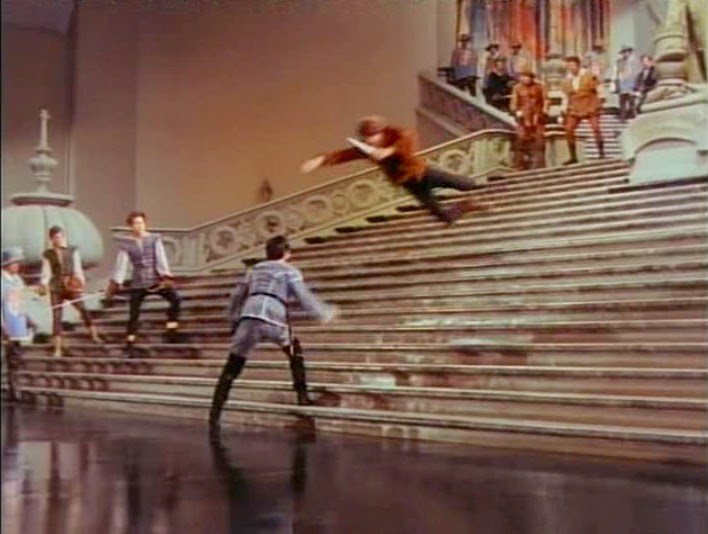
    So declares Errol Flynn, as Don Juan, as he backs up his words – and saves the Spanish throne – by hurling himself down a marble staircase to dispatch the slimy Duke de Lorca.

    “The Adventures of Don Juan” (1948) will be among my featured works this week, on “Picture Perfect.” In terms of audacity and swagger, Max Steiner’s classic film score gives Erich Wolfgang Korngold a run for the money. The music enjoyed a bit of a resurgence in the 1980s, when portions were reused in “Zorro, the Gay Blade” (1981) and “Goonies” (1985).

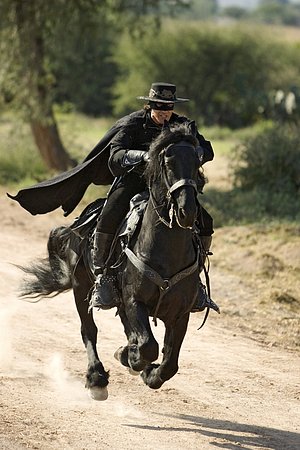
    Enjoy a rousing suite from the film, on a program of Latin swashbucklers, which will also include selections from “Captain from Castile” (Alfred Newman), “The Mask of Zorro” (James Horner), and “Puss in Boots” (Henry Jackman), on “Picture Perfect” – music for the movies – this Friday evening at 6:00 EDT, on WWFM – The Classical Network and wwfm.org.


    FUN FACT: The actual leap was accomplished by stuntman Jock Mahoney, soon to be Sally Field’s stepfather. Mahoney was paid $350 to execute the stunt.

  • Latin Swords Swashbuckling Film Scores

    Latin Swords Swashbuckling Film Scores

    Feeling a little out of shape? Boxed in? Blue? This week on “Picture Perfect,” put some swagger back into your step with an hour of audacious music from Latin swashbucklers.

    Alfred Newman gets the blood pumping with his virile soundtrack for “Captain from Castile” (1947), in which Tyrone Power flees persecution at the hands of the Inquisition to join Cortés’ expedition to conquer Mexico. The film was shot on location with one sequence set against the backdrop of an erupting volcano!

    Power, of course, was one of the screen’s great Zorros. However, with “The Mask of Zorro” (1998), Antonio Banderas becomes the Zorro for our time. He’s aided and abetted by Anthony Hopkins, as the elder Zorro who mentors him. (TWO Zorros in one movie! I could expire of joy.) Catherine Zeta-Jones is radiant, and the music by James Horner literally hits all the right notes.

    This film was already a throw-back upon release, with plenty of real-life, real-time swordplay and stunts galore, with the barest minimum of computer-generated bells and whistles. I wish to God popcorn entertainment could still be like this. “The Mask of Zorro” was like a belated last gasp of the 1980s; easily the best swashbuckler of the ‘90s – though, really, was there much competition?

    Banderas got a chance to send-up his image in the Dreamworks’ computer-animated feature, “Puss in Boots” (2011), a spin-off from the Shrek series that actually turned out to be a better sequel than “The Legend of Zorro” (2005).

    The film sports plenty of Zorro in-jokes, which extend even to Henry Jackman’s entertaining score. How is it that animated movies are just about the only movies these days that seem to keep up the great orchestral tradition of classic film scoring?

    Finally, Errol Flynn has one last swash left in his buckle for “The Adventures of Don Juan” (1948), his last wholly satisfying period adventure. Max Steiner rises to the occasion and provides one of his best scores, just about on the same level as those of the master of the genre, Erich Wolfgang Korngold.

    A cape, a plume, and seven-league boots are guaranteed mood-elevators. Forget your cares! Join me for Latin swords, on “Picture Perfect,” music for the movies. We ride hell-for-leather, this Friday evening at 6:00 EDT, on WWFM – The Classical Network and wwfm.org

  • Olivia de Havilland They Died With Their Boots On

    Olivia de Havilland They Died With Their Boots On

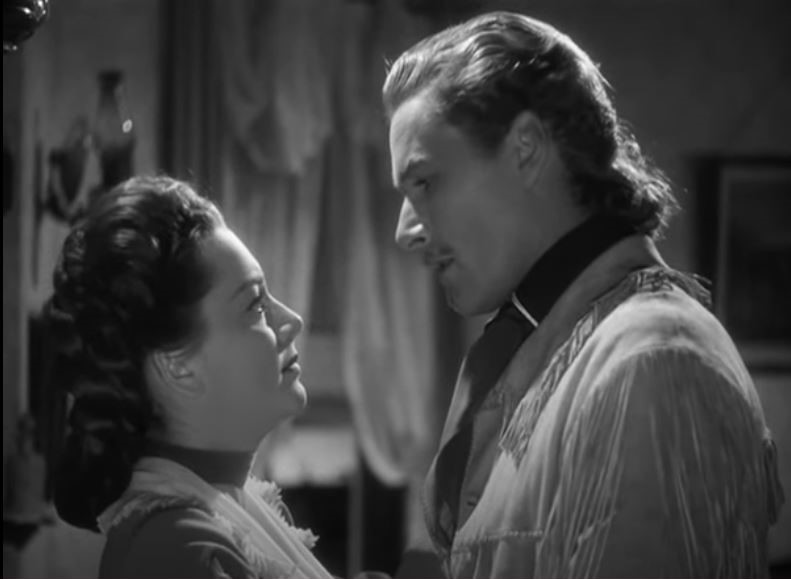
    Olivia de Havilland and Errol Flynn made eight films together. Everybody knows “The Adventures of Robin Hood,” but here’s a great scene from “They Died with Their Boots On” (1941), something of a whitewashed portrait of George Armstrong Custer.

    De Havilland was about to leave behind these types of roles, where she was relegated to “the girl” in boy’s adventure movies, and move on to meatier portrayals. But she never comes across as less than committed. Here she does an amazing job. She really does look as if she is about to lose it after Flynn delivers his big line.

    The film is given the grand Warner Brothers treatment, with plenty of gloss and a moving score by Max Steiner. This was the last time de Havilland and Flynn would ever work together. She may have had a premonition that this would be the case.

    De Havilland died yesterday at 104. This scene gets me every time.

    “Walking through life with you, ma’am, has been a very gracious thing.”

  • Korngold Errol Flynn and Hollywood’s Golden Age

    Korngold Errol Flynn and Hollywood’s Golden Age

    With the necessary emphasis on fundraising this week, I happened to miss the birthday anniversary of one of my favorite composers. Erich Wolfgang Korngold was born on May 29, 1897. Thanks to a steady diet of Errol Flynn films, his music will forever be a part of the soundtrack of my life.

    Korngold went from being one of Europe’s great musical prodigies, his works admired by Mahler, Strauss and Puccini – and championed by Schnabel, Weingartner and Klemperer – to becoming one of Hollywood’s transformative film composers. He is a link from Old World opulence to New World fantasy, his music gracing a number of Warner Brothers’ classic historical adventures.

    The best ones starred Flynn, and we’ll hear music from “The Sea Hawk” (1940) and “The Adventures of Robin Hood” (1938), as well as the mostly forgotten “Another Dawn” (1937). Flynn stars alongside Kay Francis and Ian Hunter (who would go on to play Richard the Lionheart in “Robin Hood”) in this love triangle involving pilots in a British desert colony.

    The film may be an obscurity to all save classic movie buffs, but Korngold thought enough of his music that he salvaged the main title as the opening theme to his Violin Concerto, premiered by Heifetz in 1947.

    It was an invitation from theatrical impresario Max Reinhardt that brought Korngold to Hollywood in the first place, for a cinematic adaptation of “A Midsummer Night’s Dream” (1935). The film stars James Cagney, Dick Powell and Olivia de Havilland, in her big screen debut, with Mickey Rooney an irrepressible Puck.

    For the project, Korngold adapted the famous incidental music of Felix Mendelssohn, interweaving material from Mendelssohn’s symphonies and orchestrating some of the “Songs without Words.” Even so, the music bears the composer’s unmistakable stamp, as you’ll hear in the opening number, lifted from the “Scottish Symphony,” which is marked by plenty of Korngoldian swagger.

    Set sail with Erich Wolfgang Korngold this week, on “Picture Perfect,” music for the movies. Enjoy it this Friday evening at 6:00 EDT, immediately following today’s classical music countdown. Please sustain our programming on WWFM – The Classical Network by calling 1-888-232-1212 or making your contribution at wwfm.org. Thank you for your continued support!


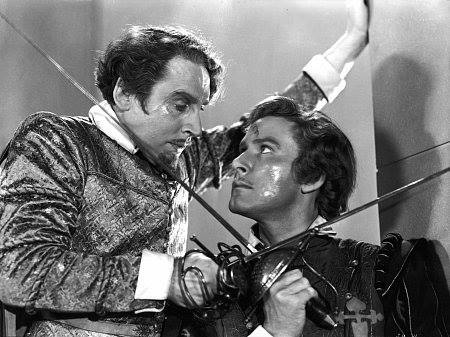
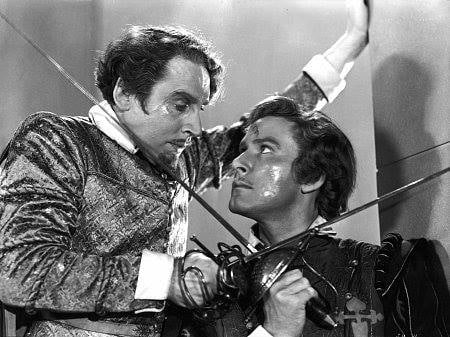
    PHOTO: The music was actually on my “personal favorites” playlist – Henry Daniell and Errol Flynn in “The Sea Hawk”

  • Sabatini, Swashbucklers & Silver Screen Gold

    Sabatini, Swashbucklers & Silver Screen Gold

    Though Rafael Sabatini’s popularity has faded somewhat over the decades, in his day the Italian-English writer might have been regarded as the heir apparent to Alexandre Dumas. His bestselling novels are full of romance and swordplay. However, I’m not sure if any of them have really endured in the public consciousness.

    Sabatini’s incident-filled pages seem ready-made for the silver screen. Film adaptations of “Scaramouche,” “The Sea Hawk” and “Captain Blood” were made during the silent era. A long-lost John Gilbert classic, adapted from Sabatini’s “Bardelys the Magnificent,” has only recently been rediscovered. Several of these, of course, were remade, more or less, to great success during the era of talking pictures.

    This week on “Picture Perfect,” we’ll hear Erich Wolfgang Korngold’s music for the Errol Flynn classics “Captain Blood” (1935) and “The Sea Hawk” (1940). The former film provided Flynn with his breakout role; the latter actually has nothing at all to do with Sabatini’s original plot, despite his onscreen credit.

    We’ll also enjoy Alfred Newman’s rollicking main title music for the pirate opus “The Black Swan” (1942), which starred Tyrone Power, and one of Victor Young’s most rousing and melodically inventive scores, for “Scaramouche” (1952), which featured Stewart Granger in probably the best swashbuckler of the 1950s.

    “Picture Perfect” sets sail at 6:00 this evening. Tune in a little earlier to enjoy a broadcast concert by Concordia Chamber Players, as always compellingly curated by the ensemble’s artistic director, Michelle Djokic.

    The program will include one of Korngold’s finest chamber works, his Suite for Two Violins, Cello and Piano Left-Hand, written for the one-armed Austrian pianist Paul Wittgenstein (for whom Ravel wrote his famous piano concerto); also the String Quartet No. 1 by Korngold’s teacher, Alexander Zemlinsky. Glenn Smith will be your host for this special concert, which will come your way at a special time.

    You’ll get two faces of Korngold today, with Concordia Chamber Players at 4 p.m. EST and on “Picture Perfect” at 6 p.m., on WWFM – The Classical Network and at wwfm.org.

Tag Cloud

Aaron Copland (92) Beethoven (95) Composer (114) Film Music (120) Film Score (143) Film Scores (255) Halloween (94) John Williams (185) KWAX (229) Leonard Bernstein (100) Marlboro Music Festival (125) Movie Music (135) Opera (198) Philadelphia Orchestra (88) Picture Perfect (174) Princeton Symphony Orchestra (106) Radio (87) Ralph Vaughan Williams (85) Ross Amico (244) Roy's Tie-Dye Sci-Fi Corner (290) The Classical Network (101) The Lost Chord (268) Vaughan Williams (103) WPRB (396) WWFM (881)

DON’T MISS A BEAT

Receive a weekly digest every Sunday at noon by signing up here


RECENT POSTS