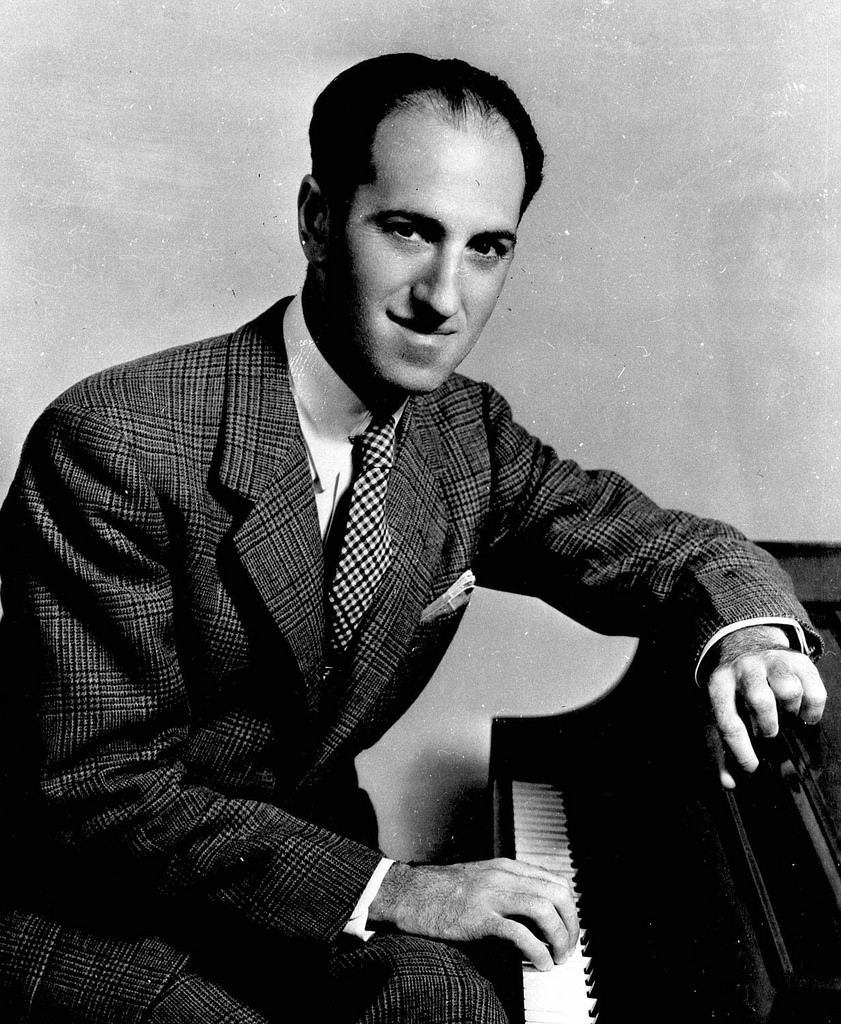
Why, it’s Gershwin’s birthday, by George! We’ll have two chances to celebrate today, on both my Saturday radio shows.
George Gershwin, of course, was one of our most versatile composers. He occupied a unique place in American music, rising from Tin Pan Alley scrapper to Broadway royalty. From there, he conquered the concert hall and even the opera house, with his blend of popular song, jazz, blues, spirituals, and European classical forms.
Like Franz Schubert a hundred years before, Gershwin managed to churn out an astonishing amount of music over a comparatively brief span. His songs, in particular, have been of enduring interest. His gift of lyricism and invention defied early critics as he bestrode the worlds of popular and classical music like an American colossus.
Sadly, at the peak of his success, he died of a brain tumor at the age of 38. But 89 years later, George, we’re still crazy for you.
This morning on “Sweetness and Light,” Gershwin will be one of four composers whose music we’ll enjoy in a salute to classic American musical theater. We’ll hear selections from Eubie Blake & Noble Sissle’s “Shuffle Along” (the 1921 all-Black musical that spawned the breakout hit “I’m Just Wild about Harry”), Leonard Bernstein’s “On the Town” (the ballet music, before it was distilled into the familiar “Three Dance Episodes,” with a 24-year-old Bernstein conducting), Gershwin’s “Porgy and Bess” (conceived by the composer as an opera, but produced on Broadway several times over the decades before finally being elevated to the pantheon), and Richard Rodgers & Lorenz Hart’s “On Your Toes” (the climactic “Slaughter on Tenth Avenue” sequence).
It’s guaranteed to get your toes tapping, for the most part, but I’ll also include a grand piano fantasy on themes from “Porgy” by Earl Wild. It’s showtime, this Saturday morning at 11:00 EDT/8:00 PDT!
Then later on today, on “The Lost Chord,” we’ll sample Gershwin’s artistry in recordings of his era, including several songs performed by Al Jolson, Fred Astaire, and Ella Logan. (So many excellent ones to choose from!)
We’ll also hear the world premiere recording of “An American in Paris” – performed by the Victor Symphony Orchestra (really members of the Philadelphia Orchestra), with the composer himself on the celesta – and the Concerto in F, performed as part of a Gershwin memorial concert at the Hollywood Bowl, with the composer’s friend, Oscar Levant, as soloist.
Three of these recordings date from 1937, the year of the composer’s death. All are from his era. I hope you’ll join me for “Vintage Gershwin,” this Saturday at 7:00 EDT/4:00 PDT.
It’s nice work if you can get it. Not that you need someone to watch over you, George. Our love is here to stay.
Strike up the band and let ‘em eat cake! Of thee I sing, on “Sweetness and Light” AND “The Lost Chord,” on KWAX Classical Oregon!
———-
Clip and save the start times for all three of my recorded shows:
PICTURE PERFECT, the movie music show – Friday at 8:00 PM EDT/5:00 PM PDT
SWEETNESS AND LIGHT, the light music program – Saturday at 11:00 AM EDT/8:00 AM PDT
THE LOST CHORD, unusual and neglected rep – Saturday at 7:00 PM EDT/4:00 PM PDT
Stream them, wherever you are, at the link.
https://kwax.uoregon.edu/
Tag: Eubie Blake
-
Our Love Is Here to Stay: Celebrating Gershwin on “Sweetness and Light” and “The Lost Chord”
-
Broadway Musicals Celebrate July 4th
With the Fourth of July still six days away, I was trying to come up with a way to honor some aspect of the country’s rich musical heritage – it is, after all, the last weekend before the holiday – but I didn’t want to start clobbering everybody with Sousa marches just yet.
I found my solution on Broadway: both of my specialty shows today are connected in some way or another to classic American musical theater.
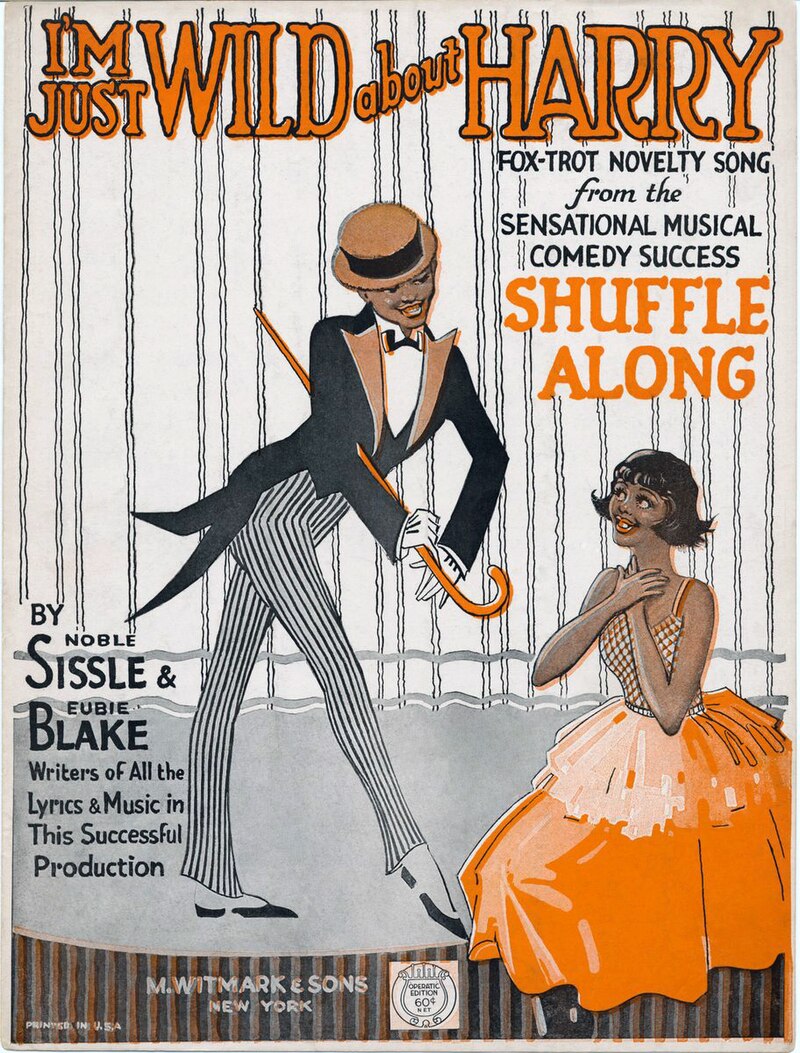
The playlist on “Sweetness and Light,” the light music show, is constructed on works that were actually staged on the Great White Way, including Eubie Blake & Noble Sissle’s “Shuffle Along” (the 1921 all-Black musical that spawned the breakout hit “I’m Just Wild about Harry”), Leonard Bernstein’s “On the Town” (the ballet music, before it was distilled into the familiar “Three Dance Episodes,” with a 24-year-old Bernstein conducting), George Gershwin’s “Porgy and Bess” (conceived by the composer as an opera, but produced on Broadway several times over the decades before finally being elevated to the pantheon), and Richard Rodgers & Lorenz Hart’s “On Your Toes” (the climactic “Slaughter on Tenth Avenue” sequence, which we’ll enjoy on Rodgers’ birthday).
We’ll get your toes tapping, for the most part, but also include a grand piano fantasy on themes from “Porgy” by Earl Wild.
It’s showtime, this Saturday morning at 11:00 EDT/8:00 PDT.
Then later, on “The Lost Chord,” a program that revives unusual and neglected repertoire, we’ll come at the same source from a different perspective, as we’ll hear concert works by composers of notable Broadway hits.
Vladimir Dukelsky was born in what is now Belarus, but when he settled in the United States, his friend, George Gershwin suggested a name change. Thereafter, he was known as Vernon Duke. As Duke, he composed such standards as “April in Paris” and “Autumn in New York,” and he had a hit show in “Cabin in the Sky.”
As Dukelsky, he had works championed by Serge Koussevitzky and choreographed by Léonide Massine and George Balanchine. We’ll hear a Piano Concerto he composed at the age of 19 at the request of Arthur Rubinstein.
Meredith Willson is best-known for his Broadway smashes “The Music Man” and “The Unsinkable Molly Brown,” but he emerged from the classical music world, as a flutist who played with John Philip Sousa and the New York Philharmonic. We’ll hear Willson’s Symphony No. 2, subtitled “The Missions of California.”
I hope you’ll join me in giving my regards to Broadway with “Broadway Lights” on “Sweetness and Light” (at 11:00 a.m. EDT/8:00 a.m. PDT), and “Broad Talents from Broadway” on “The Lost Chord” (at 7:00 p.m. EDT/4:00 p.m. PDT), both of them on KWAX, the radio station of the University of Oregon!
Stream them, wherever you are, at the link:
IMAGES: “Shuffle Along” sheet music and (top to bottom) Sissle & Blake, Rodgers & Hart, and Meredith & Rini Willson
-
Joplin’s “Treemonisha” Premieres 50 Years Ago
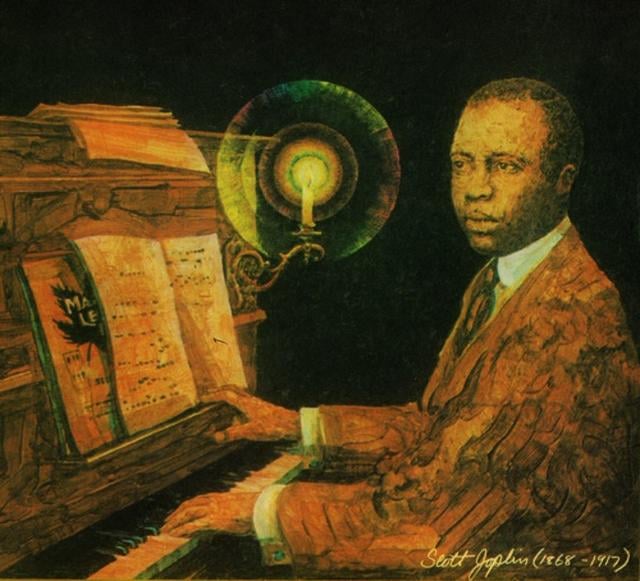
50 years ago today, the most ambitious work by America’s premier Ragtime composer received its belated first performance in Atlanta. Scott Joplin’s “Treemonisha” was presented by the Atlanta Symphony Orchestra and the Morehouse Glee Club, with Robert Shaw conducting. The chorus was prepared Wendell Whalum, and the direction and choreography were provided by Katherine Dunham.
In attendance was Eubie Blake, then a few weeks shy of his 85th birthday. Blake had known Joplin in Washington, D.C.
The plot of Joplin’s opera is set in a rural African American community near Texarkana, Arkansas, around 1884. The protagonist is 18 year-old Treemonisha, who was found under a sacred tree as a baby and raised as the daughter of Monisha and her husband Ned. As the community has no schools, her adoptive parents send her to away for her education. When she returns, she is the only member of her community who can read and write.
As the opera opens, Treemonisha foils the efforts of a conjurer, Zodzetrick, to sell a “bag of luck” to her mother. In retribution, conjurers kidnap Treemonisha and plan to toss her into a wasps’ nest. Happily, she is rescued by Remus, a townsman disguised as a scarecrow. The conjurers in turn are captured by field workers and taken into custody. However, at Treemonisha’s urging, they are forgiven and let go. Treemonisha is acknowledged as the community’s leader, and she and Monisha lead the people in a ragtime dance.
And so, in the contest between ignorance and education, superstition is overcome and grace attained through hard work, sound leadership, commitment to learning, and absolution. All well and good, but the opera also happens to be chock full of good tunes.
Joplin completed “Treemonisha” in 1910 and paid for the publication of a piano-vocal score. He sent a copy to the American Musician and Art Journal, which, in 1911, gave the work a glowing, full-page review. Presciently, the piece was lauded as an “entirely new phase of musical art and… a thoroughly American opera.”
Unfortunately, “Treemonisha” failed to gain traction. Joplin’s original orchestrations were completely lost (along with his first opera, “A Guest of Honor,” composed in 1903), and modern performances have required editing and orchestration by other hands, including T.J. Anderson (in Atlanta), Gunther Schuller (for Houston Grand Opera), and Rick Benjamin (for more intimate forces, akin to the theater pit orchestras Joplin would have known).
The work has often been characterized as a “Ragtime opera” – Joplin was, after all, the king of the rag – but “Treemonisha” encompasses a broader range of influences than such a description would suggest. The composer aspired to write a “serious” stage work in the European tradition, but one propelled by a uniquely New World vitality. As a unified artistic statement, it couldn’t have been written by anyone else. “Treemonisha” is engaging, tuneful, and very, very American.
Sadly, Joplin never lived to see his magnum opus fully staged. The work received its sole read-through in his lifetime in 1915 – two years before his untimely death at the age of 48 – at the Lincoln Theater in Harlem. Joplin himself was at the keyboard. The score then languished in obscurity for decades, until its rediscovery in 1970.
In 1971, selections were performed at the New York Public Library for the Performing Arts, with a group of singers supported by William Bolcom, Joshua Rifkin, and May Lou Williams. Following its Atlanta premiere, the complete work went on to be performed by companies all over the United States, making its Broadway debut in 1975.
In 1976, Joplin received a citation from the Pulitzer Prize committee “for his contributions to American music.” Of course, by then, he had already been dead for 59 years.
In this fascinating, poignant segment, we learn that Joplin’s orchestrations were probably trashed in 1962:
The historic Houston Grand Opera production – in English with Portuguese subtitles!
In Rick Benjamin’s orchestration for pit orchestra, with spoken introduction:
Eubie Blake plays his “Charleston Rag” in 1972 – a work he composed in 1899!
-
Scott Joplin’s 1970s Revival: The Sting & Beyond
The ‘70s were a very good decade for Scott Joplin.
Joshua Rifkin’s first LP of Joplin piano rags became a classical bestseller for Nonesuch Records in 1970. The same year, Joplin was inducted into the Songwriter’s Hall of Fame. Gunther Schuller revived period orchestrations of some of his works in 1973. The recording, “The Red Back Book,” won a Grammy.
In 1972, Joplin’s opera, “Treemonisha,” was finally given its first complete staging. And in 1976, Joplin received a citation from the Pulitzer Prize committee “for his contributions to American music.” Of course, by then, Joplin had already been dead for 59 years.
More than anything, it was probably the use of his rags on the soundtrack for “The Sting,” in 1973 (which earned Marvin Hamlisch an Oscar for best “original” score), that brought Joplin roaring back into the popular consciousness. It’s a pretty good bet that without “The Sting” – and the resulting Top-40 status of “The Entertainer” (which reached number 3 on the Billboard charts) – the movie “Scott Joplin” (1977) would not have been made. At any rate, Joplin’s sudden ubiquity couldn’t have hurt.
Billy Dee Williams, still three years ahead of his first turn as Lando Calrissian in “The Empire Strikes Back,” was already a star, thanks to successes in “Brian’s Song,” “Lady Sings the Blues,” and “Mahogany.” Williams here plays the title role in what had been planned as a TV movie, until Universal Pictures decided the film had theatrical potential. His performance received praise from the critics, even as the film itself earned tepid reviews. Its TV production values and the trajectory of its plot, necessarily all downhill after the first half hour, did not work in its favor.
Clifton Davis co-stars as ragtime artist Louis Chauvin, and a bewhiskered Art Carney plays Joplin’s publisher, John Stark. Fascinatingly, Eubie Blake appears as the judge of a piano “cutting contest” that took place in 1899. Blake, who essentially lived forever (he died in 1983 at the age of 96), would have been 12 at the time of the events depicted. 1899 was also the year Blake – himself a ragtime luminary who branched out into musical theater (his collaboration with Noble Sissle, “Shuffle Along,” is the source of “I’m Just Wild About Harry”) – composed his own “Charleston Rag.” Blake actually met Joplin once in Washington, D.C. Incidentally, that’s Dick Hyman playing on the film’s soundtrack.
“Scott Joplin” has not appeared on home video since the days of VHS, though it is available for viewing through some streaming outlets. Clips are posted on YouTube.
Happy birthday, Scott Joplin (c. 1868-1917), another artist who brought so much joy and beauty into the world, only to leave us too soon.
“The Sting” and Joplin’s “The Entertainer”
Gunther Schuller’s New England Conservatory Ragtime Ensemble and “The Maple Leaf Rag”
Joshua Rifkin plays “Bethena: A Concert Waltz”
Joplin’s “Treemonisha”
Eubie Blake plays his “Charleston Rag”
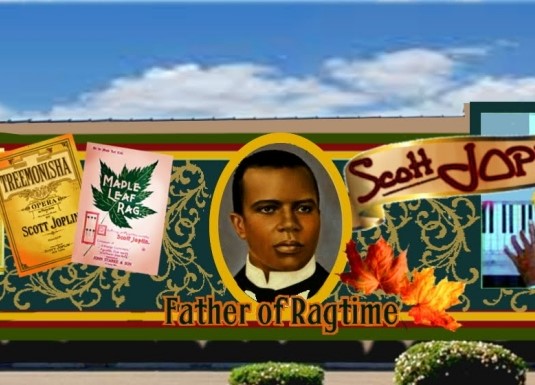
PHOTO: Detail of a mural in Joplin’s hometown of Texarkana, TX
Tag Cloud
Aaron Copland (94) Beethoven (95) Composer (114) Film Music (150) Film Score (143) Film Scores (255) Halloween (102) John Williams (198) KWAX (233) Leonard Bernstein (105) Marlboro Music Festival (125) Movie Music (165) Mozart (91) Opera (215) Philadelphia Orchestra (90) Picture Perfect (174) Princeton Symphony Orchestra (110) Radio (90) Ross Amico (244) Roy's Tie-Dye Sci-Fi Corner (290) The Classical Network (101) The Lost Chord (269) Vaughan Williams (107) WPRB (397) WWFM (881)