The ‘70s were a very good decade for Scott Joplin.
Joshua Rifkin’s first LP of Joplin piano rags became a classical bestseller for Nonesuch Records in 1970. The same year, Joplin was inducted into the Songwriter’s Hall of Fame. Gunther Schuller revived period orchestrations of some of his works in 1973. The recording, “The Red Back Book,” won a Grammy.
In 1972, Joplin’s opera, “Treemonisha,” was finally given its first complete staging. And in 1976, Joplin received a citation from the Pulitzer Prize committee “for his contributions to American music.” Of course, by then, Joplin had already been dead for 59 years.
More than anything, it was probably the use of his rags on the soundtrack for “The Sting,” in 1973 (which earned Marvin Hamlisch an Oscar for best “original” score), that brought Joplin roaring back into the popular consciousness. It’s a pretty good bet that without “The Sting” – and the resulting Top-40 status of “The Entertainer” (which reached number 3 on the Billboard charts) – the movie “Scott Joplin” (1977) would not have been made. At any rate, Joplin’s sudden ubiquity couldn’t have hurt.
Billy Dee Williams, still three years ahead of his first turn as Lando Calrissian in “The Empire Strikes Back,” was already a star, thanks to successes in “Brian’s Song,” “Lady Sings the Blues,” and “Mahogany.” Williams here plays the title role in what had been planned as a TV movie, until Universal Pictures decided the film had theatrical potential. His performance received praise from the critics, even as the film itself earned tepid reviews. Its TV production values and the trajectory of its plot, necessarily all downhill after the first half hour, did not work in its favor.
Clifton Davis co-stars as ragtime artist Louis Chauvin, and a bewhiskered Art Carney plays Joplin’s publisher, John Stark. Fascinatingly, Eubie Blake appears as the judge of a piano “cutting contest” that took place in 1899. Blake, who essentially lived forever (he died in 1983 at the age of 96), would have been 12 at the time of the events depicted. 1899 was also the year Blake – himself a ragtime luminary who branched out into musical theater (his collaboration with Noble Sissle, “Shuffle Along,” is the source of “I’m Just Wild About Harry”) – composed his own “Charleston Rag.” Blake actually met Joplin once in Washington, D.C. Incidentally, that’s Dick Hyman playing on the film’s soundtrack.
“Scott Joplin” has not appeared on home video since the days of VHS, though it is available for viewing through some streaming outlets. Clips are posted on YouTube.
Happy birthday, Scott Joplin (c. 1868-1917), another artist who brought so much joy and beauty into the world, only to leave us too soon.
“The Sting” and Joplin’s “The Entertainer”
Gunther Schuller’s New England Conservatory Ragtime Ensemble and “The Maple Leaf Rag”
Joshua Rifkin plays “Bethena: A Concert Waltz”
Joplin’s “Treemonisha”
Eubie Blake plays his “Charleston Rag”
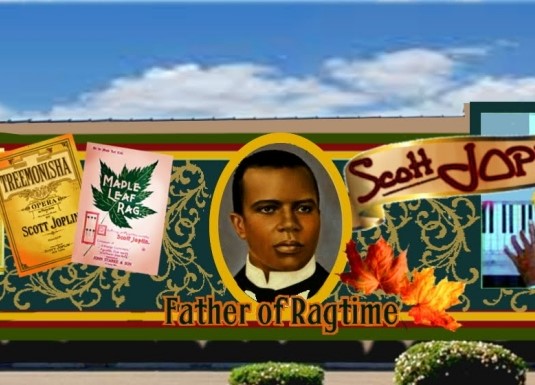
PHOTO: Detail of a mural in Joplin’s hometown of Texarkana, TX
Leave a Reply