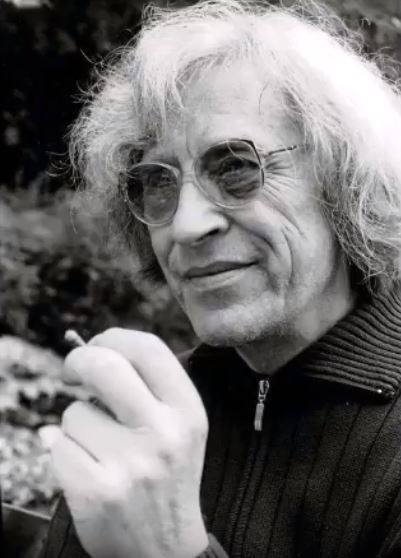
The German composer Heinz Winbeck has died. I’m ashamed to say, before today I knew nothing about this man, who forged five epic symphonies. It would seem, upon listening to the Fifth, that my existence up until now has been a barren one.
The symphony, composed in 2009, bears the subtitle “Jetzt und der Stunde des Todes” nach Motiven insbesondere des Finales der IX. Symphonie von Anton Bruckner (“Now and in the hour of death” on motives particularly from the finale of the 9th Symphony of Anton Bruckner).
So much wonderful music in the world. It is one of life’s great tragedies that one will never be able to hear all of it. If you like Bruckner, prepare to be totally blissed out.
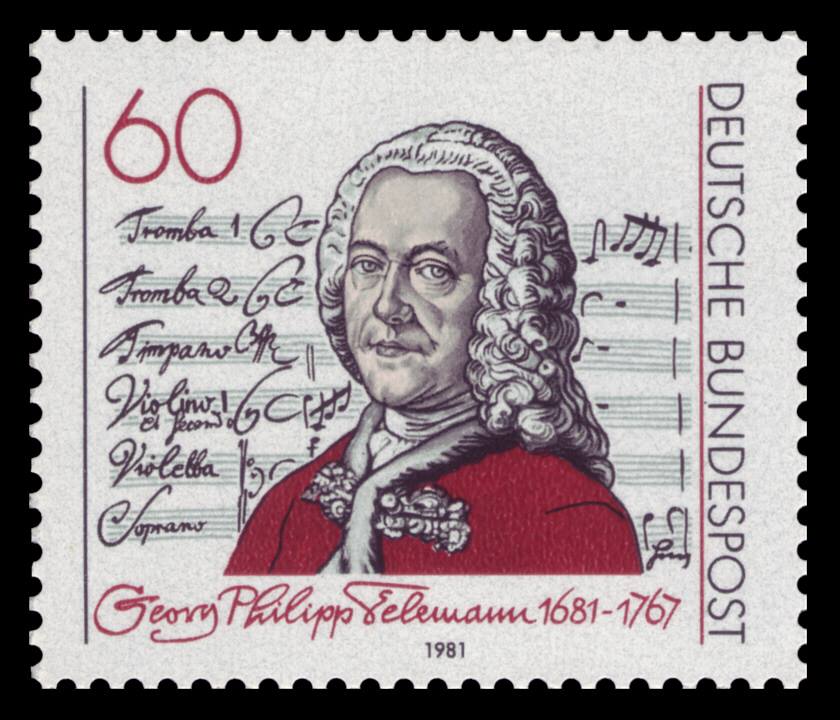
Poor Telemann. You were a casualty of having done your job too well.
A composer of genius, you were virtually self-taught, against the opposition of your family. In addition, you taught yourself flute, oboe, violin, recorder, double bass, etc. You spun out music by the yard. In fact, you wrote more music than Bach and Handel combined, over 3000 works, making you one of the most prolific composers of all time. Yet nothing in your oeuvre has captured the public imagination quite like the “Brandenburg Concertos” or the “Water Music.”
Of course, you wrote Water Music, too.
On the other hand, you were recognized in your lifetime. You were an innovator, taking what you needed from the Italians and the French to bolster your own style, and your contemporaries bought and studied your scores. You were offered the cantorate of the Thomaskirche in Leipzig ahead of Bach. You counted Bach among your friends, as well as Handel. Bach even requested that you become the godfather of his son, Carl Philipp Emanuel.
You lived an unusually long life (86 years), though it was not without its miseries. Your first wife died young. Your second ran up gambling debts in amounts larger than your annual income, and ultimately your friends had to bail you out. As you grew older, you suffered further indignities, including failing eyesight.
Celebrated in your own day, by the 19th century you were dismissed as a “polygraph,” someone you had simply composed too much. In a sense, you were a victim of your own success.
Still, you continue to give employment to thousands of early music specialists, who have done much to restore your reputation. I think at least you deserve a little recognition on your birthday:
Happy Birthday, Georg Philipp Telemann (1681-1767).
One of my favorite Telemann moments, the “Air à l’Italien” from the Suite in A Minor for Flute and Orchestra:
Today is the birthday of Woldemar Borgiel (1828-1897). Woldemar is not to be confused with He-Who-Must-Not-Be-Named from the “Harry Potter” series. Rather, he was the half-brother of Clara Schumann.
His mother had been unhappily married to Clara’s father, Friedrich Wieck, who, judging from his role as the inflexible impediment to his daughter’s marriage to Robert Schumann, must have been a barrel of laughs.
Woldemar, who was nine years younger than Clara, benefited from his brother-in-law’s advocacy. Schumann and Mendelssohn used their influence to gain him entrance into the Leipzig Conservatory. There, he studied with Ignaz Moscheles, Niels Wilhelm Gade and Julius Rietz.
It was the Schumanns who arranged for the publication of some of Woldemar’s early works, including his Piano Trio No. 1. He would hold positions at several conservatories, the most prestigious of which was the Hochschule für Musik Berlin, where he taught for a good deal of his life. He also assisted Brahms as co-editor of complete editions of Schumann’s and Chopin’s works.
Woldemar was not a prolific composer, but he was a reliable one. There is nothing to fear from saying his name.
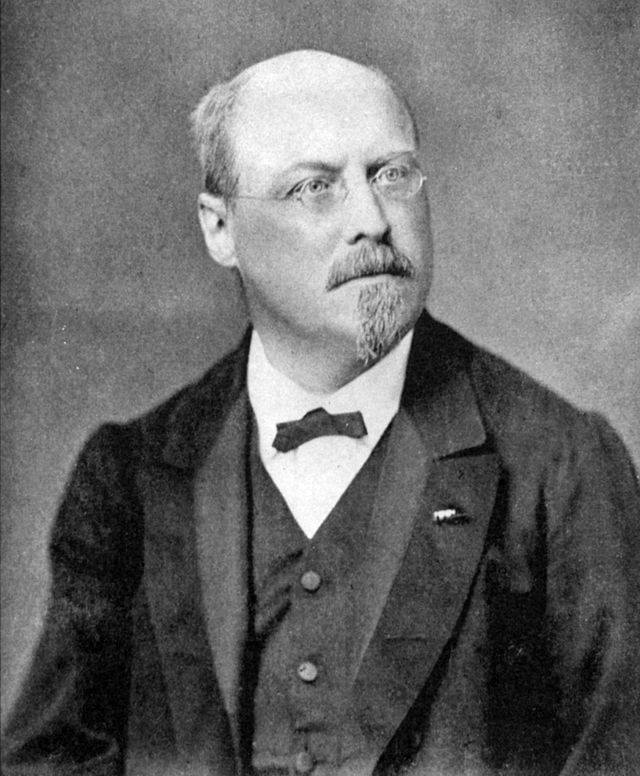
There’s one story about the German-Swiss composer Joachim Raff that I find so endearing. When Raff learned that Franz Liszt would be playing in Basel, he traveled by foot from Zurich (a distance of nearly 50 miles), through a driving rain, only to discover upon reaching the venue that the concert had sold out.
Word reached Liszt of the young man’s predicament, and the great pianist, in yet another of his legendary acts of generosity, had a chair put up on the stage so that Raff would be able to enjoy the recital – which he did, sitting there, grinning like an idiot, amidst a widening pool of water.
Raff became Liszt’s assistant at Weimar, where he orchestrated a number of the elder composer’s works, until Liszt gained the technique and confidence himself; after which time, Liszt went back and revised many of the earlier pieces. In turn, Liszt staged the premiere of Raff’s opera “King Alfred” (though, because of an illness in the family, he had to hand over the conducting duties to Raff himself).
Raff must have been a singularly likable figure. His was the rare instance of a composer who was accepted in both camps, on either side of the seemingly unbridgeable divide that separated the “absolute” music of Mendelssohn and Schumann and the “program” music – the so-called “Music of the Future” – of Liszt and Wagner.
In 1878, Raff became the first director of the Hoch Conservatory in Frankfurt, where he hired Clara Schumann, among the eminent faculty, and initiated a class for female composers.
During his lifetime, Raff was one of the best-known German composers. It’s unfortunate that so little of his music endures in the public memory (beyond, perhaps, the “Cavatina” for violin and piano), but the symphonies, in particular, have not aged well.
Raff’s practice was to choose a promising program – for instance, in the Symphony No. 5, the “Lenore” Symphony, he selected an overheated ballad by Gottfried August Bürger, about a maiden who is swept away amidst jeering specters by the phantom of her former lover – and then he would negate all the drama by rendering the symphony in classical form. In other words, the story would be straightjacketed in order to suit the requirements of form, rather than the other way around – which would be easier to forgive if the symphony weren’t nearly an hour long.
However, he did leave behind some very impressive music. You just really have to look for it. I hope you enjoy these “diamonds in the Raff”: