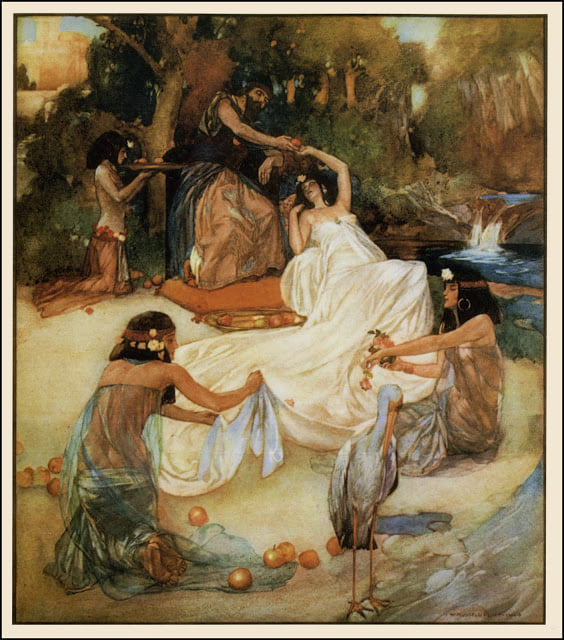
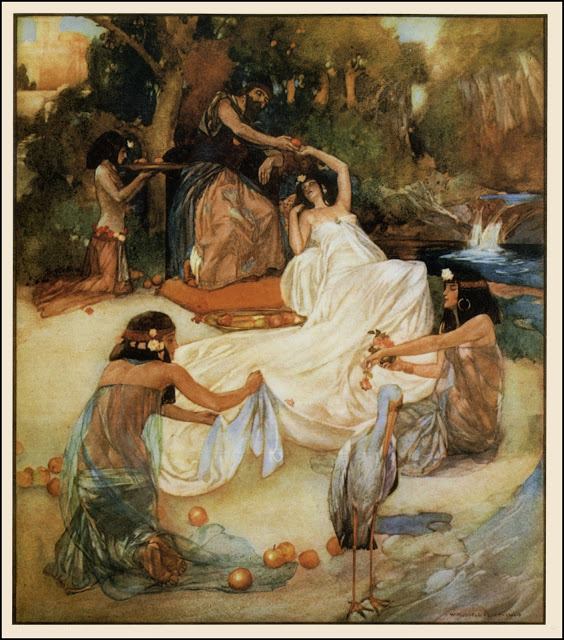
The Song of Songs. Attributed to King Solomon, this Biblical book contains some of the most ardent poetry ever written. Whether interpreted as the communion of man and woman, or as something of a more allegorical nature – the relationship, depending upon one’s system of belief, between God and Israel, between God and the Church, or between Christ and the human soul – over the centuries it has inspired some meltingly lovely music.
Since it is customary to read from the Song of Songs as part of the observance of Passover, this week on “The Lost Chord,” for Pesach, we’ll sample two complementary settings: one by Sir Granville Bantock – selections from his massive, 2 ½ hour oratorio – and one by Lukas Foss – a more intimate song cycle, in which divine and romantic love unite in understated metaphor.
What if I told you your temples behind your veil are like the halves of a pomegranate? If you fall for that, there’s plenty more where that came from, on “King Solomon’s Lines,” on “The Lost Chord,” now in syndication on KWAX, the radio station of the University of Oregon!
Clip and save the start times for all three of my recorded shows:
PICTURE PERFECT, the movie music show – Friday at 8:00 PM EDT/5:00 PM PDT
SWEETNESS AND LIGHT, the light music program – Saturday at 11:00 AM EDT/8:00 AM PDT
THE LOST CHORD, unusual and neglected rep – Saturday at 7:00 PM EDT/4:00 PM PDT
The Song of Songs. Attributed to King Solomon, this Biblical book contains some of the most ardent poetry ever written. Whether interpreted as the communion of man and woman, or as something of a more allegorical nature – the relationship, depending upon one’s system of belief, between God and Israel, between God and the Church, or between Christ and the human soul – over the centuries it has inspired some meltingly lovely music.
Since it is customary to read from the Song of Songs as part of the observance of Passover, this Sunday night on “The Lost Chord,” in anticipation of Pesach, we’ll sample two complementary settings: one by Sir Granville Bantock – selections from his massive, 2 ½ hour oratorio – and one by Lukas Foss – a more intimate song cycle, in which divine and romantic love unite in understated metaphor.
What if I told you your temples behind your veil are like the halves of a pomegranate? If you fall for that, there’s plenty more where that came from, on “King Solomon’s Lines,” this Sunday night at 10:00 EDT, on WWFM – The Classical Network and at wwfm.org.
With Halloween lurking right around a withered cornfield, in my cheerful morbidity, my thoughts drift to Keats’ “Lamia.” I’ve long been familiar with the symphonic poem on the subject by the American pianist and composer Edward MacDowell, he of MacDowell Colony fame. But this one is entirely new to me: a symphonic poem by Dorothy Howell.
Howell, born in Birmingham in 1898, was a private student of Granville Bantock. Bantock was founder of the City of Birmingham Symphony Orchestra and an active composer himself. He was also a conductor. He led the first performance of Delius’ “Brigg Fair” and was the dedicatee of Sibelius’ Third Symphony.
These studies laid the foundation for her acceptance into the Royal College of Music at the age of 15. Howell achieved fame early, with her symphonic poem, in 1919, at the age of 21. Sir Henry Wood premiered “Lamia” at The Proms and repeated it no less than five times within a single season. Subsequently, it was revived by Wood in 1921, 1923, 1924, 1926, 1930, and 1940. The work then fell into neglect, essentially for a lifetime, until it was resurrected, also at The Proms, in 2010. It received another, centenary performance there last year.
Howell, who was brought up musically (she began composing at the age of 13), received her formal education at a convent school. It’s interesting, then, that her greatest success would be a musical response to a shapeshifting seductress, and a serpent no less!
Following the premiere of “Lamia,” Howell was declared a genius and hounded by the press. Her family was disconcerted by her sudden celebrity, but she appeared to take it all in stride. She continued to compose until at least mid-century – a time when many tonal composers found it difficult to secure performances – and taught at the Royal Academy for 46 years, retiring in 1970. After that, she continued to give private instruction. She died in Malvern, weeks before he 84th birthday, in 1982. She is buried near Sir Edward Elgar, whose grave she tended.
In her lifetime, Howell received the nickname “The English Strauss,” a comparison that I think does neither composer justice.
Keats’ Lamia is a serpent woman, who has the power to send her spirit abroad. On one of these spiritual journeys, she espies a lovely Corinthian youth, by the name of Lycius. She assumes human form and places herself in his path, and it isn’t long before they are living together as man and wife. Lycius wants to make it legal, but Lamia resists. Finally, with reluctance, she consents, but only if Lycius agrees not to invite the philosopher Apollonius. All seems to go well. Lamia uses her enchantments to oversee preparations for a lavish nuptial feast. Unfortunately, then Apollonius crashes. He recognizes Lamia for who she is, the feasting and music stop, Lamia vanishes, and Lycius falls lifeless. Thanks a lot, Apollonius.
Howell’s “Lamia”:
Her Piano Concerto, in its first public performance since 1925:
Rehearsing “Two Pieces for Muted Strings”
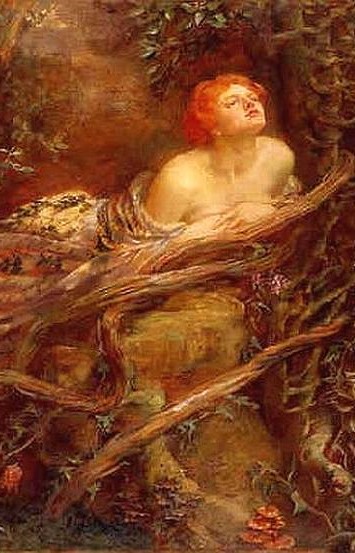
Dorothy Howell (right) with detail from “Lamia, the Serpent Woman” (1906), by Anna Léa Merritt (American painter), 1844-1930
View complete the painting and learn more about Merritt here:
The Song of Songs. Attributed to King Solomon, this Biblical book contains some of the most ardent poetry ever written. Whether it represents the communion of man and woman, or, as some would have it, something of a more allegorical nature – telling of the relationship, depending upon one’s system of belief, between God and Israel, between God and the Church, or between Christ and the human soul – over the centuries it has inspired some meltingly lovely music.
Since it is customary to read from the Song of Songs as part of the observance of Passover, we’ll devote “The Lost Chord” this week, on the eve of Pesach, to two settings: one by Sir Granville Bantock – selections from his massive, 2 ½ hour oratorio – and one by Lukas Foss – a more intimate song cycle, in which divine and romantic love unite in understated metaphor.
What if I told you your temples behind your veil are like the halves of a pomegranate? If you fall for that, there’s plenty more where that came from, on “King Solomon’s Lines,” this Sunday night at 10:00 EDT, on WWFM – The Classical Network and at wwfm.org.