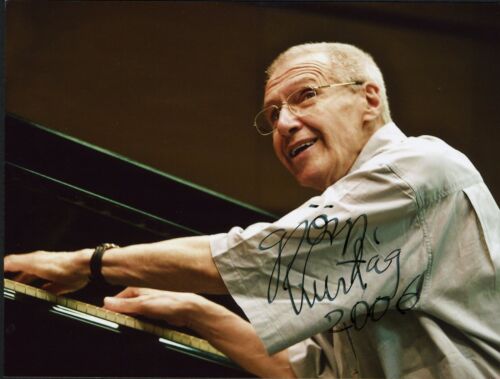
It is fortunate that György Kurtág has been so long-lived, since it wasn’t until his 60s, an age when most people contemplate retirement, that his international reputation really began to take off. But Kurtág was in it for the long haul. The aphoristic Hungarian master, still with us, was born on this date 100 years ago.
Kurtág forged a lifelong friendship with György Ligeti, while studying at Budapest’s Franz Liszt Academy, where he also met the woman who would become his wife. Márta, a pianist, died in 2019 at the age of 92.
Following the Hungarian uprising of 1956, Kurtág spent an extended period in Paris, where he studied with Olivier Messiaen, Darius Milhaud, and Schoenberg pupil Max Deutsch. It was also during this time that he was introduced to the music of Anton Webern and the plays of Samuel Beckett. When Ligeti directed him to a performance of Beckett’s “Endgame,” Kurtág described it as one of the strongest experiences of his life.
He returned to Budapest, where eventually he wound up teaching at his alma mater for 26 years. Gradually, he built a reputation as one of the most respected composers of his time. A meticulous artist, Kurtág’s works are like finely honed miniatures. But these are not pieces for display in the curio cabinet. Rather they are exquisitely crafted microcosms, notable for their poetry and flashes of expressive intensity.
It was surprising that a composer renowned for his work in smaller forms should turn to opera, especially at such a venerable age. Even so, “Fin de partie,” after “Endgame,” was enthusiastically received following its debut at La Scala in 2018.
Sadly, the U.S. premiere, which was to have taken place with the New York Philharmonic in 2021, was cancelled because of Covid. To my knowledge, it has yet to be performed in this country. Hopefully it will be rescheduled soon.
For now, raise a glass of pálinka to György Kurtág on his 100th birthday!
———
Zoltán Kocsis playing Kurtág in recital
https://www.youtube.com/watch?v=KHN58vAf3Y8
Wind Quintet, Op. 2
https://www.youtube.com/watch?v=FIFSR-1Af38
Six Short Pieces for Guitar
https://www.youtube.com/watch?v=9ZseIPZPFro
Interview with Kurtág
https://www.youtube.com/watch?v=F2p_R2m67Ys
“Fin de partie” (click closed caption for English titles)
https://www.youtube.com/watch?v=Bel9Sjfe2MA&t
Kurtág plays Mozart
https://www.youtube.com/watch?v=O5j9I4CauN0
Playing Bach with Márta
https://www.youtube.com/watch?v=Z8lTh58jhA8
Alas, some delectable videos have slipped away since the composer’s 95th birthday, including one of a performance of “Játékok” (“Games”), with Kurtág, Márta, and Kocsis, and another of “Seven Songs for Soprano and Cimbalom,” with Barbara Hannigan.
Tag: György Ligeti
-

Ligeti: Avant-Garde, Affection, and 2001
György Ligeti was that rare bird: an avant-garde composer whose music could actually inspire affection. He rocketed to worldwide fame after some of his works were used, without permission, in Stanley Kubrick’s “2001: A Space Odyssey.”
Ligeti was born into a Jewish family in an ethnically Hungarian region of Transylvania, one hundred years ago today. Destined to become one of the most important musical voices of his generation, he first had to overcome many hardships. Most of his family was wiped out in the Holocaust. He was conscripted into a forced labor brigade. He lived for a time under strict communist rule. He survived the violent Soviet putdown of the Hungarian Revolution, and finally escaped with his on-again/off-again wife in a couple of mail sacks, leaping off a night train and crawling for miles through the mud to find safety in Vienna.
Ligeti was not the kind of artist who would have flourished under totalitarianism. “Totalitarian regimes do not like dissonances,” he ruefully observed. He even abandoned the avant-garde circle in Cologne, which included Karlheinz Stockhausen, because he found the environment to be too dogmatic. Though he wrote little electronic music himself, he incorporated the lessons he learned at the Cologne Electronic Music Studio into his instrumental works, often creating otherworldly textures.
Remarkably, for all he endured, he was able to hang on to his sense of humor. Unquestionably, he had his playful side, and this shone through in his music from time to time.
Here’s the car horn prelude to his opera, “Le Grand Macabre.”
And the Act II doorbell prelude
If you’re wondering how to pronounce his name, the first sounds like George. His last name does NOT rhyme with spaghetti, since in Hungarian the accent is on the first syllable. Only when you realize this will you understand the genius of my pun when I state that “Ligeti split” in 2006. He was 83 years-old.
His centenary is a round occasion I would have loved to have observed on “The Lost Chord,” had I had the capability to record new shows. No longer reliant on WWFM, you can expect more flexibility from me in the future.
For now, happy birthday, György Ligeti!
Perhaps his greatest hit, thanks to a boost from Kubrick: the Kyrie from “Requiem”
“Lux Aeterna” (with creepy fractal)
https://www.youtube.com/watch?v=-iVYu5lyX5M.
“Mysteries of the Macabre,” a distillation of three coloratura arias from “Le Grand Macabre,” with Barbara Hannigan as Gepopo, the chief of secret police – in case you’re curious, the text is semi-nonsense!
In London
In Berlin
In New York in a semi-staged production of the complete opera
Trailer for the New York Philharmonic performances
H. Paul Moon’s film on Ligeti’s “Poème Symphonique for 100 metronomes”
Ligeti for people who think they don’t like Ligeti: the folk-inflected “Concert Românesc” (“Romanian Concerto”)
I once interviewed Cristian Măcelaru, then conductor-in-residence with the Philadelphia Orchestra, for an intermission feature for a broadcast concert on Philadelphia’s WRTI. You’ll have to scroll down to the gray box below the article at the link (below, not above, the photo of Sarah Chang) in order to hear it. I was not the one who edited the interview, or it would not have sounded so choppy!
Perhaps equally attractive, Ligeti’s “Six Bagatelles”
“I am in a prison: one wall is the avant-garde, the other wall is the past, and I want to escape.” – György Ligeti
-

Rued Langgaard Eccentric Genius Rediscovered
Even by composer standards, Rued Langgaard (1893-1952) was a little bit of a strange bird. Despite a promising start – born to musical parents, a precocious childhood, meetings with major conductors, and a symphony performed by the Berlin Philharmonic – his personal and creative eccentricities worked against him.
Langgaard followed his personal muse deep into the realm of late Romanticism at a time when most of the musical world was exploring modernist territory. Though he was given a state grant at 30, he failed to secure a permanent job until the age of 46, as an organist at the cathedral in Ribe, the oldest town in Denmark – which somehow seems appropriate for this most anachronistic of Danish outsiders.
An eccentric, shabby figure with wild hair, Laangaard died in Ribe 13 years later, in 1952, just shy of his 59th birthday, still largely unrecognized as a composer.
His reputation would not begin to gain traction for another 16 years. In all, he composed over 400 works, including 16 symphonies – which bear evocative titles such as “Yon Hall of Thunder” and “Deluge of the Sun” – and an opera, “Antikrist.”
It was in 1968 that no less a personage than György Ligeti found himself on a jury alongside Danish composer Per Nørgård. In this capacity, he examined a large number of new scores by Scandinavian composers. Unbeknownst to his fellow jurors, Nørgård had slipped in the score of Langgaard’s “Music of the Spheres.” Ligeti became captivated by what he found. When the ruse was revealed, he exclaimed, with a twinkle in his eye, “Gentlemen, I have just discovered that I am a Langgaard epigone!”
Langgaard had anticipated some of the technical aspects – tone clusters, layers, and so forth – which would appear in Ligeti’s avant garde experiments of the 1960s, in works such as “Atmosphères.”
I hope you’ll join me for “Rued Awakenings,” music of Rued Langgaard, including “Music of the Spheres,” on “The Lost Chord,” this Sunday night at 10:00 EST, on WWFM – The Classical Network and wwm.org.
-

Romanian Classical Gems Unearthed
In this season when you can’t hear “Transylvania” without imagining a wolf howl, we’ll set aside creepy castles in the Carpathian Mountains for the more congenial sounds of Romania’s concert halls.
This Sunday night on “The Lost Chord,” we’ll look beyond George Enescu, Romania’s most celebrated musical polymath, to hear music by three of his compatriots, only one of whom managed to achieve recognition beyond the borders of his homeland.
George Stephănescu (1843-1925) was a seminal figure in the development of Romanian opera. He founded the nation’s first opera company in 1885. He is also credited with having composed the first Romanian symphony. Stephănescu conducted at the National Theater and taught at the Bucharest Academy of Music. His “National Overture” of 1876 reflects his patriotic concerns.
By contrast, György Ligeti (1923-2006) was destined to be a bit of an outlier. Born into a Jewish family in an ethnically Hungarian region of Transylvania, Ligeti went on to become one of the most important composers of his generation, but much of his music is in a style that would have been deemed “avant-garde.” However, he also had his playful side. In 1951, he wrote his “Concert românesc” (“Romanian Concerto”), a wholly accessible and little-known work based on actual Romanian folk tunes he had studied at the Folklore Institute in Bucharest. Despite this being one of his most overtly delightful pieces, the work was banned after a single rehearsal in Bucharest and not heard publicly until 1971. “Totalitarian regimes do not like dissonances,” he observed ruefully.
Finally, Paul Constantinescu (1909-1963) was part of a generation of Romanian composers that came of age in the shadow of Enescu. He composed in most musical forms: opera, ballet, oratorio, incidental music, symphonic, chamber and choral music, and music for film, yet he remains little-known in the West. His concertante output includes works for violin, cello, piano and harp, in addition to a concerto for string orchestra. We’ll hear Constantinescu’s Piano Concerto, from 1952.
Children of the night! What music they make.
Go batty for exhumed Romanian classics. The Count invites you to join him in his box, for “Romania Mania,” this Sunday night at 10:00 EDT, on WWFM – The Classical Network and wwfm.org.
-

2001 A Space Odyssey Revisited
Despite anything you may have heard from Heywood Floyd, there is no outbreak at Clavius Base.
I’m moving to Clavius.
On the next Roy’s Tie Dye Sci Fi Corner, we’ll be joined by my cousin, and Roy’s lifelong friend, Joseph R. Metz, for a discussion of one of Joe’s favorite films, “2001: A Space Odyssey” (1968).
Stanley Kubrick’s masterpiece is visual, cerebral entertainment of a kind that defies description. It is that rare film that lives up to the overused adage “seeing is believing.” Boundary-pushing special effects, an unconventional story arc, and a ruminative structure that, like the mysterious Monolith that propels mankind’s development, takes a very long view – it’s a vision so ambitious that it could only be conveyed in Cinemascope.
It’s not every film that can make a cultural superstar out of György Ligeti. Ligeti, in retrospect, perhaps the most significant figure of the 1960s musical avant-garde, takes his place in the interplanetary pantheon alongside Johann and Richard Strauss.
Amazingly, Kubrick gets just about everything right, except for the year – presumably selected because it signifies a new century, but also no doubt predicated on the assumption that the space program would continue to develop at full 1960s steam. And for the “product placement.” Every corporation cited in the film has long since gone out of business! And what’s the deal with those red Djinn chairs? But to the best of our knowledge, from our current perspective, and without a time machine, “2001” is about as credible as it gets.
I understand the deliberate pace and “show-don’t-tell” narrative may not be to everyone’s taste, and that Kubrick’s approach would probably seem as alien as any extraterrestrial intelligence to someone coming to the film for the first time from the punched-up digital age of sensory overstimulation. But returning to it now, after many years, I have to say “2001,” for me anyway, has only gotten better, and somehow faster. It is so refreshing to rediscover a film that is so… cinematic.
Put your narrative expectations aside, take a chill pill, or drop some acid (as some did, back in the day), and marvel at the slow burn that is “2001: A Space Odyssey.” We’ll be riding a bicycle-built-for-two with HAL-9000 (with a sidecar for Joe), on the next Roy’s Tie-Dye Sci-Fi Corner. All our bones will be but stepping stones to a rendezvous with the moons to Jupiter. Leave your tapir meat in the comments section, as we livestream on Facebook, this Friday evening at 7:00 EDT!
Tag Cloud
Aaron Copland (92) Beethoven (94) Composer (114) Film Music (116) Film Score (143) Film Scores (255) Halloween (94) John Williams (185) KWAX (228) Leonard Bernstein (99) Marlboro Music Festival (125) Movie Music (131) Opera (197) Philadelphia Orchestra (86) Picture Perfect (174) Princeton Symphony Orchestra (106) Radio (86) Ralph Vaughan Williams (85) Ross Amico (244) Roy's Tie-Dye Sci-Fi Corner (290) The Classical Network (101) The Lost Chord (268) Vaughan Williams (99) WPRB (396) WWFM (881)