Hallelujah!
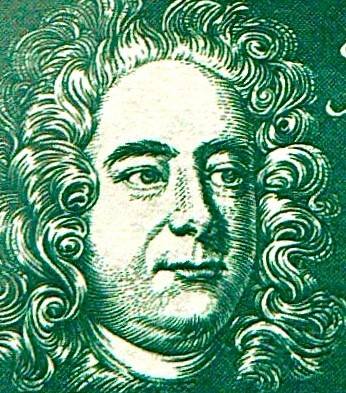
George Frideric Handel’s most famous oratorio, “Messiah,” was given its first performance in Dublin on this date in 1742. The work was presented as a charitable event, benefiting two hospitals and liberating 142 men from debtors’ prison.
Eight years later, Handel revived the piece at London’s Foundling Hospital, a recently-instituted home for abandoned infants and children. He had already donated an organ to the hospital’s chapel, and the year before, recycled the “Hallelujah Chorus” as part of his “Foundling Hospital Anthem.” Again, Handel’s oratorio raised a ton of money. The charitable presentation became an annual event, with the composer returning every year for the remainder of his life. Handel’s relationship to the institution was cemented with an honorary title. When he died, he bequeathed the rights to “Messiah” to the hospital.
“Messiah” falls into three parts, with a running time of roughly 2 ½ hours, often padded by intermissions. The famous “Hallelujah Chorus” comes at the end of Part II, which focuses on the Passion of Jesus, so really the oratorio is as much of an Easter piece as it is appropriate for Christmas – actually more so, midwinter tradition aside.
Reaching the end of his manuscript, Handel inscribed the letters “SDG” – an acronym for “Soli Deo Gloria,” “To God alone the glory.” This, combined with the speed at which he composed it (Handel tossed off the entire oratorio in a mere 24 days), has contributed to a widespread belief that the music was conceived in a blaze of divine inspiration. The well-worn tale is that, as Handel composed the “Hallelujah Chorus,” “He saw all heaven before him.”
For as beautiful as that sounds – and I would like it to be true – many of Handel’s large-scale works were composed within similar time frames. It was not unusual in those days for composers to just churn this stuff out. Handel’s next oratorio, “Samson,” begun within a week of his finishing “Messiah,” was completed in a month.
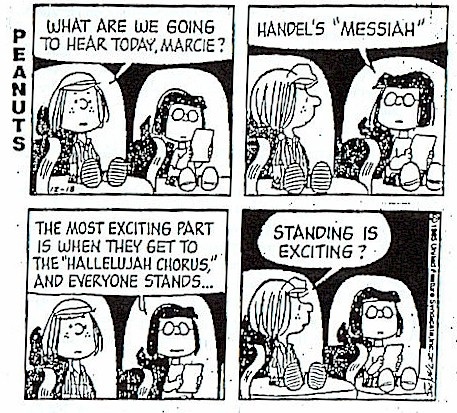
The custom of standing for the “Hallelujah Chorus” is said to have originated at the work’s 1743 London premiere, when King George II, possibly drowsing through a rather somber stretch, sprang to his feet at the sudden exultant clamor, so that everyone in the hall was obliged to stand.
When the legend becomes fact, print the legend. It’s good to be the king!