Tag: Heitor Villa-Lobos

  • Vivaldi and Villa-Lobos for the Birds

    Vivaldi and Villa-Lobos for the Birds

    Because I squandered yesterday in shameless self-promotion on account of the appearance of my newspaper article about Julian Grant’s new harpsichord concerto (which will be introduced on this weekend’s concerts of the Princeton Symphony Orchestra), I neglected to mark the birthday of Baroque luminary Antonio Vivaldi. Since today happens to be the anniversary of the birth of Brazilian master Heitor Villa-Lobos, let’s hear it for the V’s, as I juxtapose avian inspirations by Vivaldi and Villa-Lobos.

    Happy birthday, boys!

    ———


    Vivaldi, “Il Gardellino” (“The Goldfinch”)

    https://www.youtube.com/watch?v=QfZGSeRwEO0


    Villa-Lobos, “Uirapuru,” folkloric rainforest piece named for Brazilian bird

    https://www.youtube.com/watch?v=p1sPSAD9SEc

    And in case you missed it

    https://www.communitynews.org/princetoninfo/artsandentertainment/grant-goes-for-baroque-in-new-harpsichord-concerto/article_94cf66e3-ae6b-4c7f-b193-2dc7fcdc2592.html

  • Bernstein Villa-Lobos TV’s Lost Art

    Bernstein Villa-Lobos TV’s Lost Art

    Like so much else in the United States, the standards of broadcast television have eroded beyond recognition since the days of Leonard Bernstein’s “Young People’s Concerts” first aired on CBS from 1958 to 1972. The most celebrated American conductor – communicative, charismatic, and cool – introduced classical music to receptive kids in living rooms across the nation. Such was the network’s belief in this Saturday morning program that for three years it was broadcast in prime time. Later, it was shown on Sunday afternoons. The shows were syndicated in more than 40 countries, and the series was honored with five Emmys.

    It’s sad to reflect that there was once a time when those who set the standards for network television actually saw it as part of the medium’s mission to educate and to elevate. How quaint of legislators and executives of our grandparents’ generation to want that.

    Of course, at the same time, the Flintstones were hawking cigarettes…

    Inevitably, the lure of lucre would trump public service, and the presence of educational and artistic programming would dwindle. I’m thankful that remnants of this sort of thing were still around in the ‘70s and ‘80s, though mostly thanks to PBS – now under fire by small minds and empty souls determined to undermine anything that truly does make this country great.

    Here, on the birthday of Brazilian master Heitor Villa-Lobos, Bernstein sums up the composer’s musical aims in four minutes in this “Young People’s Concerts” broadcast of 1963:

    Then he conducts Villa-Lobos’ biggest hit, “Bachianas Brasileiras No. 5.”

    On an earlier broadcast, in 1960, Bernstein conducted the composer’s second-biggest hit, “The Little Train of Caipira,” from “Bachianas Brasileiras No. 2”

    Happy birthday, Heitor Villa-Lobos, and requiescat in pace, American sanity.

  • Latin American Music Getaway on KWAX

    Latin American Music Getaway on KWAX

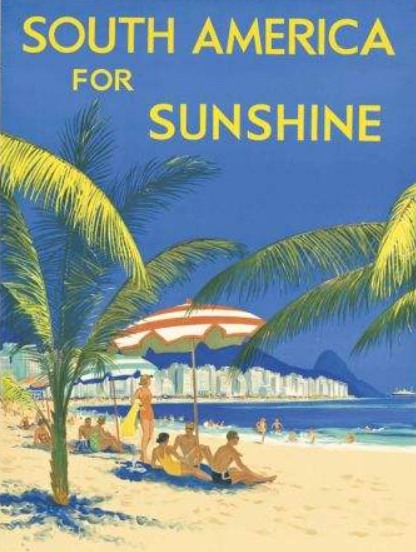
    With more snow and frigid temperatures on the way – at least where I’m typing, here in the Mid-Atlantic United States – I’m thinking it might be cheering for some to reflect that it’s actually summer in the Southern Hemisphere. Who am I to deny the pleasure? This week on “Sweetness and Light,” I invite you to think warm thoughts as we take a musical journey to Latin America.

    Argentina, Brazil, Chile, Paraguay, and Peru will be represented in works by Agustín Barrios, Theodoro Valcárcel Caballero, Camargo Guarnieri, Astor Piazzolla, and Heitor Villa-Lobos.

    We’ll cap the hour back in New York with more cowbell and Morton Gould’s vibrant “Latin-American Symphonette.”

    Join the conga line. It’s a South American getaway on “Sweetness Light,” this Saturday morning at 11:00 EST/8:00 PST, exclusively on KWAX, the radio station of the University of Oregon!

    Stream it wherever you are at the link:

    https://kwax.uoregon.edu/

  • Bidu Sayão Comic Brazil’s Opera Superhero

    Bidu Sayão Comic Brazil’s Opera Superhero

    Who really cares about Batman or Wolverine? Since we’re all basically living in the tropics anymore anyway, here’s a comic book about Bidu Sayão. Thrill to the adventures of Brazil’s most famous operatic soprano!

    You have to scroll down to the bottom of Bruce Duffie’s interview to see a more complete spread.

    https://www.bruceduffie.com/sayao.html

    Sayão was a great champion of the music of her compatriot, Heitor Villa-Lobos. Here she is, in Villa-Lobos’ “Bachianas Brasileiras No. 5,” with the composer conducting.

    Later, she came out of retirement to sing Villa-Lobos’ “Forests of the Amazon.” You can hear some of it at the end of these selections from some of her signature roles (Manon, Juliette, and Mimi). There’s even a Brazilian folk song tossed into the mix.

    She’s heavenly in Debussy’s “La Damoiselle élue,” after Dante Gabriel Rossetti’s “The Blessed Damozel,” recorded here with Eugene Ormandy and the Philadelphia Orchestra.

    And “Si mes vers avaient des ailes” (“If my verses had wings,” text by Victor Hugo), by Venezuelan-born French composer Reynaldo Hahn.

    Once she established herself at New York’s Metropolitan Opera, Sayão had the good sense to make her home in the cooler clime of Lincolnville, Maine.

    Her comic book dates from the 1940s. I’m hoping for a Jack Kirby-style cover, complete with Bidu punching out Hitler.

  • Macbeth, Emperor Jones & Lost Music

    Macbeth, Emperor Jones & Lost Music

    This week on “The Lost Chord,” I indulge my inner English major with a program inspired by two plays that explore the relationship of power and corruption – Shakespeare’s “Macbeth” and Eugene O’Neill’s “The Emperor Jones.”

    The impulse grew out of my recollection of the rarely-heard ballet by Heitor Villa-Lobos, which originally aired on television in 1957. However, since the score was never published, it was believed lost for decades until rediscovered by the conductor Jan Wagner (who is Venezuelan, despite his Teutonic name). Wagner will conduct the Odense Symphony Orchestra, a Nordic band, in a surprisingly idiomatic performance.

    Also on the program will be a half-remembered relic of American musical history, an aria from Louis Gruenberg’s opera, “The Emperor Jones,” sung by baritone Lawrence Tibbett, recorded in 1933.

    “The Emperor Jones,” written in 1920, could be a potentially sensitive subject in a more politically correct era. No doubt about it, O’Neill’s tragedy is a product of its time, with plenty of minstrel show dialect, and the uncomfortable use of the N-word.

    Already in 1924, Sidney Gilpin, the actor who created Brutus Jones, hedged at playing the character in its first revival, unless O’Neill first changed what he perceived as some of the more offensive passages. O’Neill stood his ground, and Gilpin’s replacement, Paul Robeson, went on to international stardom.

    It’s easy to write-off “The Emperor Jones” as an embarrassing relic. Yet there have been some high-profile stagings over the past few years which demonstrate that the play still has much to tell us.

    Jones is a former railroad porter and convict, who kills a guard in his escape from prison, and through bluff and bravado establishes himself as emperor of a Caribbean island. He maintains his power through cruelty and exploitation. However, he overplays his hand, and the situation quickly erodes. As his subjects rise up against him, Jones retreats into the jungle and descends into primal fear, haunted by images of his victims.

    The play not only parallels some of the themes of “Macbeth,” it also demonstrates the fragility of human reason; how easily under the influence of adrenaline, brought on by raw terror, man is undone by the animal impulses of fight or flight; the psychological impact of guilt; and an insight into tyranny which was remarkably prescient given that fascism would soon overtake Europe.

    I don’t know why it never occurred to me before to juxtapose the two plays, but a quick Google search reveals that I am not the first, so there goes my dream of an honorary doctorate.

    Also on the show will be selections from rarely-heard incidental music written for two productions of “Macbeth,” by William Walton (for John Gielgud) and Sir Arthur Sullivan (for Henry Irving), respectively.

    Power corrupts, on “Power Plays,” on “The Lost Chord,” now in syndication on KWAX, the radio station of the University of Oregon!


    Remember, KWAX is on the West Coast, so there’s a three-hour difference for those of you listening in the East. Here are the respective air-times for all three of my recorded shows (with East Coast conversions in parentheses):

    PICTURE PERFECT, the movie music show – Friday on KWAX at 5:00 PM PACIFIC TIME (8:00 PM EASTERN)

    SWEETNESS AND LIGHT, the light music program – ALL NEW! – Saturday on KWAX at 8:00 AM PACIFIC TIME (11:00 AM EASTERN)

    THE LOST CHORD, unusual and neglected rep – Saturday on KWAX at 4:00 PM PACIFIC TIME (7:00 PM EASTERN)

    Stream all three, at the times indicated, by following the link!

    https://kwax.uoregon.edu/


    PHOTOS: Gielgud as Macbeth (left) and Tibbett as Brutus Jones

Tag Cloud

Aaron Copland (92) Beethoven (94) Composer (114) Film Music (116) Film Score (143) Film Scores (255) Halloween (94) John Williams (185) KWAX (228) Leonard Bernstein (99) Marlboro Music Festival (125) Movie Music (131) Opera (197) Philadelphia Orchestra (86) Picture Perfect (174) Princeton Symphony Orchestra (106) Radio (86) Ralph Vaughan Williams (85) Ross Amico (244) Roy's Tie-Dye Sci-Fi Corner (290) The Classical Network (101) The Lost Chord (268) Vaughan Williams (99) WPRB (396) WWFM (881)

DON’T MISS A BEAT

Receive a weekly digest every Sunday at noon by signing up here


RECENT POSTS