Tag: Hollywood Golden Age

  • Miklós Rózsa’s “Double Life” Explored

    Miklós Rózsa’s “Double Life” Explored

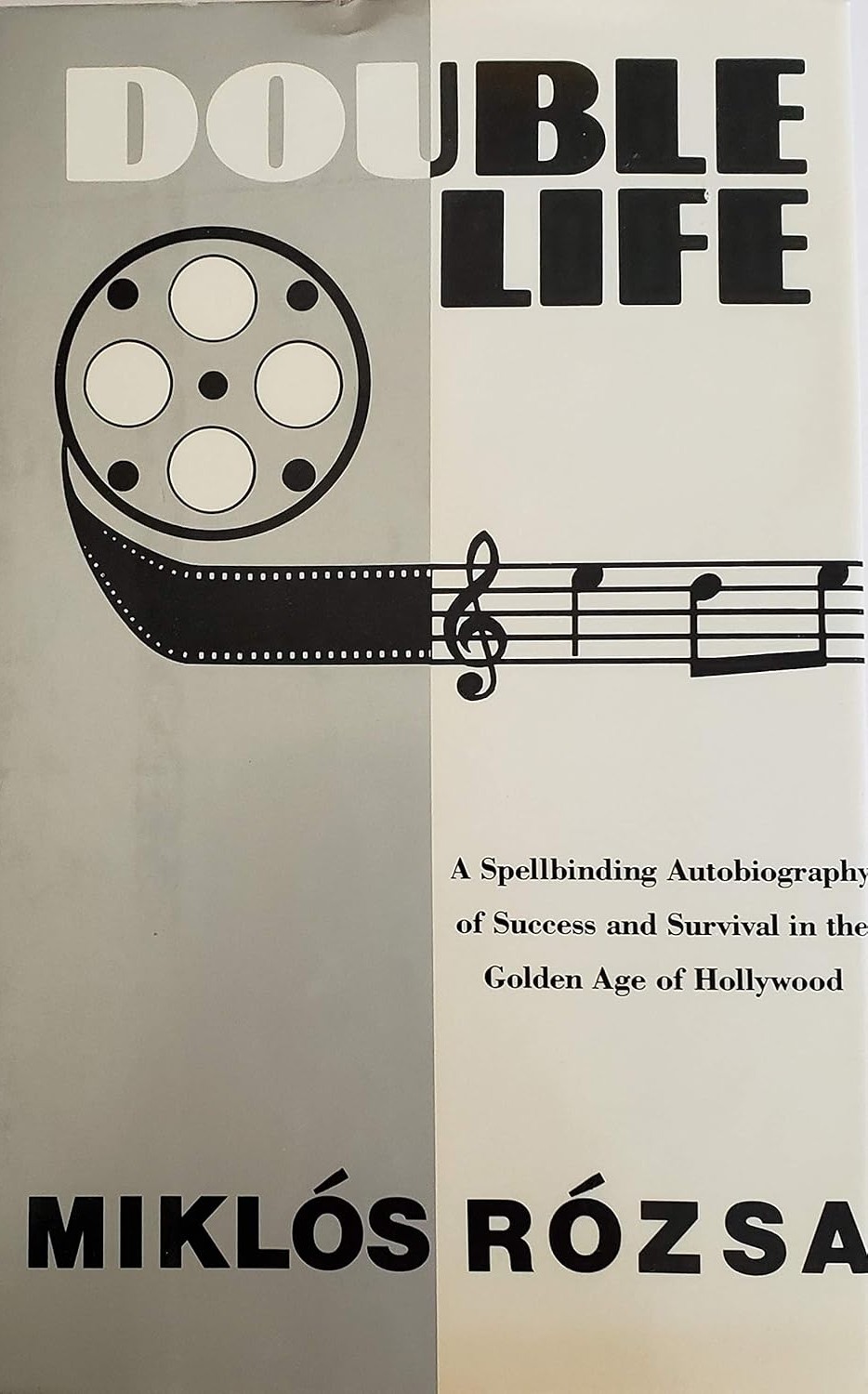
    I’ve owned Miklós Rózsa’s autobiography, “Double Life,” for decades, but for some reason I never got around to actually reading it from cover to cover until last month.

    First of all, if you don’t know who Rózsa is, he was one of the great film composers of Hollywood’s Golden Age. In fact, his earliest scores predate his career in Hollywood, as he got his start working for the Korda brothers in England. It was when production of “The Thief of Bagdad” was moved to California during World War II that Rózsa unexpectedly found himself a new home. He states that he anticipated a stay of, at most, 40 days, but he wound up working there for 40 years! Rózsa composed notable scores for films in most genres, but he was particularly successful in film noir, and later, historical and Biblical epics. Some of the other films he scored include “The Four Feathers,” “Double Indemnity,” “Spellbound,” “The Lost Weekend,” “Quo Vadis,” “Lust for Life,” “King of Kings,” “El Cid,” and of course “Ben-Hur.” He worked right into the 1980s. As a satisfying bookend to his career, he wrote the music for the Steve Martin comedy “Dead Men Don’t Wear Plaid,” which incorporates clips from many classic films, some of which Rózsa had actually scored the first time around, decades earlier!

    I took the book down from the shelf on Rózsa’s birthday (April 18). Surely a large part of the reason for my previous neglect had to have been the book’s physical inaccessibility, as for a long time, when I was living in Philadelphia, most of my library was in boxes, since every couple of years I wound up moving to another apartment (a problem compounded by the sheer volume of inventory related to my also running a book business). But since I’ve settled in Princeton, I’ve had most of my things out on shelves (save those in a storage locker I’m still trying to get rid of), and for the past few years, Rózsa’s autobiography remained perched, imperiously, on high.

    I imagine the most difficult part of writing a book of this sort, with an author looking back from his late 70s and early 80s, is not trying to recall everything, but rather deciding what to leave out. Rózsa’s career as a composer took him from rural Hungary to Budapest to Paris to London to Hollywood, and he met and worked with many significant figures along the way. It’s sobering to be reminded, in the comparative comfort and convenience of the 21st century, just how common it was in those days, a time when the world was war-torn, and even under the best of circumstances, travel and communication were not anything like they are today, how easy it was to lose contact with one’s family. Often bon voyage turned out to be goodbye. Between the political situation being what it was and travel being such a burdensome and frequently dangerous undertaking, one would stand a good chance of never seeing one’s loved ones ever again. Rózsa’s father, who insisted he study chemistry, died before he could see his son become an internationally famous composer, although he lived long enough to be assured by other notable musicians that Rózsa had the kind of talent to succeed. Rózsa was able to get his mother into the United States and finally, after some anxiety, also his sister.

    The book takes its title from the film “A Double Life,” about an unstable Shakespearean actor, played by Ronald Colman, who comes to identify a little too closely with the character of Othello, unhinged by jealousy, with tragic results. Rózsa was recognized with his second Academy Award for his score. (His other two Oscars were for his work on Alfred Hitchcock’s “Spellbound” and the William Wyler version of “Ben-Hur.”) The “double life” application became something of a cliché when discussing Rózsa, with commentators pointing out how the composer’s career was divided between music for the screen and music for the concert hall. I myself, as a Rózsa fan, have for decades toed the line. But in my heart of hearts, I always thought, well, yeah, he wrote some music for the concert hall, but hardly enough to justify that distinction – this, despite all the recordings of his music that I own. In my mind, I always compartmentalized his concert career as having occurred mostly in his early years, with a few concertos, undeniably among his major works (written for Heifetz, Piatigorsky, Starker, Pennario, and Zukerman, no less) coming later. But reading the autobiography, I was struck by just how consistent his output of “classical music” was. He couldn’t be at work at it constantly, of course, with all the deadlines being piled on by the film studios, but he was nearly always composing during vacations, and he was sure to push for plenty of time off when negotiating his contracts. Rózsa was much more than a one-trick pony, and I can now say with confidence that he did not try to inflate his activity in the concert hall with his claim of having led a double life.

    Of course, his musical language is of a conservative mold – which is to say it is “traditional,” in terms of being recognizably tonal and directly communicative. He was not alone among those who endured prejudice from music critics on account of being “Hollywood composers.” But in fact, Rózsa was a leopard that never changed its spots. Anyone with ears will recognize that the music for “Ben-Hur” is Hungarian to its core. Anyway, he was a composer who steadfastly championed tonality, which was not a fashionable stance among the arbiters and academics of mid-century, and he comes out quite strongly in his book in stating his belief that dodecaphonic music is an arid dead-end and a betrayal of the function of music. These words are mine, not his, but I think they fairly accurately reflect his philosophy.

    Here’s a little of what he actually did have to say on the subject: “I am old-fashioned enough also to maintain that no art is worthy of the name unless it contains some element of beauty. I have tried always in my own work to express human feelings and assert human values, and to do this I have never felt the slightest need to move outside the orbit of the tonal system. Tonality means line; line means melody; melody means song; and song, especially folk song, is the essence of music, because it is the natural, spontaneous and primordial expression of human emotion.”

    Not only did he have to deal with snobbery and condescension in critical circles, then (at least his music was well-received by audiences), at “work,” his frustrations were those of most Hollywood composers-for-hire: producers and filmmakers who don’t understand the first thing about music; “hacks” plucked from the world of popular music, who drag down the overall quality and expectations within the system; technicians who view music as subservient to sound effects (more than once, he laments, his music was dialed down in favor of clattering swords); and a general lack of appreciation once the work is completed. It was common for the industry’s biggest successes, both in front of and behind the camera, to walk off the lot for the last time, without so much as a thank you. It’s a brutal business, with everyone regarded as a cog, and I imagine it has only gotten worse.

    I suppose, since in a way I have also lived a double life, in terms of my enthusiasms for classical and film music, I am optimally situated as the perfect audience for this book. Many of Rózsa’s admirers, no doubt, will be panting to get to the Hollywood chapters in order to devour all the personal observations and behind-the-scenes drama of their favorite films; but classical music aficionados will find a lot of it equally fascinating, as there are many anecdotes about well-known figures from that world. You will read about an encounter with Richard Strauss, who not only taught Rózsa an important lesson about orchestration, but also ensured his acceptance as a young composer in Budapest; about Arthur Honegger’s enormous pipe collection (he selected a different one from a wall of 100 to smoke on any given day); and about Rózsa and the nascent conductor Charles Munch running into – and pretending not to notice – one another as they nearly enter the same pawn shop. You will also get some fly-on-the-wall anecdotes about Bernard Herrmann at his irascible best (or worst). Rózsa had the good fortune never to be on the receiving end of Herrmann’s ire. He did, however, once find himself in a café sitting across from Hitler at Bayreuth!

    Throughout (the composer’s evident distaste for fascism aside), Rózsa’s charm, breeding, and dry humor are evident. Also, his humility and gratitude. I glanced at a couple of other reviews, when writing this. One described the biography as “serviceable” and another as “dry… and rather impersonal.” It’s crazy that readers can walk away after having read the same book with totally different impressions. Granted, the kind of gentility that comes through in this memoir (Rózsa’s Hungarian-inflected English smoothed by Christopher Palmer) seems to have become a thing of the past. More’s the pity. So many of that generation experienced uncertainty, hardship, and peril on a scale that most living comfortably in the United States today would have a hard time relating to, yet they managed to hang on to their dignity and treated others with respect. They knew how to conduct themselves. If restraint, good taste, and wit, as opposed to immoderation, vulgarity, and crudity, is “impersonal,” so be it.

    The book was completed in 1982 and revised in 1989, by which time the composer had suffered multiple strokes. He was reduced from his former activities of writing for large forces and conducting orchestras to composing sonatas for solo instruments, but the flow of music never ceased. It’s really quite remarkable, as while his prose is full of the kind of wisdom that comes with age, there is nothing “old” about it. Is it true, then, that in our minds we remain young, if we’re fortunate enough to retain our reason, even as our bodies are in physical decline?

    The preface is by André Previn, with whom Rózsa worked for the first time when Previn, already a brilliant pianist and improviser, was scarcely out of high school. The foreword, a not very funny in-joke by Antal Doráti, a fine conductor and a lifelong friend of the composer, adds nothing. I suspect anyone going into this for “Hollywood dishing” will find it wanting. But anyone interested in the broader experiences of the composer in both worlds, Hollywood and classical music – his double life – will find it an absorbing page-turner. I am gratified finally to have added it to my knowledge.


    “I never lost sight of my real profession: that of composer, not of music to order but simply of the music that was in me to write.” – Miklós Rózsa

  • David Raksin Hollywood’s Golden Age Composer

    David Raksin Hollywood’s Golden Age Composer

    Thanks to his unusual longevity and abundant wit, film composer David Raksin was, for years, the mouthpiece of a faded era, the man to whom historians and journalists would turn when seeking a well-turned quote or anecdote about his long-past contemporaries of the Golden Age of Hollywood.

    Raksin was born in Philadelphia on this date in 1912. This week on “Picture Perfect,” we’ll celebrate the occasion by revisiting some of his music written for the silver screen.

    Raksin received his early musical training from his father, who played in concert bands and theater orchestras, and was also a member of the Philadelphia Orchestra. The younger Raksin formed his own dance band, taught himself orchestration, and put himself through the University of Pennsylvania by playing gigs. After graduation, he went to New York, where he played and sang with a number of ensembles and worked as an arranger.

    It was pianist Oscar Levant who brought him to the attention of his friend, George Gershwin. Gershwin was so impressed with Raksin’s arrangement of “I Got Rhythm,” that it wasn’t long before the boy from Philadelphia was orchestrating for musical theater and receiving invitations to Hollywood.

    While Raksin would go on to compose all sorts of music, for the stage and concert hall, he is best recognized as a composer for film. He wrote over 100 film scores in all, and 300 scores for television. He was twice nominated for an Academy Award – for “Forever Amber,” in 1947, and “Separate Tables” in 1958.

    Raksin’s haunting theme for the noir classic “Laura” (1944), after lyrics were added by Johnny Mercer, became a sensation. It’s said that during the composer’s lifetime it was the second most-recorded song in history, behind only Hoagy Carmichael’s “Stardust.”

    Raksin’s first Hollywood job, believe it or not, was working for Charlie Chaplin. Chaplin hired Raksin to assist him on the score for his last silent film, and one of the most famous, “Modern Times” (1936). “Modern Times” had actually been conceived as a sound picture (it would have been Chaplin’s first), but he soon realized that his “Little Tramp” would lose his universal appeal, should the character be allowed to talk. So he reverted to his usual silent format, though punctuated by evocative sound effects and one notable gibberish song.

    Chaplin exercised close control over every aspect of his productions, right down to more-or-less composing the music. He had experience as a violinist and cellist, who had practiced sometimes four to six hours a day. He had good musical instincts and a certain melodic fecundity, which, with the help of his orchestrators, he would use to underscore his feature films.

    Raksin later revealed it was he who had essentially scored “Modern Times,” with Chaplin whistling tunes and asking him to make them fit the action.

    Such close and exacting supervision could be a challenge for Chaplin’s collaborators. Raksin was actually fired once, after only a week and a half, though quickly rehired. When the music director, Alfred Newman, stormed out of one of the recording sessions, Raksin refused to take up the baton in his stead, which led to further acrimony. The rift was eventually mended, and decades later Raksin would recollect his work on “Modern Times” as some of the happiest days of his life.

    The recording we’ll hear was conducted by none other than Carl Davis, who on occasion served a similar function, as when he collaborated with Paul McCartney on his “Liverpool Oratorio.” Davis, a prolific film composer himself, died yesterday at the age of 86.

    As was the case with “Laura,” the love theme from “Modern Times” was later outfitted with lyrics, and became a popular standard as “Smile,” attracting countless vocal artists, including Nat King Cole. Again, what cohesion there is to the film score is largely thanks to Raksin.

    Although Raksin had taught himself a great deal, he did receive instruction from Harl McDonald at the University of Pennsylvania, Isadore Freed in New York, and later Arnold Schoenberg in Los Angeles.

    At times he found himself frustrated when dealing with the musical ignorance of Hollywood producers. He was fond of relating a story about having finally found one that was musically literate. The producer claimed he didn’t want anything “Hollywood” for his film, but rather “something different, really powerful – like ‘Wozzeck.’”

    Raksin, elated, invited the producer to dinner at his home. As the two were conversing over drinks, the producer remarked suddenly, “What’s that crap you’re playing?” “That crap,” Raksin responded, “is ‘Wozzeck.’”

    For “The Man with a Cloak” (1951), a story influenced by elements drawn from the life and stories of Edgar Allan Poe, Raksin slyly worked twelve-tone elements into his score – one of the first instances of a composer having done so for a Hollywood film. A few years later, Leonard Rosenman would take modernistic techniques to a whole other level. Raksin employs the language of the Second Viennese School in scenes featuring the Poe character, who in the film goes by the name of his fictional creation, Dupin. The character is given a leitmotif consisting of a tone row made up of the notes E-D-G-A and D-flat (which could be read as “Re”), effectively revealing the identity of Dupin as Edgar, right in the music. For all that, the score retains its accessibility and manages to wed the language of Schoenberg to the necessities of Hollywood storytelling.

    The film, based on a novel of John Dickson Carr, had quite a cast: Joseph Cotten, Barbara Stanwyck, Louis Calhern, Leslie Caron, and even Jim Backus.

    We’ll conclude the hour with one of Raksin’s greatest scores, that for “The Bad and the Beautiful” (1952), Vincent Minelli’s extraordinarily cynical view of Hollywood. Kirk Douglas plays a character Raksin must have known well: a ruthless producer who uses and abuses everyone around him. The film, which also stars Lana Turner, Walter Pigeon, and Dick Powell, won a whole slew of Oscars, including one for Gloria Graham as Best Supporting Actress.

    Raksin died in 2004, at the age of 92. His music was beautiful, but never bad. I hope you’ll take an hour to sample some of it with me on Raksin’s birthday, on “Picture Perfect,” music for the movies, now in syndication on KWAX, the radio station of the University of Oregon!


    Keep in mind, KWAX is on the West Coast, so there’s a three-hour difference for the Trenton-Princeton area. Here are the respective air-times of my recorded shows (with East Coast conversions in parentheses):

    PICTURE PERFECT, the movie music show – Friday on KWAX at 5:00 PACIFIC TIME (8:00 PM EDT)

    THE LOST CHORD, unusual and neglected rep – Saturday on KWAX at 4:00 PACIFIC TIME (7:00 PM EDT)

    Stream them here!

    https://kwax.uoregon.edu/

  • Korngold’s “Baby Serenade” for Father’s Day

    Korngold’s “Baby Serenade” for Father’s Day

    Happy Father’s Day!

    Proud papa Erich Wolfgang Korngold wrote his “Baby Serenade” after receiving news from his wife, Luzi, that she was expecting another child. This was in the spring of 1928. Korngold completed the work in time for the birth of his second son, Georg. It was good training for the composer, as there would certainly be plenty of firm deadlines in his future.

    Korngold, of course, became one of the great composers of Hollywood’s Golden Age, fondly remembered especially for his scores for the films of Errol Flynn. But he was also an astounding prodigy who achieved international fame for his operas and concert works.

    He came to the U.S. to assist theatrical impresario Max Reinhardt on a film adaptation of “A Midsummer Night’s Dream” for Warner Bros. Warner Bros. understood a good thing when they had it and offered Korngold a very generous contract, allowing him to pick his own projects and even permitting him to coach the actors on-set to get performances that would suit his musical ideas.

    It was while he was here scoring “The Adventures of Robin Hood” in 1938 that the Nazis marched into Austria and changed the course of Korngold’s life. For the safety of his family, he remained in California and became a U.S. citizen in 1943.

    The “Baby Serenade” was composed years before Korngold’s American adventure. Still, there’s plenty in it to suggest the cinematic Korngold to come. Also, there are saxophones and some jazz-inflected passages that very much reflect the era in which it was written. It’s certainly a lighthearted work, with leaner texters than those of the rich orchestral utterances of his larger concert pieces.

    Georg (whose family nickname was Schurli, but he went by George) repaid the favor years later, as a record producer who would help revive and preserve his father’s legacy.

    The “Baby Serenade” falls into five movements:

    I. Overture: Baby Comes Into the World

    II. Song: It’s a Good Baby

    III. Scherzino: It Has the Most Beautiful Toys

    IV. Jazz: Baby Tells a Story

    V. Epilogue: And Now It Sings Itself to Sleep

    Listen to it here:

    The arrival of Georg was one premiere which could not be postponed!


    PHOTO: Korngold and family, with Georg front and center

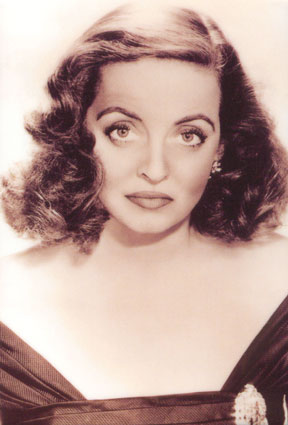
  • Bette Davis Hollywood Icon on Picture Perfect

    Bette Davis Hollywood Icon on Picture Perfect

    Fasten your seat belts – it’s going to be a bumpy night!

    This week on “Picture Perfect,” for Academy Awards weekend, the focus is on Bette Davis.

    A two-time Academy Award-winner, Davis was the first actor to receive ten nominations, five of them in consecutive years. She remains one of the most recognizable figures from Hollywood’s Golden Age.

    Enjoy an assortment of classic scores composed for her indelible films, including “Now, Voyager” (Max Steiner), “Mr. Skeffington” (Franz Waxman), “All About Eve” (Alfred Newman), and “The Private Lives of Elizabeth and Essex” (Erich Wolfgang Korngold).

    Davis’ wins came early – she received statuettes for “Dangerous” (1935) and “Jezebel” (1938) – but she turned in solid performances for pretty much her entire career. There is little about her style which doesn’t scream “ACTING!” So it seems only an appropriate choice for this Academy Awards weekend.

    It’s a grand throwback to an era when the big screen was filled by larger-than-life personalities. You can always bet on Bette, on “Picture Perfect,” music for the movies, this Saturday evening at 6:00 EST, on WWFM – The Classical Network and wwfm.org.

  • Korngold Hollywoods Golden Age Composer

    Korngold Hollywoods Golden Age Composer

    Happy birthday, Erich Wolfgang Korngold!

    This week on “Picture Perfect,” we’ll celebrate one of the most influential composers of Hollywood’s Golden Age, by way of two of his most popular scores, both of them for film adaptations of the novels of Rafael Sabatini.

    Though Sabatini’s own popularity has faded somewhat with the passage of time, in his day the Italian-English writer might have been regarded as heir apparent to Alexandre Dumas. His bestselling novels are full of romance and derring-do. However, I’m not sure if any of them have really endured in the consciousness of the wider public.

    Sabatini’s incident-filled pages seem ready-made for the silver screen. Film adaptations of “Scaramouche,” “The Sea Hawk” and “Captain Blood” were made during the silent era. A long-lost John Gilbert classic, adapted from Sabatini’s “Bardelys the Magnificent,” has only recently been rediscovered. Several of these, of course, were remade, more or less, to great success during the era of talking pictures.

    We’ll hear Korngold’s music for the Errol Flynn classics “Captain Blood” (1935) and “The Sea Hawk” (1940). The former provided Flynn with his breakout role; the latter actually has nothing at all to do with Sabatini’s original plot, despite the writer’s prominent onscreen credit.

    We’ll also enjoy Alfred Newman’s rollicking main title music for the pirate opus “The Black Swan” (1942), which starred Tyrone Power, and one of Victor Young’s most rousing and melodically inventive scores, for “Scaramouche” (1952), which featured Stewart Granger in probably the best swashbuckler of the 1950s.

    Polish up those seven-league boots and don your gaudiest plumage. Then join me, as we set sail with Erich Wolfgang Korngold and friends, and the novels of Rafael Sabatini, on “Picture Perfect,” music for the movies, this Friday evening at 6:00 EDT, on WWFM – The Classical Network and wwfm.org.

Tag Cloud

Aaron Copland (92) Beethoven (95) Composer (114) Film Music (120) Film Score (143) Film Scores (255) Halloween (94) John Williams (185) KWAX (229) Leonard Bernstein (100) Marlboro Music Festival (125) Movie Music (135) Opera (198) Philadelphia Orchestra (88) Picture Perfect (174) Princeton Symphony Orchestra (106) Radio (87) Ralph Vaughan Williams (85) Ross Amico (244) Roy's Tie-Dye Sci-Fi Corner (290) The Classical Network (101) The Lost Chord (268) Vaughan Williams (103) WPRB (396) WWFM (881)

DON’T MISS A BEAT

Receive a weekly digest every Sunday at noon by signing up here


RECENT POSTS