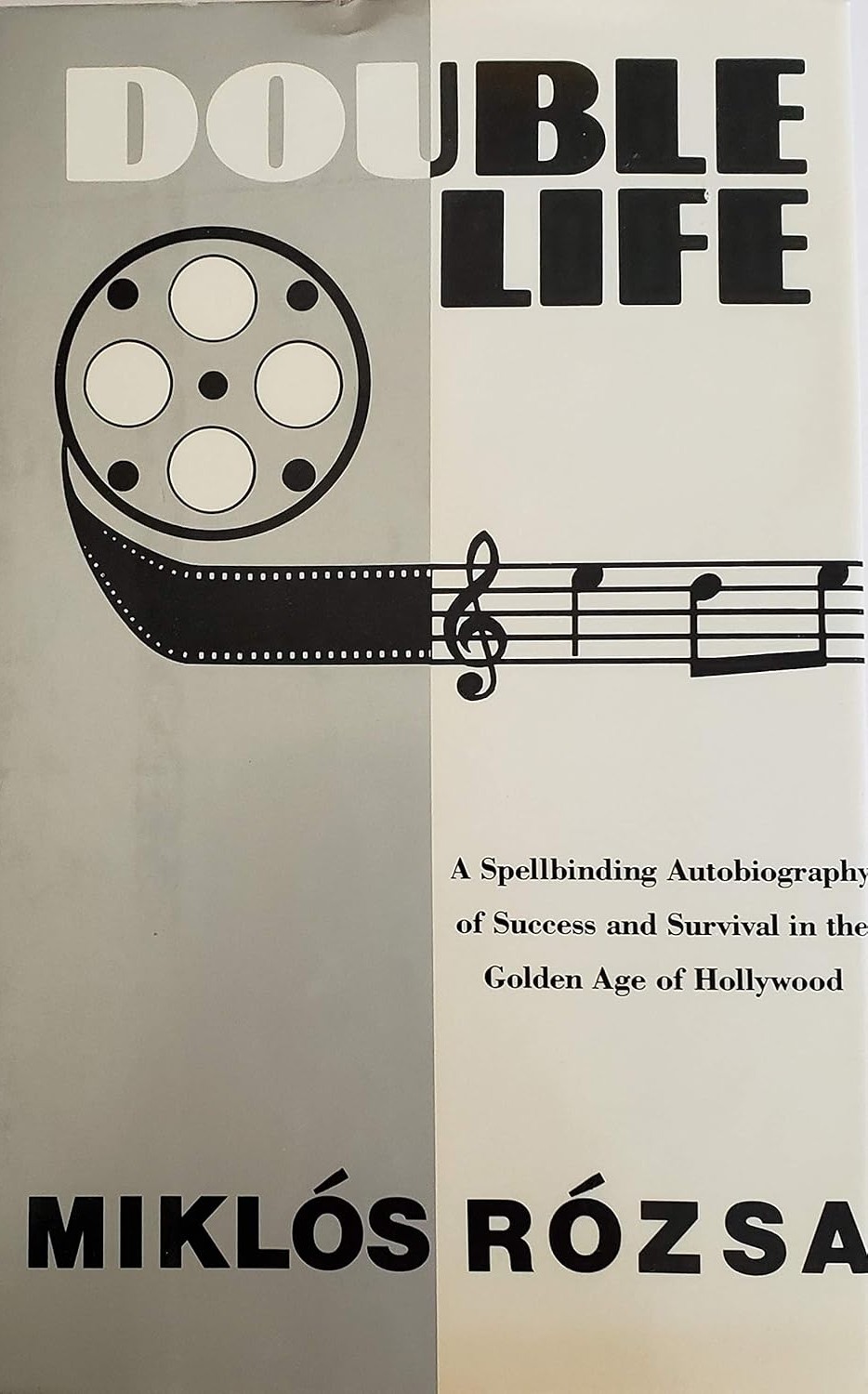
I’ve owned Miklós Rózsa’s autobiography, “Double Life,” for decades, but for some reason I never got around to actually reading it from cover to cover until last month.
First of all, if you don’t know who Rózsa is, he was one of the great film composers of Hollywood’s Golden Age. In fact, his earliest scores predate his career in Hollywood, as he got his start working for the Korda brothers in England. It was when production of “The Thief of Bagdad” was moved to California during World War II that Rózsa unexpectedly found himself a new home. He states that he anticipated a stay of, at most, 40 days, but he wound up working there for 40 years! Rózsa composed notable scores for films in most genres, but he was particularly successful in film noir, and later, historical and Biblical epics. Some of the other films he scored include “The Four Feathers,” “Double Indemnity,” “Spellbound,” “The Lost Weekend,” “Quo Vadis,” “Lust for Life,” “King of Kings,” “El Cid,” and of course “Ben-Hur.” He worked right into the 1980s. As a satisfying bookend to his career, he wrote the music for the Steve Martin comedy “Dead Men Don’t Wear Plaid,” which incorporates clips from many classic films, some of which Rózsa had actually scored the first time around, decades earlier!
I took the book down from the shelf on Rózsa’s birthday (April 18). Surely a large part of the reason for my previous neglect had to have been the book’s physical inaccessibility, as for a long time, when I was living in Philadelphia, most of my library was in boxes, since every couple of years I wound up moving to another apartment (a problem compounded by the sheer volume of inventory related to my also running a book business). But since I’ve settled in Princeton, I’ve had most of my things out on shelves (save those in a storage locker I’m still trying to get rid of), and for the past few years, Rózsa’s autobiography remained perched, imperiously, on high.
I imagine the most difficult part of writing a book of this sort, with an author looking back from his late 70s and early 80s, is not trying to recall everything, but rather deciding what to leave out. Rózsa’s career as a composer took him from rural Hungary to Budapest to Paris to London to Hollywood, and he met and worked with many significant figures along the way. It’s sobering to be reminded, in the comparative comfort and convenience of the 21st century, just how common it was in those days, a time when the world was war-torn, and even under the best of circumstances, travel and communication were not anything like they are today, how easy it was to lose contact with one’s family. Often bon voyage turned out to be goodbye. Between the political situation being what it was and travel being such a burdensome and frequently dangerous undertaking, one would stand a good chance of never seeing one’s loved ones ever again. Rózsa’s father, who insisted he study chemistry, died before he could see his son become an internationally famous composer, although he lived long enough to be assured by other notable musicians that Rózsa had the kind of talent to succeed. Rózsa was able to get his mother into the United States and finally, after some anxiety, also his sister.
The book takes its title from the film “A Double Life,” about an unstable Shakespearean actor, played by Ronald Colman, who comes to identify a little too closely with the character of Othello, unhinged by jealousy, with tragic results. Rózsa was recognized with his second Academy Award for his score. (His other two Oscars were for his work on Alfred Hitchcock’s “Spellbound” and the William Wyler version of “Ben-Hur.”) The “double life” application became something of a cliché when discussing Rózsa, with commentators pointing out how the composer’s career was divided between music for the screen and music for the concert hall. I myself, as a Rózsa fan, have for decades toed the line. But in my heart of hearts, I always thought, well, yeah, he wrote some music for the concert hall, but hardly enough to justify that distinction – this, despite all the recordings of his music that I own. In my mind, I always compartmentalized his concert career as having occurred mostly in his early years, with a few concertos, undeniably among his major works (written for Heifetz, Piatigorsky, Starker, Pennario, and Zukerman, no less) coming later. But reading the autobiography, I was struck by just how consistent his output of “classical music” was. He couldn’t be at work at it constantly, of course, with all the deadlines being piled on by the film studios, but he was nearly always composing during vacations, and he was sure to push for plenty of time off when negotiating his contracts. Rózsa was much more than a one-trick pony, and I can now say with confidence that he did not try to inflate his activity in the concert hall with his claim of having led a double life.
Of course, his musical language is of a conservative mold – which is to say it is “traditional,” in terms of being recognizably tonal and directly communicative. He was not alone among those who endured prejudice from music critics on account of being “Hollywood composers.” But in fact, Rózsa was a leopard that never changed its spots. Anyone with ears will recognize that the music for “Ben-Hur” is Hungarian to its core. Anyway, he was a composer who steadfastly championed tonality, which was not a fashionable stance among the arbiters and academics of mid-century, and he comes out quite strongly in his book in stating his belief that dodecaphonic music is an arid dead-end and a betrayal of the function of music. These words are mine, not his, but I think they fairly accurately reflect his philosophy.
Here’s a little of what he actually did have to say on the subject: “I am old-fashioned enough also to maintain that no art is worthy of the name unless it contains some element of beauty. I have tried always in my own work to express human feelings and assert human values, and to do this I have never felt the slightest need to move outside the orbit of the tonal system. Tonality means line; line means melody; melody means song; and song, especially folk song, is the essence of music, because it is the natural, spontaneous and primordial expression of human emotion.”
Not only did he have to deal with snobbery and condescension in critical circles, then (at least his music was well-received by audiences), at “work,” his frustrations were those of most Hollywood composers-for-hire: producers and filmmakers who don’t understand the first thing about music; “hacks” plucked from the world of popular music, who drag down the overall quality and expectations within the system; technicians who view music as subservient to sound effects (more than once, he laments, his music was dialed down in favor of clattering swords); and a general lack of appreciation once the work is completed. It was common for the industry’s biggest successes, both in front of and behind the camera, to walk off the lot for the last time, without so much as a thank you. It’s a brutal business, with everyone regarded as a cog, and I imagine it has only gotten worse.
I suppose, since in a way I have also lived a double life, in terms of my enthusiasms for classical and film music, I am optimally situated as the perfect audience for this book. Many of Rózsa’s admirers, no doubt, will be panting to get to the Hollywood chapters in order to devour all the personal observations and behind-the-scenes drama of their favorite films; but classical music aficionados will find a lot of it equally fascinating, as there are many anecdotes about well-known figures from that world. You will read about an encounter with Richard Strauss, who not only taught Rózsa an important lesson about orchestration, but also ensured his acceptance as a young composer in Budapest; about Arthur Honegger’s enormous pipe collection (he selected a different one from a wall of 100 to smoke on any given day); and about Rózsa and the nascent conductor Charles Munch running into – and pretending not to notice – one another as they nearly enter the same pawn shop. You will also get some fly-on-the-wall anecdotes about Bernard Herrmann at his irascible best (or worst). Rózsa had the good fortune never to be on the receiving end of Herrmann’s ire. He did, however, once find himself in a café sitting across from Hitler at Bayreuth!
Throughout (the composer’s evident distaste for fascism aside), Rózsa’s charm, breeding, and dry humor are evident. Also, his humility and gratitude. I glanced at a couple of other reviews, when writing this. One described the biography as “serviceable” and another as “dry… and rather impersonal.” It’s crazy that readers can walk away after having read the same book with totally different impressions. Granted, the kind of gentility that comes through in this memoir (Rózsa’s Hungarian-inflected English smoothed by Christopher Palmer) seems to have become a thing of the past. More’s the pity. So many of that generation experienced uncertainty, hardship, and peril on a scale that most living comfortably in the United States today would have a hard time relating to, yet they managed to hang on to their dignity and treated others with respect. They knew how to conduct themselves. If restraint, good taste, and wit, as opposed to immoderation, vulgarity, and crudity, is “impersonal,” so be it.
The book was completed in 1982 and revised in 1989, by which time the composer had suffered multiple strokes. He was reduced from his former activities of writing for large forces and conducting orchestras to composing sonatas for solo instruments, but the flow of music never ceased. It’s really quite remarkable, as while his prose is full of the kind of wisdom that comes with age, there is nothing “old” about it. Is it true, then, that in our minds we remain young, if we’re fortunate enough to retain our reason, even as our bodies are in physical decline?
The preface is by André Previn, with whom Rózsa worked for the first time when Previn, already a brilliant pianist and improviser, was scarcely out of high school. The foreword, a not very funny in-joke by Antal Doráti, a fine conductor and a lifelong friend of the composer, adds nothing. I suspect anyone going into this for “Hollywood dishing” will find it wanting. But anyone interested in the broader experiences of the composer in both worlds, Hollywood and classical music – his double life – will find it an absorbing page-turner. I am gratified finally to have added it to my knowledge.
“I never lost sight of my real profession: that of composer, not of music to order but simply of the music that was in me to write.” – Miklós Rózsa
Leave a Reply