Nick sat down against the charred stump and smoked a cigarette. He lit a match and watched it burn and as it burned he thought of boxers and marlins and the Spanish Civil War. The stories were brave and strong and good. He ordered a mojito and prepared to face the music.
This week on “Picture Perfect,” the focus is on Ernest Hemingway.
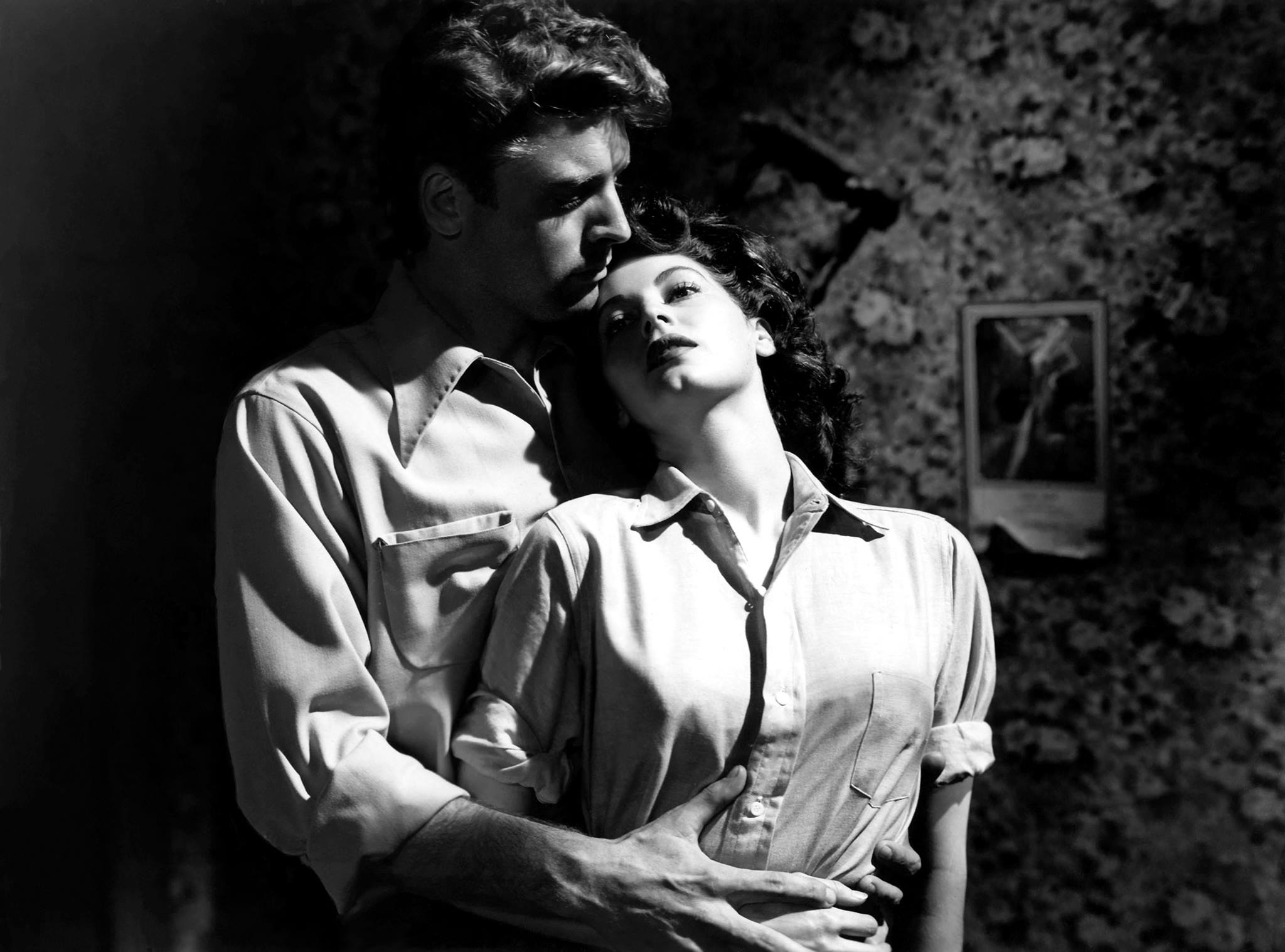
Seemingly at odds with Hemingway’s minimalist, “iceberg” style, big screen adaptations of the writer’s work show what the stories don’t tell. In the case of 1946’s “The Killers,” the screenwriters unapologetically just made stuff up, an entire back story explaining the motivations for the hit of boxer “Swede” Anderson. Fortunately, those screenwriters happened to include an uncredited John Huston, who virtually codified noir with “The Maltese Falcon.”
“The Killers” provided Burt Lancaster with his break-out role. It also features a knock-out score by Miklós Rózsa, in which he uses the dum-dee-dum-dum motto later made famous by the television series “Dragnet.”
In 1977, George C. Scott reunited with his “Patton” director, Franklin J. Schaffner, for an adaptation of Hemingway’s posthumously published novel, “Islands in the Stream.” Scott gives one of his best performances as a Hemingway-like figure living on a Caribbean island. “Patton” composer Jerry Goldsmith wrote the music. Goldsmith spoke of it often as his favorite score.
Hemingway himself handpicked the leads for the 1943 adaptation of “For Whom the Bell Tolls,” with Gary Cooper and Ingrid Bergman falling in love against the backdrop of the Spanish Civil War. The music was by the prolific and versatile Victor Young.
And finally, Spencer Tracy is the whole show, as he faces off against a large marlin, in the 1958 version of “The Old Man and the Sea.” Dimitri Tiomkin’s music earned him his fourth Academy Award.
Join me for an hour of laconic grace and stoic manliness on “Picture Perfect,” music for the movies, now in syndication on KWAX Classical Oregon!
———-
Clip and save the start times for all three of my recorded shows:
PICTURE PERFECT, the movie music show – Friday at 8:00 PM EDT/5:00 PM PDT
SWEETNESS AND LIGHT, the light music program – Saturday at 11:00 AM EDT/8:00 AM PDT
THE LOST CHORD, unusual and neglected rep – Saturday at 7:00 PM EDT/4:00 PM PDT
Stream them, wherever you are, at the link!
https://kwax.uoregon.edu/
Tag: Miklos Rozsa
-
The Great Painters on “Picture Perfect”
How to translate visual art to the big screen? Generally, by focusing on the drama in the artists’ lives, that’s how.
And what drama!
This week on “Picture Perfect,” expand your palette with music from movies about the great artists. “The Agony and the Ecstasy” (1965), based on the novel of Irving Stone, dramatizes the friction between Michelangelo (Charlton Heston) and his benefactor, Pope Julius II (Rex Harrison), over the painting of the ceiling of the Sistine Chapel. For his part, Michelangelo would have been perfectly content to stick to sculpture. Alex North’s score is an Early Music banquet, with allusions to – and sometimes outright quotations of – music of the Renaissance.
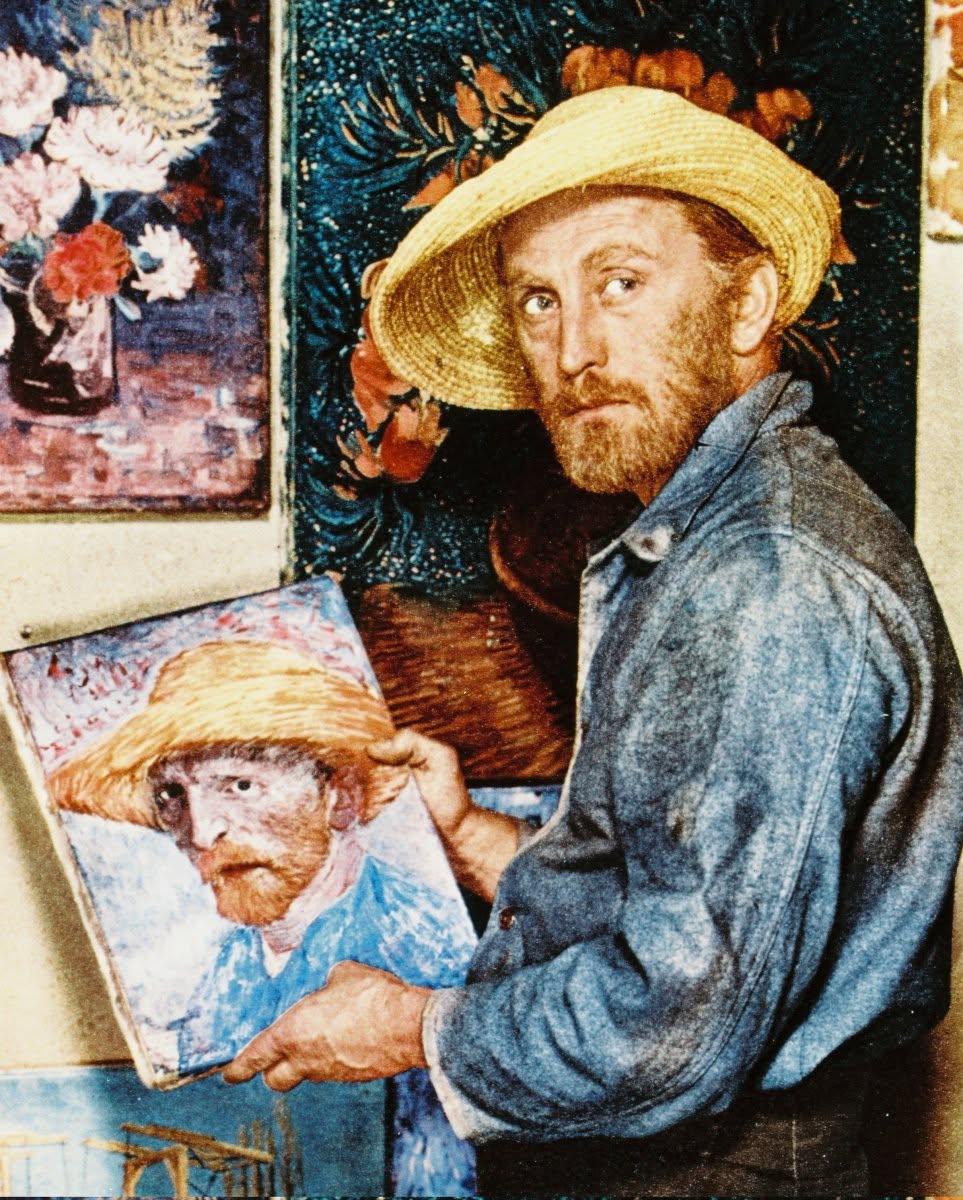
Stone had another bestseller in “Lust for Life” (1956), about the tormented Vincent van Gogh. This time Kirk Douglas plays one of his most sympathetic roles – and looks remarkably like the artist. Anthony Quinn turns up as his “frenemy,” the painter Paul Gaugin, and earns an Academy Award for Best Supporting Actor. The great Miklós Rózsa wrote the music, softening up the edges of his brawny Hungarian sound with ethereal suggestions of the French Impressionists.
John Huston brought Pierre La Mure’s novel about Henri de Toulouse-Lautrec to the big screen as “Moulin Rouge” (1952) – not to be confused with the more recent Baz Luhrmann spectacle starring Nicole Kidman and Ewan McGregor, which relegated the artist to a supporting role. José Ferrer dominates the earlier version, spending most of the film walking through off-camera trenches and shuffling along on his knees. Georges Auric, one of the composers of Les Six (the loose collective that also included Francis Poulenc and Darius Milhaud), captures the spirit of the titular cabaret. The score became one of Auric’s best-known, thanks to the waltz, which yielded the popular hit “Where is Your Heart?”
“The Picasso Summer” (1969) is a departure from the usual formula of focusing on the artist himself. Instead, a young couple (Albert Finney and Yvette Mimieux), admirers of Picasso’s work, take off on a European adventure in an attempt to track him down. Originally Picasso had agreed to appear, but he was driven off by some off-screen drama involving a matador friend and Yul Brynner’s wife! The film was based on a short story by Ray Bradbury. Bradbury hated the adaptation, as did the studio, and “The Picasso Summer,” after being heavily cut and patched with new footage, was never released theatrically in the United States. The film is striking for its extended animation sequences inspired by Picasso’s paintings, and for its score by Michel Legrand.
I hope you’ll join me for brushes with the great artists, on “Picture Perfect,” music for the movies, now in syndication on KWAX Classical Oregon!
——-
Clip and save the start times for all three of my recorded shows:
PICTURE PERFECT, the movie music show – Friday at 8:00 PM EDT/5:00 PM PDT
SWEETNESS AND LIGHT, the light music program – Saturday at 11:00 AM EDT/8:00 AM PDT
THE LOST CHORD, unusual and neglected rep – Saturday at 7:00 PM EDT/4:00 PM PDT
Stream them, wherever you are, at the link!
https://kwax.uoregon.edu -
Old World Composers Go West on “Picture Perfect”
Before American composers like Jerome Moross and Elmer Bernstein made the western distinctly their own, the task of scoring the genre fell largely to European émigrés. This week on “Picture Perfect,” we’ll take a look at some outside perspectives on how the West was won.
Literally the godson of Richard Strauss, Max Steiner came from Vienna, where he studied with Johannes Brahms and Robert Fuchs. In Hollywood, he wound up scoring such classics as “King Kong,” “Gone with the Wind” and “Casablanca.”
Among his over 300 film projects were a number of westerns. One of these was “They Died with Their Boots On” (1941), which starred Errol Flynn as George Armstrong Custer and Olivia de Havilland as Libby, the woman who becomes his wife. Steiner’s score features familiar folk material, some old-fashioned faux “Indian” music, and one of his characteristically lush love themes.
Born in Ukraine in 1894, Dimitri Tiomkin was a pupil of Alexander Glazunov. He came to revolutionize the sound of the American West, when he wrote the music for “High Noon,” the first of his “ballad” scores. Advance word, based on an early screening for the press, was that the picture would be a failure. However, Tiomkin had such faith in the theme song, sung in the film by Tex Ritter, that he hired Frankie Laine to record it, and the record became a world-wide hit. In fact, his score is largely credited with having saved the film.
Tiomkin was recognized with two Academy Awards: one for Best Original Song, and one for the score itself. It was the first time a composer won two Oscars for his work on the same movie. It also changed the way western scores were done. In the 1950s, Tiomkin became THE western composer of choice. He produced a number of subsequent ballad scores, including that for “Gunfight at the O.K. Corral” (1957). Asked how it was that a composer from Ukraine could write so convincingly for the American West, Tiomkin quipped, “A steppe is a steppe is a steppe.”
Another unexpected source of classic western music, Franz Waxman was born in Upper Silesia. He arrived in the U.S. by way of Germany. Nonetheless, as part of the composer’s varied and prolific output, he did indeed score a number of films in the genre, including “The Furies” (1950), a peculiar noir-western hybrid. Walter Huston, in his final film, plays a cattle baron who remarries and throws his empire into jeopardy. Barbara Stanwyck is his strong-willed daughter.
Hungarian-born composer Miklós Rózsa scored many films with historical settings – “Quo Vadis,” “Ben-Hur,” and “King of Kings,” among them. However, to my knowledge, his only western was “Tribute to a Bad Man” (1956). James Cagney stars as a rancher who doles out some frontier justice.
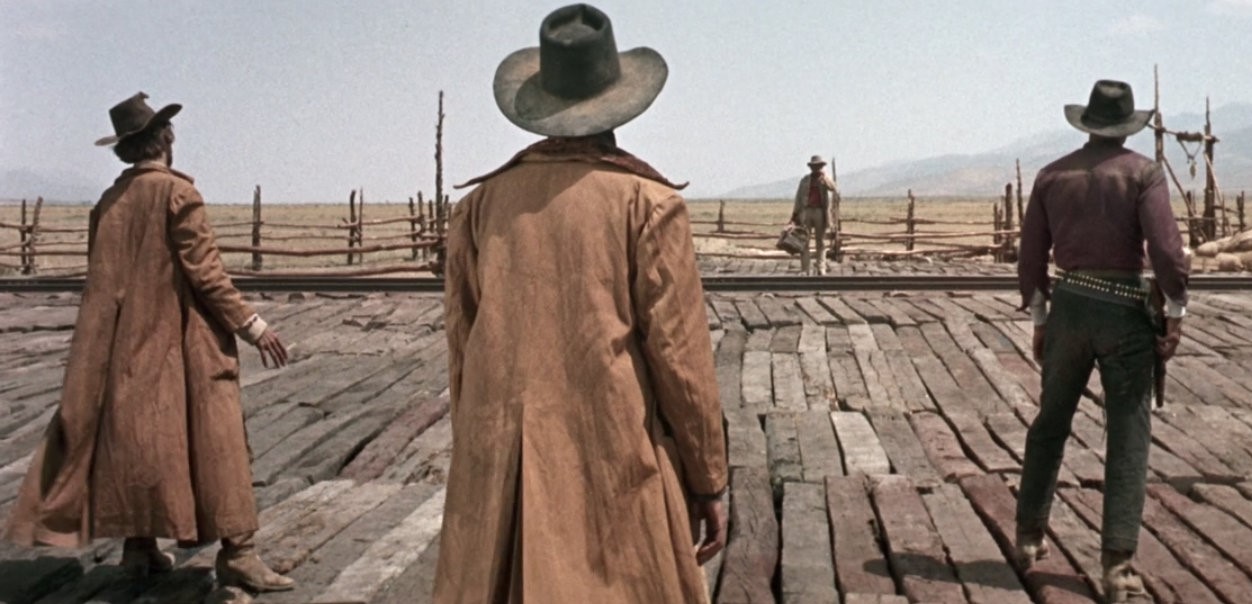
Finally, we’ll hear music by Ennio Morricone, from arguably the most operatic of all spaghetti westerns, “Once Upon a Time in the West” (1968). As a reaction to Tiomkin’s ballad scores and the neo-Coplandisms of Elmer Bernstein and the rest, Morricone brings his own quirky sensibility to bear on the classic western iconography. Get ready for indelible motifs for harmonica and banjo, but also an unexpectedly moving elegiac arioso, underscoring the close of the American West with the arrival of the railroad.
Doublecheck your train tables and wind your pocket watches. Old World composers go west this week on “Picture Perfect,” music for the movies, now in syndication on KWAX Classical Oregon!
——-
Clip and save the start times for all three of my recorded shows:
PICTURE PERFECT, the movie music show – Friday at 8:00 PM EDT/5:00 PM PDT
SWEETNESS AND LIGHT, the light music program – Saturday at 11:00 AM EDT/8:00 AM PDT
THE LOST CHORD, unusual and neglected rep – Saturday at 7:00 PM EDT/4:00 PM PDT
Stream them, wherever you are, at the link!
https://kwax.uoregon.edu -
“What’s in a Name?” on “Picture Perfect”
This week on “Picture Perfect,” a show built around movies with women’s names for titles permits us to travel across a broad of array of genres – contemporary drama, Regency Era comedy of manners, 1940s film noir, and 16th century costume picture.
In “Rachel, Rachel” (1968), Joanne Woodward plays a repressed, small-town schoolteacher, who learns to take control of her own life. The film marked the directorial debut of Woodward’s husband, Paul Newman. “Rachel, Rachel” was nominated for four Academy Awards, including those for Best Actress and Best Picture. Newman picked up a Golden Globe and a New York Critics Circle Award for his direction. The lovely Americana score is by Jerome Moross.
In “Emma” (1996), adapted from novel of Jane Austen, Gwyneth Paltrow plays a high spirited-though-somewhat-clueless matchmaker, who fails to recognize her own feelings or those of the men around her. Among the supporting cast are Alan Cumming, Toni Collette, Ewan McGregor, and Jeremy Northam. Screenwriter and director Douglas McGrath fell in love with the book while an undergraduate at Princeton University. Rachel Portman wrote the Academy Award-winning score.
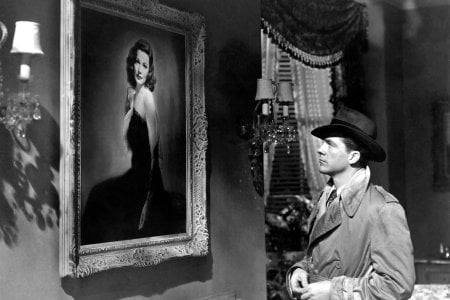
Not surprisingly, the Otto Preminger film noir “Laura” (1944) also sports quite the cast, including Gene Tierney, Dana Andrews, Clifton Webb, Judith Anderson, and Vincent Price. The equally impressive theme, heard in multiple permutations throughout the film, was written by Philadelphia-born composer David Raksin. Outfitted with lyrics by Johnny Mercer, it went on to become the second most-recorded song during the composer’s lifetime, behind only Hoagie Carmichael’s “Stardust.”
Finally, “Diane” (1956) takes us back to 16th century France, with a plot concerning Diane de Poitiers, played by Lana Turner, a member of the court of Francis I, who becomes the mistress of the king’s son, Henri d’Orléans, a very young Roger Moore. Their illicit love unfolds against the backdrop of Medici intrigue and lust for power. Miklós Rózsa, M-G-M’s go-to-composer for historical spectacles, wrote the music.
I hope you’ll join me for “What’s in a Name?,” on “Picture Perfect,” music for the movies, now in syndication on KWAX Classical Oregon!
——–
Clip and save the start times for all three of my recorded shows:
PICTURE PERFECT, the movie music show – Friday at 8:00 PM EDT/5:00 PM PDT
SWEETNESS AND LIGHT, the light music program – Saturday at 11:00 AM EDT/8:00 AM PDT
THE LOST CHORD, unusual and neglected rep – Saturday at 7:00 PM EDT/4:00 PM PDT
Stream them, wherever you are, at the link!
https://kwax.uoregon.edu
——–
PHOTO: Dana Andrews likes his women stiff, like his bourbon -
Take a Walk on the Wild Side on “Picture Perfect”
This week on “Picture Perfect,” poised as we are between the birthdays of Henry Mancini (April 16) and Miklós Rózsa (April 18), we’ll hear music by both composers as part of a cinematic carnival of the animals.
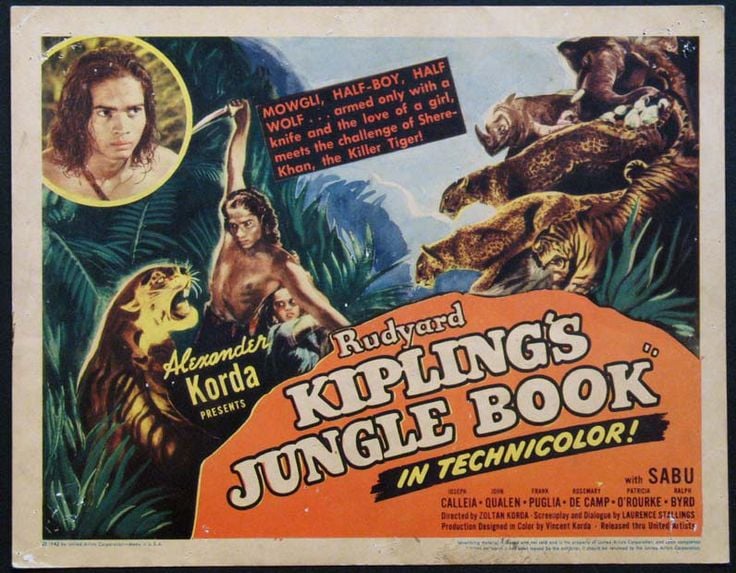
Take a walk on the wild side with music from “The Jungle Book” (1942), the classic Korda Brothers’ adaptation of Rudyard Kipling’s tale of tails. The film stars the charismatic Sabu as Mowgli. (For the record, Kipling pronounced the name such that the first syllable rhymes with “cow.”) Miklós Rózsa wrote the enchanting score.
We’ll also hear selections from John Barry’s music for “Born Free” (1966), based on Joy Adamson’s memoir about the raising of Elsa, an orphaned lion cub who grows to adulthood and is eventually released into the Kenyan wilderness. The music turned out to be a double Academy Award winner for Barry, who was recognized for Best Original Score and Best Original Song.
Jerome Moross is probably best known for his music to “The Big Country.” His “great outdoors” style lends verve to the National Geographic special, “Grizzly!” (1967), a documentary about a pair of ecologists studying North American bears. The energetic Americana score is both memorable and motivating.
And we can’t allow the hour to pass without listening to Henry Mancini’s “Baby Elephant Walk,” from “Hatari!” (So many exclamation points in these wilderness titles!) The film was directed by Howard Hawks and stars John Wayne. In case you’re wondering, “Hatari!” is Swahili for “Danger!”
No danger in treating yourself to a musical menagerie of classic film scores, on “Picture Perfect,” music for the movies, now in syndication on KWAX Classical Oregon!
——–
Clip and save the start times for all three of my recorded shows:
PICTURE PERFECT, the movie music show – Friday at 8:00 PM EDT/5:00 PM PDT
SWEETNESS AND LIGHT, the light music program – Saturday at 11:00 AM EDT/8:00 AM PDT
THE LOST CHORD, unusual and neglected rep – Saturday at 7:00 PM EDT/4:00 PM PDT
Stream them, wherever you are, at the link!
https://kwax.uoregon.edu
Tag Cloud
Aaron Copland (94) Beethoven (95) Composer (114) Film Music (148) Film Score (143) Film Scores (255) Halloween (97) John Williams (196) KWAX (232) Leonard Bernstein (105) Marlboro Music Festival (125) Movie Music (163) Mozart (91) Opera (215) Philadelphia Orchestra (90) Picture Perfect (174) Princeton Symphony Orchestra (110) Radio (90) Ross Amico (244) Roy's Tie-Dye Sci-Fi Corner (290) The Classical Network (101) The Lost Chord (269) Vaughan Williams (107) WPRB (397) WWFM (881)