
Congratulations to Jennifer Higdon on her third Grammy (even if the Awards themselves pay classical music scant regard).
Tag: Jennifer Higdon
-

Whitman’s Lilacs: Hartmann & Higdon’s Musical Echoes
“When Lilacs Last in the Dooryard Bloom’d,” Walt Whitman’s pastoral elegy, written in the wake of the assassination of Abraham Lincoln, drew its most famous musical response from Paul Hindemith. Hindemith dedicated his requiem to the memory of Franklin Delano Roosevelt. This Sunday night on “The Lost Chord,” we continue our celebration of the bicentennial of the birth of America’s national poet (on May 31, 1816) with two lesser-known works inspired by the same source.
Karl Amadeus Hartmann died within weeks of Hindemith (who fled Germany in 1938), in December of 1963. An anti-fascist composer who made the decision to remain at home during Hitler’s reign of terror, Hartmann’s music was condemned as degenerate and banned from public performance. Holding fast was a dangerous game for an artist at odds with the regime. This type of opposition was described by writer Thomas Mann as “inner immigration.”
Following the war, Hartmann was one of the few surviving anti-fascists in Bavaria whom the Allied Forces could promote to a position of responsibility. He used that trust to reintroduce the world to music which had been prohibited since 1933 under National Socialist aesthetic policy.
Hartmann remained in Munich for the rest of his life, where his administrative duties cut heavily into what would have been his own compositional time and energy. His own greatest champions were his contemporaries, and performances of his music nearly died out with them. However, in recent years, his works have received more exposure thanks to recordings.
Hartmann wrote Symphony No. 1 in 1935 as an act of political dissidence. Naturally, at the time, no one in Germany would touch it, and Hartmann cemented his “undesirable” status. It would be over a decade before the piece would receive its first performance, in 1948. Following revisions, the work reached its final form in 1955.
Subtitled “Versuch eines Requiems” (or “Attempt at a Requiem”), the symphony employs texts selected from Whitman’s poetry. Unusually, it falls into five movements, as opposed to four. Four of them employ a contralto, but the third is purely instrumental, a set of variations on a theme from Hartmann’s anti-war opera, “Simplicius Simplicissimus.”
Closer to home, Philadelphia-based composer Jennifer Higdon scored her setting, “Dooryard Bloom,” for baritone and orchestra. The work was written on a commission from the Brooklyn Philharmonic in 2004.
Higdon, born in Brooklyn in 1962, but raised in Atlanta and Seymour, TN, took up composition while studying as a flutist at Bowling Green State University. She went on to earn an Artist’s Diploma from the Curtis Institute of Music, and a Master’s Degree from the University of Pennsylvania. She is now on the faculty of Curtis, and her works are frequently programmed by the Philadelphia Orchestra. She was the recipient of the Pulitzer Prize for Music in 2010 for her Violin Concerto.
I hope you’ll join me for the third of four weeks devoted to music inspired by the verse of Walt Whitman. Whitman chants his song of “sane and sacred death,” on “Lilacs Last,” this Sunday night at 10:00 EDT, on WWFM – The Classical Network and wwfm.org.
Clockwise from left: Lilacs, Whitman, Hartmann, and Higdon (with helper)
-
Cathedral Sounds on The Lost Chord
Happy Easter, everyone! I’ve been all tied up with Easter activities for most of the day, so I’m only just getting around to extending the invitation for you to cap off your Sunday by joining me on “The Lost Chord” for an hour of pieces inspired or influenced by cathedrals.
We’ll hear Jennifer Higdon’s “blue cathedral” (all lower-case), from 1999, commissioned by the Curtis Institute of Music in honor of its 75th anniversary. The work is dedicated to the memory of Higdon’s younger brother, Andrew Blue. In the writing of the piece, she imagined a journey through a glass cathedral in the sky, with transparent walls and crystal pillars, through which clouds and endless expanses of blue would be visible.
Guitarist-composer Agustin Barrios wrote “La Catedral” (“The Cathedral”) in 1921, after having heard music of Johann Sebastian Bach performed on the organ of the cathedral of San Juan Bautista de las Misiones in his native Paraguay.
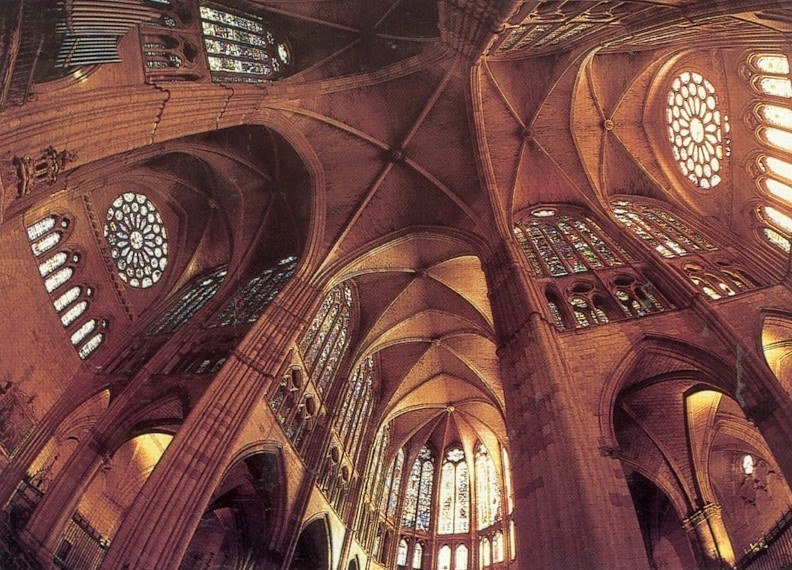
Englishman Joby Talbot composed “Path of Miracles” in 2005. The work – dedicated to the memory of his father, Vincent – was written on a commission from the vocal chamber group Tenebrae. Its four movements reflect stops along the medieval pilgrimage route to Santiago. The third of these, an evocation of León Cathedral, is imagined as a kind of “Lux Aeterna,” the interior of the space bathed in light.
Finally, American composer Adolphus Hailstork recollected his experiences as a child chorister at the Cathedral of All Saints in Albany, New York, when he came to write his “Sonata da Chiesa” (“Church Sonata”) in 1992. Hailstork, composer-in-residence at Old Dominion University in Norfolk, Virginia, conceived the work’s seven vibrant sections – “Exaltation,” “O Great Mystery,” “Adoration,” “Jubilation,” “O Lamb of God,” “Grant Us Thy Peace,” and “Exaltation” – for string orchestra, providing a joyous conclusion to the hour.
I hope you’ll join me for “Master Builders” – architects of cathedrals in sound – this Sunday night at 10:00 EDT, on WWFM – The Classical Network and wwfm.org.
PHOTO: The vaulted ceiling of León Cathedral
-

Zhou Tian Grammy Nominee on WWFM
Coming up in the 3:00 hour, it’s one more chance to catch Zhou Tian’s Concerto for Orchestra in advance of this Sunday’s Grammy Awards ceremony. Zhou’s piece is nominated in the category of Best Contemporary Classical Composition. We’ll hear the world premiere recording of the work, with the Cincinnati Symphony Orchestra. Zhou was in Princeton last year for the U.S. premiere of his work, “Broken Ink,” with the Princeton Symphony Orchestra.
Prior to the airing of his Concerto for Orchestra, we’ll enjoy “An Exaltation of Larks” by one of his teachers, Philadelphia composer – and Pulitzer Prize winner – Jennifer Higdon. The work was written for the LARK Quartet (“exaltation” is the term for a collection of larks) of which Princeton Symphony Orchestra concertmaster Basia Danilow is a member.
Join me at 3:00 EST for an hour of outstanding contemporary music, on WWFM – The Classical Network and wwfm.org.
Zhou Tian with Basia Danilow of the PSO and the Lark Quartet
-
Dolce Suono Ensemble Plays Higdon & More
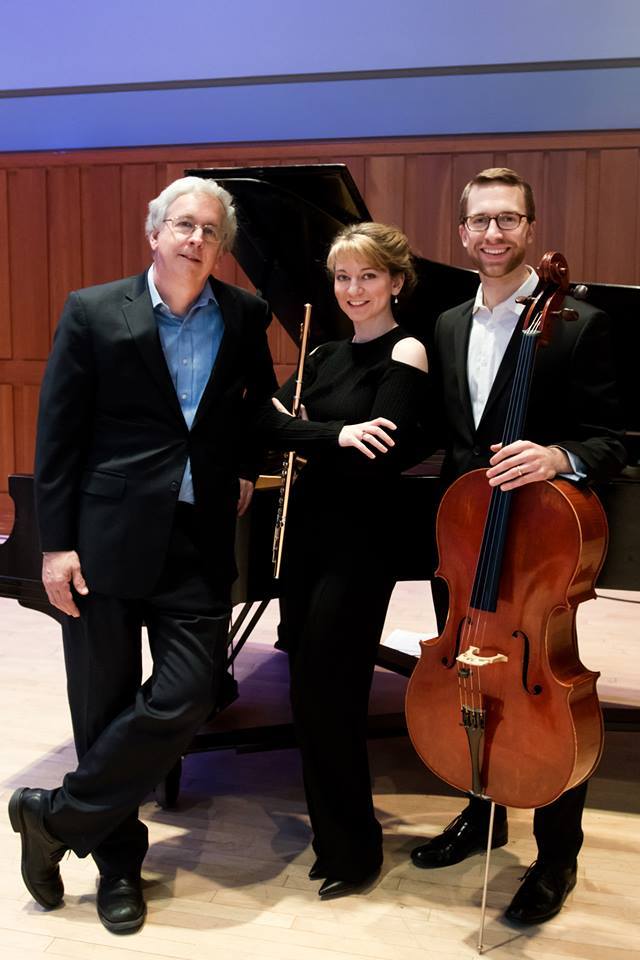
Artistic director Mimi Stillman named her Dolce Suono Ensemble after a passage in Dante’s “Divine Comedy” that reads “…in voce mista al dolce suono” (“…the words blending with the sweet sound”).
There will be sweet sounds aplenty on today’s Noontime Concert on The Classical Network, which will come your way from the Brandywine River Museum of Art in Chadds Ford, PA. On the program will be music by Jean Sibelius, Philippe Gaubert, Antonin Dvořák, Claude Debussy, and Leonard Bernstein, with two works by Philadelphia composers: Andrea Clearfield’s “Spirit Island” and Jennifer Higdon’s “American Canvas.”
“American Canvas” falls into three movements, each named for a different visual artist – Georgia O’Keefe, Jackson Pollock, and Andrew Wyeth. The Brandywine Museum, of course, houses an extensive collection of canvases painted by three generations of the Wyeth family.
“American Canvas” was composed on a commission from the Dolce Suono Ensemble with grants from the Musical Fund Society of Philadelphia and the William Penn Foundation. The Dolce Suono Trio consists of flutist and artistic director Mimi Stillman, pianist Charles Abramovic, and cellist Nathan Vickery. Stillman will introduce each of the pieces from the Brandywine stage.
Dolce Suono’s next concert will explore the musical tastes of the Founding Fathers and the musical culture of Philadelphia around the founding of our nation. The ensemble will present “Music in the Second Capital” this Sunday at 3 p.m. at Old Pine St Presbyterian Church, 412 Pine Street, Philadelphia. For more information, look online at dolcesuono.com/events.
Following today’s Noontime Concert, stick around for a complete recording of the “Messa da Requiem” by Giuseppe Verdi, as we celebrate the Italian master’s 204th birthday. There will be sweet sounds aplenty, this Tuesday, from 12 to 4 p.m. EDT, on WWFM – The Classical Network and wwfm.org.
Tag Cloud
Aaron Copland (93) Beethoven (95) Composer (114) Film Music (144) Film Score (143) Film Scores (255) Halloween (94) John Williams (195) KWAX (229) Leonard Bernstein (104) Marlboro Music Festival (125) Movie Music (159) Mozart (90) Opera (212) Philadelphia Orchestra (89) Picture Perfect (174) Princeton Symphony Orchestra (109) Radio (88) Ross Amico (244) Roy's Tie-Dye Sci-Fi Corner (290) The Classical Network (101) The Lost Chord (269) Vaughan Williams (105) WPRB (397) WWFM (881)