Calling all rapscallions and scapegraces! This week on “Picture Perfect,” get ready to revel in some freewheeling lack of judgment, with an hour of films based on picaresque novels.
For those of you who weren’t English majors, the picaresque novel is a literary genre often characterized by the presence of rogues or anti-heroes as protagonists, episodic, wayward structures, and, not infrequently, low humor.
We’ll hear music from “The Reivers,” after William Faulkner’s Pulitzer Prize-winning novel, a coming-of-age story about a boy swept into automobile theft and illicit horseracing in the American South. Mark Rydell directed the 1969 film, which stars Steve McQueen as the rakish Boon Hogganbeck and features narration by Burgess Meredith. John Williams wrote the breezy Americana score.
Mark Twain’s “The Adventures of Huckleberry Finn” is frequently categorized as an American picaresque. It’s certainly one of the funniest of “serious” books. A middling film adaptation was made in 1960, directed by Michael Curtiz, with Tony Randall given top billing, shifting the focus of the story to the con artistry of the King and the Duke. It features an evocative score by Jerome Moross.
If Hervey Allen’s “Anthony Adverse” had any humor to begin with, it was definitely lost in translation. (Too bad the novel was written in English.) However, the 1936 screen adaptation certainly does sprawl. One could say it’s picaresque in the worst way. It just doesn’t go anywhere. It does, however, feature a top-notch cast (Frederic March, Olivia De Havilland, Claude Rains, etc.) and an Academy Award-winning score by Erich Wolfgang Korngold.
While the modern picaresque novel has its roots in the Renaissance, the genre really seemed to hit its stride in the 18th century, with comic novelists such as Henry Fielding. Fielding’s “Tom Jones,” perhaps the quintessential picaresque, was made into a film in 1963. It went on to win Academy Awards for Best Picture, Best Director (Tony Richardson), Best Adapted Screenplay (John Osborne), and Best Original Score (John Addison). Addison’s music suits Richardson’s quirky virtuosity like an off-kilter powdered wig.
We’re up to no good, with an hour of picaresque adventures, on “Picture Perfect,” music for the movies, now in syndication on KWAX Classical Oregon!
———
Clip and save the start times for all three of my recorded shows:
PICTURE PERFECT, the movie music show – Friday at 8:00 PM EDT/5:00 PM PDT
SWEETNESS AND LIGHT, the light music program – Saturday at 11:00 AM EDT/8:00 AM PDT
THE LOST CHORD, unusual and neglected rep – Saturday at 7:00 PM EDT/4:00 PM PDT
Stream them, wherever you are, at the link!
https://kwax.uoregon.edu
Tag: Jerome Moross
-
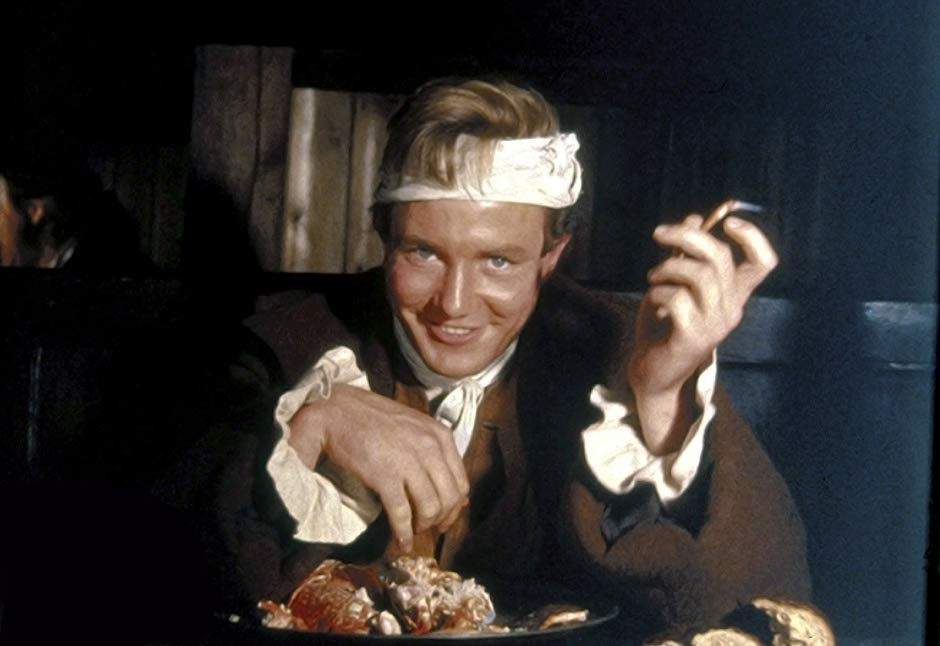
Picaresque Adventures on “Picture Perfect”
-
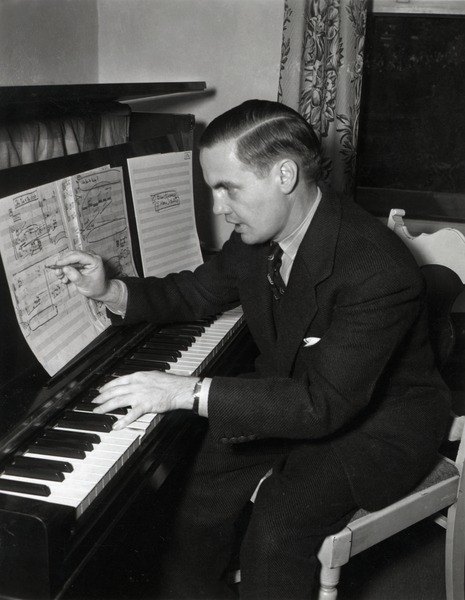
When Worlds Collide: Jerome Moross Remembers George Antheil
When worlds collide! On George Antheil’s birthday, here are some recorded recollections of Jerome Moross of Trenton’s “Bad Boy of Music.” Antheil, one of the great eccentrics, was most notorious for his “Ballet Mécanique,” a clangorous work for player pianos, electric bells, sirens, and airplane propellers, that caused the audience at its premiere in Paris in 1926 to take the place apart.
Moross was composer of the film score for “The Big Country” and the musical theater piece “The Golden Apple” (which yielded the standard “Lazy Afternoon”). When Moross refers to Benny, he of course means his good friend, Bernard Herrmann, with whom he used to sneak into rehearsals of Carnegie Hall concerts, and who later wrote the music for “Citizen Kane,” “The Day the Earth Stood Still,” “Jason and the Argonauts,” and Martin Scorsese’s “Taxi Driver.”
Antheil eventually wound up in California himself, where his musical language settled down, so that he earned his bread writing film scores and symphonies, as well as books, newspaper articles, and magazine columns on a wide variety of subjects, including war correspondence, murder mysteries, advice to the lovelorn, glandular criminology and bust enhancement (!).
It was the latter topic that attracted actress Hedy Lamarr for what started out as a consultation. It turned out Lamarr was also every inch the Renaissance person, and soon they were partnering on a frequency-hopping device conceived to prevent the enemy from blocking Allied torpedoes. They offered it to the military, which never used it. In recent years, it has been claimed (perhaps overstated) that their invention anticipated modern spread-spectrum communications technology.
It’s a small world after all – from Trenton to New York to the Champs-Élysées to Hollywood. Happy birthday, George Antheil!
———-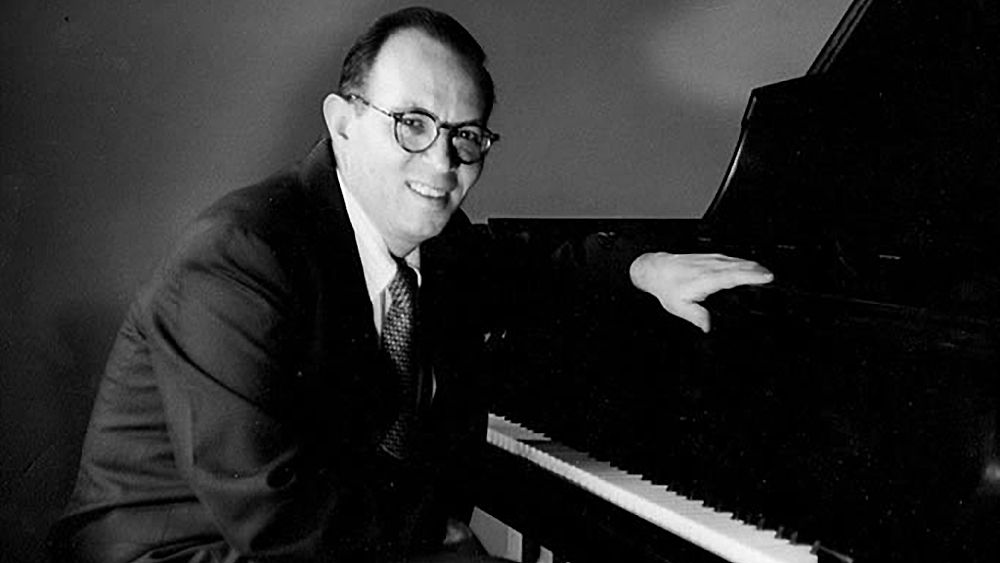
Moross talks Antheil
https://archive.org/details/AM_1979_06_19
The Ben Hecht film he refers to is the ballet noir “Specter of the Rose”
Antheil’s “Ballet Mécanique”
His Symphony No. 4 -
“What’s in a Name?” on “Picture Perfect”
This week on “Picture Perfect,” a show built around movies with women’s names for titles permits us to travel across a broad of array of genres – contemporary drama, Regency Era comedy of manners, 1940s film noir, and 16th century costume picture.
In “Rachel, Rachel” (1968), Joanne Woodward plays a repressed, small-town schoolteacher, who learns to take control of her own life. The film marked the directorial debut of Woodward’s husband, Paul Newman. “Rachel, Rachel” was nominated for four Academy Awards, including those for Best Actress and Best Picture. Newman picked up a Golden Globe and a New York Critics Circle Award for his direction. The lovely Americana score is by Jerome Moross.
In “Emma” (1996), adapted from novel of Jane Austen, Gwyneth Paltrow plays a high spirited-though-somewhat-clueless matchmaker, who fails to recognize her own feelings or those of the men around her. Among the supporting cast are Alan Cumming, Toni Collette, Ewan McGregor, and Jeremy Northam. Screenwriter and director Douglas McGrath fell in love with the book while an undergraduate at Princeton University. Rachel Portman wrote the Academy Award-winning score.
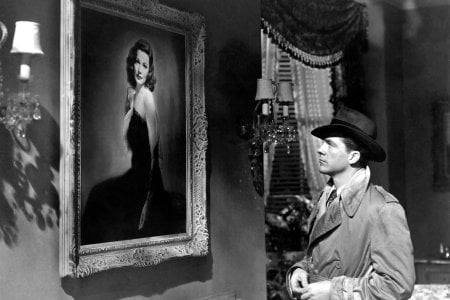
Not surprisingly, the Otto Preminger film noir “Laura” (1944) also sports quite the cast, including Gene Tierney, Dana Andrews, Clifton Webb, Judith Anderson, and Vincent Price. The equally impressive theme, heard in multiple permutations throughout the film, was written by Philadelphia-born composer David Raksin. Outfitted with lyrics by Johnny Mercer, it went on to become the second most-recorded song during the composer’s lifetime, behind only Hoagie Carmichael’s “Stardust.”
Finally, “Diane” (1956) takes us back to 16th century France, with a plot concerning Diane de Poitiers, played by Lana Turner, a member of the court of Francis I, who becomes the mistress of the king’s son, Henri d’Orléans, a very young Roger Moore. Their illicit love unfolds against the backdrop of Medici intrigue and lust for power. Miklós Rózsa, M-G-M’s go-to-composer for historical spectacles, wrote the music.
I hope you’ll join me for “What’s in a Name?,” on “Picture Perfect,” music for the movies, now in syndication on KWAX Classical Oregon!
——–
Clip and save the start times for all three of my recorded shows:
PICTURE PERFECT, the movie music show – Friday at 8:00 PM EDT/5:00 PM PDT
SWEETNESS AND LIGHT, the light music program – Saturday at 11:00 AM EDT/8:00 AM PDT
THE LOST CHORD, unusual and neglected rep – Saturday at 7:00 PM EDT/4:00 PM PDT
Stream them, wherever you are, at the link!
https://kwax.uoregon.edu
——–
PHOTO: Dana Andrews likes his women stiff, like his bourbon -
Take a Walk on the Wild Side on “Picture Perfect”
This week on “Picture Perfect,” poised as we are between the birthdays of Henry Mancini (April 16) and Miklós Rózsa (April 18), we’ll hear music by both composers as part of a cinematic carnival of the animals.
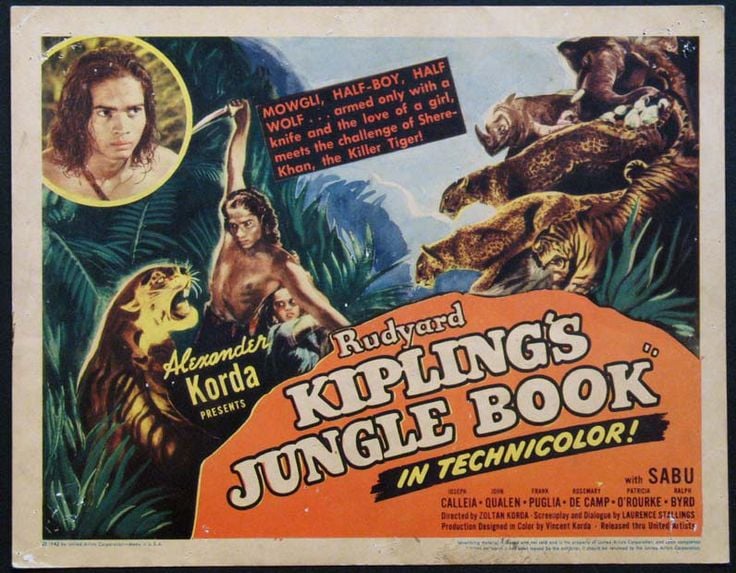
Take a walk on the wild side with music from “The Jungle Book” (1942), the classic Korda Brothers’ adaptation of Rudyard Kipling’s tale of tails. The film stars the charismatic Sabu as Mowgli. (For the record, Kipling pronounced the name such that the first syllable rhymes with “cow.”) Miklós Rózsa wrote the enchanting score.
We’ll also hear selections from John Barry’s music for “Born Free” (1966), based on Joy Adamson’s memoir about the raising of Elsa, an orphaned lion cub who grows to adulthood and is eventually released into the Kenyan wilderness. The music turned out to be a double Academy Award winner for Barry, who was recognized for Best Original Score and Best Original Song.
Jerome Moross is probably best known for his music to “The Big Country.” His “great outdoors” style lends verve to the National Geographic special, “Grizzly!” (1967), a documentary about a pair of ecologists studying North American bears. The energetic Americana score is both memorable and motivating.
And we can’t allow the hour to pass without listening to Henry Mancini’s “Baby Elephant Walk,” from “Hatari!” (So many exclamation points in these wilderness titles!) The film was directed by Howard Hawks and stars John Wayne. In case you’re wondering, “Hatari!” is Swahili for “Danger!”
No danger in treating yourself to a musical menagerie of classic film scores, on “Picture Perfect,” music for the movies, now in syndication on KWAX Classical Oregon!
——–
Clip and save the start times for all three of my recorded shows:
PICTURE PERFECT, the movie music show – Friday at 8:00 PM EDT/5:00 PM PDT
SWEETNESS AND LIGHT, the light music program – Saturday at 11:00 AM EDT/8:00 AM PDT
THE LOST CHORD, unusual and neglected rep – Saturday at 7:00 PM EDT/4:00 PM PDT
Stream them, wherever you are, at the link!
https://kwax.uoregon.edu -
Holy Men and Missions on “Picture Perfect”
This week on “Picture Perfect,” in this season of wall-to-wall Biblical epics, I thought we’d enjoy a bit of counterprogramming in the form of music from films about faith, conscience, and the church.
Otto Preminger’s “The Cardinal” was released in 1963. Based on the novel by Henry Morton Robinson, the story follows a fictional Boston Irish Catholic priest from his ordination in 1917 to his appointment as cardinal on the eve of World War II. Tom Tryon played the lead. Tryon would later become a best-selling author himself (as Thomas Tryon), with books like “The Other” and “Harvest Home.”
An interesting factoid: The Vatican’s liaison officer for the production was Joseph Ratzinger, the future Pope Benedict XVI.
As always, Moross’ score is irrepressibly lyrical, even buoyant. The man never seemed to run out of good tunes.
We’ll also have music from “The Shoes of the Fisherman,” from 1968, another film based on a best-selling novel, this time by Morris L. West.
Anthony Quinn plays Kiril Pavlovich Lakota, an archbishop who serves 20 years in a Siberian labor camp. He is released and sent to Rome where is promoted to the cardinalate. When the Pope dies, suddenly, Lakota, a dark horse candidate, is elected as a replacement. The story balances Lakota’s internal struggles and personal torments with mounting global turmoil.
The music is by Alex North, who sets the melancholy lyricism of Russian folksong against the steely grandeur of his music for the Vatican.
The remainder of the program will be devoted to movies about missionaries. Georges Delerue provided a noble, austere score for the 1991 Bruce Beresford film “Black Robe,” based on a novel by the Irish Canadian writer Brian Moore, in which a Jesuit priest treks through 1500 miles of Canadian wilderness on a mission to convert the native tribes of the Huron and the Algonquin.
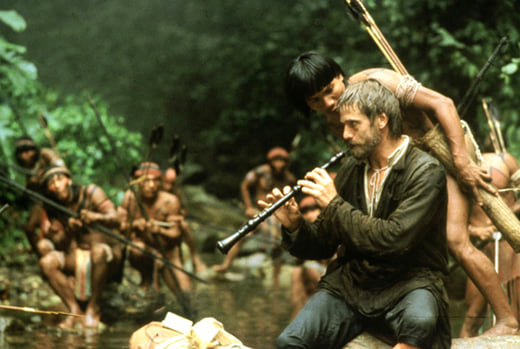
Ennio Morricone’s moving music for Roland Joffé’s 1986 film “The Mission,” which features Jeremy Irons as a Jesuit priest and Robert DeNiro as a reformed slave hunter in the South American jungle, has received a great deal of exposure over the years, both through its use in television commercials and by figure skaters, who made “Gabriel’s Oboe” a recognizable hit. It has become one of Morricone’s best-loved scores.
I hope you’ll join me for “Holy Men and Missions” this week, on “Picture Perfect,” music for the movies, now in syndication on KWAX Classical Oregon!
——–
Clip and save the start times for all three of my recorded shows:
PICTURE PERFECT, the movie music show – Friday at 8:00 PM EDT/5:00 PM PDT
SWEETNESS AND LIGHT, the light music program – Saturday at 11:00 AM EDT/8:00 AM PDT
THE LOST CHORD, unusual and neglected rep – Saturday at 7:00 PM EDT/4:00 PM PDT
Stream them, wherever you are, at the link!
https://kwax.uoregon.edu
Tag Cloud
Aaron Copland (93) Beethoven (95) Composer (114) Film Music (145) Film Score (143) Film Scores (255) Halloween (94) John Williams (195) KWAX (229) Leonard Bernstein (104) Marlboro Music Festival (125) Movie Music (160) Mozart (91) Opera (213) Philadelphia Orchestra (89) Picture Perfect (174) Princeton Symphony Orchestra (109) Radio (88) Ross Amico (244) Roy's Tie-Dye Sci-Fi Corner (290) The Classical Network (101) The Lost Chord (269) Vaughan Williams (105) WPRB (397) WWFM (881)