Hearken ye to “Picture Perfect” this week for sweet airs from movies set in the Age of Chivalry.
Peradventure ye will encounter sounds and delights from “The Warlord” (Jerome Moross), “El Cid” (Miklós Rózsa), “Lionheart” (Jerry Goldsmith), and “The Adventures of Robin Hood” (Erich Wolfgang Korngold).
Verily, chivalry is not dead, this Friday evening at 6 EDT, on WWFM – The Classical Network and wwfm.org.
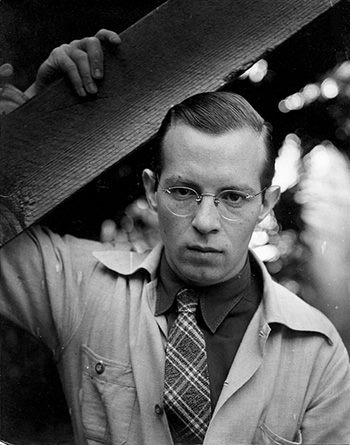
When “Porgy and Bess” concluded its New York run in 1935, George Gershwin invited Jerome Moross to join the show, on tour, as a pianist. It was on a bus trip to Los Angeles to participate in “Porgy’s” west coast premiere that the 23 year-old composer made a stop in Albuquerque.
“[A]s we hit the Plains I got so excited,” Moross recollected. “. . .[T]he next day I got to the edge of town and then walked out onto the flat land with a marvelous feeling of being alone in the vastness, with the mountains cutting off the horizon. The whole thing was just too much for me . . . it was marvelous, and I just fell in love with it.”
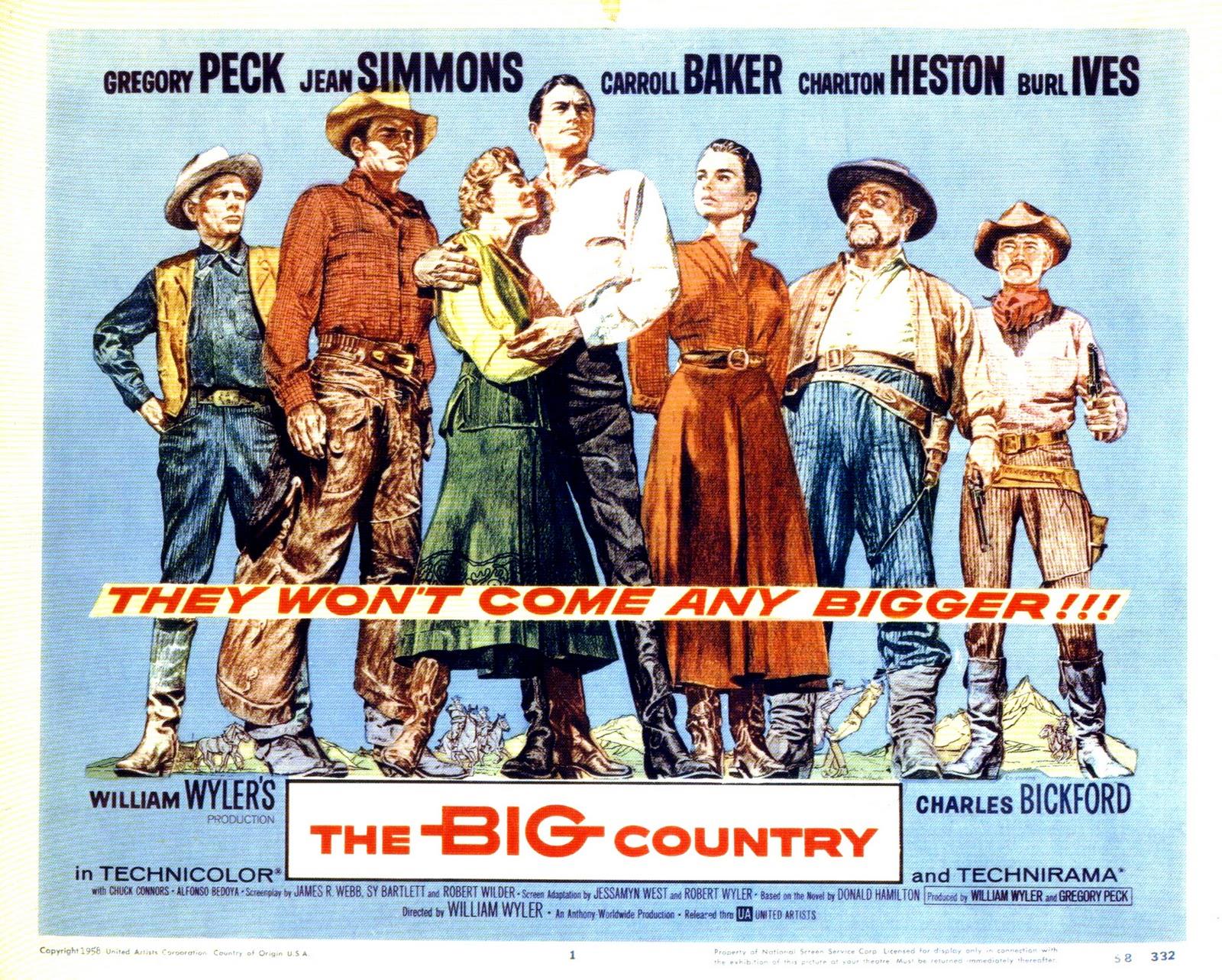
The experience served him well, as some of his most famous music, the Academy Award-nominated score for “The Big Country,” enshrines that sense of excitement in the face of sweeping vistas. Western high-spirits and American jazz color most of Moross’ output, whether for the silver screen, musical theater, or concert hall.
We’ll celebrate the composer’s birthday this afternoon, with selections from all three, during my air shift, from 4 to 7 p.m. EDT, on WWFM – The Classical Network and at wwfm.org.
Also listen for selections by Enrique Granados and Ernst von Dohnányi, left over from last Wednesday, when my car broke down on the way to the station. Get a horse!
Perhaps the weather in the Philadelphia-Princeton area has been more conducive to film noir, but this week on “Picture Perfect,” I’ll be giving you the chance to dream about the great outdoors. Sundrenched plains and horses, that is.
We’ll combat the effects of light deprivation with an hour of music from some big movie westerns – including “The Big Country” (1958, with music by Jerome Moross), “The Big Sky” (1952, by Dimitri Tiomkin), “Big Jake” (1971, by Elmer Bernstein) and “Silverado” (1985, by Bruce Broughton).
It’s all BIG this week, under the bright, open skies of the American west, on “Picture Perfect,” music for the movies, this Friday evening at 6 EDT, with a repeat Saturday morning 6; or you can listen to it later as a webcast at wwfm.org.
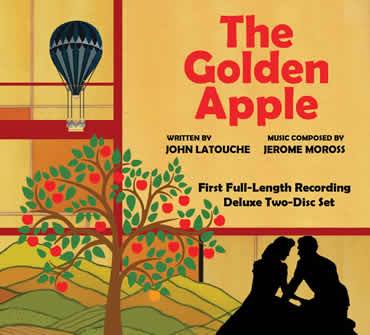
Virtually just in time for Jerome Moross’ 102nd birthday anniversary (which is today), I received a new, 2-CD set – the first complete recording – of the composer’s ebullient Broadway show, “The Golden Apple.”
Moross, of course, wrote one of the great, big screen western scores, that for “The Big Country” (1958). Prior to that, he was a protégé of Aaron Copland and a friend of Bernard Herrmann (with whom he used to sneak into rehearsals of the New York Philharmonic.)
“The Golden Apple” (1954) is a witty mash-up of Americana and Greek mythology, the scenario loosely based on elements from Homer’s “The Iliad” and “The Odyssey.” The marriage of libretto and music nimbly expands the boundaries of popular entertainment, prefiguring by several decades through-composed musical theater hits like “The Phantom of the Opera” and “Les Miserables.”
The music is quintessential Moross. There is a touch of “The Big Country” in just about everything he wrote, and if you are a fan of that score, you will likely find much to enjoy in “The Golden Apple.” The composer stitches together an infectious crazy quilt of ballads, cakewalks, marches and music hall-type numbers. Philadelphia-born Hershy Kay expertly assists with the lush orchestrations.
While it was met with critical acclaim at the time of its opening, the musical failed to find the audience it deserved. Instead, crowds flocked to “The Pajama Game.” Despite the show’s unjust neglect, one of the numbers in particular quickly became a popular standard, the bluesy ballad “Lazy Afternoon” – though others, like “It’s the Going Home Together” and “Windflowers,” are equally deserving.
The new recording, from PS Classics, is taken from a 2014 production mounted by Lyric Stage of Irving, TX, featuring a 38-piece orchestra and a 43-member cast. The texts are well-enunciated by the singers – essential for comprehension of the plot, certainly, but also a joy in itself for the wit of John Latouche’s lyrics, which tickle both the funny bone and the brain – and the recorded balance of voice and music is well-judged. Even so, the booklet contains a luxury so often sadly missing in these days of no-frills packaging: a full libretto.
A superb recording featuring the original cast was issued in 1954, but only a fraction of the show’s numbers were represented, and many of those in truncated form. Also, the sound on compact disc reissue is beginning to show its age, tinny and a tad harsh.
At last “The Golden Apple” can be heard and enjoyed as it was originally intended, with almost 90 minutes of previously unrecorded material. The release is very reasonably priced, essentially two discs for the price of one. There are periodic outbursts of applause revealing the recording’s live origins. However, these are few and largely unobtrusive. If you are a fan of Moross’ music and can tolerate musical theater, I encourage you to give it a shot.
Tomorrow is the birthday of Jerome Moross, whose music for “The Big Country” secures his place in the pantheon of the great film composers. It was my intention to at least acknowledge him on this week’s “Picture Perfect.” However, since I just did a program devoted to Moross’ western scores only a few months ago, it was necessary to come up with something else. The more I thought about it, the more I saw red – cardinal red.
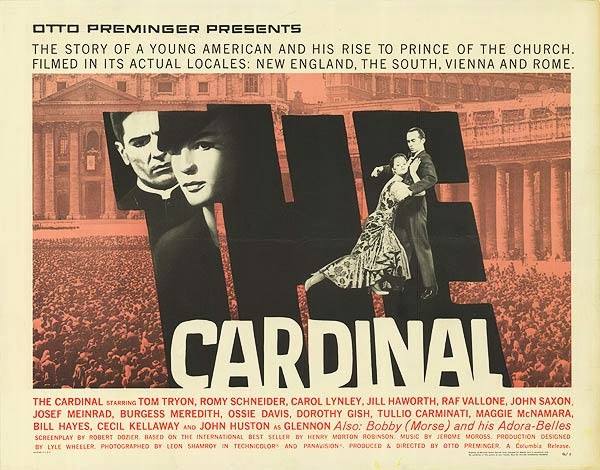
Otto Preminger’s “The Cardinal” was released in 1963. Based on the novel by Henry Morton Robinson, the story follows a fictional Boston Irish Catholic priest from his ordination in 1917 to his appointment as cardinal on the eve of World War II. Tom Tryon played the lead. Tryon would later become a best-selling author himself (as Thomas Tryon), with books like “The Other” and “Harvest Home.”
An interesting factoid: The Vatican’s liaison officer for the production was Joseph Ratzinger, the future Pope Benedict XVI.
As always, Moross’ score is irrepressibly lyrical, even buoyant. The man never seemed to run out of good tunes.
We’ll also have music from “The Shoes of the Fisherman,” from 1968, another film based on a best-selling novel, this time by Morris L. West.
Anthony Quinn played Kiril Pavlovich Lakota, an archbishop who serves 20 years in a Siberian labor camp. He is released and sent to Rome where is promoted to the cardinalate. When the Pope dies, suddenly, Lakota, a dark horse candidate, is elected as a replacement. The story balances Lakota’s internal struggles and personal torments with mounting global turmoil.
The music was by Alex North, who sets the melancholy lyricism of Russian folksong against the steely grandeur of his music for the Vatican.
The remainder of the program will be devoted to movies about missionaries. Georges Delerue provided a noble, austere score for the 1991 Bruce Beresford film “Black Robe,” based on a novel by the Irish Canadian writer Brian Moore, in which a Jesuit priest treks through 1500 miles of Canadian wilderness on a mission to convert the native tribes of the Huron and the Algonquin.
Ennio Morricone’s moving music for Roland Joffé’s 1986 film “The Mission,” which featured Jeremy Irons as a Jesuit priest and Robert DeNiro as a reformed slave hunter in the South American jungle, has received a great deal of exposure over the years, both through its use in television commercials and by figure skaters, who made “Gabriel’s Oboe” a recognizable hit. It has become one of Morricone’s best-loved scores.
Join me for “Holy Men and Missions” this week, on “Picture Perfect” – music for the movies – this Friday evening at 6 ET, or listen to it later as a webcast at http://www.wwfm.org.