Tag: Johannes Brahms

  • Princeton Symphony Brahms & Schoenberg

    Princeton Symphony Brahms & Schoenberg

    To open its 2025-26 season, the Princeton Symphony Orchestra is offering a rare opportunity to experience an established masterpiece from two very different perspectives.

    Johannes Brahms’ Piano Quartet in G minor of 1861 was orchestrated by Arnold Schoenberg in 1937. Brahms was 28 when he wrote it. At the time of its transmogrification, Schoenberg was 63.

    Despite his notorious reputation as the godfather of dodecaphonic music, Schoenberg greatly admired Brahms and indeed would celebrate him, emphasizing his underappreciated genius as a musical adventurer, in a series of 1947 talks titled “Brahms the Progressive.”

    Schoenberg’s reimagining of the piano quartet is warm and affectionate. For most of the work, he manages a pretty good Brahms impression, if not a slavish one. It’s hard to imagine Brahms ladling on the percussion quite like that in the “gypsy rondo” finale. Furthermore, perhaps disorientingly, there is no piano in it. So it’s not Brahms, exactly, but it IS entertaining. Otto Klemperer, who conducted the premiere of the hybrid in Los Angeles, on Brahms’s birthday anniversary, May 7, 1938, paid tribute to Schoenberg’s accomplishment. “You can’t even hear the quartet,” he declared, “so beautiful is the orchestration.”

    Brahms-Schoenberg will make up the second half of this weekend’s Princeton Symphony Orchestra concerts. The program will also include Antonín Dvořák’s Violin Concerto, with soloist Aubree Oliverson, who charmed audiences last year with her performances of the Tchaikovsky concerto. The concerts will open with “Orpheus’ Comet” by Bulgarian composer Dobrinka Tabakova.

    To get the Brahms fresh in our ears and enhance our appreciation of Schoenberg’s achievement, the PSO will present Brahms’ Piano Quartet No. 1 in its original guise on Thursday night, with PSO favorite Natasha Paremski, along with violinist Marc Uys, violist Xandi van Dijk, and cellist John-Henry Crawford. The concert will include commentary by PSO music director Rossen Milanov – who, of course, will also conduct the weekend concerts.

    Brahms’ chamber work will be performed at Trinity Church Princeton, 33 Mercer St., on Thursday at 7 p.m.

    The orchestral program will be presented at Princeton University’s Richardson Auditorium, Saturday at 7:30 p.m. and Sunday at 4 p.m.

    At another related event, storyteller Maria LoBiondo will refresh our memories of the Orpheus myth, in preparation for our brush with “Orpheus’ Comet,” as she weaves her spell at Princeton Public Library, this Wednesday at 7 p.m. Attendees will have the opportunity to enter a drawing to win free tickets for this weekend’s concerts.

    Don’t look back with regret like Orpheus. For more information, visit princetonsymphony.org.

  • Brahms & Tchaikovsky A Classical Bromance

    Brahms & Tchaikovsky A Classical Bromance

    Ever since I learned some years ago that Johannes Brahms (1833-1897) and Pyotr Ilych Tchaikovsky (1840-1893) – who share a birthday on May 7 – actually met on several occasions, and that Tchaikovsky’s initial suspicion of, and contempt for, his colleague and rival softened into a genuine admiration for the man (if not his music), I haven’t been able to resist revisiting the story of this classical music true bromance.

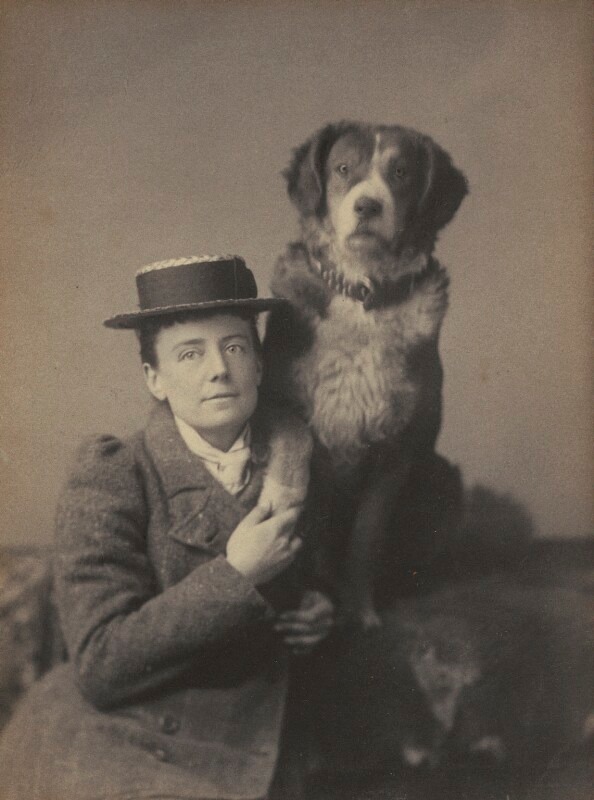
    This year, I’ll put a different spin on it by sharing the observations of English composer Ethel Smyth (1858-1944) and the antics of her exuberant dog Marco. Smyth, whose steely determination to become a composer, in a day when it was the sort of thing that women simply didn’t do, wore down the opposition of her father – a major general in the Royal Artillery! – and enrolled at the Leipzig Conservatory in 1877.

    When the conservatory didn’t measure up to her expectations, she acquired further polish through private studies with Heinrich von Herzogenberg (and fell in love with his wife). Her adventures in Germany brought her into contact with Dvořák, Grieg, Clara Schumann, and Herzogenberg’s friend, Johannes Brahms.

    It was at a private performance of Brahms’ Piano Quintet, with the composer in attendance, that Smyth’s St. Bernard mix, Marco, burst through a door, toppling the cellist’s music stand, which, much to everyone’s relief, the notoriously prickly Brahms found hilarious.

    Smyth also became friendly with Tchaikovsky, another visitor. Her first-hand accounts of her interactions and correspondence with both composers make for enjoyable reading. According to her, Tchaikovsky was “secretly terrified” of Marco, but whenever he wrote, he never failed to ask after him.

    Brahms also kept in touch. It’s said that he carried a photo of Smyth with him until the time of his death.

    In his diary, Tchaikovsky had characterized Brahms as a “scoundrel” and “a giftless bastard.” He was elated to find him, in reality, to be full of warmth and good humor. His preemptive hatred likely had more to do with the over-the-top and widely-broadcast veneration of establishment figures, such as Eduard Hanslick and Hans von Bülow, who hailed Brahms as the rightful heir of Beethoven.

    “I’ve been on the booze with Brahms,” Tchaikovsky wrote after their first meeting. “He is tremendously nice – not at all proud as I’d expected but remarkably straightforward and entirely without arrogance. He has a very cheerful disposition, and I must say that the hours I spent in his company have left me with nothing but pleasant memories.”

    I always find it oddly endearing that Brahms and Tchaikovsky were able to look past their personal aversions to one another’s music to actually grow to appreciate their individual qualities as people. There’s a lesson to be learned from that, I think. You can read more about it – and Marco! – at the links below to the website Tchaikovsky Research.

    Happy birthday, boys. I’m glad it all worked out in the end.


    Smyth, Marco, Brahms, and Tchaikovsky

    https://en.tchaikovsky-research.net/pages/Ethel_Smyth

    Tchaikovsky and Brahms (and Grieg)

    https://en.tchaikovsky-research.net/pages/Johannes_Brahms


    Brahms, Piano Trio No. 3 in C minor, Op. 101 (disliked by Tchaikovsky)

    Tchaikovsky, Symphony No. 5 in E minor (disliked by Brahms)

    Smyth, Serenade in D, her first orchestral work (written with the encouragement of Tchaikovsky)

  • Why Is Schumann Suddenly Everywhere?

    Why Is Schumann Suddenly Everywhere?

    Is Robert Schumann having a moment?

    It seems everywhere I turn these days everyone is playing Schumann – in a way that, judging from the comparatively tepid response to his bicentennial 14 years ago, I would have never thought possible.

    Let me be clear from the start that this is not intended to be a “hit piece” on Schumann, who, by any standard, should be regarded as one of the greatest composers who ever lived. When one becomes immersed in his world, it’s not unusual for everything to go topsy-turvy. Intellectual rigor and a literary sensibility are dashed against the rocks of passion. I emerge from the brine, wringing out my clothes, exhilarated, but wondering what the hell happened. At its most personal, his music is like a siren song. But is it for every season?

    On the evidence of concert and radio programmers, it would seem so.

    Whenever I’m around my digital radio, I swear, two hours will not pass without an encounter with Schumann. Even that ne plus ultra of classical music programmers, Peter Van de Graaff, airs Schumann’s music regularly. My most recent enthusiasm is Yle Klassinen, a classical music service out of Finland. Its playlist is breathtakingly diverse, and yet, all at once, there he is again – Robert Schumann. (Even now, I am listening to Karl Goldmark. The performers: the Robert Schumann Philharmonic!)

    Is Schumann the new Brahms?

    Perhaps part of the reason we are hearing more Schumann is that we’re oversaturated with music by his star discovery. (I’m not noticing any comparable surge in the performance of music by Albert Dietrich.)

    In terms of classical radio, surely this boost is attributable in part to the form’s lamentable race to the bottom, in programming the most, and therefore shortest, selections, allowing for so much variety within a single hour, like dicing the world’s masterpieces into an overwatered gazpacho. If a work is presented complete (even classical radio hosts need to run to the bathroom), the tendency is to go “short.” Hence the insane popularity of Schumann’s Symphony No. 4, which at a half an hour or less is being aired much more frequently now than any of the Brahms’ symphonies. In their complete form, that is. Vapid radio will still drop in the third movement of Brahms 4th symphony (the one adapted and recorded by the progressive rock group Yes) from time to time.

    I’m also hearing a lot of Schumann piano music (beyond the ubiquitous “Kinderszenen”) and songs (if it’s a station that isn’t queasy about vocal music) and even substantial chamber works. I haven’t approached it scientifically, but it also seems to me that Schumann is being heard more on live concert programs.

    Is it a case of renewed curiosity, now that we’re hearing more about Clara? Is Robert riding Clara’s skirts, as she once rode his coattails? If so, I am not seeing a comparable effect with the Mendelssohns, Felix and his sister Fanny. Not that Felix Mendelssohn ever hurts for performances. It’s just that, like Schumann, everyone seems to turn up their noses and regard him as somehow “second tier.” Or perhaps as seated far to the back of the first tier.

    Of course, in the right mood, those of us of a certain disposition have no problem connecting with Schumann’s kaleidoscopic Romanticism – by turns tender and turbulent, lyrical and seething, tormented and perhaps even a little eldritch.

    There really is no one else like him – even if, of the great composers, he seems about the furthest away from Tarzan, in every respect, that I can imagine.


    Schumann of the Apes, cartoon by Pablo Helguera from 2012

  • Schumann’s Ghost Variations Lemonade From Madness

    Schumann’s Ghost Variations Lemonade From Madness

    When life gave him syphilis, he made lemonade. Or something like that.

    In 1854, after a twenty-year latency, Robert Schumann began to lose his grip on sanity. He complained of a persistent “A” note ringing in his ears, hallucinated that he was being hounded by devils, and hurled himself into the Rhine. He would spend his final years in an asylum, to which he committed himself at the age of 44.

    Even in the best of times, Schumann often struggled with what we now call manic-depression or bipolar disorder. His two extremes are reflected in the assumed literary doppelgangers, Florestan (the impetuous) and Eusebius (the introspective), also frequently referenced in his piano music. Evidently, there could be an undercurrent of intensity about him, even when he was at his dreamiest.

    Both before and after Schumann’s icy plunge from the bridge, he was at work on his final composition, the “Ghost Variations,” believing the theme to have been dictated to him by the spirit of Mendelssohn or Schubert. In reality, Schumann had used the theme several times before, including, only a few months earlier, in his Violin Concerto.

    Clara, his wife, wouldn’t allow the piece to be published. No doubt it held for her extremely personal, likely unpleasant associations. Still, family friend Johannes Brahms, whom Schumann had mentored and championed, would quote it in his own composition, “Variations on a Theme by Robert Schumann.”

    Brahms dedicated his tribute to Clara, who, awkwardly, also happened to be his secret (?) crush. When Schumann went into the asylum, she was pregnant with her seventh child and left to care for the family herself. She was discouraged from visiting her husband until the very end, for fear of triggering a relapse. In the meantime, Brahms was her only link, as he could enter and leave the sanatorium freely.

    The “Ghost Variations” may not be Schumann’s healthiest music, but what do you expect? It is undeniably intimate and achieves a kind of fragile beauty. You won’t encounter it very often.

    It’s also bittersweet. Kind of like a glass of lemonade.

    Happy birthday, Robert Schumann.

  • Menahem Pressler Beaux Arts Trio RIP

    Menahem Pressler Beaux Arts Trio RIP

    The pianist Menahem Pressler has died. Pressler was the anchor of one of the world’s most beloved chamber music ensembles, the Beaux Arts Trio. He was the only musician to perform with the group, which underwent several personnel changes, throughout its entire 53-year existence.

    The serenity of his playing betrayed no indication of a harrowing start. Many of his relatives – grandparents, uncles, aunts, and cousins – were murdered during the Holocaust. Somehow he managed to escape Nazi Germany with his immediate family in 1939.

    In 1946, he won first prize at the Debussy International Piano Competition in San Francisco. Not long after, he made his Carnegie Hall debut with the Philadelphia Orchestra conducted by Eugene Ormandy.

    Beginning in 1955, Pressler taught at Indiana University Jacobs School of Music. The same year, he became a founding member of the Beaux Arts Trio.

    Following the trio’s dissolution in 2008, Pressler returned to his career as a concert pianist. He made his debut with the Berlin Philharmonic at the age of 90.

    Pressler died yesterday at the age of 99. He would have been 100 in December.

    To coincide with the birthday of Johannes Brahms, here’s a lovely Beaux Arts performance of the composer’s Piano Trio No. 1.

    Pressler plays Chopin in 2018

    Pressler documentary in German (activate subtitles by clicking on CC)

    R.I.P.


    PHOTO: Pressler (center) with Beaux Arts colleagues Isadore Cohen (left) and Bernard Greenhouse

Tag Cloud

Aaron Copland (92) Beethoven (95) Composer (114) Film Music (120) Film Score (143) Film Scores (255) Halloween (94) John Williams (185) KWAX (229) Leonard Bernstein (100) Marlboro Music Festival (125) Movie Music (135) Opera (198) Philadelphia Orchestra (88) Picture Perfect (174) Princeton Symphony Orchestra (106) Radio (87) Ralph Vaughan Williams (85) Ross Amico (244) Roy's Tie-Dye Sci-Fi Corner (290) The Classical Network (101) The Lost Chord (268) Vaughan Williams (103) WPRB (396) WWFM (881)

DON’T MISS A BEAT

Receive a weekly digest every Sunday at noon by signing up here


RECENT POSTS