Tag: Johannes Brahms

  • Woldemar Bargiel Birthday Forgotten Composer

    Woldemar Bargiel Birthday Forgotten Composer

    Today is the birthday of… He Who Must Not Be Named.

    Oh, wait a minute. Sorry. Case of mistaken identity. It’s actually the birthday of WOLDEMAR BARGIEL. Bargiel, who lived from 1828 to 1897, was the half-brother of Clara Schumann.

    Bargiel’s mother had been married to Clara’s father, Friedrich Wieck – unhappily, I might add – which should come as little surprise, considering Wieck was the man who threatened to shoot Robert Schumann for courting his daughter. He faced the would-be couple down in court, violated Clara’s privacy, spread vicious rumors about her, and even promoted a rival pianist in her place in the hopes that she would supplant his own daughter. Wieck was so unruly in his determination to see “justice” done that he himself was ordered to pay the lovers a hefty sum and sentenced to jail for 18 days. Amazingly, everyone eventually reconciled, once Wieck became a grandfather, though he never completely abandoned his slippery-yet-inflexible ways.

    It was he who drove Bargiel’s future mother, Mariane, into the arms of one of his friends, a fellow music teacher, who would soon become her second husband.

    Despite the turbulence that rocked their parents’ world, Woldemar and Clara – who was nine years his senior – enjoyed a warm relationship. Thanks to her advocacy, Bargiel was welcomed by both Robert Schumann and Felix Mendelssohn, and was admitted to the Leipzig Conservatory, where he studied with Ignaz Moscheles, Niels Gade and Julius Rietz. Later, Clara and Robert arranged for the publication of some of his early works.

    Bargiel would one day repay the favor by coediting with Johannes Brahms a complete edition of Robert Schumann’s scores.

    Avada Kedavra! Happy birthday, Woldemar Bargiel!


    Bargiel’s Adagio for Cello and Orchestra:

    His Piano Trio No. 1:

  • Brahms: Beyond the Bearded Bear

    Brahms: Beyond the Bearded Bear

    It’s amusing that the most enduring image of Johannes Brahms is that of a gruff and portly, bearded old bear, incongruously disposed to writing lullabies.

    Lest we forget, Brahms was once a slender young man with piercing blue eyes, who wore his hair long and caused Clara Schumann, 17 years his senior, to confide to her diary, “He is so masterful that it seems God sent him into the world complete.”

    Also, he liked his coffee strong.

    Don’t expect anything too grandfatherly on this week’s “Music from Marlboro,” when the focus will be on Brahms’ unusually intense Piano Quintet in F minor.

    This is not music of wistful recollection. The quintet is often tempestuous and even tragic, fueled by all the passion and earnestness of an excitable young man. Brahms began his quintet in 1862, when he was 29 years-old.

    That’s not to say the composer ever teeters over into sentiment or excess of a kind common to his fin-de-siècle successors. Even in his 20s, Brahms was too much himself ever to allow that to happen.

    Instead he takes the prototype of the piano quintet – established by his friend and mentor, Robert Schumann – and fashions it into something unsettled and at times downright sublime. We are in the presence of something great, but also perhaps a little terrifying.

    This masterpiece of Brahms’ early maturity began life as a string quintet, written under the spell of Schubert’s famous Quintet in C. Brahms showed the work in this form to Clara Schumann and his friend, the violinist Joseph Joachim. Both were full of praise, at least at first, but gradually the compliments gave way to suggestions. Joachim, in particular, admired the work’s power, but confessed he found little in it to charm.

    Undaunted, Brahms took the piece and arranged it for two pianos in 1863-64, consigning the original version, for strings alone, to flames of woe. This two-piano reworking was politely rather than enthusiastically received, and Clara, thinking now it sounded more like a transcription than an original composition, begged him to recast it once more.

    The third time proved to be a charm. The resulting quintet, which achieved its final state in the summer of 1864, was met with resounding acclaim. At last, the piece had arrived at a perfect marriage of expression and form.

    While Brahms retains the classical poise for which he is so well known, he stiffens the sinews and conjures the blood, so to speak. In fact, there are times when he ratchets up the tension so effectively it seems the music might just fly off the rails.

    We’ll hear an exciting performance from the 2007 Marlboro Music Festival, featuring pianist Richard Goode, violinists Augustin Hadelich and Benjamin Beilman, violist Samuel Rhodes, and cellist Amir Eldan.

    In tandem with the whole “bearded bear” thing, Brahms is generally pigeonholed as the Classicist among Romantics. With this in mind, I’ll open the hour with a work by Walter Piston, the great American classicist, a two-time Pulitzer Prize winner, who gained esteem as one of our worthiest symphonists. These days, his symphonies are hardly ever played (more’s the pity), but we sure do hear his ballet “The Incredible Flutist” – probably his least characteristic composition.

    Piston’s 1946 “Divertimento for Nine Instruments” was performed at the Marlboro Music Festival in 1977, by violinists Young Uck Kim and Mitchell Stern, violist Karen Dreyfus, cellist Jerry Grossman, double bassist Julius Levine, flutist Julia Bogorad, oboist Roger Cole, clarinetist Stewart Newbold, and bassoonist Sol Schoenbach.

    It is, after all, called “classical music.” Tune in for worthwhile works by a pair of classicists, on the next “Music from Marlboro,” this Wednesday evening at 6:00 EDT, on WWFM – The Classical Network and wwfm.org.

    Marlboro School of Music and Festival: Official Page


    PHOTOS: Boy, Brahms… you really let yourself go!

  • Celebrating Clara Schumann’s Bicentennial

    Celebrating Clara Schumann’s Bicentennial

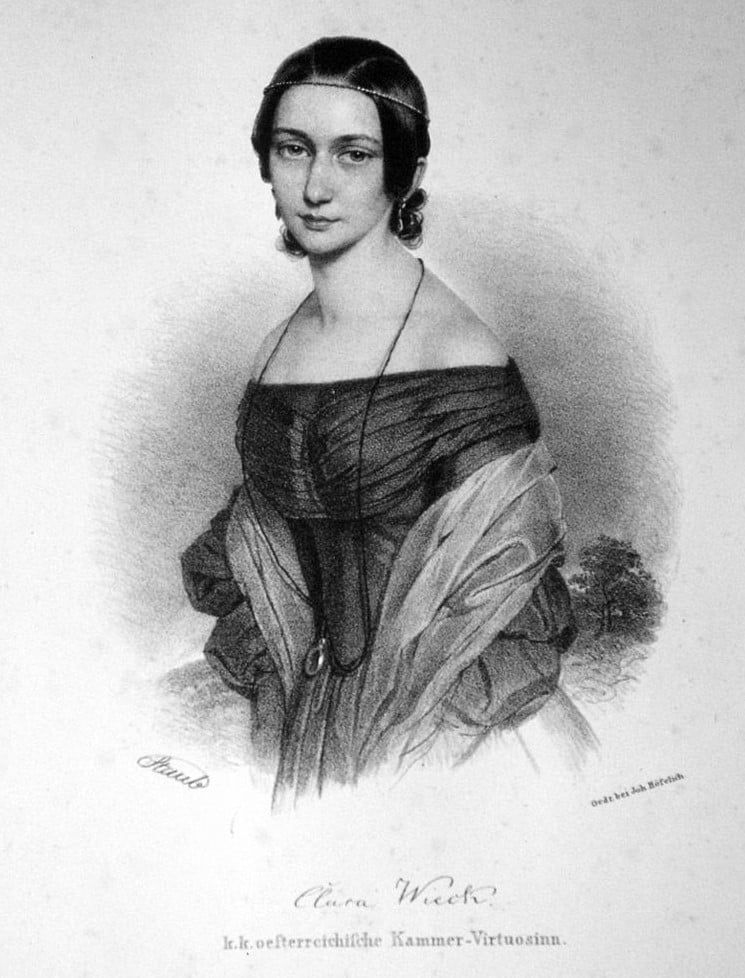
    I invite you to join me today in celebrating the bicentennial of the birth of Clara Schumann. Clara Schumann was born Clara Wieck on this date in 1819; she died in 1896.

    While she composed comparatively little herself, if we were to stack her manuscripts alongside those of her associates, Robert Schumann and Johannes Brahms, based on what survives, she really sold herself short.

    Still, there’s no underestimating her influence as a pianist. Not only was she praised for her imaginative and sensitive interpretations at the keyboard, as a successful performer, she was also able to keep enough food on the table to sustain her large family and to hold it all together when her mercurial husband slipped off the rails.

    For the last two decades of her life, she taught at the Hoch Conservatory in Frankfurt. This shot out tendrils in all directions, including to the Juilliard School, where one of her pupils taught Malcolm Frager and Bruce Hungerford.

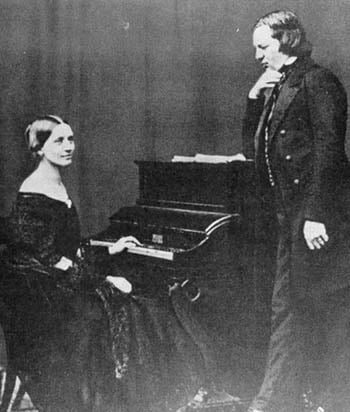
    Fortunately, enough of her music survives to put together a decent salute. We just heard her Piano Trio in G minor on “Music from Marlboro” on Wednesday. Today, we’ll enjoy her “Three Romances” for violin and piano, as well as her Konzertsatz in F minor, the first movement of an intended second piano concerto. We’ll also hear Robert Schumann’s “Variations on a Theme by Clara Wieck” (her maiden name) and “Widmung,” or “Dedication,” a song Robert composed for his new bride.

    I am celebrating women all month long. To this end, we’ll also hear Elisabetta Brusa’s opulent Schumann tribute, “Florestan.” Then at 6:00, we’ll hear film scores of Doreen Carwithen, alongside those of her decades-long partner and future husband, William Alwyn.

    I hope you’ll join me for Clara Schumann and more, from 3 to 6:00 EDT – with “Picture Perfect” following at 6 – on WWFM – The Classical Network and wwfm.org.

  • Clara Schumann: Genius, Wife, and Forgotten Composer

    Clara Schumann: Genius, Wife, and Forgotten Composer

    Clara Schumann was a musician of impeccable taste. Her insights and opinions helped mold the artistic development of her husband and also to a great extent that of Johannes Brahms, who frequented the Schumann house from the age of 20 and became a life-long friend. She was also a pianist of genius. She performed publicly to great acclaim for over six decades. It was through concertizing that she supported her unstable husband and eight children. Later in life, she also became a revered teacher.

    Her acceptance as performer and pedagogue were highly unusual for a woman of her time. She was a child prodigy, the daughter of Friedrich Wieck, who also taught Robert Schumann. Under her father’s tutelage, she demonstrated a marked facility in composition. She was also a better pianist than Robert, who, according to some accounts, had managed to wreck one of his hands through the use of a finger-strengthening device (an assertion Clara denied.)

    Having enjoyed such a promising start, it’s heartbreaking, then, to read Clara’s comment, confided to her diary in 1839, at the age of 20, “I once believed that I possessed creative talent, but I have given up on this idea. A woman must not desire to compose – there never yet has been one able to do it. Should I expect to be the one?”

    It’s especially sad, since composing gave her such pleasure. “There is nothing that surpasses the joy of creation,” she wrote. “if only because through it one wins hours of self-forgetfulness, when one lives in a world of sound.”

    Fortunately for us, we have her Piano Trio in G minor, and on this week’s “Music from Marlboro,” we’ll have the pleasure of hearing it performed at the 2005 Marlboro Music Festival by pianist Ieva Jokubaviciute, violinist Julianne Lee, and cellist Judith Serkin.

    Clara would have been 26 at the time of her Trio’s composition. She passed the summer of 1846 on the isle of Norderney, where she accompanied her husband during his convalescence following an attack of neurasthenia. While there, compounding the Schumanns’ misfortunes, Clara suffered a miscarriage. The completion of her Trio must have seemed like an especially welcome escape. A year later, Robert composed his first piano trio, Op. 63, which bears some striking similarities to his wife’s creation.

    We’ll round out the hour with Robert Schumann’s “Andante and Variations,” from 1849. Though written soon after the back-to-back masterpieces of the Piano Quintet and Piano Quartet, both in the key of E flat major, Schumann was less pleased with his new work. Part of the problem was in its unusual instrumentation, which called for two pianos, two cellos, and horn. Early performances in the Schumann home were so loud, it may have contributed to the composer’s disgust with the piece.

    Schumann withdrew the work from his catalogue, later revising it for two pianos at the suggestion of Felix Mendelssohn. He also altered the structure of piece, which he ruthlessly cropped. It was Brahms and Clara Schumann who reappraised the value of his original thoughts and resurrected the work in the form he had initially intended, twelve years after the composer’s death, giving it its first public performance in 1868. It is in this version that the piece is now most often heard.

    We’ll hear it performed at the 1985 Marlboro Music Festival by husband-and-wife pianists Claude Frank and Lilian Kallir, cellists Melissa Meeli and Peter Stumpf, and hornist Julie Landsman.

    It’s an all-Schumann hour, in advance of the Clara Schumann bicentennial (which falls on Friday), on the next “Music from Marlboro,” this Wednesday evening at 6:00 EDT, on WWFM – The Classical Network and wwfm.org.

    Marlboro School of Music and Festival: Official Page

  • Dvořák’s Early Genius at Marlboro Music Festival

    Dvořák’s Early Genius at Marlboro Music Festival

    It was in the autumn of 1877 that a 36 year-old Antonin Dvořák included his “Moravian Duets” with his application for an Austrian State grant for “young, talented and poor artists.” Still little known outside of his native Bohemia, Dvořák caught the interest of Johannes Brahms, who sat on the board of adjudication. Recognizing the younger man’s talent, Brahms recommended Dvořák to his German publisher, Fritz Simrock.

    Simrock’s edition of Dvořák’s duets proved to be so popular that it went into a second printing. (Even so, he did not pay the composer!) When that sold out, he requested that Dvořák write something akin to Brahms’ wildly successful “Hungarian Dances.” The resultant “Slavonic Dances” cemented Dvořák’s international fame.

    On this week’s “Music from Marlboro,” Dvořák pays his dues, with two early works that reveal his genius in utero.

    The Piano Quartet No. 1 in D major, Op. 23, was composed over a span of just eighteen days during the summer of 1875. Dvořák was 33 and probably already at work on the “Moravian Duets.”

    Though a product of his early maturity, Dvořák’s quartet is already imbued with the composer’s soon-to-be familiar “Czech national sound.” Not nearly as well known as the “American” String Quintet or the Piano Quintet in A major, it is nevertheless unmistakably from the same pen, with no shortage of memorable melodies and brimming with his indelible charm. The work didn’t hit print until 1880 (around the time of the second run of the “Moravian Duets”). Tellingly, it was not published by Simrock, but rather by Schlesinger, a Berlin rival.

    We’ll hear it performed at the 1969 Marlboro Music Festival by pianist and Marlboro co-founder Rudolf Serkin, violinist Shmuel Ashkenasi, violist Martha Strongin Katz, and cellist Robert Sylvester.

    The “Moravian Duets” grew out of songs Dvořák wrote specifically for domestic performance by a wealthy merchant and his wife, who also happened to be amateur singers. At the merchant’s request, Dvořák began by arranging Moravian national songs, but quickly segued into providing wholly original music for the traditional folk texts.

    Delighted with the results, the merchant paid for the duets’ first printing in Prague, prior to Christmas 1876. Further songs followed. The complete cycle of 23, for two voices and piano accompaniment, appeared as three separate sets, assigned to different vocal ranges, between 1875 and 1881.

    We’ll round out the hour with the four songs of the first of these, collected under Op. 20, in its final form, performed in Czech by soprano Mary Burgess and tenor John Humphrey, with pianist Luis Batlle – a commercial recording made for Columbia Masterworks as an offshoot of the 1966 Marlboro Music Festival.

    One of the advantages of being a “provincial” composer is that Dvorak was already a master by the time he was discovered. Discover these works from his early maturity on the next “Music from Marlboro,” this Wednesday evening at 6:00 EDT, on WWFM – The Classical Network and wwfm.org.

    Marlboro School of Music and Festival: Official Page

Tag Cloud

Aaron Copland (92) Beethoven (95) Composer (114) Film Music (120) Film Score (143) Film Scores (255) Halloween (94) John Williams (185) KWAX (229) Leonard Bernstein (100) Marlboro Music Festival (125) Movie Music (135) Opera (198) Philadelphia Orchestra (88) Picture Perfect (174) Princeton Symphony Orchestra (106) Radio (87) Ralph Vaughan Williams (85) Ross Amico (244) Roy's Tie-Dye Sci-Fi Corner (290) The Classical Network (101) The Lost Chord (268) Vaughan Williams (103) WPRB (396) WWFM (881)

DON’T MISS A BEAT

Receive a weekly digest every Sunday at noon by signing up here


RECENT POSTS