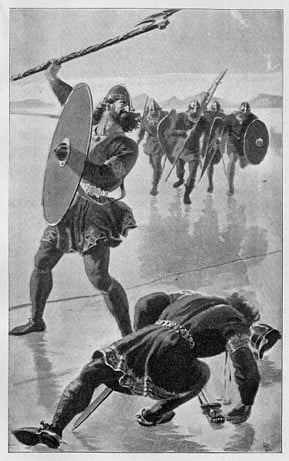
This week on “The Lost Chord,” brace yourself for Icelandic composer Jon Leif’s “Saga Symphony.” Scored for tuned anvils, stones, whip, shields of iron, leather, and wood, great wooden casks played by large hammers, and six ancient long horns, or lurs, the work is an intriguing blend of extravagance and austerity.
Leifs studied in Leipzig and wound up stranded in Nazi Germany for much of World War II. You’d think the National Socialists would have gone ape for this musical advocate of Norse heroism, but two things worked against him: the modernist language of much of his output, and the fact that his wife and children were Jewish. Also, he found Wagner repellent, asserting that Wagner completely misunderstood the essence and artistic tradition of the North. Public performances of Leif’s works were discouraged (and would have been impractical anyway). Under the circumstances, he preferred to attract as little attention to himself as possible. He found escape in rereading the Icelandic sagas, even as he was used for propaganda purposes to strengthen Germany’s relations with Scandinavia.
Leifs finally managed to obtain permission to leave Germany in 1944. Unfortunately, suspicion of Nazi associations further hindered acceptance of his music abroad. It was only with a series of compact disc recordings released on the Swedish label BIS, beginning in the 1990s, that Leifs – who died in 1968 – was revealed to be Iceland’s most important composer, with a voice as distinctive as any of his time.
Iceland of a hundred years ago was a very different place than it is now. Leifs didn’t hear his first orchestra until he traveled to Leipzig. The “Saga Symphony” is a direct response to Franz Liszt’s “A Faust Symphony,” a performance of which sent the young composer into ecstasies. He went home and immediately began work on the piece we’ll hear tonight. However, his own approach is quite different from Liszt’s. In terms of symphonic development, there is none to speak of. In its place are evocative fields of static harmonies.
Each of the work’s five movements is a character portrait of a hero from the Norse sagas: the vitriolic warrior Skarphéðinn Njálsson (Njál’s Saga), who hacks and hews with his battle axe; the strong-willed Guðrún Ósvífsdóttir (Saga of the Laxardals), who avenges herself against her husband’s killer; the latently heroic comic braggart and coward Björn of Mörk, who takes shelter behind the swashbuckler Kári Sölmundarson, as Kári avenges the deaths of Njál and his sons; Grettir Ásmundarson, who vanquishes the ghost of Glámr in a wrestling match, only to be haunted ever after; and the warrior-poet Tormod Kolbrunarskald (The Foster Brother’s Saga), who pulls an arrow from his heart and even in the throes of death formulates an intricate poem.
Greet your fate with courage and stoicism. Join me for “Liking the Viking,” on “The Lost Chord,” now in syndication on KWAX Classical Oregon!
——–
Clip and save the start times for all three of my recorded shows:
PICTURE PERFECT, the movie music show – Friday at 8:00 PM EST/5:00 PM PST
SWEETNESS AND LIGHT, the light music program – Saturday at 11:00 AM EST/8:00 AM PST
THE LOST CHORD, unusual and neglected rep – Saturday at 7:00 PM EST/4:00 PM PST
Stream them, wherever you are, at the link!
https://kwax.uoregon.edu
Tag: Jón Leifs
-

Explore Viking Lore Hear the Lur on Lost Chord
Experience the lore of the lur!
This week on “The Lost Chord,” we’ll embrace our hirsute stoicism with a “low key” (like Loki, get it?) hour of music inspired by the Icelandic Eddas.
Experience selections from “The Rheingold Curse,” after the “Volsunga Saga,” the earliest written sources of the ancient Germanic myths (including those of Sigurd, Loki, and Fafnir). We’ll hear them in imaginative, though scholarly-informed, realizations by Benjamin Bagby and the ensemble Sequentia.
Then we’ll turn to “The Creation of the World,” Part One of a bold, massive “Edda” oratorio by Icelandic composer Jón Leifs. Odin and his brothers defeat the giant Ymir, and from him fashion Earth, Sea, and Heavens, and soon after create the first man and woman from two trees. With its horn-helmeted, grunting choruses, laconic pounding, and austere poetry, this one will have you shouting for more mead.
Swan’s bone flutes, tuned rocks, and Nordic lurs (reconstructions of ancient Viking horns) lend “Cold Comfort,” on “The Lost Chord,” now in syndication on KWAX, the radio station of the University of Oregon!
Remember, KWAX is on the West Coast, so there’s a three-hour difference for those of you listening in the East. Here are the respective air-times for all three of my recorded shows (with East Coast conversions in parentheses):
PICTURE PERFECT, the movie music show – Friday on KWAX at 5:00 PM PACIFIC TIME (8:00 PM EST)
SWEETNESS AND LIGHT, the light music program – ALL NEW! – Saturday on KWAX at 8:00 AM PACIFIC TIME (11:00 AM EST)
THE LOST CHORD, unusual and neglected rep – Saturday on KWAX at 4:00 PM PACIFIC TIME (7:00 PM EST)
Stream all three, at the times indicated, by following the link!
-

Mount St Helens Blows Up The Lost Chord This Week
I suppose I should apologize on behalf of my former employer for all the smoke this week. You can’t burn a bridge that’s stood for 28 years without kicking up a little pollution.
That said, my unnatural dismissal from a certain local classical music station puts me in mind of some more natural disasters. With my broadcast base shifting for the time being to the Pacific Northwest and KWAX, the radio station of the University of Oregon, my thoughts drift back to 1980 and the fearsome eruption of Mount St. Helens. When Helens blew, she killed 57 people, reduced hundreds of square miles to wasteland, and caused over a billion dollars in damage. The most active volcano in the contiguous United States, Helens is situated only a three-hour drive north of Eugene (home of KWAX).
This week on “The Lost Chord” we’ll be dancing around the mouth of the volcano, as it were. Composer Alan Hovhaness was always acutely attuned to nature. For decades, he lived outside Seattle, where he enjoyed a fruitful relationship with the Seattle Symphony. Mountains, in particular, inspired a number of his more reverential works. Commenting on his best-known music, the Symphony No. 2, “Mysterious Mountain,” composed in 1955, he wrote, “Mountains are symbols, like pyramids, of man’s attempt to know God. Mountains are symbolic meeting places between the mundane and spiritual worlds.”
The friction of the natural and the transcendent certainly informs the progression of his Symphony No. 50, the “Mount St. Helens” Symphony, composed in 1983: from a sense of grandeur in the first movement, a prelude and fugue in praise of Helens; the placidity of Paradise Lake, the beauty of which disappeared forever; and the volcano itself, recalled in the third and final movement, most percussively rendered. The violence subsides, and the dawn hymn of the opening returns in triumph.
Hovhaness’ volcano symphony is like a walk in the park alongside the mad inspirations of Icelandic genius Jon Leifs. Leifs’ “Hekla,” from 1961, is probably the closest you’ll ever want to get to a volcanic eruption. Requiring 19 percussionists banging away on anvils, stones, sirens, plate bells, chains, shotguns, cannons, and a large wooden stump, it has been called the loudest piece of classical music ever written. For their own well-being, the performers were instructed to wear earplugs.
As a bonus, with what’s left of our hearing, we’ll also enjoy “Volcanic Eruption and Atonement” from Leifs’ ballet, “Baldr.”
In this graduation season, if there was a degree awarded for distinguished achievement in volcanology, these composers undoubtedly would have graduated “Magma Come Loudly.”
Prepare to be blown away, this Saturday on “The Lost Chord,” now in syndication on KWAX!
See below for streaming information.
Keep in mind, KWAX is on the West Coast, so there’s a three-hour difference for the Trenton-Princeton area. Here are the respective air-times of my shows (with East Coast conversions in parentheses):
PICTURE PERFECT, the movie music show – Friday on KWAX at 5:00 PACIFIC TIME (8:00 PM EDT)
THE LOST CHORD, unusual and neglected rep – Saturday on KWAX at 4:00 PACIFIC TIME (7:00 PM EDT)
Stream them here!
-

Leifs Saga Symphony Viking Weekend on WWFM
This Sunday night on “The Lost Chord,” Viking Weekend continues! Brace yourself for Icelandic composer Jon Leif’s “Saga Symphony.” Scored for tuned anvils, stones, whip, shields of iron, leather, and wood, great wooden casks played by large hammers, and six ancient long horns, or lurs, the work is an intriguing blend of extravagance and austerity.
Leifs studied in Leipzig and wound up stranded in Nazi Germany for much of World War II. You’d think the National Socialists would have gone ape for this musical advocate of Norse heroism, but two things worked against him: the modernist language of much of his output, and the fact that his wife and children were Jewish. Also, he found Wagner repellent, asserting that Wagner completely misunderstood the essence and artistic tradition of the North. Public performances of Leif’s works were discouraged (and would have been impractical anyway). Under the circumstances, he preferred to attract as little attention to himself as possible. He found escape in rereading the Icelandic sagas, even as he was used for propaganda purposes to strengthen Germany’s relations with Scandinavia.
Leifs finally managed to obtain permission to leave Germany in 1944. Unfortunately, suspicion of Nazi associations further hindered acceptance of his music abroad. It was only with a series of compact disc recordings released on the Swedish label BIS, beginning in the 1990s, that Leifs – who died in 1968 – was revealed to be Iceland’s most important composer, with a voice as distinctive as any of his time.
Iceland of a hundred years ago was a very different place than it is now. Leifs didn’t hear his first orchestra until he traveled to Leipzig. The “Saga Symphony” is a direct response to Franz Liszt’s “A Faust Symphony,” a performance of which sent the young composer into ecstasies. He went home and immediately began work on the piece we’ll hear tonight. However, his own approach to the symphony is quite different from Liszt’s. In terms of symphonic development, there is none to speak of. In its place are evocative fields of static harmonies.
Each of the work’s five movements is a character portrait of a hero from the Norse sagas: the vitriolic warrior Skarphéðinn Njálsson (Njál’s Saga), who hacks and hews with his battle axe; the strong-willed Guðrún Ósvífsdóttir (Saga of the Laxardals), who avenges herself against her husband’s killer; the latently heroic comic braggart and coward Björn of Mörk, who takes shelter behind the swashbuckler Kári Sölmundarson, as Kári avenges the deaths of Njál and his sons; Grettir Ásmundarson, who vanquishes the ghost of Glámr in a wrestling match, only to be haunted ever after; and the warrior-poet Tormod Kolbrunarskald (The Foster Brother’s Saga), who pulls an arrow from his heart and even in the throes of death formulates an intricate poem.
Greet your fate with courage and stoicism. Join me for “Liking the Viking,” this Sunday night at 10:00 EST, on WWFM – The Classical Network and wwfm.org
-

Viking Lore Sounds on “The Lost Chord”
Experience the lore of the lur!
This Sunday night on “The Lost Chord,” it’s a stoic start to the new year, with musical settings of the Icelandic Eddas.
Enjoy selections from “The Rheingold Curse,” after the “Volsunga Saga,” the earliest written sources of the ancient Germanic myths (including those of Sigurd, Loki, and Fafnir). We’ll hear them in imaginative, though scholarly-informed, realizations by Benjamin Bagby and the ensemble Sequentia.
Then we’ll turn to “The Creation of the World,” Part One of a bold, massive “Edda” oratorio by Icelandic composer Jón Leifs. Odin and his brothers defeat the giant Ymir, and from him fashion Earth, Sea, and Heavens, and soon after create the first man and woman from two trees. With its horn-helmeted, grunting choruses, laconic pounding, and austere poetry, this one will have you shouting for more mead.
It’s a new year of swan’s bone flutes, tuned rocks, and Nordic lurs (reconstructions of ancient Viking horns), on “Cold Comfort,” this Sunday night at 10:00 EST, on WWFM – The Classical Network and wwfm.org.
Tag Cloud
Aaron Copland (94) Beethoven (95) Composer (114) Film Music (150) Film Score (143) Film Scores (255) Halloween (102) John Williams (198) KWAX (233) Leonard Bernstein (105) Marlboro Music Festival (125) Movie Music (165) Mozart (91) Opera (215) Philadelphia Orchestra (90) Picture Perfect (174) Princeton Symphony Orchestra (110) Radio (90) Ross Amico (244) Roy's Tie-Dye Sci-Fi Corner (290) The Classical Network (101) The Lost Chord (269) Vaughan Williams (107) WPRB (397) WWFM (881)