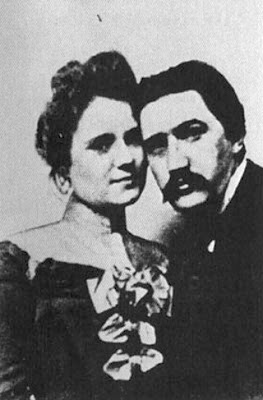
Josef Suk’s 30th year was a tragic one, marked by the deaths of both his young wife, Otilie, and her father, his former teacher, Antonín Dvořák. Not surprisingly, a sense of morbidity colors much of his mature output. The double-loss directly inspired Suk’s “Asrael Symphony,” named for the Angel of Death.
This Sunday night on “The Lost Chord,” we’ll take a look at “A Summer’s Tale,” the next step in Suk’s emotional rehabilitation. The work is a five-movement symphonic poem, the second of a four-part cycle that contemplates death and the meaning of life. More affirmative than the grim “Asrael,” which is full of pain, loss, and grief, “A Summer’s Tale” explores the healing powers of nature, in a score that at times reflects the epic romanticism of Gustav Mahler and at others the impressionism of Claude Debussy. It was composed over the course of just six weeks in the summer of 1907. Further tinkering took place over the next year-and-a-half. The work received its premiere in January of 1909.
Suk later described the theme of the piece as “finding a soothing balm in nature.” I hope you’ll join me as we clear a path to “Healing by Nature” – Josef Suk’s “A Summer’s Tale” – this Sunday night at 10:00 EDT, on WWFM – The Classical Network and wwfm.org.
It was the vision of Pierre de Coubertin, in founding the modern Olympic Games, that his competition would uphold the classical ideal of all-around excellence. This meant not only in athletics, but also in music and literature. This is what would elevate his Games above all other sports championships.
Unfortunately, even in 1896, the concept proved to be a hard sell. In fact, it wasn’t until 1912, in Stockholm, that Coubertin’s original plan received any kind of traction. That’s the year Riccardo Barthelemy, Caruso’s pianist, received a gold medal for his “Marcia trionfale olimpica” (“Olympic Triumphal March”).
It was not only the committee that proved to be suspicious of this particular aspect of the competition. The world’s great composers also demonstrably shied away. While undoubtedly well-intentioned, those who initiated the event had little experience in the arts. They were accustomed to judging speed and distance, as opposed to compositional excellence. Furthermore, the musical submissions were expected to be in some way sports-oriented. Composers love awards as much as anyone, but this particular contest, initiated in the Titanic year of 1912, seemed like a recipe for disaster.
By 1924, for the Olympiad in Paris, the committee managed to assemble a panel of 43 judges, some of them very reputable indeed, including Igor Stravinsky, Béla Bartók, and Maurice Ravel. Unfortunately, with so many chefs, they couldn’t come to a consensus – or perhaps harbored reservations about the quality of the entries – and no medal was awarded.
In 1928, the best they could muster was a bronze for Rudolph Simonsen, who later became director of the Royal Danish Academy of Music.
The most famous composer to participate in these Olympic competitions was Josef Suk – pupil and son-in-law of Antonin Dvořák – and even he only merited a silver in 1932.
Eventually, to cloak the embarrassment of not generating enough medals, the ranking system was replaced with “Honorable Mention.” It was hoped the category would continue to be attractive to promising young composers, but it virtually killed the possibility of drawing any big names.
Arts competitions remained part of the Olympic Games until 1948. Other categories included architecture, literature, painting, and sculpture. Ultimately, these competitions were discontinued because of concerns about the artists being professionals, in contrast to the amateur status of the athletes. A non-competitive art and cultural festival has been presented in conjunction with the games since 1952. A vast majority of the music composed for these Olympic competitions has never been recorded.
Rudolph Simonsen, Symphony No. 2 “Hellas” (1928 Bronze Medal winner)
Josef Suk, “Towards a New Life” (1932 Silver Medal winner)
Josef Suk’s 30th year was a tragic one, marked by the deaths of both his young wife, Otilie, and his former teacher, her father, Antonín Dvořák. Not surprisingly, a sense of morbidity colors much of his mature output. The double-loss directly inspired Suk’s “Asrael Symphony” (named for the Angel of Death).
This Sunday night on “The Lost Chord,” we’ll take a look at “A Summer’s Tale,” the next step in Suk’s emotional rehabilitation. The work is a five-movement symphonic poem, the second of a four-part cycle, that contemplates death and the meaning of life. More affirmative than the grim “Asrael,” which is full of pain, loss and grief, “A Summer’s Tale” explores the healing powers of nature, in a score that at times reflects the epic romanticism of Gustav Mahler and at others the impressionism of Claude Debussy. It was composed over the course of just six weeks in the summer of 1907. Further tinkering took place over the next year-and-a-half. The work received its premiere in January of 1909.
Suk later described the theme of the piece as “finding a soothing balm in nature.” I hope you’ll join me as I clear a path to “Healing by Nature” – Josef Suk’s “A Summer’s Tale” – this Sunday night at 10:00 EDT, on WWFM – The Classical Network and wwfm.org.
December 26. St. Stephen’s Day. The day King Wenceslas “looked out” and trudged through snow and wind and gathering darkness to bring flesh, wine and fuel to one of his needy subjects.
This afternoon on The Classical Network, we’ll salute the good king, whose legendary deeds were immortalized in the famous Christmas carol, with Josef Suk’s “Meditation on the Old Czech Hymn, ‘St. Wenceslaus.’” We’ll also acknowledge the Irish St. Stephen’s tradition of “hunting the wren.”
As stomachs and ear drums continue to be wassailed and assailed during this perhaps too merry season, we’ll also have plenty of music about banqueting and toys.
This week’s “Music from Marlboro” (6:00 EST) will feature evergreen works by Beethoven and Wagner.
It shouldn’t require the patience of a saint to enjoy the music, from 4 to 7 p.m. EST, on WWFM – The Classical Network and wwfm.org.
Josef Suk was the one-time pupil and eventual son-in-law of Antonin Dvořák. In fact, his early works very much reflect Dvořák’s influence, in sunny, romantic music full of nationalistic touches.
However, a double tragedy occurred in Suk’s 30th year, in 1905, when he lost both his father-in-law and his beloved wife – Dvořák’s older daughter – Otilie. The events directly inspired Suk’s “Asrael Symphony,” named for the Angel of Death. Not surprisingly, morbidity colors much of his mature output.
“A Summer’s Tale” is the next step in Suk’s emotional rehabilitation. The work is a five-movement symphonic poem, the second of a four-part cycle, which contemplates death and the meaning of life. More affirmative than the grim “Asrael,” which is full of pain, loss and grief, “A Summer’s Tale” explores the healing powers of nature, in a score that at times reflects the epic romanticism of Gustav Mahler and the impressionism of Claude Debussy. It was composed over the course of just six weeks in the summer of 1907. Further tinkering took place over the next year-and-a-half. The work received its premiere in January of 1909.
Suk later described the theme of the piece as “finding a soothing balm in nature.” Tune in tonight and see if you agree.
That’s “Healing by Nature” – Suk’s “A Summer’s Tale” – on “The Lost Chord,” this Sunday night at 10:00 EDT, on WWFM – The Classical Network and wwfm.org.
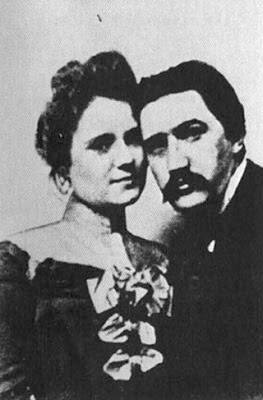
PHOTOS: Otilie Dvořáková and Josef Suk, in happier days