Tag: KWAX

  • Academy Awards Weekend: Film Music on KWAX

    Academy Awards Weekend: Film Music on KWAX

    We’re entering Academy Awards weekend, and the winner is… YOU!

    Why? Because I’ve recorded THREE BRAND NEW SHOWS for KWAX for your delectation.

    Regardless of how you feel about the current state of the industry or the awards ceremony itself, you have to concede, there’s quite a rich history of impressive music written for film. And the Academy Awards is always the perfect excuse to go excavating.

    I’ll be leaning heavily into the nostalgia, beginning today on PICTURE PERFECT. We’ll hear selections from what has been dubbed the greatest film music concert in history. Elmer Bernstein, Johnny Green, Bernard Herrmann, Henry Mancini, Alfred Newman, Alex North, David Raksin, Miklós Rózsa, Dimitri Tiomkin, Franz Waxman, and more turned out for the occasion – all of them to conduct their own music.

    They were joined by Mahalia Jackson, Andy Williams, and Jack Benny. What could only be described as a Hollywood Bowl superconcert was broadcast live over the CBS television network on September 25, 1963.

    Highlights were issued on what became a highly collectible LP. The content was expanded for a CD reissue on the Columbia Legacy label in 1995. However, based on my reading and the fact that I’m finding other selections in my personal library that were recorded at the venue on the same date, there’s still much that remains to be compiled. Put out whatever you’re holding back on a double-disc, please, Sony!

    On today’s show, we’ll hear ten musical selections. I hasten to add, not everyone mentioned will be represented; nor were they even included on the commercial recordings. Tune in to KWAX at 8:00 pm EST/5:00 pm PST. (See the streaming information below).

    Then be sure to join me tomorrow morning when I’ll present a potpourri of classic film themes on SWEETNESS AND LIGHT. Tune in sharp at 11:00 EST/8:00 PST to enjoy 90 seconds of introductory fanfares from the great studios of Hollywood’s Golden Age.

    Finally, also tomorrow, on THE LOST CHORD, it’s another in an occasional series of programs devoted to concert works by composers better known for their work in film. Among the featured works will be “Pas de Deux,” a concerto for violin, cello and orchestra, by James Horner (“Star Trek II: The Wrath of Khan,” “Braveheart,” “Titanic”), and the Concerto for Flute and String Orchestra by Jerome Moross (“The Big Countrty,” “The Cardinal,” “The Valley of Gwangi”). That show will stream Saturday at 7:00 pm EST/4:00 pm PST.

    That should give you plenty of time to load up on the popcorn and buffalo wings for Sunday night’s ceremony. Listen to all three of these NEWLY-RECORDED RADIO SHOWS, wherever you are, at the link!

    PICTURE PERFECT, the movie music show – Friday on KWAX at 5:00 PM PACIFIC TIME (8:00 PM EST)

    SWEETNESS AND LIGHT, the light music program – Saturday on KWAX at 8:00 AM PACIFIC TIME (11:00 AM EST)

    THE LOST CHORD, unusual and neglected rep – Saturday on KWAX at 4:00 PM PACIFIC TIME (7:00 PM EST)

    https://kwax.uoregon.edu/


    More about “the greatest film music concert in history”

    http://www.filmmusicsociety.org/news_events/features/2013/092313.html

  • Kapralova & Smyth: Forgotten Female Composers

    Kapralova & Smyth: Forgotten Female Composers

    This week on “The Lost Chord,” the focus will be on outstanding works by two extraordinary female composers, from comparatively early in their respective careers.

    Unfortunately, in the case of Vitězslava Kápralová (1915-1940), it was not to be a long one. One of the great hopes of Czech music, Kápralová undoubtedly would be much better known had she not died of tuberculosis at the age of 25. As it stands, her reputation is only beginning to emerge from the shadow of her teacher and lover, Bohuslav Martinu.

    Kápralová’s String Quartet was written while she was yet a student at the Prague Conservatory, where her teachers included Vitězslav Novák and Václav Talich. (She studied with Martinu later in Paris.) The work was completed in 1936, when Kápralová was about 21 years-old.

    More about Kápralová here, in this article written to mark her centenary in 2015:

    https://www.telegraph.co.uk/culture/music/classicalmusic/11365848/The-tragedy-of-Europes-great-forgotten-female-composer.html?fbclid=IwAR26f65euwM_lesL-fSWvTids3argkS6dbtmz5P3ruuP9cCYKUsn1F-IXC4

    Ethel Smyth (later DAME Ethel Smyth, 1858-1944) was one of the most vocal advocates of the women’s suffrage movement in England. She overcame early opposition to a career in music on the part of her father to receive the praise of George Bernard Shaw, who called her Mass “magnificent.”

    However, her works were often better-appreciated abroad. Her operas, in particular, were embraced in Germany. One of them, “Der Wald,” was the only opera by a woman composer mounted by New York’s Metropolitan opera for over a century!

    Smyth served time in prison for putting out the windows of politicians who opposed a woman’s right to vote. She also wrote for the cause “The March of the Women.” When Sir Thomas Beecham went to visit her in jail, he witnessed her conducting through the bars of her window with a toothbrush as her associates gathered for exercise in the courtyard.

    Smyth’s “Serenade in D” – a symphony in all but name – was her first orchestral score, composed in 1890, when she was about 32 years-old. In my opinion, it’s better than just about anything composed by her contemporary, Sir Hubert Parry, and much more compelling than the symphonies of Sir Charles Villiers Stanford.

    More about Smyth here, in this piece put together in connection with a revival of her opera, “The Wreckers,” by the great Leon Botstein:

    https://www.npr.org/sections/deceptivecadence/2015/07/23/410033088/one-feisty-victorian-womans-opera-revived?fbclid=IwAR0XG4Np46RjSJWuUIYwENZ9zFIdkoQYGL7vncYT7i5qFK5_sREFzI56gKw

    I hope you’ll join me for music by these two extraordinary women. That’s “A Woman’s Place is in the Concert Hall” on “The Lost Chord,” now in syndication on KWAX, the radio station of the University of Oregon!


    Remember, KWAX is on the West Coast, so there’s a three-hour difference for those of you listening in the East. Here are the respective air-times for all three of my recorded shows (with East Coast conversions in parentheses):

    PICTURE PERFECT, the movie music show – Friday on KWAX at 5:00 PM PACIFIC TIME (8:00 PM EST)

    SWEETNESS AND LIGHT, the light music program – ALL NEW! – Saturday on KWAX at 8:00 AM PACIFIC TIME (11:00 AM EST)

    THE LOST CHORD, unusual and neglected rep – Saturday on KWAX at 4:00 PM PACIFIC TIME (7:00 PM EST)

    Stream all three, at the times indicated, by following the link!

    https://kwax.uoregon.edu/


    Vitězslava Kápralová honored on a postage stamp; Ethel Smyth taken into custody

  • Smetana’s Sweetness Light for 200th Anniversary

    Smetana’s Sweetness Light for 200th Anniversary

    Sadly, even by “great composers” standards, Bedřich Smetana didn’t get to enjoy much in the way of sweetness or light. On the contrary, he suffered much tragedy and turbulence in his life – untimely deaths of family and friends, political instability, an unhappy second marriage, chronic illness, deafness, madness, and his own early demise at the age of 60.

    But he is celebrated as the founder of a Czech national school in music, the composer of abundant characteristic dances and other folk-inflected pieces. So for the 200th anniversary of his birth, on March 2, 1824, we’ll honor these aspects of his legacy with an hour of his “lighter” works.

    Of course, not all of Smetana’s music can characterized as sweet OR light. He was an admirer and acolyte of Franz Liszt, and there is often a substantial Wagnerian influence, in some of his operas, especially. Some of the Czech dances we’ll enjoy wed Bohemian folk tradition with knuckle-busting keyboard Romanticism. And of the operas, we have but one very brief selection, the famous polka from “The Bartered Bride” – however taken from a complete recording of the work, so we’ll get to experience it from a fresh perspective, with the rarely-heard chorus.

    Interestingly, the surname Smetana is also the word for a kind of cream, frequently of the sour variety, or perhaps a crème fraîche. I assure you, the emphasis this week will be on “Sweet Cream,” for the 200th anniversary of the composer’s birth.

    It will be tragedy tomorrow, comedy today, on “Sweetness and Light,” this Saturday morning at 11:00 EST/8:00 PST, exclusively on KWAX, the radio station of the University of Oregon!

    Enjoy it, wherever you are, here:

    https://kwax.uoregon.edu/


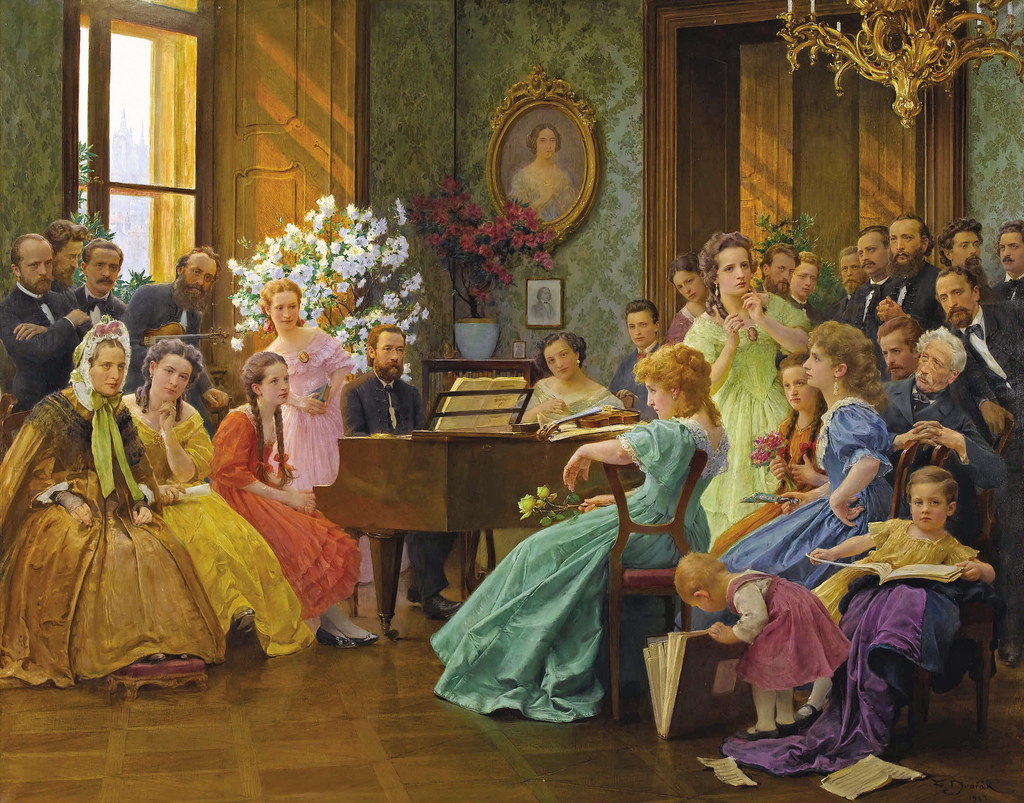
    IMAGE: Bedřich Smetana, babe-magnet

  • Rediscovering Black Composers

    Rediscovering Black Composers

    Time was, one really had to scrape to pull together a good Black History program. My, how things have changed! The past few years have seen an explosion of recordings and wider exposure for composers once known mostly to record collectors. Who knew that Florence Price would one day be played everywhere?

    This week on “Sweetness and Light,” I feel sheepish even making it a two-parter, as I’m still merely skating across the surface. But it is, after all, a light music show.

    Enjoy a second cup of coffee with Afro-British composer Samuel Coleridge-Taylor; the “Dean of Afro-American composers,” William Grant Still; former slave “Blind Tom” Wiggins (allegedly once the highest-paid pianist of the 19th century); Philadelphia-born bugle virtuoso Francis Johnson (including his “Princeton Gallopade”); and Duke Ellington.

    Next year, maybe I’ll make it a four-parter. Or better yet, be more conscious about including more of this music throughout the year. I try, but I can’t tell you how many times things get cut, so that I can fit it all into an hour. (Apologies to you, Scott Joplin, Eubie Blake, and Edmond Dédé!)

    Good music is not a black and white issue. I hope you’ll join me for another “Sweetness and Light,” music calculated to charm and to cheer. It’s part two of “Black and Light,” this Saturday morning at 11:00 EST/8:00 PST, exclusively on KWAX, the radio station of the University of Oregon!

    Listen to it, wherever you are, at the link:

    https://kwax.uoregon.edu/


    PHOTO: Have coffee with the Duke

  • Gilded Age Novels on Film A Picture Perfect Series

    Gilded Age Novels on Film A Picture Perfect Series

    The opening scene of Martin Scorsese’s “The Age of Innocence,” in which Newland Archer (Daniel Day-Lewis) first glimpses his cousin, Ellen Olenska, during a performance of Gounod’s “Faust,” was actually shot at the Academy of Music in Philadelphia. I remember the call for anyone with a tux to come down to the Academy so that they could fill out the balconies with extras. Sadly, I had to work (not that I owned a tux).

    “The Age of Innocence” is but one of the films we’ll be treating this week on “Picture Perfect,” as the focus will be on adaptations from novels of, or about, the Gilded Age. “The Gilded Age” was a term coined by none other than Mark Twain to describe the era extending roughly from the end of Reconstruction (following the Civil War) to the turn of the 20th century. He didn’t mean it as a compliment. A gilded age is one which conceals serious social problems beneath a veneer of gold.

    “The Heiress” (1949) was adapted from a play by Ruth and Augustus Goetz, which in turn was based on the Henry James’ novel, “Washington Square.” Olivia De Havilland is the “plain Jane” heiress of the title, Ralph Richardson her overbearing father, and Montgomery Clift, the adventurer who may or may not be out for her fortune. De Havilland won an Oscar for her portrayal, as did the music, by Aaron Copland.

    “The Age of Innocence” (1993) is based on a novel by one-time James correspondent and close friend, Edith Wharton. The book was published in 1920, but looks back to the 1870s, its story dealing with the impending marriage of an upper class couple and the appearance of a disreputable interloper who threatens their happiness. The title is an ironic play on the outward manners of New York society, in contrast to its inward machinations. The novel earned a Pulitzer Prize, the first Pulitzer awarded to a woman. The film was something of a curve ball from director Martin Scorsese, who made his name on meaner streets. Veteran composer Elmer Bernstein provided a lovely, Brahmsian score.

    “The Magnificent Ambersons” (1942) is based on another Pulitzer Prize winner, this time by Booth Tarkington, from 1918. The novel is part of trilogy that tells the story of the declining fortunes of three generations of an aristocratic Midwestern family, between the end of the Civil War and the early years of the 20th century. With industrialism on the rise, the Ambersons’ “old money” wealth and prestige wane.

    “Ambersons” became the basis for only the second film directed by Orson Welles. By that time, however, the fall-out from “Citizen Kane” caused the film to be removed from Welles’ control and re-cut by the studio, shaving a full hour off the original running time. It says something about the quality of the film that it yet remains in itself a magnificent achievement.

    The score was by Bernard Herrmann, CBS staff composer from Welles’ radio days. Herrmann had followed Welles to Hollywood to provide the music for “Citizen Kane.” Like the film, the score was drastically edited, with half the music removed. The famously irascible Herrmann, who had just written his Academy Award winning music for “The Devil and Daniel Webster,” was so angry that he threatened legal action if his name was not removed from the credits.

    The action of “Mr. Skeffington” (1944), based on a 1940 novel by Elizabeth von Arnim, begins at a point some consider the end of the Gilded Age, the eve of World War I. Bette Davis stars as a woman so enamored of her own beauty and the suitors it attracts that she fails to value the affections of the man who eventually becomes her husband. Mr. Skeffington, played by Claude Rains, is a Jewish financier, riding high in the ‘teens, but his fortunes change when he’s caught in Europe during the rise of the Nazis.

    Both Davis and Rains earned Academy Award nominations for their work. The vivid score is by Franz Waxman. Davis was going through a period of emotional turmoil during the filming, so that she was allegedly insufferable to everyone during the entire shoot. Someone finally poisoned her eyewash. When the police questioned the director, Vincent Sherman, he wished them good luck with their investigation. “If you asked everyone on the set who would have committed such a thing, everyone would raise their hand!”

    Certainly all that glitters is not gold, this week. We peel back the veneer of prosperity with “Novels of the Gilded Age,” on “Picture Perfect,” music for the movies, now in syndication on KWAX, the radio station of the University of Oregon!


    Remember, KWAX is on the West Coast, so there’s a three-hour difference for those of you listening in the East. Here are the respective air-times for all three of my recorded shows (with East Coast conversions in parentheses):

    PICTURE PERFECT, the movie music show – Friday on KWAX at 5:00 PM PACIFIC TIME (8:00 PM EST)

    SWEETNESS AND LIGHT, the light music program – ALL NEW! – Saturday on KWAX at 8:00 AM PACIFIC TIME (11:00 AM EST)

    THE LOST CHORD, unusual and neglected rep – Saturday on KWAX at 4:00 PM PACIFIC TIME (7:00 PM EST)

    Stream all three, at the times indicated, by following the link!

    https://kwax.uoregon.edu/

Tag Cloud

Aaron Copland (94) Beethoven (95) Composer (114) Film Music (149) Film Score (143) Film Scores (255) Halloween (97) John Williams (197) KWAX (232) Leonard Bernstein (105) Marlboro Music Festival (125) Movie Music (164) Mozart (91) Opera (215) Philadelphia Orchestra (90) Picture Perfect (174) Princeton Symphony Orchestra (110) Radio (90) Ross Amico (244) Roy's Tie-Dye Sci-Fi Corner (290) The Classical Network (101) The Lost Chord (269) Vaughan Williams (107) WPRB (397) WWFM (881)

DON’T MISS A BEAT

Receive a weekly digest every Sunday at noon by signing up here


RECENT POSTS