Tag: KWAX

  • Doomed Love Anthems to Avoid Valentine’s Day

    Doomed Love Anthems to Avoid Valentine’s Day

    Nearly as much as New Year’s Eve, Valentine’s Day rankles me. I resent the Hallmark cards and the convenience store chocolates and the commerce-driven peer pressure. I feel much more at home with Mieczyslaw Karlowicz.

    Karlowicz was born in 1876. By all accounts one of the gloomiest of composers, his outlook and philosophy might well be described as pessimism leavened with pantheism. In Karlowicz’s melancholy world, all love is unfulfilled or doomed; all existence leads to tragedy and destruction. In high romantic fashion, he contemplated suicide. The only place he seemed to find solace was in his beloved Tatras. He once noted, “Atop a high mountain, I become one with the surrounding space. I cease to feel individual. I can feel the mighty, everlasting breath of eternal being.”

    It is perhaps a kind of poetic justice that a life spent cultivating suicidal despair, and raising it to a level of high art, would be cut short, when Karlowicz was killed in an avalanche in 1909, aged only 32 years – a most fitting end for this pantheist with fatalistic tendencies.

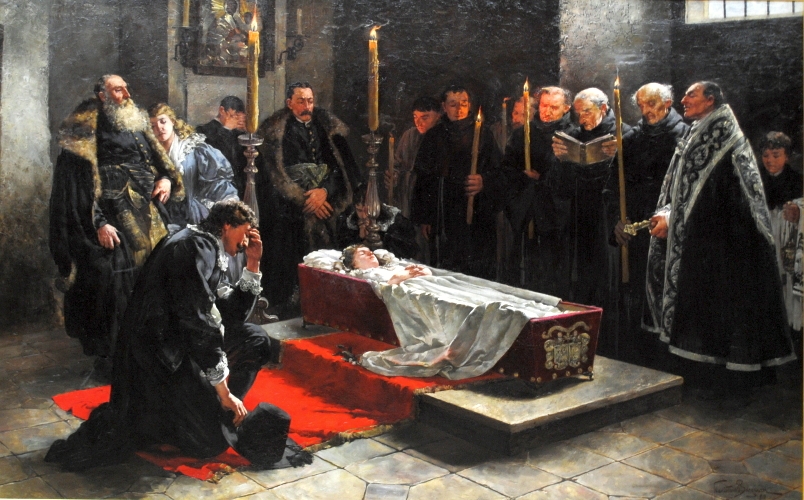
    This week on “The Lost Chord,” we’ll hear one of the six symphonic poems upon which Karlowicz’s reputation, in large part, is based. “Stanislaw and Anna Oswiecim,” inspired by a painting of Stanislaw Bergmann, evokes a tale of forbidden love between brother and sister, ending in inevitable tragedy.

    We’ll follow that with what has been cited as the most performed concerto of the 20th century. Yet, despite its multiple recordings, it is still far from being universally recognized in the West. “The Butterfly Lovers,” for violin and orchestra, is based on an ancient Chinese tale, about the young daughter of a rich landlord, who disguises herself as a boy in order to get an education. Her secret is discovered by a classmate. The two fall in love. However, the girl’s parents have promised her in marriage to a wealthy man. The lovelorn boy dies of grief. On the day of her wedding, the girl passes the boy’s tomb, which opens to receive her. She hurls herself inside, and the lovers emerge as butterflies fluttering freely in the air. The tale has been described as a Chinese “Romeo and Juliet.”

    The concerto was an enormous success at its premiere, in 1959. However, due to the vagaries of totalitarianism, the work was reviled during the Cultural Revolution, condemned for its western influences and evocations of feudal China. Within five years, everyone associated with the work was in prison. The music was branded “bourgeois,” and the composers publicly accused of crimes worse than murder. One of the creators, Chen Gang, spent two years in prison, then several more years under house arrest at the Shanghai Conservatory, with manual labor in the mornings and self-criticism sessions in the afternoons. The soloist in the concerto’s first performance, He Zhanhao, is given co-credit for the work’s composition.

    It was after the Cultural Revolution that “The Butterfly Lovers” really took flight (if you’ll pardon the expression). It has been called the “Tchaikovsky Violin Concerto of the East.”

    I hope you’ll join me for an hour of musical expressions of doomed love, this week – “Valentines, Nay!” – now in syndication on KWAX, the radio station of the University of Oregon!


    Remember, KWAX is on the West Coast, so there’s a three-hour difference for those of you listening in the East. Here are the respective air-times for all three of my recorded shows (with East Coast conversions in parentheses):

    PICTURE PERFECT, the movie music show – Friday on KWAX at 5:00 PM PACIFIC TIME (8:00 PM EST)

    SWEETNESS AND LIGHT, the light music program – ALL NEW! – Saturday on KWAX at 8:00 AM PACIFIC TIME (11:00 AM EST)

    THE LOST CHORD, unusual and neglected rep – Saturday on KWAX at 4:00 PM PACIFIC TIME (7:00 PM EST)

    Stream all three, at the times indicated, by following the link!

    https://kwax.uoregon.edu/


    PHOTO: “Stanislaw Oswiecim at the Body of Anna Oswiecimowna” (1888) by Stanislaw Bergmann

  • Valentine’s Day Music KWAX Sweetness and Light

    Valentine’s Day Music KWAX Sweetness and Light

    This morning on KWAX, it’s flowers and chocolate for breakfast. I’ll do my best to indulge your sweet tooth and lend a serotonin boost with a special Valentine’s Day sampler.

    Luxuriate with an assortment of decadent Fritz Kreisler violin bonbons, a suite from Lord Berners’ ballet “Cupid and Psyche,” Victor Herbert’s orchestration of Franz Liszt’s “Liebestraum,” Henry Mancini’s arrangement of Nino Rota’s “Love Theme from Romeo and Juliet,” and some romantic reveries by Gilbert & Sillivan, Charles Ancliffe, and Leonard Bernstein.

    Better limber up those lips. It will be an hour of musical confections for Valentine’s Day on “Sweetness and Light,” this Saturday morning at 11:00 EST/8:00 PST. Hear it exclusively on KWAX, the radio station of the University of Oregon!

    You can stream it, wherever you are, at the link:

    https://kwax.uoregon.edu/

  • Doomed Love Movie Music on KWAX Radio

    Doomed Love Movie Music on KWAX Radio

    There’s no love like doomed love. We all know it’s true. Happily ever after is fine for the neighbors. The rest of us flock to “Titanic,” “Casablanca,” and “The Umbrellas of Cherbourg.” The one that got away hangs heaviest on the heart.

    In accordance with Gothic convention, nothing’s hotter than when two people love one another so intensely, they destroy themselves, each other, and everyone else around them. If impediments fan the flames of desire, then death is the greatest impediment of all.

    This week on “Picture Perfect,” it’s an hour of star-crossed lovers who remain connected beyond the mortal plane.

    Join me for selections from “Somewhere in Time” (John Barry), “The Ghost and Mrs. Muir” (Bernard Herrmann), “Always” (John Williams), and “Wuthering Heights” (Alfred Newman).

    If you can’t stand the heat, stay out of the kitchen. We’ll be fanning the flames of desire on “Picture Perfect,” music for the movies, now in syndication on KWAX, the radio station of the University of Oregon!


    Remember, KWAX is on the West Coast, so there’s a three-hour difference for those of you listening in the East. Here are the respective air-times for all three of my recorded shows (with East Coast conversions in parentheses):

    PICTURE PERFECT, the movie music show – Friday on KWAX at 5:00 PM PACIFIC TIME (8:00 PM EST)

    SWEETNESS AND LIGHT, the light music program – ALL NEW! – Saturday on KWAX at 8:00 AM PACIFIC TIME (11:00 AM EST)

    THE LOST CHORD, unusual and neglected rep – Saturday on KWAX at 4:00 PM PACIFIC TIME (7:00 PM EST)

    Stream all three, at the times indicated, by following the link!

    https://kwax.uoregon.edu/

  • Dacapo Records Rediscovering Danish Classics

    Dacapo Records Rediscovering Danish Classics

    Dacapo Records, the self-described “Danish National label,” was founded in 1989 to promote the classical music of Denmark. Danish music composed over a period of a thousand years forms the core of the Dacapo discography. This week on “The Lost Chord,” I hope you’ll “Dane” to join me for representative works by Emil Reesen and Asger Hamerik.

    Reesen made his mark in ballet, opera, and film score. He was also a concert pianist, who studied with Siegfried Langgaard, a pupil of Franz Liszt. In 1927, he was appointed conductor of the Danish Radio Symphony Orchestra. In 1931, he also began work as a ballet conductor at the Royal Danish Theatre. Later in life, he conducted the Vienna Symphony and made recordings with the Berlin Philharmonic.

    Reesen is probably best-known for his operetta “Farinelli.” We’ll hear his 1928 “Variations on a Theme by Franz Schubert” (only a few days after Schubert’s birthday anniversary on January 31st).

    Asger Hamerik studied at home with J.P.E. Hartmann and Niels Wilhelm Gade, in Berlin with Hans von Bulow, and in Paris with Hector Berlioz. Berlioz would remain a lasting influence, as would Dukas and Franck.

    Hamerik went on to serve as director of the Peabody Institute in Baltimore for over a quarter century (1871-98). Many of his large-scale orchestral works were first performed by the Peabody orchestra.

    He returned to Denmark in 1900. In his lifetime, he was considered the best-known Danish composer after Gade. (Things changed in a hurry with the rise of Carl Nielsen.)

    We’ll hear his final symphony, the Symphony No. 7 – the “Choral” Symphony – from 1897, a work that drew comparisons to the works of Mahler for its sheer size. Its first performance in Baltimore employed hundreds of musicians.

    I hope you’ll join me, as Danish music makes its mark this week, on “Denmarketing” – recordings from the Dacapo Records catalogue – on “The Lost Chord,” now in syndication on KWAX, the radio station of the University of Oregon!


    Remember, KWAX is on the West Coast, so there’s a three-hour difference for those of you listening in the East. Here are the respective air-times for all three of my recorded shows (with East Coast conversions in parentheses):

    PICTURE PERFECT, the movie music show – Friday on KWAX at 5:00 PM PACIFIC TIME (8:00 PM EST)

    SWEETNESS AND LIGHT, the light music program – ALL NEW! – Saturday on KWAX at 8:00 AM PACIFIC TIME (11:00 AM EST)

    THE LOST CHORD, unusual and neglected rep – Saturday on KWAX at 4:00 PM PACIFIC TIME (7:00 PM EST)

    Stream all three, at the times indicated, by following the link!

    https://kwax.uoregon.edu/


    BONUS: Emil Reesen conducts the “Dance of the Cockerels” from Nielsen’s “Maskarade”

  • Mendelssohn’s Spring Song & More

    Mendelssohn’s Spring Song & More

    How many times have you heard Felix Mendelssohn’s “Spring Song” parodied, in cartoons or otherwise?

    Yesterday, Punxsutawney Phil prognosticated an early spring, and today is Mendelssohn’s birthday (born on this date in 1809), so conditions are ripe to give it another listen. You’ll have your chance this morning on “Sweetness and Light.”

    A selection of Mendelssohn’s “Songs without Words” (of which “Spring Song” is the most famous) will be offered, played by pianist Daniel Barenboim, as will one of the composer’s delightful string symphonies, written at the tender age of 12.

    I will always associate “War March of the Priests” with the organ arrangement played by Vincent Price under the opening credits of “The Abominable Dr. Phibes.” We’ll hear it performed by Arthur Fielder and the Boston Pops. Also featured will be music from “A Midsummer Night’s Dream,” freely adapted for a 1935 film (starring James Cagney, Olivia de Havilland, and Mickey Rooney) by Erich Wolfgang Korngold.

    Finally, we’ll enjoy two takes on the “Wedding March,” one in a paraphrase by Franz Liszt, given the Vladimir Horowitz treatment, and the other in a zany performance by Lara St. John’s polka band, Polkastra, that would have made Spike Jones proud.

    I hope you’ll join me for an hour of felicitous Mendelssohn on “Sweetness and Light.” It will put a spring in your step and a song in your heart, when you tune in this morning at 11:00 EST/8:00 PST. Hear it exclusively on KWAX, the radio station of the University of Oregon!

    Stream it, wherever you are, at the link:

    https://kwax.uoregon.edu/


    While you’re waiting, here’s “Spring Song” (1931) by future Disney animator Cy Young. Back when cartoons were cartoons!

    Happy birthday, Felix Mendelssohn!

Tag Cloud

Aaron Copland (92) Beethoven (95) Composer (114) Film Music (123) Film Score (143) Film Scores (255) Halloween (94) John Williams (187) KWAX (229) Leonard Bernstein (101) Marlboro Music Festival (125) Movie Music (138) Opera (202) Philadelphia Orchestra (89) Picture Perfect (174) Princeton Symphony Orchestra (106) Radio (87) Ralph Vaughan Williams (85) Ross Amico (244) Roy's Tie-Dye Sci-Fi Corner (290) The Classical Network (101) The Lost Chord (268) Vaughan Williams (103) WPRB (396) WWFM (881)

DON’T MISS A BEAT

Receive a weekly digest every Sunday at noon by signing up here


RECENT POSTS