Tag: Leos Janacek

  • Janáček Sci-Fi Opera & A Hi-Fi Crossword

    Janáček Sci-Fi Opera & A Hi-Fi Crossword

    On Leoš Janáček’s birthday, I recollect that I was on my way to see “The Makropulos Case” at the Metropolitan Opera a number of years ago, when my car broke down on the New Jersey Turnpike. I never did get to see it. Janáček’s 1925 opera – based on a play by Karel Čapek, author of the novel “War with the Newts” and the play “R.U.R.” (credited with introducing the word “robot”) – is about a 337-year-old woman who, thanks to an elixir, is preserved in the flower of youth, but comes to regard life with clinical detachment.

    This is not Janáček’s only science fiction opera. Less-known, perhaps, is Janáček’s “The Excursions of Mr. Brouček to the Moon and to the 15th Century” – actually more of a fantasy, I suppose.

    These got me pondering, and not for the first time, the “lowly” genre of science fiction and its unlikely influence on the high art of classical music. The topic is still fresh in my mind from having recently revisited Karl-Birger Blomdahl’s 1959 opera “Aniara,” in which a journey to Mars goes horribly wrong, thanks to, of all things, a good old-fashioned Swedish celebration of Midsummer.

    During the pandemic in 2020, one of the things that kept me mentally engaged while doing menial chores around the house was compiling clues for a weekly crossword puzzle that I would post on Sunday mornings. The topic for the first week of October was “Hi-Fi Sci-Fi.”

    I know tomorrow is the 4th of July and the weekend is bound to be a busy one for many, but if you’re interested in bookmarking it for later, you’ll find a link to the puzzle below. Both Janáček operas (and “Aniara”) are among the clues.

    To fill out the puzzle, follow the link and select “solve online” at the bottom of the page. You’ll then be able to type directly into the squares. Once you feel you’ve exhausted the puzzle, you’ll find the solutions by clicking on “Answer Key PDF.”

    Test your knowledge of “Hi-Fi Sci-Fi” here:

    https://www.armoredpenguin.com/crossword/Data/2020.10/0407/04073509.417.html

    Happy birthday, Leoš Janáček!


    IMAGES (clockwise from upper left): Janáček; art deco stage design for “The Makropulos Case;” art nouveau cover art for libretto to “The Excursions of Mr. Brouček;” Čapek’s “Makropulos” novel

  • Kafka Janáček Birthday Connection Brod’s Legacy

    Kafka Janáček Birthday Connection Brod’s Legacy

    Franz Kafka (1883-1924) and Leoš Janáček (1854-1928) were both born on this date. The two apparently never met, but beyond their common nationality (Czech), they shared an association with Max Brod. Brod was Kafka’s friend and literary executor, who ignored the writer’s explicit instructions to burn his work, opting instead to have it published. He also did much to promote Janáček and disseminate his music. He translated the libretti for some of the composer’s operas and wrote the first Janáček biography. Here Brod memorializes Janáček in an obituary he wrote in 1928:

    https://musiksalon.universaledition.com/en/article/remembering-leos-janacek

    An article about Kafka and music:

    https://www.theguardian.com/books/2012/oct/05/kafka-was-author-unmusical-will-self

    More on the subject:

    http://www.kafka.org/index.php?aid=247

    A fragment of a film inspired by Kafka’s “The Metamorphosis” by Philadelphia-born University of the Arts graduates, the Brothers Quay, set to music by Janáček:

    More about the project from the Museum of Modern Art:

    https://www.moma.org/explore/inside_out/2013/01/04/the-quay-brothers-the-metamorphosis-by-franz-kafka/

    An earlier Quay film, “Leoš Janáček: Intimate Excursions”


    PHOTO: A Quay window into Janáček

  • Milan Kundera Dies Author of *Unbearable Lightness*

    Milan Kundera Dies Author of *Unbearable Lightness*

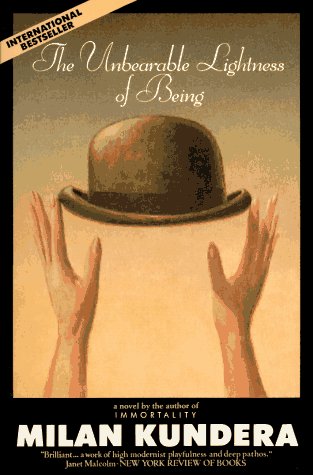
    The Czech writer Milan Kundera has died. His father was concert pianist and musicologist Ludvik Kundera, a colleague of Leoš Janáček. Ludvik headed the Janáček Music Academy in Brno from 1948 to 1961.

    Milan himself had considered a career in music, but instead gravitated toward literature. After he was busted down by the Communist Party for his subversive views, he supplemented his income as a jazz musician. He eventually fled Czechoslovakia in 1975 to make Paris his home.

    There was plenty of Janáček on the soundtrack of Philip Kaufman’s film adaptation of Kundera’s most famous novel, “The Unbearable Lightness of Being,” which starred Daniel Day Lewis, Juliette Binoche, and Lena Olin. Kundera described his novels as polyphonic symphonies, and he likened “The Book of Laughter and Forgetting” to a set of Beethoven variations.

    For a time, he taught film theory at Prague’s Academy of Performing Arts. Among his students was Miloš Forman, who would go on to direct the Academy Award winning adaptation of Peter Schaffer’s play, “Amadeus.”

    “They [human lives] are composed like music,” Kundera observes in “The Unbearable Lightness of Being.” “Guided by his sense of beauty, an individual transforms a fortuitous occurrence (Beethoven’s music, death under a train) into a motif, which then assumes a permanent place in the composition of the individual’s life. Anna could have chosen another way to take her life. But the motif of death and the railway station, unforgettably bound to the birth of love, enticed her in her hour of despair with its dark beauty. Without realizing it, the individual composes his life according to the laws of beauty even in times of greatest distress.

    “It is wrong, then, to chide the novel for being fascinated by mysterious coincidences (like the meeting of Anna, Vronsky, the railway station, and death or the meeting of Beethoven, Tomas, Tereza, and the cognac), but it is right to chide man for being blind to such coincidences in his daily life. For he thereby deprives his life of a dimension of beauty.”

    At the time of his death, Kundera was 94-years-old.


    Kundera’s obituary in the New York Times

    https://www.nytimes.com/2023/07/12/world/europe/milan-kundera-dead.html

    Trailer for “The Unbearable Lightness of Being”

    The soundtrack

    https://en.wikipedia.org/wiki/The_Unbearable_Lightness_of_Being_(soundtrack)#:~:text=The%20soundtrack%20is%20composed%20of,Jarmila%20%C5%A0ul%C3%A1kov%C3%A1%20and%20Vojt%C4%9Bch%20Jochec.

    Once again, I neglected to observe Janáček’s birthday this year. (Janáček was born on July 3, 1854.) Here I celebrate in 2019:

  • Czech Composers’ Illicit Love Affairs

    Czech Composers’ Illicit Love Affairs

    After 28 years of intimacy, I imagine there are moments when any relationship can feel strained. Without proper maintenance, even the strongest edifice can develop fissures. Lack of appreciation, lack of trust, unapologetic exploitation, and downright condescension hasten the erosion of kindly feelings.

    I’m not saying that was the case with these Czech composers, but only just emerging from the slight regard I experienced at WWFM, after nearly three decades of sharing my life’s blood, I feel an especial sympathy for those who were compelled to move on.

    Happily, I have found a loving home at KWAX, the radio station of the University of Oregon, where my shows continue to air in syndication, while I regroup, record, and reestablish my presence.

    All this is preamble to my thesis this week on “The Lost Chord,” on which I’ll present two examples of Czech composers whose newfound love resulted in flowering creativity.

    Anyone at all acquainted with the life story of Leoš Janáček knows about his relationship with Kamila Stasslova. Stasslova was the married woman, 38 years Janáček’s junior, who was the recipient of his “intimate letters” (hence, the subtitle of his autobiographical String Quartet No. 2). Though the relationship was a chaste one, she instilled in the composer an ardor that propelled him to the creation of a series of masterworks that spanned his final decade. This is the music that essentially made Janáček’s reputation.

    Less well-known perhaps is the case of Vitězslava Kaprálová. As both a composer and a conductor, Kaprálová undoubtedly would have achieved much greater things had her life not been cut short by tuberculosis at the age of 25. Among her teachers were Vitězslav Novák, Václav Talich, Charles Munch, Nadia Boulanger and Bohuslav Martinů.

    Her relationship with Martinů deepened into one of romantic love, which fueled some of the older composer’s most powerful works, even as he grappled with his emotional turmoil, caught as he was between his wife and an irresistible attraction to his star pupil.

    Kaprálová reciprocated, producing a number of pieces under Martinů’s influence, generally submitting them for his approval. One such work was the “Partita for Piano and String Orchestra,” composed in 1938 and 1939. Martinů is said to have made a substantial contribution to its final version.

    But really the idea for this particular topic grew out of a consideration of Zdeněk Fibich, the unsung Czech master who was roughly nine years younger than Dvořák. Fibich lived something of a turbulent emotional life. When his first wife was about to give birth to twins, one of her sisters came to help out with the delivery. The sister and one of the newborns fell ill and died. They were followed within two years by the other child and Fibich’s wife.

    Fibich promptly married another of his wife’s sisters, only to abandon her and the son she bore him, in favor of one of his pupils, Anežka Schulzová. He documented the affair, musically, in his collection of piano pieces, “Moods, Impressions and Reminiscences,” composed between 1892 and 1899. He referenced material therein in a number of works written during the last decade of his life.

    One of these was the Symphony No. 2, which incorporates the musical reminiscence about the day he declared his love to Schulzová. This occurs in the second movement of the symphony, with another full-blown statement in the finale.

    Alas, these Czechs are not alone in having bounced. I hope you’ll join me for “Bohemian Lifestyle: Illicit Love in Czech Music,” now exclusively in syndication. You’ll find my shows on KWAX, with a link to the times of their streaming below.


    Keep in mind, the station is on the West Coast, so there’s a three-hour time difference – actually rather convenient for those of us located in the vicinity of WWFM. Here are the conversions of the respective air-times:

    PICTURE PERFECT – Fridays on KWAX at 5:00 PACIFIC TIME (8:00 PM EDT)

    THE LOST CHORD – Saturdays on KWAX at 4:00 PACIFIC TIME (7:00 PM EDT)

    https://kwax.uoregon.edu/


    In radio as in life: Vítězslava Kaprálova finds new love with Bohuslav Martinů

  • Czech Composers’ Forbidden Love Affairs

    Czech Composers’ Forbidden Love Affairs

    Anyone at all acquainted with the life story of Leoš Janáček knows about his relationship with Kamila Stasslova. Stasslova was the married woman, 38 years Janáček’s junior, who was the recipient of his “intimate letters” (hence, the subtitle of his autobiographical String Quartet No. 2). Though the relationship was a chaste one, she instilled in the composer an ardor which propelled him into the creation of a series of masterworks that spanned his final decade. This is the music which essentially made Janáček’s reputation as a composer for the ages.

    This Sunday night on “The Lost Chord,” we’ll have two more examples of Czech extramarital love that resulted in flowering creativity. Vitězslava Kaprálová undoubtedly would be much better known had she not died of tuberculosis at the age of 25. Kaprálová was already launched on a promising, if sadly abbreviated, trajectory as a brilliant composer-conductor, attaining a level of respect unusual at the time for a woman in her field. Her teachers included Vitězslav Novák, Václav Talich, Charles Munch, Nadia Boulanger, and Bohuslav Martinů.

    Her relationship with Martinů deepened into one of romantic love, which fueled some of the older composer’s most resonant works, as he grappled with the emotional turmoil, caught as he was between his wife and an irresistible attraction to his star pupil.

    Kaprálová reciprocated his feelings, in the meantime producing a number of pieces under his influence, then submitting them for his appraisal. One such work was the “Partita for Piano and String Orchestra,” composed in 1938-39. Martinů is said to have made a substantial contribution to its final form.

    The idea for the thesis of tonight’s show grew out of a consideration of Zdeněk Fibich, the unsung Czech master, who was roughly nine years younger than Dvořák. Fibich too suffered a turbulent emotional life. When his first wife was about to give birth to twins, one of her sisters came to help out with the delivery. The sister and one of the newborns fell ill and died. Within two years, they were followed by the other child and Fibich’s wife.

    Fibich promptly married another of his wife’s sisters, only to abandon her and the son she bore him, for one of his pupils, Anežka Schulzová. Schulzová would serve not only as his muse, but also as an artistic collaborator. Fibich documented the affair musically in his collection of piano pieces, “Moods, Impressions and Reminiscences,” composed between 1892 and 1899. He would reference material from this collection in a number of other works written during the final decade of his life.

    One of these was the Symphony No. 2, a musical remembrance of the day he declared his love to Schulzová. Material from Fibich’s “Moods” forms the basis of the second movement of the symphony, with another heartfelt quotation in the finale.

    Life is complicated.

    I hope you’ll join me for “Bohemian Lifestyle,” illicit love in Czech Music, this Sunday night at 10:00 EDT,” on WWFM – The Classical Network and wwfm.org.


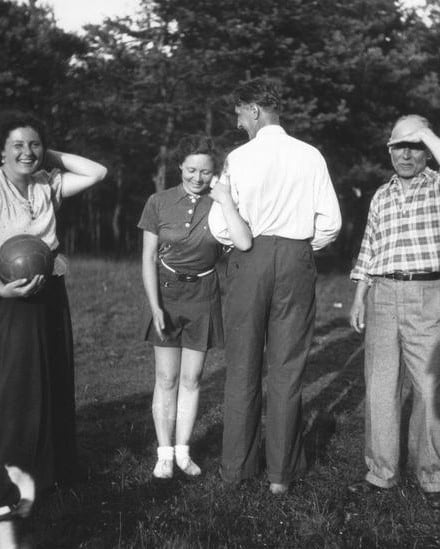
    PHOTO: Vítězslava Kaprálová (center) with Bohuslav Martinů

Tag Cloud

Aaron Copland (92) Beethoven (95) Composer (114) Film Music (120) Film Score (143) Film Scores (255) Halloween (94) John Williams (185) KWAX (229) Leonard Bernstein (100) Marlboro Music Festival (125) Movie Music (135) Opera (198) Philadelphia Orchestra (88) Picture Perfect (174) Princeton Symphony Orchestra (106) Radio (87) Ralph Vaughan Williams (85) Ross Amico (244) Roy's Tie-Dye Sci-Fi Corner (290) The Classical Network (101) The Lost Chord (268) Vaughan Williams (103) WPRB (396) WWFM (881)

DON’T MISS A BEAT

Receive a weekly digest every Sunday at noon by signing up here


RECENT POSTS