I never had much truck with astrology. Otherwise, how do you explain Anton Bruckner and Darius Milhaud being born on the same date?
Bruckner (b. 1824), socially awkward and profoundly devout, always aspiring to the sublime in his music, mostly through grand forms such as the symphony and the mass; and Milhaud (b. 1892), bon vivant, a member of Les Six, churning out hundreds of pieces, against the better judgment of classical greybeards embracing a wide variety of often “lowly” influences (café music, jazz, folk song).
These are generalizations, of course – Bruckner dabbled in piano quadrilles and Milhaud wrote some pieces inspired by the Jewish liturgy – but by the most casual assessment, the men and artists were opposites. And thank goodness for it. The world of music would be a colorless place, if it were all church pews or boeufs-sur-les-toits.
Artistic temperament, dear Brutus, is not in our stars, but in ourselves.
Happy birthday, Anton Bruckner and Darius Milhaud.
Barenboim’s brassy Bruckner in Chicago
Buoyant, bearded Bernstein conducts “Le boeuf sur le toit”
With Bastille Day coming up on Monday, the focus this week on “The Lost Chord” will be Les Six, that collective of French composers who rose to prominence in Paris in the 1920s, followers of Jean Cocteau and Erik Satie – in reality, each following their own aims, but loosely organized around a reactionary stance against Wagnerism in music and the so-called Impressionism of Debussy and Ravel.
But never mind all that. What’s important is that they wrote plenty of delightful music, mostly in a neoclassical style.
We’ll have a chance to get up close and personal, as we listen to music by Les Six, performed by members of Les Six, with Georges Auric and Jacques Février playing music of Erik Satie into the bargain.
You can always count on The Six. I hope you’ll join me for “Six by Six” on “The Lost Chord,” now in syndication on KWAX, the radio station on University of Oregon!
Clip and save the start times for all three of my recorded shows:
PICTURE PERFECT, the movie music show – Friday at 8:00 PM EDT/5:00 PM PDT
SWEETNESS AND LIGHT, the light music program – Saturday at 11:00 AM EDT/8:00 AM PDT
THE LOST CHORD, unusual and neglected rep – Saturday at 7:00 PM EDT/4:00 PM PDT
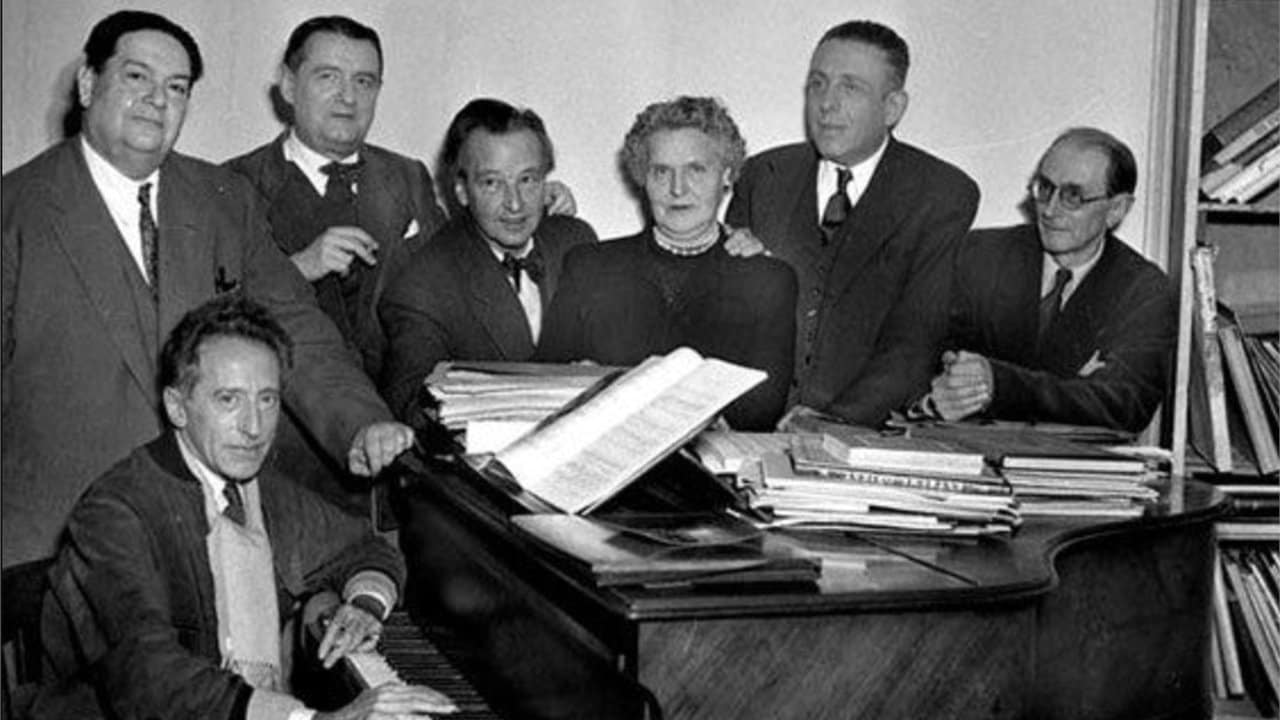
PHOTO: Standing, left-to-right, Darius Milhaud, Georges Auric, Arthur Honegger, Germaine Tailleferre, Francis Poulenc, and Louis Durey, with Jean Cocteau at the piano
Darius Milhaud, the French composer who rose to prominence in the late ’teens and 1920s, as part of that loose collective known as Les Six, died 50 years ago today.
Milhaud was such an insanely prolific composer – in common with Telemann and Heitor Villa-Lobos – that he’s often hard to pin down. An enlightened and fair-minded individual of leisure might make it a point to try to listen to everything Milhaud ever wrote before passing judgment. The rest of us content ourselves with parroting the assessments of the gatekeepers, in the assumption that anything beyond the five or six pieces that always get played must be somehow inferior.
Be that as it may, every once in a while, I’ll stumble across a perfectly delightful Milhaud creation. Some of these have languished in obscurity; others flitter around the periphery.
I’ve always had a special fondness for “La cheminée du roi René” (“King René’s Chimney”), the multi-movement work for woodwind quintet that grew out of a film score. The anthology “Cavalcade d’amour” (1939), directed by Raymond Bernard, portrays three love stories from three different eras – the 15th century, 1830, and 1930. Milhaud opted for the former, a segment set at the court of René I. (Arthur Honegger and Roger Désormière provided music for the other two.) Milhaud felt a certain affinity with the subject, as he himself grew up in Aix-en-Provence, the location of René’s castle and court.
The title alludes to a Provençal proverb that plays on words for “fireplace,” “chimney,” and “promenade,” as the king is said to have enjoyed his walks in the winter sun. The phrase “se chauffer à la cheminée du roi René,” then, means to warm oneself at “King René’s chimney” (i.e. by basking in the heat of the sun).
Okay, so it’s a winter piece, maybe. But I don’t hear it that way. In fact, it strikes me as the perfect music for a lazy summer afternoon. A good example of how imprecise musical impressions can be and why the concept of program music – music intended to suggest extra-musical concepts and even objects – has always stirred controversy.
The woodwind quintet was first performed in 1941 at Mills College in Oakland, CA, where Milhaud would go on to teach for nearly a quarter-century.
I first encountered the piece as signature music for the Friday-night-at-11:00 radio program “Music through the Centuries,” hosted by George Diehl, on the late, lamented WFLN, for nearly 50 years Philadelphia’s classical music station. Diehl was on the faculty of LaSalle University. He wrote program notes for the Philadelphia Orchestra and, if I’m not mistaken, was once the station’s program director. Every week, he would use the hour as a platform to explore unusual and neglected repertoire. In fact, I credit him as a source of inspiration for my own weekly show, “The Lost Chord.”
I suspect Diehl used the classic recording of “La cheminée du roi René” by the Philadelphia Woodwind Quintet. I also like this one, by the Athena Ensemble.
Remembering Darius Milhaud on the 50th anniversary of his death. How many more riches are left to discover beyond the treasure room of King René?
PHOTO: Milhaud on a typical morning, completing his third piece before breakfast
I know Christopher Columbus is anathema these days, but I can’t help but buy music inspired by him whenever I can find it on the cheap. Pictured are two recordings I acquired recently from Princeton Record Exchange. Both works are by members of Les Six, that loose collective of composers, brought together by Jean Cocteau, that flourished in Paris in the late ‘teens and 1920s.
The Milhaud is the more idiomatic and musically satisfying of the two, with an all-French cast, captured at the Théâtre des Champs-Élysées. The conductor is Manuel Rosenthal, a composer himself (and a Ravel pupil), best known for his arrangements of Offenbach for the ballet “Gaîté Parisienne.” Unfortunately, the sound is also idiomatic – which is to say, mid-1950s French, complete with tinny cymbal crashes and fillings-rattling climaxes. It‘s a live performance, as opposed to a studio recording.
The Honegger is a recorded premiere, a recreation of a radio drama in state-of-the-art digital sound. However, it’s delivered by actors in a manner and acoustic that suggest a theatrical performance. (It was actually recorded in a church.) Furthermore, the dialogue is in English.
Toward the beginning, someone shows up just long enough to do their best John Cleese-style impression of a Frenchman. Puzzlingly, for the remainder of the performance, all the Italian and Spanish parts are spoken in unaccented English. Well, unaccented in Italian and Spanish, anyway. The principals are all divided as to whether they should emulate English stage-speak or American high school drama club. Columbus himself sounds like a good approximation of 1940s Warner Bros.’ supercilious screen-villain Henry Daniell.
I wish the release had included as a bonus an isolated presentation of the music, without the spoken dialogue, since, unlike the historic Columbus, the actors are in imminent peril of dropping off a flat earth into the chasm of parody. The first few minutes, when it’s just the narrator, before the actual dramatization begins, is especially agonizing.
Be that as it may, I’m pleased to be able to add them both to my collection of Columbiana. There’s a surprising amount of it, composed by the likes of Leonardo Balada, Gaetano Donizetti, Manuel de Falla, Alberto Franchetti, Philip Glass, Victor Herbert, Richard Wagner, William Walton, and Kurt Weill, among others.
Fingers crossed that I can still get away with posting about it on Columbus Day, if only because of my Italian surname.
Selections from Rosenthal’s 1956 recording of Milhaud’s “Christophe Colomb” (1930)
A staging of the complete opera in a 1993 production
Arthur Honegger’s radio play “Christophe Colomb” (1940)
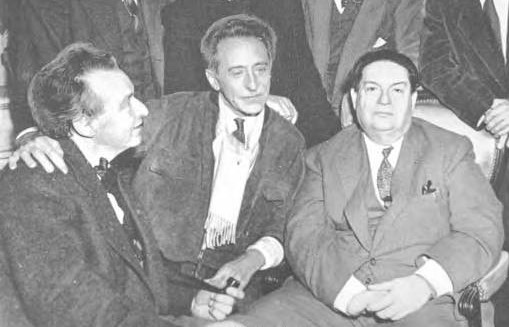
PHOTO: Honegger and Milhaud, flanking mentor Jean Cocteau
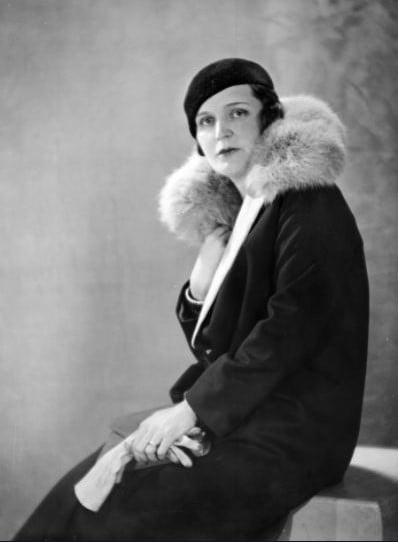
Germaine Tailleferre was the only female member of Les Six, that loose collective of composers that rose to prominence in Paris in the late Nineteen-Teens and ‘20s, under the guidance of Jean Cocteau. Her famous colleagues included Francis Poulenc, Darius Milhaud, Arthur Honegger, and Georges Auric. Louis Durey, a hard-line communist who went on to set poems by Ho-Chi Minh and Mao Zedong, is the one nobody remembers. (I wonder why.)
Tailleferre was strong-willed from the start. Her birth name was Taillefesse, but she changed it to spite her father, since the old man opposed her musical studies. However, she took piano lessons with her mother and was admitted into the Paris Conservatory. It was there that she met the rest of The Six and that the prizes began to pile up. She also earned the friendship and received the support of Maurice Ravel.
In 1925, she married Ralph Barton, the American caricaturist, and moved to New York. Two years later, the couple returned to France, then divorced. Her career thrived in the 1920s and ‘30s. With the outbreak of World War II, however, she beat it back to the United States, leaving most of her scores at her home in Grasse, and passed the war years in Philadelphia. (Please, if anyone knows anything about her Philadelphia years, message me!)
After the war, she again returned to France, where she resumed her career. As she got older, her pieces tended to be shorter, as she suffered from arthritis. She also wrote a lot for children and young pianists. She composed virtually right up until the time of her death in 1983, when she was 91 years-old. She wrote so much, in fact, that a lot of the music of her later years has never been published, and fresh discoveries from her output are being recorded all the time.
Here’s an interesting write-up about Tailleferre and her relationship with Barton. The quote that headlines the piece is not by Tailleferre, but by Germaine Greer!
Furthermore, I love that the video at the bottom of the page, of the composer’s “Six chansons françaises,” is age-restricted due to the fact that it’s illustrated with the painting of a nude. Mon Dieu!
Happy birthday, Germaine Tailleferre!
The Concertino for Harp and Orchestra (1927):
The lovely and wistful “Arabesque” for clarinet and piano (1972):
The Concerto for Piano and Orchestra (1924). The piece was given its U.S. premiere – in the presence of the composer – by Alfred Cortot and the Philadelphia Orchestra, conducted Leopold Stokowski.