To a great many, Memorial Day is the unofficial start of summer, a time for picnics and trips to the shore, for Hollywood to flood the multiplexes with soulless blockbusters, a signifier of the end of school, and the beginning of three long, lazy months of way too much daylight.
But it didn’t always bear those associations. The precursor of Memorial Day was Decoration Day, first widely observed in 1868, to honor and remember those who died in the Civil War. It was a time for decorating graves, making solemn speeches, and marching in parades. These customs metamorphosed to the point where, after World War I, Memorial Day was seen as an occasion to honor those who died in ALL American wars.
Regardless of how one may perceive armed conflict, of whether any given war may be called just or unjust, it is not war itself or conflict in general that is being celebrated. Rather, it is the sacrifice of those who died in defense of a larger cause, and ostensibly that cause has been for the common good.
One would think, were one an idealist, that by this stage of our collective development, when any disruption in the global fabric obviously effects all of us, that wars would be considered obsolete. But sadly, human nature being what it is, there will probably always be reasons to remember.
This week on “The Lost Chord,” we’ll salute those who made the ultimate sacrifice, by listening to three works commemorating the dead of World War II, including “For the Fallen,” a berceuse for orchestra by Bernard Herrmann; Aaron Copland’s Violin Sonata, dedicated to Lt. Larry H. Dunham, who was killed in the Pacific in 1943; and the peace cantata “A Time for Remembrance,” by John Duffy.
Duffy himself was a World War II veteran, who lied about his age when enlisting. He became part of the Amphibious Scouts and Raiders, forerunners to the Navy SEALs, before deploying on the USS Hopping, a destroyer escort in the Pacific. His duties included detonating Japanese mines by shooting them from ship deck. When his ship took fire from shore batteries at Okinawa, the sailor standing next to him was killed. Duffy had to stand guard over the dead man’s body until burial at sea in the morning. That night watch determined the course of his life. “Since our time is so fleeting and unpredictable,” he later commented, “I knew I had to dedicate my life to music.”
War is no picnic. I hope you’ll join me for “Requiescat in pace,” on “The Lost Chord,” now in syndication on KWAX Classical Oregon.
——–
Clip and save the start times for all three of my recorded shows:
PICTURE PERFECT, the movie music show – Friday at 8:00 PM EDT/5:00 PM PDT
SWEETNESS AND LIGHT, the light music program – Saturday at 11:00 AM EDT/8:00 AM PDT
THE LOST CHORD, unusual and neglected rep – Saturday at 7:00 PM EDT/4:00 PM PDT
Stream them, wherever you are, at the link!
https://kwax.uoregon.edu
——–
John Duffy on his war experiences and his decision to become a composer:
Tag: Memorial Day
-

No Picnic: “Requiescat in pace” on “The Lost Chord”
-

Memorial Day Picnic on “Sweetness and Light”
For many, Memorial Day marks the unofficial start of summer, as people take advantage of the three-day weekend, and the hopefully mild weather, to celebrate.
Of course, Memorial Day itself is a rather solemn holiday, as we’re meant to honor the sacrifice of those who laid down their lives in defense of our country.
That said, this morning on “Sweetness and Light,” since there’s little “sweet” or “light” about war, I figured rather we’d take the hour to enjoy a little Memorial Day picnic, if you will.
I hope you’ll join me for an outdoor overture, a barbecue divertimento, a carousel waltz, some gazebo dances, a pickle-and-pepper rag, a teddy bear’s picnic, and, yes, even a musical moment of reflection for the fallen.
The first of the summer’s patriotic holidays is upon us. Wrap yourself in the flag and everything else in bacon, this morning on “Sweetness and Light.” The three-legged races and pie-eating contests commence at 11:00 EDT/8:00 EDT, exclusively on KWAX Classical Oregon!
Stream it, wherever you are, at the link:
https://kwax.uoregon.edu/ -
Valor and Sacrifice for Memorial Day Weekend on “Picture Perfect”
This week on “Picture Perfect,” it’s all about valor and sacrifice, as we anticipate Memorial Day.
Memorial Day has its roots in Decoration Day, established in 1868 to honor the Civil War dead. We’ll hear music from “Glory” (1989), inspired by the extraordinary courage of Colonel Robert Gould Shaw’s 54th Massachusetts Voluntary Regiment, an all African American outfit that distinguished itself in an impossible assault on Fort Wagner, near Charleston, South Carolina. The outstanding cast features Morgan Freeman, Matthew Broderick, and Cary Elwes, with an Oscar-winning performance by Denzel Washington. The poignant score is by James Horner.
Gary Cooper had one of his best roles as “Sergeant York” (1941), based on the true story of Alvin C. York, who went from backwoods hell-raiser to devout pacifist. After a period of soul-searching, York was able to reconcile his strong moral convictions with the unfortunate reality that sometimes it really is necessary to fight. He went on to distinguish himself on the battlefield and become one of the most-decorated soldiers of the First World War. The folksy score, evocative of York’s Tennessee roots, is by Max Steiner.
In director Michael Cimino’s “The Deer Hunter” (1978), three men from a small Pennsylvania steel town serve in Vietnam, then struggle to cope with the war’s psychological impact. The harrowing film, especially memorable for its scenes of Russian roulette in a P.O.W. camp, won five Academy Awards, including Best Picture and Best Director. Christopher Walken was honored with the award for Best Supporting Actor. Stanley Myers wrote the music. We’ll hear his famous “Cavatina,” performed by guitarist John Williams, not to be confused with…
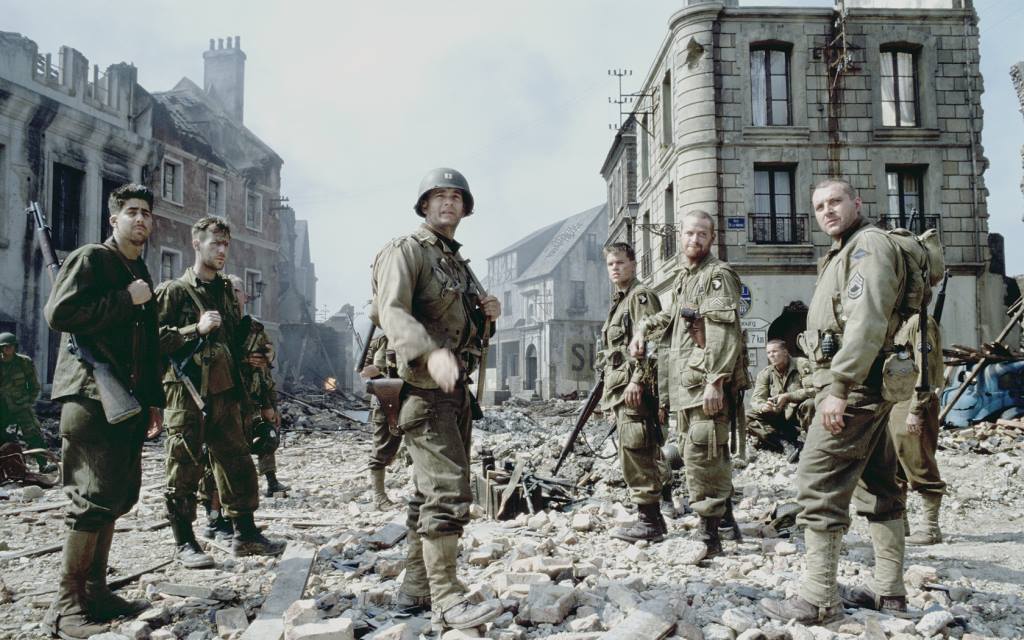
… composer John Williams, who provided one of his sparser scores for “Saving Private Ryan” (1998). Steven Spielberg’s war-is-hell narrative yet manages to honor the sacrifice of the fighting men of World War II. The opening – a sustained “you-are-there” battle sequence on Omaha Beach – is unforgettable. Remarkably, it is presented wholly without music, Williams preferring to allow the tension of the mise-en-scène to speak for itself. Spielberg picked up his second Academy Award for Best Director. The film, however, inexplicably, lost to “Shakespeare in Love.”
I hope you’ll join me for music from these cinematic meditations on the costs and consequences of war, as we honor the valor and sacrifice of soldiers who died while serving in America’s armed forces, on “Picture Perfect,” music for the movies, now in syndication on KWAX Classical Oregon!
——-
Clip and save the start times for all three of my recorded shows:
PICTURE PERFECT, the movie music show – Friday at 8:00 PM EDT/5:00 PM PDT
SWEETNESS AND LIGHT, the light music program – Saturday at 11:00 AM EDT/8:00 AM PDT
THE LOST CHORD, unusual and neglected rep – Saturday at 7:00 PM EDT/4:00 PM PDT
Stream them, wherever you are, at the link!
https://kwax.uoregon.edu -

Memorial Day Picnic on Sweetness and Light
For many, Memorial Day marks the unofficial start of summer, as people take advantage of the three-day weekend, and the hopefully mild weather, to celebrate.
Of course, Memorial Day itself is a rather solemn holiday, as we’re meant to honor the sacrifice of those who laid down their lives in defense of our country.
That said, this morning on “Sweetness and Light,” since there’s little “sweet” or “light” about war, I figured rather we’d take the hour to enjoy a little Memorial Day picnic, if you will.
I hope you’ll join me for an outdoor overture, a barbecue divertimento, a carousel waltz, some gazebo dances, a pickle-and-pepper rag, a teddy bear’s picnic, and, yes, even a musical moment of reflection for the fallen.
The first of the summer’s patriotic holidays is upon us. Wrap yourself in the flag and everything else in bacon, this morning on “Sweetness and Light.” The three-legged races and pie-eating contests commence at 11:00 EDT/8:00 EDT, exclusively on KWAX, the radio station of the University of Oregon!
Stream it, wherever you are, at the link:
-

WWII Movie Music for Memorial Day
While you’re sitting in traffic heading into your three-day weekend, take a moment to consider that you’ve got it easy compared to what Allied soldiers went through in Europe, the Pacific, and North Africa to keep the world free from tyranny.
This week on “Picture Perfect,” we’ll have music from two films of the World War II era that exemplify Hollywood’s morale-boosting approach. “Sahara” (1943) pits Humphrey Bogart as a tank commander who defends a watering hole against a superior force of parched Nazis. “Objective: Burma!” (1945) drops Errol Flynn behind enemy lines to take out a Japanese radar station.
Neither film shuns the reality that war is hell (with some particularly suggestive gruesomeness in the latter), yet the filmmakers rose above the kind of nihilistic edge that underscores so many movies made today. When all was said and done, war movies in the 1940s sold America on hope and sacrifice and the promise of final victory.
The conflict cast a long shadow, and in the 1950s and ‘60s Hollywood continued to churn out WWII films at an impressive rate, selling tickets to the generation that had “been there.” “The Guns of Navarone” (1961) features Gregory Peck (exempt from service during the actual war because Martha Graham injured his back), David Niven (Lieutenant Colonel in the British Commandos at Normandy) and Anthony Quinn (born in Mexico and not naturalized until 1947) as a special unit of Allied military specialists on a mission to blow up some big Nazi guns trained over the Aegean Sea.
Efforts to get “Patton” (1970) off the ground had been in motion since 1953! The filmmakers wanted access to Patton’s diaries, but displayed horrible timing in approaching the late general’s family the day after the death of his widow. Not surprisingly, the family was completely turned off and withheld its cooperation. In the end Franklin J. Schaffner directed from a script by Francis Ford Coppola and Edmund H. North. Patton’s colleague, Omar Bradley, served as an advisor on the film. (He’s played on screen by Karl Malden.)
“Patton” likely would have been a knockout on any level (Rod Steiger turned down the lead, much to his later regret), but it is really George C. Scott that pushes it over the top. And how much more over the top can it get than that opening monologue, assembled from Patton’s speech to the Third Army, delivered in front of an enormous American flag? Only a larger-than-life actor such as Scott could have done it justice and not been dwarfed by both the subject and the iconography. Scott won a much-deserved Academy Award for his performance – which he famously refused to accept.
I hope you can join me for equally outsized music by Miklós Rózsa (“Sahara”), Franz Waxman (“Objective: Burma!”), Dimitri Tiomkin (“The Guns of Navarone”) and Jerry Goldsmith (“Patton”), as we look forward to Memorial Day with classic films set during World War II, on Picture Perfect, music for the movies, now in syndication on KWAX, the radio station of the University of Oregon!
Clip and save the start times for all three of my recorded shows:
PICTURE PERFECT, the movie music show – Friday at 8:00 PM EDT/5:00 PM PDT
SWEETNESS AND LIGHT, the light music program – Saturday at 11:00 AM EDT/8:00 AM PDT
THE LOST CHORD, unusual and neglected rep – Saturday at 7:00 PM EDT/4:00 PM PDT
Stream them, wherever you are, at the link!
Tag Cloud
Aaron Copland (94) Beethoven (95) Composer (114) Film Music (148) Film Score (143) Film Scores (255) Halloween (97) John Williams (196) KWAX (232) Leonard Bernstein (105) Marlboro Music Festival (125) Movie Music (163) Mozart (91) Opera (215) Philadelphia Orchestra (90) Picture Perfect (174) Princeton Symphony Orchestra (110) Radio (90) Ross Amico (244) Roy's Tie-Dye Sci-Fi Corner (290) The Classical Network (101) The Lost Chord (269) Vaughan Williams (107) WPRB (397) WWFM (881)