How fortuitous that he would be born on October 1. What better way to start Halloween month than with the composer of “The Sorcerer’s Apprentice?”
Though Dukas left a comparatively small output – he was a notorious perfectionist who destroyed much – what survives of his music is of very high quality. Of that, he lends to his Halloween street cred with two other works of a fantastical, potentially horrific nature:
an opera about Bluebeard and his sixth wife, “Ariane et Barbe-Bleue”
and a so-called dance poem, “La Péri,” about a fatal encounter with a Persian fairy.
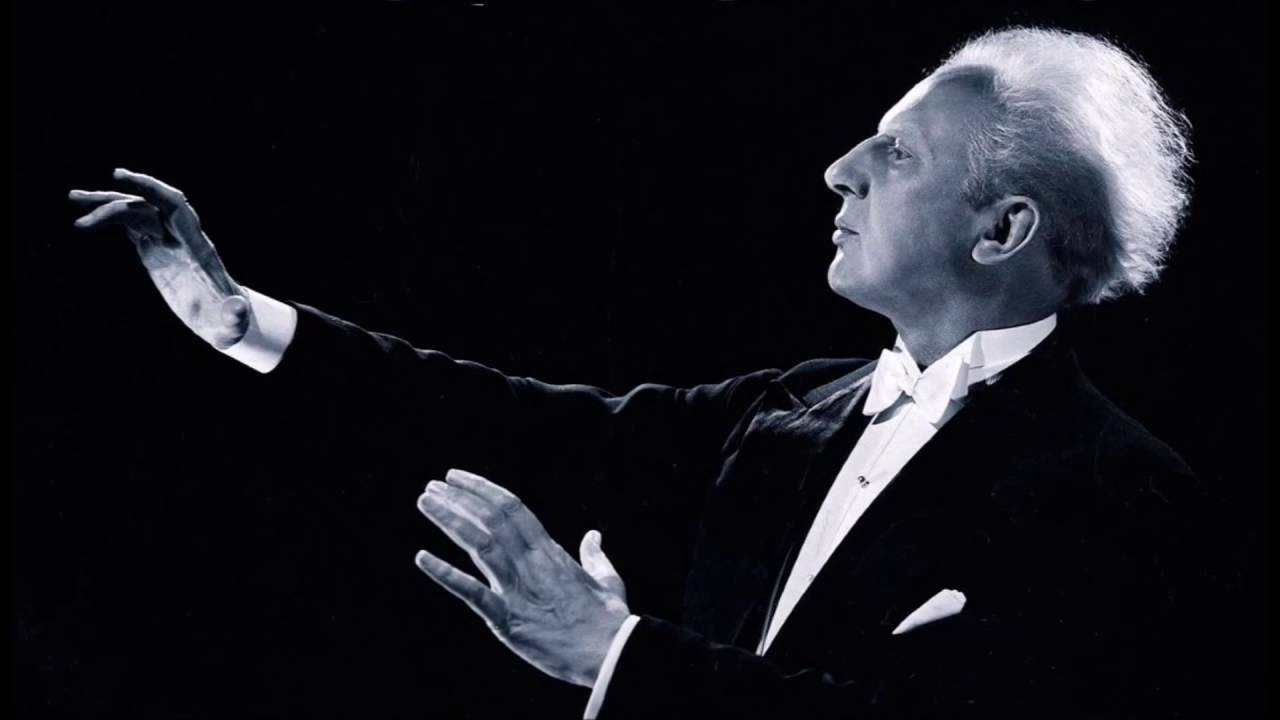
With wild hair, dove-like hands, and a faux middle-European accent (as the son of a Polish-born cabinet-maker who emigrated to and worked in London), Leopold Stokowski certainly knew how to work a crowd. But he also knew his way around a score.
He could be flamboyant in manner, controversial in his interpretations, and an easy target for parody. But he was also magnetic and, at his best, a true magician of the podium.
I hope you’ll join me today for both of my Saturday radio shows as I honor Stokowski on the anniversary of his birth. (He was born on this date in 1882). You’ll find more information at the bottom of this post.
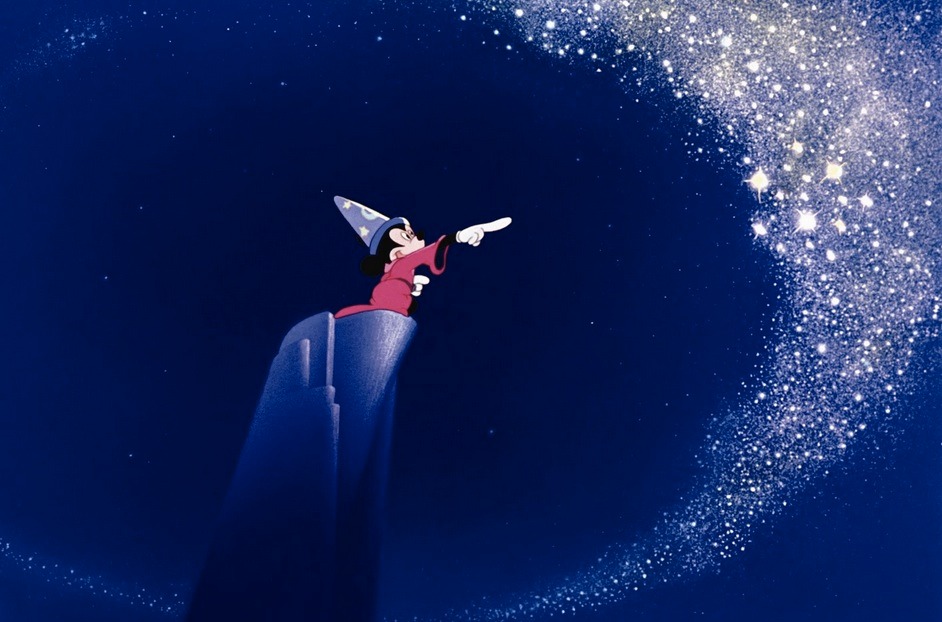
Stokowski was a natural for the movies. He appeared in more than a dozen motion pictures and documentaries and was frequently parodied in cartoons during Hollywood’s golden age. His most enduring film has been Walt Disney’s “Fantasia,” in which he conjures flights of animated fantasy from his art deco perch, and even shakes hands with Mickey Mouse. The recordings made for the actual film pioneered multi-channel stereo.
Stokowski always did have a reputation for embracing experimental technologies to capture or even enhance the fidelity of sound. On stage and in the recording studio, he was meticulous in arranging his musicians to achieve the sonic results he desired. It was really he who established the so-called “Philadelphia sound,” with its celebrated string sonorities, which he managed to replicate to a greater or lesser extent with many of the orchestras he worked with.
The quintessential Stokowski performance often stood apart for its dramatic flair and opulence. He was often at his best in the colorful French and Russian classics, where he really knew how to make the instrumental colors pop. But he also had an insatiable curiosity and a drive to introduce new music and unusual, off-the-beaten-path works.
On the other hand, there were occasions when he could truly astonish by driving a Mozart symphony like a team of wild horses. You truly never knew what this sorcerer was going to pull out of his hat.
One should never come to a Leopold Stokowski performance with an air of complacency, even if one thinks one knows the music inside out. Equally, one should never learn a score from a Stokowski recording. The extent of his recreative powers can only be fully appreciated when listening to him once you’ve heard everyone else. (There was often a lot of creativity in his “recreativity.”)
Some of his inspirations were genius – I love when he holds the chorus at the end of his London Phase 4 recording of Ravel’s “Daphnis and Chloe” Suite No. 2 – and in case it isn’t provocative enough, he actually has the engineers thrillingly boost the sound – but even for me, his swooning additions to his 1970s recording of “Siegfried’s Funeral March” are a bridge too far. Not everything he did will delight everyone, but the guy was not afraid to take chances.
Stokowski, who trained as an organist, possessed intimate knowledge of the keyboard music of Johann Sebastian Bach. At a time when such repertoire would have been comparatively unknown to orchestra subscribers, Stoky brought Bach to the concert hall by way of his own imaginative transcriptions. Hard to believe these were considered controversial at the time.
Clearly, Stokowski was a remarkable figure for so many reasons. Among them was his astonishing longevity. At the time of his death in 1977, at the age of 95, he had signed a contract that would have kept him busy in the recording studio until he was 100. It’s astonishing that so many of his late recordings were as good as anything he had ever done.
In common with Oscar Wilde, Stoky knew there is only one thing worse than being talked about, and that is not being talked about. His ever-evolving origin story. His wealthy marriages. His celebrity love affairs. His elegant bearing and riveting showmanship. It’s not just because of Bugs Bunny that music-lovers still revere him or toss up their hands in incredulity and gasp “LEOPOLD!”
——–
Join me on KWAX Classical Oregon for “Sweetness and Light,” Stokowski conducts music by Ottokar Novacek, Paul Dukas, Fikret Amirov, Johann Sebastian Bach, Wolfgang Amadeus Mozart, and Claude Debussy, this Saturday morning at 11:00 EDT/8:00 PDT.
Then on “The Lost Chord,” Stokowski conducts Wagner in vintage recordings featuring the Philadelphia Orchestra, this Saturday evening/afternoon at 7:00 EDT/4:00 EDT.
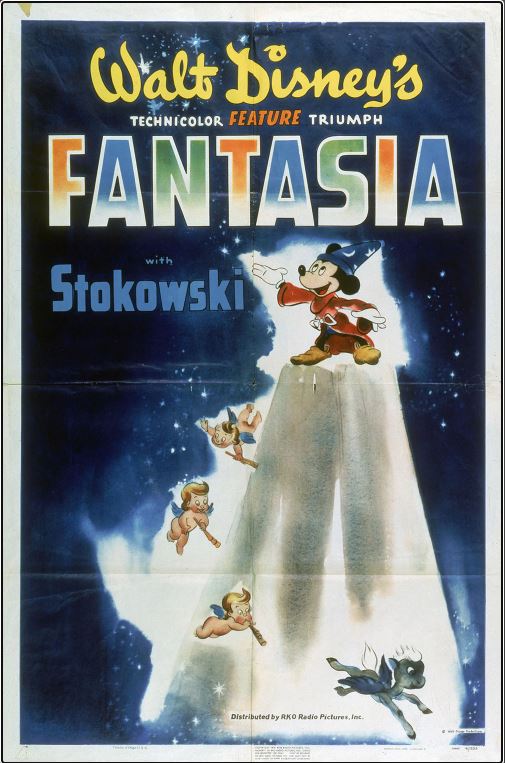
Walt Disney’s “Fantasia” was released into theaters for the first time on this date in 1940.
Giddy with the success of “Snow White and the Seven Dwarfs” (1937), which became a surprise hit – the highest grossing feature up to that time (soon to be supplanted by “Gone with the Wind”) – and hoping to reinvigorate the popularity of house brand Mickey Mouse, Disney spared no expense in the creation of this bold, beautiful, mind-bending, slightly pretentious, occasionally kitschy experimental enterprise, engaging Leopold Stokowski and the Philadelphia Orchestra to record the film’s soundtrack and, on its initial run, displaying it in special road show productions, featuring souped-up, “Fantasound” surround audio. This was the first feature film to be released in stereo. It ran in one venue in New York for a solid year. At a point, Disney even toyed with the idea of pumping different scents into the theater, but he must have realized it was all becoming a little too Scriabinesque.
Eventually reality caught up. “Fantasia” was a money-loser from the start. The war in Europe cut off any possibility of overseas revenue, and it became apparent that the film would have to be reissued, with cuts, in standard format, in regular theaters, if the studio hoped to make any of its money back. As it was, it didn’t turn a profit until 1969. I suspect it was the same crowd that was buzzing to “2001: A Space Odyssey” that finally pushed “Fantasia” into the black. Adjusting for inflation, it is now the 24th highest-grossing film in the United States. There aren’t any studios, and very few classical record companies, that would make that kind of investment in the future anymore.
I venture to guess most people who were lucky enough to see “Fantasia” in the cinema, back in the days before home video brought an end to its regular theatrical reissues, were charmed to see Stokowski shake hands with Mickey Mouse. Even so, this is the moment that became seared into many an impressionable memory. And I know I loved it.
Apologies for posting it in two parts, but “Fantasia” was reissued and “restored” a number of times over the years. This one I know sports Stoky’s original audio.
The soundtrack also features Princeton’s Westminster Choir (heard at the end of the second clip, cut off during the segue into Schubert’s “Ave Maria”).
There’s also at least one discarded sequence from the film that was completed, but then cut to keep the length down. It involved cranes and Debussy’s “Clair de lune.”
You may be aware, it was Disney’s original vision to swap out sequences with new material every few years. However, this was not done until 1999, with the release of “Fantasia 2000.” Regardless of what you may think of that film, with its gallery of celebrity talking heads and James Levine stepping into Leopold Stokowski’s extra-large shoes, it lacks the resonance of the 1940 original. In any case, the project having gone stagnant for six decades, I have a hard time accepting the new stuff as canon! That said, I’m thankful for anything that introduces people to classical music.
Glancing at the reissue schedule, I must have seen “Fantasia” for the first time in April 1977. I would have been ten years-old, and as I suggest, Chernabog coming out of that mountain floored me. I would have assumed that I was younger, but then I was a sensitive child. The last time I saw “Fantasia” in the theater must have been 1990.
When is the last time Disney rolled the dice on a project like this? It’s sad that the studio that gave us “Snow White and the Seven Dwarfs,” “Treasure Island,” “20,000 Leagues Under the Sea,” and “Mary Poppins” has turned into such a pop cultural meat grinder. Now the owner of Marvel, Lucasfilm, the Jim Henson Company, and 20th Century Fox (among others), Disney is more powerful than ever. And still, it keeps feeding off the bottom of the tank. These days, I find reality far more disturbing than a demon on Bald Mountain.
In his lifetime, he was as recognized as – well, as Mickey Mouse.
With his wild hair, dove-like hands, and faux middle-European accent, Leopold Stokowski was familiar to anyone who went to the movies.
In the latter decades of the 20th century, kids were still emulating Looney Tunes’ cries of “LEOPOLD!,” thanks to television reruns of Bugs Bunny.
Once upon a time, before classical music became marginalized…
I’ll pass on asking the rhetorical question of what the hell happened to my country, and instead channel my energy into projecting happy birthday wishes to the beyond for Leopold Stokowski!
Conducting Tchaikovsky in the film “Carnegie Hall” (1947)
Shaking hands with Mickey Mouse in “Fantasia” (1940)
Parodied in “Long-Haired Hair” (1949)
Introduced by Burns & Allen in “The Big Broadcast of 1937”
Introduced in a snood around the 3:30 mark in “Hollywood Steps Out” (1941)
Walt Disney’s “Fantasia” was released into theaters for the first time 80 years ago today.
Giddy with the success of “Snow White and the Seven Dwarfs” (1937), which became a surprise hit – the highest grossing feature up to that time (soon to be supplanted by “Gone with the Wind”) – and hoping to reinvigorate the popularity of house brand Mickey Mouse, Disney spared no expense in the creation of this bold, beautiful, mind-bending, slightly pretentious, occasionally kitschy experimental enterprise, engaging Leopold Stokowski and the Philadelphia Orchestra to record the film’s soundtrack and, on its initial run, displaying it in special road show productions, featuring souped-up, “Fantasound” surround audio. This was the first feature film to be released in stereo. It ran in one venue in New York for a solid year. At a point, Disney even toyed with the idea of pumping different scents into the theater, but he must have realized it was all becoming a little too Scriabinesque.
Eventually reality caught up. “Fantasia” was a money-loser from the start. The war in Europe cut off any possibility of overseas revenue, and it became apparent that the film would have to be reissued, with cuts, in standard format, in regular theaters, if the studio hoped to make any of its money back. As it was, it didn’t turn a profit until 1969. I suspect it was the same crowd that was buzzing to “2001: A Space Odyssey” that finally pushed “Fantasia” into the black. It is now the 24th highest-grossing film in the United States. There aren’t any studios, and very few classical record companies, that would make that kind of investment in the future anymore.
I venture to guess most people who were lucky enough to see “Fantasia” in the cinema, back in the days before home video brought an end to its regular theatrical reissues, were charmed to see Stokowski shake hands with Mickey Mouse. Even so, this is the moment that became seared into many an impressionable memory. And I know I loved it.
Apologies for posting it in two parts, but “Fantasia” was reissued and “restored” a number of times over the years. This one I know sports Stoky’s original audio.