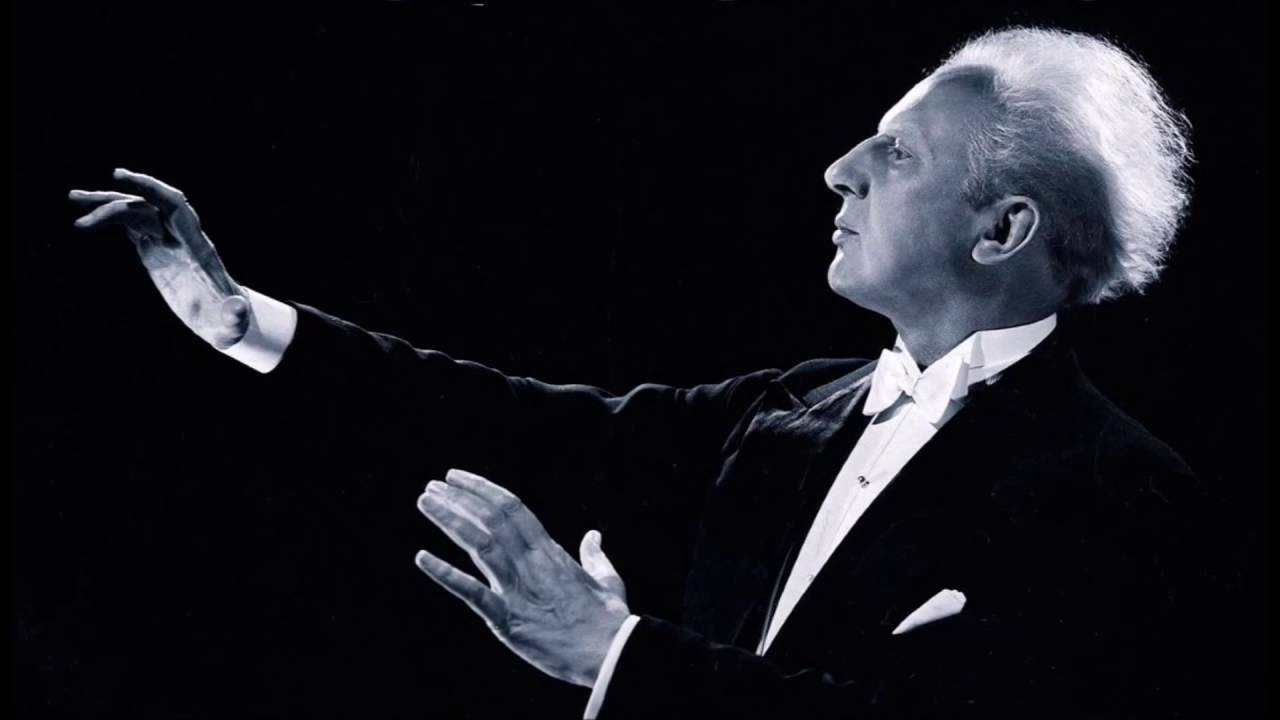
With wild hair, dove-like hands, and a faux middle-European accent (as the son of a Polish-born cabinet-maker who emigrated to and worked in London), Leopold Stokowski certainly knew how to work a crowd. But he also knew his way around a score.
He could be flamboyant in manner, controversial in his interpretations, and an easy target for parody. But he was also magnetic and, at his best, a true magician of the podium.
I hope you’ll join me today for both of my Saturday radio shows as I honor Stokowski on the anniversary of his birth. (He was born on this date in 1882). You’ll find more information at the bottom of this post.
Stokowski was a natural for the movies. He appeared in more than a dozen motion pictures and documentaries and was frequently parodied in cartoons during Hollywood’s golden age. His most enduring film has been Walt Disney’s “Fantasia,” in which he conjures flights of animated fantasy from his art deco perch, and even shakes hands with Mickey Mouse. The recordings made for the actual film pioneered multi-channel stereo.
Stokowski always did have a reputation for embracing experimental technologies to capture or even enhance the fidelity of sound. On stage and in the recording studio, he was meticulous in arranging his musicians to achieve the sonic results he desired. It was really he who established the so-called “Philadelphia sound,” with its celebrated string sonorities, which he managed to replicate to a greater or lesser extent with many of the orchestras he worked with.
The quintessential Stokowski performance often stood apart for its dramatic flair and opulence. He was often at his best in the colorful French and Russian classics, where he really knew how to make the instrumental colors pop. But he also had an insatiable curiosity and a drive to introduce new music and unusual, off-the-beaten-path works.
On the other hand, there were occasions when he could truly astonish by driving a Mozart symphony like a team of wild horses. You truly never knew what this sorcerer was going to pull out of his hat.
One should never come to a Leopold Stokowski performance with an air of complacency, even if one thinks one knows the music inside out. Equally, one should never learn a score from a Stokowski recording. The extent of his recreative powers can only be fully appreciated when listening to him once you’ve heard everyone else. (There was often a lot of creativity in his “recreativity.”)
Some of his inspirations were genius – I love when he holds the chorus at the end of his London Phase 4 recording of Ravel’s “Daphnis and Chloe” Suite No. 2 – and in case it isn’t provocative enough, he actually has the engineers thrillingly boost the sound – but even for me, his swooning additions to his 1970s recording of “Siegfried’s Funeral March” are a bridge too far. Not everything he did will delight everyone, but the guy was not afraid to take chances.
Stokowski, who trained as an organist, possessed intimate knowledge of the keyboard music of Johann Sebastian Bach. At a time when such repertoire would have been comparatively unknown to orchestra subscribers, Stoky brought Bach to the concert hall by way of his own imaginative transcriptions. Hard to believe these were considered controversial at the time.
Clearly, Stokowski was a remarkable figure for so many reasons. Among them was his astonishing longevity. At the time of his death in 1977, at the age of 95, he had signed a contract that would have kept him busy in the recording studio until he was 100. It’s astonishing that so many of his late recordings were as good as anything he had ever done.
In common with Oscar Wilde, Stoky knew there is only one thing worse than being talked about, and that is not being talked about. His ever-evolving origin story. His wealthy marriages. His celebrity love affairs. His elegant bearing and riveting showmanship. It’s not just because of Bugs Bunny that music-lovers still revere him or toss up their hands in incredulity and gasp “LEOPOLD!”
——–
Join me on KWAX Classical Oregon for “Sweetness and Light,” Stokowski conducts music by Ottokar Novacek, Paul Dukas, Fikret Amirov, Johann Sebastian Bach, Wolfgang Amadeus Mozart, and Claude Debussy, this Saturday morning at 11:00 EDT/8:00 PDT.
Then on “The Lost Chord,” Stokowski conducts Wagner in vintage recordings featuring the Philadelphia Orchestra, this Saturday evening/afternoon at 7:00 EDT/4:00 EDT.
Stream them, wherever you are, at the link!
https://kwax.uoregon.edu/
Leopold Stokowski on “Sweetness and Light” and “The Lost Chord”
by
10 responses
Comments
10 responses to “Leopold Stokowski on “Sweetness and Light” and “The Lost Chord””
-
“Leopold!”
-
Lesley Siedt Exactly! ✋🤚
-
Classic Ross Amico 😁❤️
-
-
-
That Bizet and Mendelssohn he did when he was 94 or 95 is astonishing. So alive and fresh!
-
R Bradley Wilson One of my favorite YouTube videos is of Stokowski conducting Debussy’s “Prelude to the Afternoon of a Faun,” during a concert in honor of his 90th birthday in 1972. https://www.youtube.com/watch?v=ArORmjt4ltY
-
-
His art-deco perch ended up as a plant stand in William Smith’s (Associate Conductor of The Philadelphia Orchestra) apartment next to the Academy of Music. After Bill’s death, I don’t know what happened to it, it probably moved west to Arizona with Debbie. But on my many visits to their apartment, the plant stand was always center stage. As the winner of the only Leopold Stokowski Memorial Conducting Competition in Association with The Philadelphia Orchestra in 1979, it was always a thrill to see.
-
Mark Laycock Amazing. I would have mounted the thing at least once a day to air conduct the Toccata and Fugue in D minor!
-
Tag Cloud
Aaron Copland (93) Beethoven (95) Composer (114) Film Music (144) Film Score (143) Film Scores (255) Halloween (94) John Williams (195) KWAX (229) Leonard Bernstein (104) Marlboro Music Festival (125) Movie Music (159) Mozart (91) Opera (212) Philadelphia Orchestra (89) Picture Perfect (174) Princeton Symphony Orchestra (109) Radio (88) Ross Amico (244) Roy's Tie-Dye Sci-Fi Corner (290) The Classical Network (101) The Lost Chord (269) Vaughan Williams (105) WPRB (397) WWFM (881)
Leave a Reply