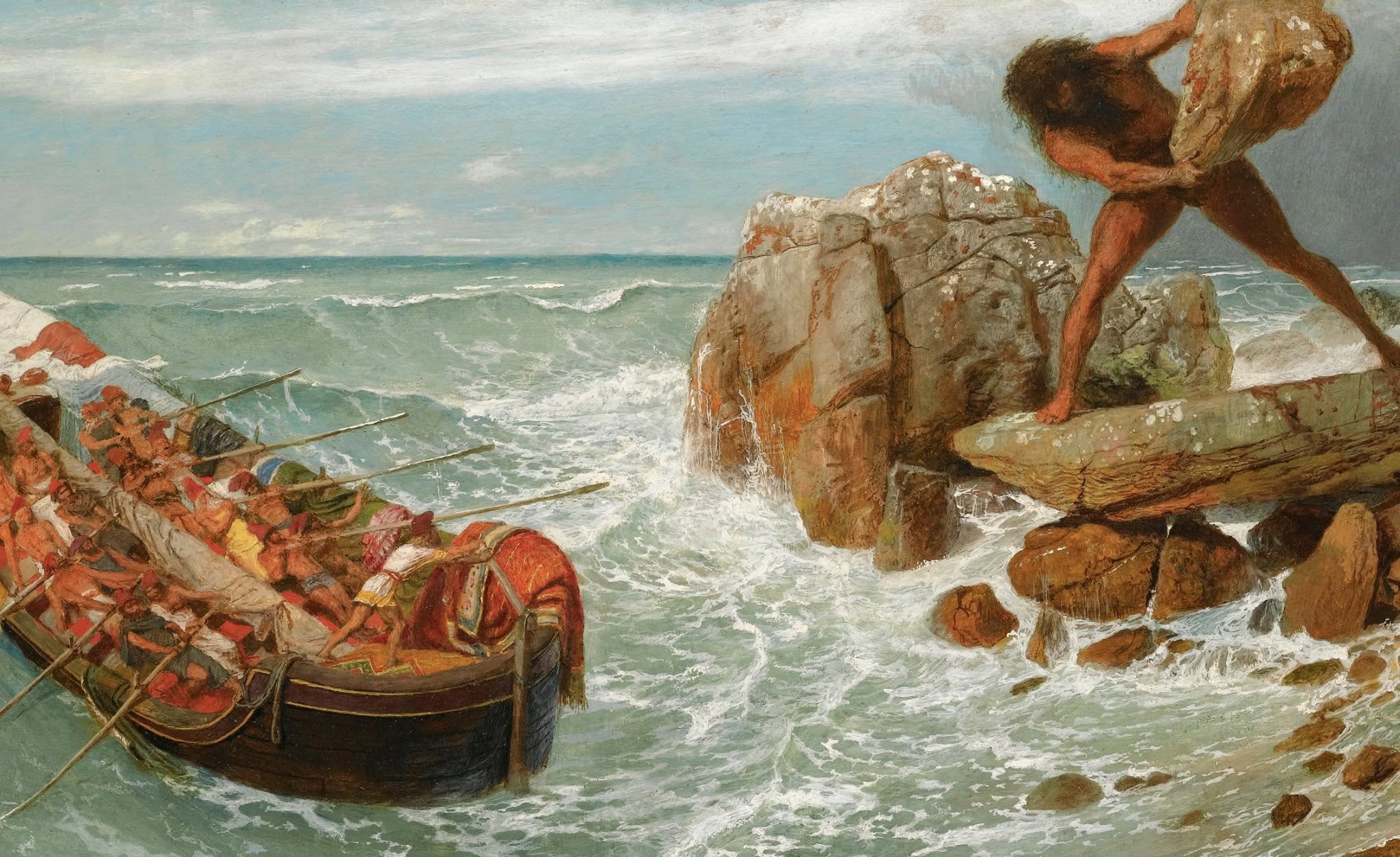
With Christopher Nolan’s “The Odyssey” sailing into theaters today, interest in Classical mythology is renewed. I mean, I think it’s always been a fascination for school children, but thanks to that early inculcation, it remains with us for the rest of our lives – sometimes pushed to the backs of our brains, but who doesn’t remember with affection the Greek heroes, their imposing quests and impossible challenges, the fickle gods, the peculiar trysts, the triumphs and turns of fortune, and perhaps most of all, the grotesque monsters?
“The Odyssey” is an excuse for me to revisit these youthful enthusiasms, as I make Classical mythology the focus of all three of my radio shows this weekend (with air times and streaming information posted below).
First, today, on “Picture Perfect,” it’s a mythological mash-up of music from fantasy films, including selections from “Helen of Troy” (Max Steiner), “Clash of the Titans” (Laurence Rosenthal), “Hercules” (Pino Donaggio), and “Jason and the Argonauts” (Bernard Herrmann).
Then, tomorrow morning on “Sweetness and Light,” it’s an ambrosial assortment of pieces inspired by Orpheus and Eurydice, Daphnis and Chloe, Hercules, and a riot of nymphs, satyrs, and fauns, vividly evoked by Jacques Offenbach, Howard Hanson, Cécile Chaminade, George Frideric Handel, Camille Saint-Saëns, and Maurice Ravel.
Finally, indomitable Odysseus makes his belated return from the Trojan War to Ithaca on “The Lost Chord,” in works by Ernst Boehe (“Departure and Shipwreck” from the symphonic cycle “From Odysseus’ Voyages”) and Benjamin Britten (the radio play “The Rescue of Penelope,” narrated with gusto by Dame Janet Baker), on “Home Sweet Homer.”
So much for moderation. Join me for a triple helping of Classical classics. I’ll be stringing my bow and launching arrows down a gallery of axe-heads, in celebration of “The Odyssey,” on “Picture Perfect,” “Sweetness and Light,” and “The Lost Chord” – all three originating from KWAX Classical Oregon!
——–
Clip and save the start times of my recorded shows:
PICTURE PERFECT, the movie music show – Friday at 8:00 PM EST/5:00 PM PST
SWEETNESS AND LIGHT, the light music program – Saturday at 11:00 AM EST/8:00 AM PST
THE LOST CHORD, unusual and neglected rep – Saturday at 7:00 PM EST/4:00 PM PST
Stream them, wherever you are, at the link!
https://kwax.uoregon.edu/
——–
IMAGE: “Odysseus and Polyphemus” (1896) by Arnold Böcklin
Tag: Movie Music
-
Pantheon of Film Composers, Circa 1997
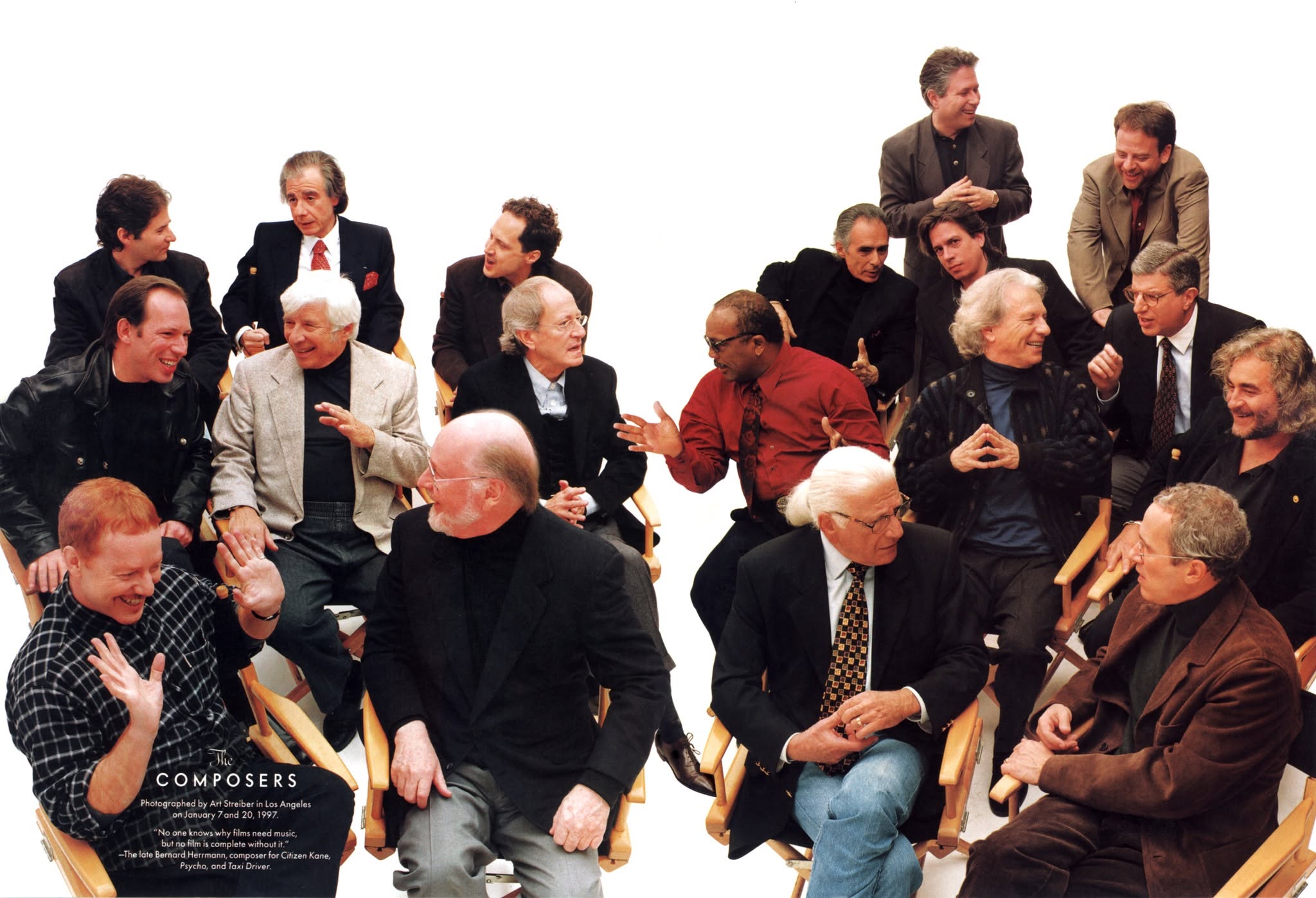
I was reminded of this photo the other day when it resurfaced on Facebook (in humorously doctored form). Here’s the original, reproduced from a two-page spread in a special “Hollywood 1997” issue of Vanity Fair that appeared on newsstands in April of that year. Be forewarned: if you care about film music of the era, and the decades preceding, your head might explode.
Front row, L to R: Danny Elfman, John Williams, Jerry Goldsmith, James Newton Howard
Middle row: Hans Zimmer, Elmer Bernstein, John Barry, Quincy Jones, Maurice Jarre, Michael Kamen
Back row, seated: James Horner, Lalo Schifrin, Mark Isham, Bill Conti, Elliot Goldenthal, Marvin Hamlisch (who looks a bit like Bernard Herrmann, chatting with Jarre in front of him)
Standing: Alan Menken, Marc Shaiman
The photo, by Art Streiber, is actually doctored, with the subjects being captured in two sessions, on January 7 & 20, 1997.
Some notable omissions (and by no means an exclusive list): the Newmans, Alan Silvestri, Patrick Doyle, Rachel Portman, and of course Ennio Morricone. Still, a stunning assemblage, from a time when Goldsmith, Elmer Bernstein, John Barry, and Maurice Jarre still walked among us. All gone now. We’ve also lost Quincy Jones, Marvin Hamlisch, Lalo Schifrin, Michael Kamen, and James Horner.
Zimmer (what could he possibly have to talk about with Elmer Bernstein?) has done more than anyone to drive the classic Hollywood sound to extinction. Sadly, his influential brand of electronically generated and/or manipulated drones and ostinati have come to dominate cinema in the digital era, as films are tweaked into bland homogeneity virtually up to the day of release. Most of it is easily forgettable, as a chainsaw or a leaf blower is forgettable. The annoyance evaporates as soon as it stops. Recently, I was impressed by his work on “Dune,” but as is so often the case, so much of it is more like sound design than music.
I am thankful to have lived through such a great era, but I am continually reminded of all that’s changed for the worse. In 1997, the movies were already on shaky ground. My heart aches every day, not least of all for their faded glory. -
Dimitri Tiomkin and Ballet on the Beach
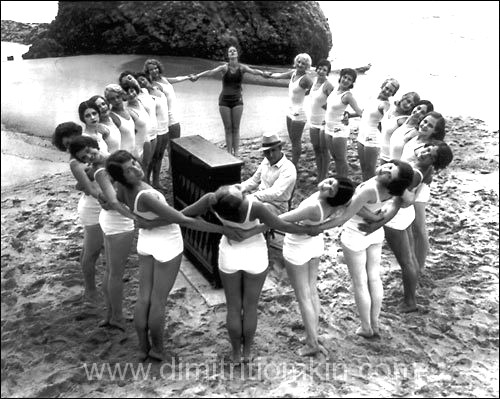
It’s summer, and for some, life’s a beach. Here’s a fun photo of future film legend Dimitri Tiomkin, the man who kicked off the craze for title songs in the seemingly incongruous genre of the movie western, when his score and song for “High Noon” earned wide acclaim, double Oscars, and enormous financial dividends. In fact, “Do Not Forsake Me, Oh My Darlin’” has been credited by some with having saved the picture from box office failure and cementing its status as an American classic.
From then on, Tiomkin was always sure to include a title song in his westerns – “Gunfight at the O.K. Corral,” “The Alamo,” “The War Wagon,” “Rio Bravo,” and, for television, “Rawhide,” among them – and for films in other genres, as well (“Friendly Persuasion,” “The Guns of Navarone,” “Wild Is the Wind”).
Interestingly, Tiomkin was born in Ukraine and studied at the St. Petersburg Conservatory with Alexander Glazunov. When asked the secret to his exceptional success writing music for westerns, Tiomkin replied with a shrug, “A steppe is a steppe is a steppe.”
Early on, it had been his mother’s dream that he become a concert pianist. To this end, he studied with Felix Blumenfeld, teacher of Horowitz, and Isabelle Vengerova. Also with Ferruccio Busoni and Egon Petri. He made his debut with the Berlin Philharmonic in Liszt’s Piano Concerto No. 2. At Carnegie Hall, he played Ravel, Scriabin, Poulenc, and Alexandre Tansman. He also gave the European premiere, in Paris, of Gershwin’s Concerto in F, with the composer in attendance.
Predating his Hollywood years, Tiomkin accompanied and wrote music for a ballet company run by his wife, Austrian dancer and choreographer Albertina Rasch, with whom he had first teamed on the American vaudeville circuit. After the stock market crash of 1929, opportunities in New York dwindled, but Rasch was hired to supervise dance numbers in MGM musicals. It was during this time that the beach photo was taken.
Tiomkin made mostly undistinguished, often uncredited contributions to motion pictures in the 1930s. The best known of these was a misbegotten all-star adaptation of “Alice in Wonderland” in 1933. But it was with Frank Capra’s “Lost Horizon,” in 1937, that he was really able to show his stuff. The opulent score was conducted by the vastly more experienced Max Steiner. Recognition came just in time, as Tiomkin broke his arm, effectively ending his career as a concert pianist.
He needn’t have worried. He found success composing more than 100 film scores, earning 22 Academy Award nominations. He won four, and numerous Golden Globes. Enough of the title songs were covered by major artists and turned into popular hits that he made a very comfortable living.
You can learn more about Tiomkin and Rasch at Castle Rock Beach and the then-provocative photo (which, as we would say today, “went viral”) at the link.Some of his ballet music for Rasch was recorded in 2020 for the album “Paris Under the Stars,” released on the Intrada label.
-
Picaresque Adventures on “Picture Perfect”
Calling all rapscallions and scapegraces! This week on “Picture Perfect,” get ready to revel in some freewheeling lack of judgment, with an hour of films based on picaresque novels.
For those of you who weren’t English majors, the picaresque novel is a literary genre often characterized by the presence of rogues or anti-heroes as protagonists, episodic, wayward structures, and, not infrequently, low humor.
We’ll hear music from “The Reivers,” after William Faulkner’s Pulitzer Prize-winning novel, a coming-of-age story about a boy swept into automobile theft and illicit horseracing in the American South. Mark Rydell directed the 1969 film, which stars Steve McQueen as the rakish Boon Hogganbeck and features narration by Burgess Meredith. John Williams wrote the breezy Americana score.
Mark Twain’s “The Adventures of Huckleberry Finn” is frequently categorized as an American picaresque. It’s certainly one of the funniest of “serious” books. A middling film adaptation was made in 1960, directed by Michael Curtiz, with Tony Randall given top billing, shifting the focus of the story to the con artistry of the King and the Duke. It features an evocative score by Jerome Moross.
If Hervey Allen’s “Anthony Adverse” had any humor to begin with, it was definitely lost in translation. (Too bad the novel was written in English.) However, the 1936 screen adaptation certainly does sprawl. One could say it’s picaresque in the worst way. It just doesn’t go anywhere. It does, however, feature a top-notch cast (Frederic March, Olivia De Havilland, Claude Rains, etc.) and an Academy Award-winning score by Erich Wolfgang Korngold.
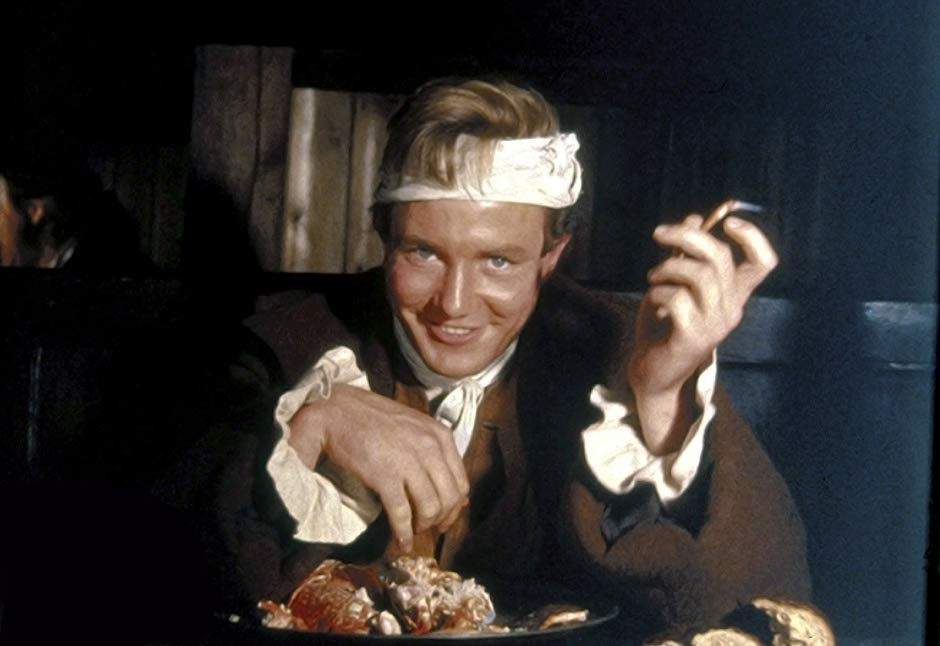
While the modern picaresque novel has its roots in the Renaissance, the genre really seemed to hit its stride in the 18th century, with comic novelists such as Henry Fielding. Fielding’s “Tom Jones,” perhaps the quintessential picaresque, was made into a film in 1963. It went on to win Academy Awards for Best Picture, Best Director (Tony Richardson), Best Adapted Screenplay (John Osborne), and Best Original Score (John Addison). Addison’s music suits Richardson’s quirky virtuosity like an off-kilter powdered wig.
We’re up to no good, with an hour of picaresque adventures, on “Picture Perfect,” music for the movies, now in syndication on KWAX Classical Oregon!
———
Clip and save the start times for all three of my recorded shows:
PICTURE PERFECT, the movie music show – Friday at 8:00 PM EDT/5:00 PM PDT
SWEETNESS AND LIGHT, the light music program – Saturday at 11:00 AM EDT/8:00 AM PDT
THE LOST CHORD, unusual and neglected rep – Saturday at 7:00 PM EDT/4:00 PM PDT
Stream them, wherever you are, at the link!
https://kwax.uoregon.edu -
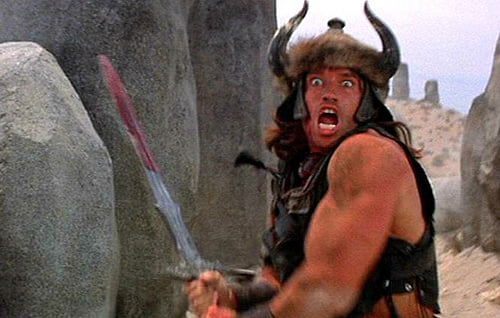
Movies Adapted from the Writings of Robert E. Howard on “Picture Perfect”
I prefer to keep my barbarians fictional, thank you. But with the nation’s 250th birthday approaching, I expect there will be plenty of instances in which truth will exceed credibility. It’s the world we live in, folks. Robert E. Howard, take me away!
This week on “Picture Perfect,” it’s an hour of music from movies inspired by Howard’s imaginative writings. Howard is best recognized for having created Conan the Cimmerian, a heroic warrior of the Hyborian Age. The character became the center of a series of lucrative stories first published in “Weird Tales” magazine, beginning in 1932.
It would be a half century before Conan made the leap to the big screen, under the direction of John Milius. “Conan the Barbarian” (1982) propelled Arnold Schwarzenegger, already a legend in the field of bodybuilding, to international superstardom. Okay, “Conan” isn’t exactly “Citizen Kane,” but it does have its pleasures. The intensity of the violence can be a little disturbing, but the ponderous tone is a blast. “Conan” is a film that takes itself just seriously enough to make it occasionally hilarious.
Another thing “Conan” has going for it is the fact that it was made on a blockbuster budget. The first-rate production values extend to the music by Basil Poledouris, who employs a full symphony orchestra to impressive ends. In fact, the “Conan” score was one of the strongest of the decade. It’s amazing that anyone would find so much inspiration in such a mediocre film, but Poledouris’ music intersperses Borodin-style Central Asia lyricism with brawny, thrilling action music.
Sadly, the sequel, “Conan the Destroyer,” betrays signs of penny-pinching, so that it often winds up feeling like a direct-to-video effort. Poledouris was forced to make do with a smaller orchestra, which sounds a bit too much like a television ensemble. Still, he gave it his all, and there’s something to be said for the fact that it is an original score, rather than a mere retread of the original.
Of perhaps related interest: it looks like a long-anticipated third Schwarzenegger Conan movie will finally be happening. “King Conan” is expected to begin filming next year, with Christopher McQuarrie writing and directing!
Let’s hope it fares better than an adaptation inspired by another one of Howard’s pulp creations, Kull of Atlantis, who was given the big screen treatment in “Kull the Conqueror” (1997). Kevin Sorbo, TV’s Hercules, plays the title role. The composer, Joel Goldsmith (son of Jerry), was asked to incorporate heavy metal riffs into his orchestral underscore. I haven’t actually seen this one, but for some reason I don’t feel like I’m missing anything.
The astoundingly prolific Ennio Morricone – with more than 500 motion picture and television scores to his name – had an uncanny knack for spinning garbage into gold. His music for “Red Sonja” (1985) lends the film an aura of ‘80s cheese ball fun, perhaps more so than it deserves. This is the film that introduced Brigitte Nielsen as the chain-mailed barbarian beauty. Schwarzenegger appears in the supporting role of Lord Kalidor.
There are those who would deny themselves the guilty pleasures of viewing these silly, cheesy, violent films. In “Conan the Destroyer,” when our hero is presented with the statement, “I suppose nothing hurts you,” he responds, “… Only pain.”
Make the music loud, Crom! Drive my enemies before me and drown the lamentations of their women! Saddle up with Conan the Barbarian on “Picture Perfect” – music for movies inspired by the writings of Robert E. Howard – now in syndication on KWAX Classical Oregon!
——-
Clip and save the start times for all three of my recorded shows:
PICTURE PERFECT, the movie music show – Friday at 8:00 PM EDT/5:00 PM PDT
SWEETNESS AND LIGHT, the light music program – Saturday at 11:00 AM EDT/8:00 AM PDT
THE LOST CHORD, unusual and neglected rep – Saturday at 7:00 PM EDT/4:00 PM PDT
Stream them, wherever you are, at the link!
https://kwax.uoregon.edu
Tag Cloud
Aaron Copland (94) Beethoven (95) Composer (114) Film Music (148) Film Score (143) Film Scores (255) Halloween (97) John Williams (196) KWAX (232) Leonard Bernstein (105) Marlboro Music Festival (125) Movie Music (163) Mozart (91) Opera (215) Philadelphia Orchestra (90) Picture Perfect (174) Princeton Symphony Orchestra (110) Radio (90) Ross Amico (244) Roy's Tie-Dye Sci-Fi Corner (290) The Classical Network (101) The Lost Chord (269) Vaughan Williams (107) WPRB (397) WWFM (881)