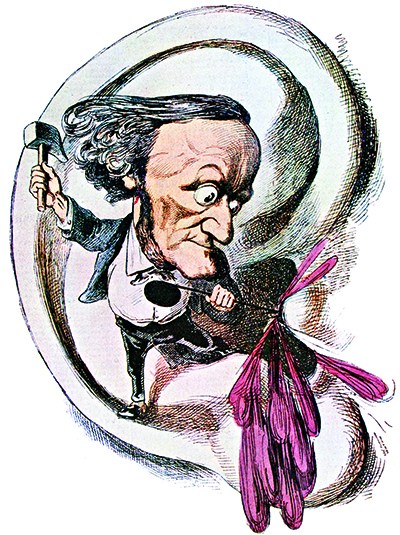
In 1876, the four operas – or music dramas (the composer’s preferred term) – of Wagner’s “Ring Cycle” were performed together for the first time, from August 13 through August 17, at the inaugural Bayreuth Festival, in the Festspielhaus (a theater of the composer’s design) in Bayreuth, Germany. The Bayreuth Festival has continued as a mecca for Wagnerites down to the present day.
To mark the 150th anniversary of the “Ring,” all three of my radio shows this weekend will tie in, in one way or another, with this most grandiose and influential undertaking.
First, today on “Picture Perfect,” we’ll have music from four films in which Erich Wolfgang Korngold served as ghostwriter for onscreen composers, providing a ballet for Errol Flynn’s in “Escape Me Never” (1946), a tone poem for Charles Boyer in “The Constant Nymph” (1943), and a cello concerto for Claude Rains in “Deception” (1946). More to the point, Korngold actually appears onscreen – hastily made-up when the actor hired for the purpose didn’t show – to play conductor Hans Richter in the Wagner biopic “Magic Fire,” for which he adapted selections from, yes, the Ring Cycle.
Then tomorrow morning, on “Sweetness and Light,” it will be the unlikeliest “light music” program, as we listen to piano transcriptions by Carl Tausig and Louis Brassin, the “Siegfried Idyll” (probably the sweetest thing Wagner ever wrote), humorist Anna Russell’s classic routine “The Ring of the Nibelungs (An Analysis),” and a cheeky work for piano four-hands by Gabriel Fauré & André Messager, in which they distill somber motifs from the cycle into a frivolous ballroom dance.
Finally, tomorrow afternoon/evening (depending on where you are), it will be an hour of historic recordings of “Die Walküre” – the second of the “Ring” operas (er, music dramas) – by Lawrence Tibbett, with Leopold Stokowski and the Philadelphia Orchestra, in 1934, and Lotte Lehmann and Lauritz Melchior, with Bruno Walter and the Vienna Philharmonic, in 1935. Also, we’ll hear Karl Muck conducting selections from Wagner’s “Parsifal” at the actual Festspielhaus, in 1927. The recording will feature actual bells of Wagner’s design, which were later melted down for munitions by the Nazis.
Hojotoho! Get out your party hats (helmets with horns and wings, of course), as we celebrate the 150th anniversary of the “Ring” this weekend, on KWAX Classical Oregon!
Stream the shows, wherever you are, at the times below:
PICTURE PERFECT, the movie music show – Friday at 8:00 PM EDT/5:00 PM PDT
SWEETNESS AND LIGHT, the light music program – Saturday at 11:00 AM EDT/8:00 AM PDT
THE LOST CHORD, unusual and neglected rep – Saturday at 7:00 PM EDT/4:00 PM PDT
Here’s the link!
https://kwax.uoregon.edu
Tag: Movie Music
-
Tyrannical Sea Captains on “Picture Perfect”
This week on “Picture Perfect,” taste the lash and prepare to be keelhauled! We’ll have music from movies featuring tyrannical sea captains.
Tyranny and sadism are common ingredients in nautical adventure films, where hard-bitten sea captains find it “Better to reign in Hell, than serve in Heaven.”
At least that’s the mantra of Wolf Larsen, who does his best to uphold the philosophy of Milton’s Satan, in Jack London’s “The Sea Wolf” (1941). Larsen is a tough Norwegian sea captain who presides over his ship, the Ghost, with strength and brutality.
Edward G. Robinson plays Larsen. John Garfield is the working class seaman who opposes him. And Ida Lupino is the castaway with a past, with whom he falls in love in spite of himself. The score is by Erich Wolfgang Korngold, who also provided the music for the seafaring adventures of Errol Flynn.
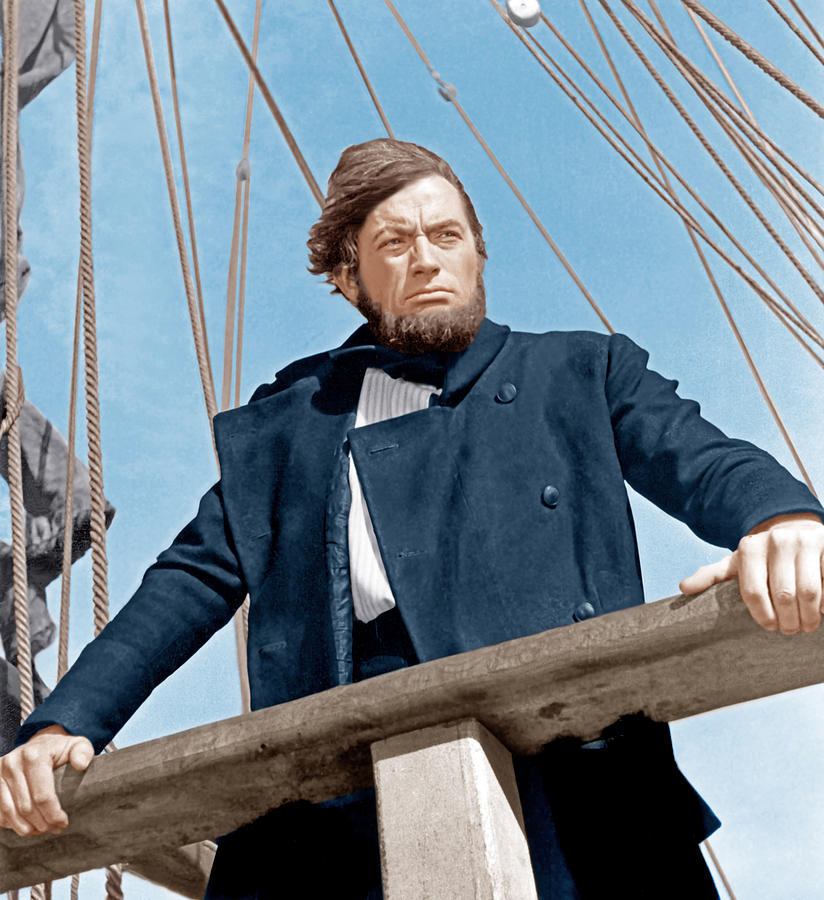
Captain Ahab requires little introduction. Everyone knows his ivory leg and his obsessive quest for the White Whale. Gregory Peck plays him in a film version of Herman Melville’s “Moby Dick” (1956), which was adapted by Ray Bradbury and directed by John Huston. The score is by English composer Philip Sainton.
Humphrey Bogart was nominated for an Academy Award for his performance as Lieutenant Commander Phillip Francis Queeg, in a big screen adaptation of Herman Wouk’s “The Caine Mutiny” (1954). Queeg, in charge of a U.S. Navy destroyer-minesweeper, is pushed over the edge by his obsession with strawberries pilfered from the officers’ mess. Max Steiner’s upbeat, patriotic theme provides a nice counterpoint to the interpersonal turmoil aboard the Caine.
Finally, the most iconic of tyrannical sea captains, Captain Bligh, is represented by “Mutiny on the Bounty” (1962). Historical novelists Charles Nordhoff and James Norman Hall make hay from the 1789 insurrection aboard the HMS Bounty.
The classic film version from 1935 starred Charles Laughton as Bligh and Clark Gable as Fletcher Christian. The remake featured Trevor Howard as Bligh, with Marlon Brando, envisioning Christian as a kind of high seas dandy.
It’s said that Brando essentially directed all his own scenes himself. The film was colossal failure, earning back only $13 million of its $19 million budget. Nonetheless, it managed to inspire Bronislau Kaper to compose one of his most monumental scores.
Take a bucket of salt water with your stripes, you dog! Then join me for tyrannical sea captains on “Picture Perfect,” music for the movies, now in syndication on KWAX Classical Oregon!
——-
Clip and save the start times for all three of my recorded shows:
PICTURE PERFECT, the movie music show – Friday at 8:00 PM EDT/5:00 PM PDT
SWEETNESS AND LIGHT, the light music program – Saturday at 11:00 AM EDT/8:00 AM PDT
THE LOST CHORD, unusual and neglected rep – Saturday at 7:00 PM EDT/4:00 PM PDT
Stream them, wherever you are, at the link!
https://kwax.uoregon.edu -
Get Animated with “Picture Perfect”
“Music is a moral law,” wrote Plato. “It gives soul to the universe, wings to the mind, flight to the imagination… and life to everything.”
That includes computer-generated imagery.
While my distaste for the overkill of CGI in alleged “live action” movies is quite well known, I have to concede that, when shelling out the clams for a big-budget movie, one stands a better chance these days of getting a quality ride if one banks on the solely computer-animated feature. Put an action hero in a computer-animated landscape, and everything looks incredibly fake. But integrate the characters, by creating them in the computer as well, and the result is often much more absorbing, imaginative, and even wittier than your run-of-the-mill Hollywood blockbuster.
Furthermore, in a day when so many movies sport scores made up of droning electronics punctuated by colorless action cues, the computer-generated feature seems to attract composers who still understand how to write music.
This week on “Picture Perfect,” we’ll listen to enlivening scores from four computer-generated films.
We’ll hear selections from the first installment in the “Ice Age” franchise, by David Newman (son of Golden Age heavy-hitter Alfred Newman, brother of Thomas Newman, and cousin of Randy Newman).
We’ll also have some of John Williams’ music from “The Adventures of Tintin,” after the comic book adventurer created by Belgian artist and writer Hergé. Tintin’s popularity in Europe failed to translate into big domestic box office, comparatively speaking, but the score is Williams’ best of its kind – an exciting adventure piece full of leitmotifs and great action cues – since the first of the Harry Potter films.
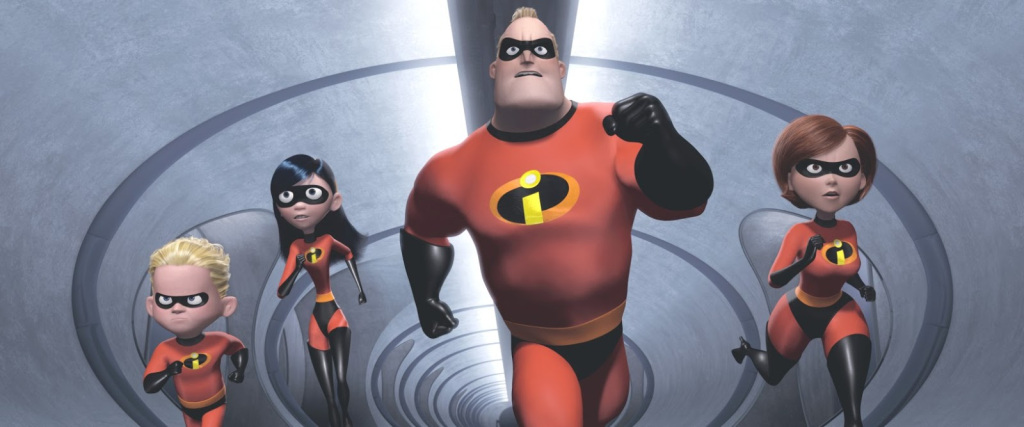
We’ll round out the hour with two projects scored by Michael Giacchino for Pixar Animation Studios. Giacchino’s break-out success was the sly superhero satire, “The Incredibles,” for which he composed in the swinging ‘60s espionage style popularized by John Barry when writing for the James Bond films.
We’ll also hear selections from Giacchino’s Academy Award-winning score to “Up.” “Up” was nominated for Best Picture at the 82nd Academy Awards, only the second animated feature ever to be included in the category.
I think we can all use a little animation, can’t we? I hope you’ll join me for an hour of selections from computer-animated adventures, on “Picture Perfect,” music for the movies, now in syndication on KWAX Classical Oregon!
——-
Clip and save the start times for all three of my recorded shows:
PICTURE PERFECT, the movie music show – Friday at 8:00 PM EDT/5:00 PM PDT
SWEETNESS AND LIGHT, the light music program – Saturday at 11:00 AM EDT/8:00 AM PDT
THE LOST CHORD, unusual and neglected rep – Saturday at 7:00 PM EDT/4:00 PM PDT
Stream them, wherever you are, at the link!
https://kwax.uoregon.edu See less -
Full Disclosure About “Disclosure Day”
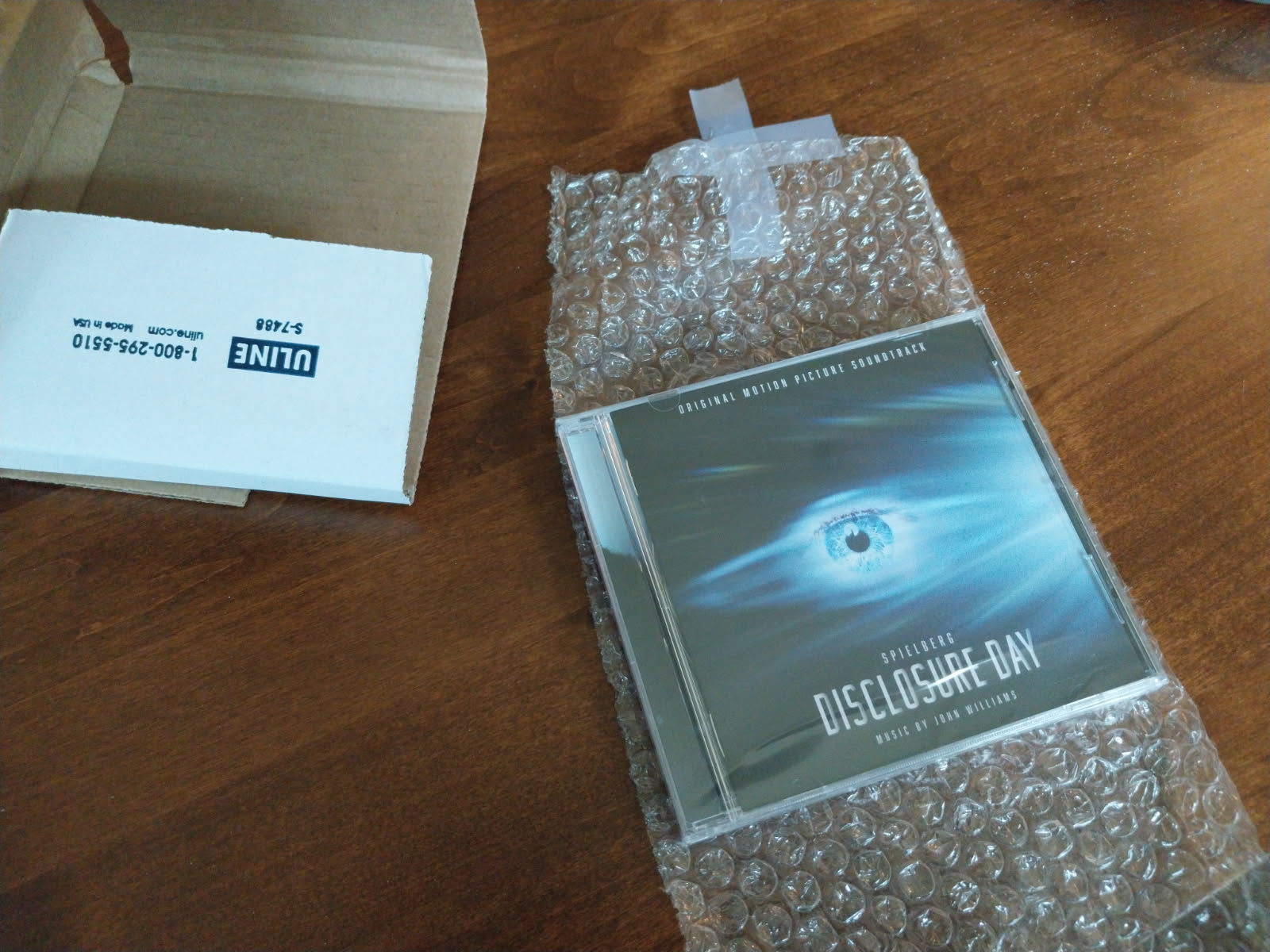
This finally arrived in the mail last week. Does anyone who’s seen the movie even remember it at this point? The quality of the film aside, I am always thankful for more John Williams, especially when he’s not squandering his talent on the diminishing returns of “Star Wars” or Indiana Jones.
What’s remarkable, Williams having written and recorded this at the ages of 93 and 94, is how good it is. This is not one of his scores in “heroic blockbuster” mode. The car chase cue is one of the least remarkable tracks on the album. The train scene everyone raves about, for some reason (it makes no sense), is presented in the film without music. Rather, it is the emotional moments and the moments of wonder (in the music, if not the film) that resonate and remind one of what the movie is so sorely lacking.
The film opened on June 12. I ordered the CD from Waxwork Records on June 18. The soundtrack was shipped exactly one month later. This should not be construed as a slam against Waxwork. It’s just the way things are now, and I can’t see how it helps sales. If the product is not available for purchase by your average, moderately-interested person on the street, either immediately in a brick-and-mortar shop or for two-day delivery from an online retailer, how can you expect more than a few thousand sales, mostly to hardcore John Williams fans and die-hard film score collectors? I guarantee Williams’ name alone would generate many times that amount, if only they would make it easier for people to buy it. As it is, it’s not even available on Amazon, save as a digital download.
Quality-wise, I have no qualms. This is a polished product of the sort that used to be put out by the major labels. The sound is immediate, without seeming to be right in your face; the choral contributions and electronic elements blend well with the acoustic instruments. I must say, the bass is quite striking, to a degree I haven’t really noticed in previous orchestral soundtrack releases – although I confess my consumption of newer movie music has diminished, most of my purchases tending toward music of decades past. Considerably past, in terms of most of the classical stuff. If you want to really feel the lower registers – the cellos, double basses, and percussion – “Disclosure Day” has a unique, appealing sound. More important is the content, and there’s plenty here, in terms of emotion and lyricism, for me to enjoy.
Alas, physical media are not the priority they once were. I miss the days of just being able to walk into a record store and buy a soundtrack when it arrived a week or two before a film’s release. Now, if you want the CD, you have to do your research, find out who is distributing it, and jump through the hoops of preorder and postal delivery. The digital downloads for “Disclosure Day” weren’t even available until the day of the film’s release. I really don’t understand this strategy. A successful soundtrack album has always been one more tool with which to sell a film. How many repeat viewings has Williams’ music inspired? But all that is peanuts, I suppose, in a world in which a movie has to make $300 million in order to turn a profit.
When I called Waxwork to request a few tracks to air on one of my radio shows in advance of the official soundtrack release, I was told it wouldn’t be possible; there would be a rights issues, and I would have to contact Universal directly. Everything has become such a corporate labyrinth over the past decades, it’s like trying to infiltrate the Illuminati to get permission from a studio. Don’t even get me started on Disney. At least at Waxwork someone actually answered the phone, and he was normal and pleasant, competent and human and real, the way people used to be. The prospect of having to deal with Universal was not appealing. In the end, I decided to wait the extra week and just air some tracks from the digital download. So yeah, I bought the soundtrack twice.
All this jealously-guarded secrecy surrounding every aspect of the film, and the final trailer basically gives away the entire movie…
My summation is spoiler-free: I can describe my viewing experience as one of anger, at the start, softening, by the end, to disappointment. At least Emily Blunt and John Williams were good, though I have to admit, in the scenes where Spielberg tries to be more contemporary and dystopian, the score does seem a bit out of place. As I say, Williams does emotion and wonder very well. Watching “Disclosure Day” was a reminder of how much those two qualities are lacking in movies today. Even Spielberg movies, apparently.
I can’t believe I am living in a world where you can’t get a CD of a John Williams soundtrack. The guy who broke all records for soundtrack sales and singlehandedly revived the orchestral film score with such verve that it carried into the 21st century. His appeal transcends the collectors’ market, or at least it did. But since everyone’s awareness about anything, beyond what they are fed on social media, seems to have diminished, you have to be 50 years old to remember a better world.
Disney has to be the biggest group of idiots, judging from its handling of Williams’ last soundtrack, for “Indiana Jones and the Dial of Destiny” – a far less interesting score, save for the delectable “Helen’s Theme,” which is pure golden age, though evidently not appreciated by everyone. As has been the case with the current score, clearly different people expect different things from John Williams. If it doesn’t possess “Jurassic Park” bombast, they’re incapable of recognizing or remembering a theme, apparently. At its best, the music for “Disclosure Day” is gorgeous. I’ve already commented on how the opening track, “Listen,” taps into the spiritual world of Vaughan Williams’ “Tallis Fantasia.” Already, right there, I am sold.
Others have pointed out a kinship between one of the tracks and Williams’ music for Spielberg’s “A.I.,” which, by the way, is easily my most-hated Spielberg film. And while I’m at it, he really missed the boat on creating a prescient sci-fi classic about honest-to-goodness, now-in-the-headlines, anxiety-provoking A.I.! While “Disclosure Day” doesn’t make me violently angry the way “A.I.” did, both movies make me question why I ever liked Spielberg to begin with. But then I remember “Jaws,” “Raiders,” “CE3K,” “E.T.,” and a few others.
“Disclosure Day” is no “Close Encounters,” for as much as it wants to be, and it is certainly no “E.T.” Say what you want about Spielberg’s remake of “War of the Worlds,” at least it was coherent. In 2 ½ hours, “Disclosure Day” has plenty of time to tell its story. But the ideas the screenplay seems to think are the most profound don’t cut very deep, at least in the way they are handled, and plot holes so glaring a ten-year-old child would recognize them are brushed off with a single line of dialogue, if that.
Despite some nice visual touches and some potentially interesting, sadly underdeveloped ideas, there’s more talk than show in what is, after all, a visual medium, and one this director has always exploited better than just about everyone else.
“Disclosure Day” often doesn’t make sense, and I couldn’t understand what any of the critics saw in it, until I realized we have very few actual critics who understand movies anymore, or even basic storytelling. The film proves that, if Spielberg wants to speak to the heart, if he wants empathy and wants us to “listen,” then John Williams is indispensable.
This soundtrack gives me a lot of pleasure, and moves me in a way the movie most definitely did not. -
A Still Presence Behind the Stooges
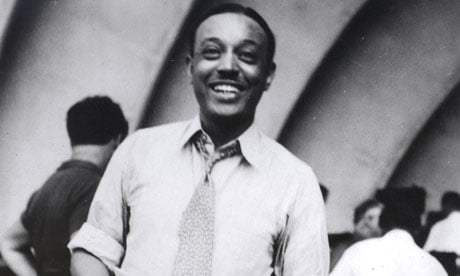
For his many achievements – as the first Black American composer to write a symphony, the first to conduct a major U.S. orchestra, and the first to compose an opera, among other things – William Grant Still would be recognized as the “Dean of Afro-American Composers.” But face it, even under the best of circumstances, a full-time composer has to scramble to make ends meet. Still was not alone in seeking employment in Hollywood, which could always be counted on, once you were in, for a decent paycheck.
However, unlike some of his peers, he was employed mostly as an orchestrator and a composer of “additional music.” One of the films he worked on was Dimitri Tiomkin’s “Lost Horizon” in 1937. John Williams did the same kind of work for Tiomkin on “The Guns of Navarone” in 1961, and we all know how that worked out for him. Still was never given his shot to break into the upper echelon, the way so many white composers who did the same kind of grunt work were. To my knowledge, he never even received a screen credit, but if you know differently, please correct me!
A number of his cues were recycled as “library music” to fill out scores for B-movies and television shows. I was reminded of this yesterday by my friend (and former editor) Dan Aubrey, who will be accompanying me tonight to The Three Stooges Film Festival at the Princeton Garden Theatre, when he made a quip about Still’s music accompanying “eye gauging and cranium pounding.” Allegedly, Still’s work was indeed used in some of the Stooges’ shorts. I’m not sure which ones, and IMDB is no help in this regard, but I will listen more carefully, whenever I go back and watch them.
In the 1950s, he compiled his “Laredo Suite” for use in television westerns, such as “Gunsmoke,” “Have Gun, Will Travel,” and “Rawhide.” (He had written music for a number of film westerns starring Charles Starrett.) Still was far from the only composer to do this. Bernard Herrmann put together some suites of mood music and action cues to be dropped into CBS westerns. The difference is that, even if he wasn’t always credited on the shows, Herrmann was a headliner at the movies.
Still’s involvement with the Stooges is funny and sad at the same time. During the 1930s and ‘40s, Aaron Copland (the “Dean of American Composers”) was scoring prestige pictures such as “Our Town” and “Of Mice and Men.” He was even recognized with an Academy Award for his work on “The Heiress.”
Of course, Still wasn’t alone among talented composers who toiled on the Hollywood production line, but as a Black musician, it’s doubtful he would have been able to rise much higher in mainstream movies until at least the 1960s, after Otto Preminger hired Duke Ellington to score “Anatomy of a Murder,” in 1959, and Quincy Jones made his mark with “The Pawnbroker,” in 1964. And even then, would he have been accepted if the music he wrote wasn’t “jazz”?
While laboring anonymously in motion pictures of the 1930s, Still conducted a concert at the Hollywood Bowl with the Los Angeles Philharmonic. On July 23, 1936, he presented his “Afro-American Symphony.” It was the first time a Black man would conduct a major American orchestra. The next year, in August 1937, the work would be repeated on the first Hollywood Bowl program ever to be devoted exclusively to works by American composers.Still’s “Afro-American” remains one of my favorite American symphonies.
https://www.youtube.com/watch?v=b9iGFLpO5Nk
Fascinating reconstruction of Still’s “Laredo Suite,” library music for westerns, although I suspect the cuts have been posted out of sequence:
https://www.youtube.com/watch?v=CpJQK1miHV4&list=PLgK8FIC-dBq-qGKj5r3vXlGSP3nd9jfq-
Information on The Three Stooges Film Festival, tonight at the Princeton Garden Theatre:
https://www.princetongardentheatre.org/films/three-stooges-garden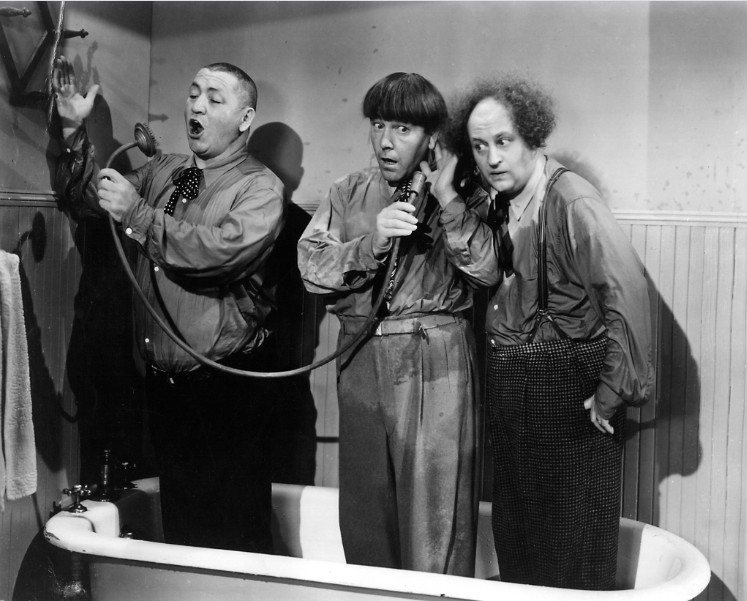
———-
PHOTO: William Grant Still at the Hollywood Bowl
Tag Cloud
Aaron Copland (94) Beethoven (95) Composer (114) Film Music (148) Film Score (143) Film Scores (255) Halloween (97) John Williams (196) KWAX (232) Leonard Bernstein (105) Marlboro Music Festival (125) Movie Music (163) Mozart (91) Opera (215) Philadelphia Orchestra (90) Picture Perfect (174) Princeton Symphony Orchestra (110) Radio (90) Ross Amico (244) Roy's Tie-Dye Sci-Fi Corner (290) The Classical Network (101) The Lost Chord (269) Vaughan Williams (107) WPRB (397) WWFM (881)