Tag: Music Criticism

  • Evenings with Hector Berlioz: Music, Scorn, and Genius

    Evenings with Hector Berlioz: Music, Scorn, and Genius

    “Music makes herself beautiful and charming for those who love and respect her; she has nothing but scorn and contempt for those who sell her.” Only one of the many quotable observations in Hector Berlioz’s “Evenings with the Orchestra.”

    I’ve been reluctant to try to encapsulate this book, which I finished weeks ago, in preparation for this year’s Bard Music Festival. “Hector Berlioz and His World” will begin on Friday at Bard College in Annandale-on-Hudson, NY. (For more information, see the link below.)

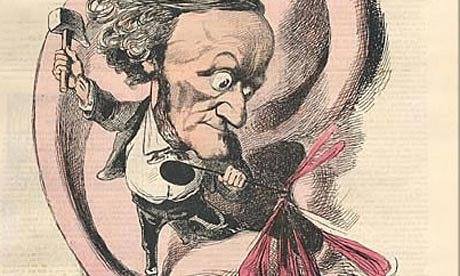
    Oscar Wilde’s Lord Henry memorably observed, “To define is to limit,” and there is something about this book – like Berlioz himself – that defies limitation. It’s every bit as much of a chimera as the composer’s most ambitious music. Satire, autobiography, music criticism, sociology, aesthetic philosophy, slapstick comedy, parable, historical romance, science fiction, and grand guignol form a curious menagerie, startling as the wonders of Dr. Lao’s circus parade.

    The tales and framing device provide glimpses into the composer’s life, his encounters with musicians great and poor, his intense love affairs raising him on wings to heaven, only to dash him in the other place, his observations on a beleaguered art in a hopelessly flawed and vulgar world, and his impressions of what he perceives as our very greatest and worst music.

    At times, these take on a fantastical element. The composer projects his criticisms of the current state of the art, circa 1850, five hundred years into the future, to an authoritarian, Gluck-worshipping society, complete with air ships like something out of Edgar Rice Burroughs. I kept expecting Raymond Massey to show up in his massive “Things to Come” helmet. In one of the interludes, things turn unexpectedly gruesome, rivaling the most horrifying episode in Edgar Allan Poe. In another, we learn of composer William Vincent Wallace’s erotic adventures among the cannibals of New Zealand.

    We are introduced to the microcosm of the opera house, with its vainglorious tenors, who treat music scores like so many hangers on which to display their gaudy clothes; impresarios who know little about, and care nothing for, the integrity of the works they present; and the routine rough handling, arbitrary cuts, and clumsy alterations to which even the greatest operas are routinely subjected.

    Furthermore, Berlioz seldom allows an opportunity to pass with which he can use to illustrate what a bunch of idiots the wider public are. Yes, even back then.

    The overarching conceit has the narrator (Berlioz or an alter ego) visit the pit of a foreign opera house, where most of the musicians are shown to quickly lose interest in whatever jejune trifle they’re given to perform, dismiss whatever imbecilities transpire onstage, and pass the time gossiping and exchanging the anecdotes and stories that become the bases of the various chapters of the book.

    There are notable exceptions. Whenever the works of Gluck or Weber find their way onto the music stands, they play as if they are handing down Holy Scripture.

    A recurring target is the overzealous bass drummer. Berlioz makes no secret of his disgust with the vulgarity of most Italian opera, especially Rossini; but he is no easier on the French, at one point offering an ostensible – albeit extensive – review of a new opera by Adolphe Adam that, beyond a few sentences at the end, is really mostly an account of Berlioz’s weekend in the country. This review originally appeared in a Paris newspaper. As you can imagine, there was no love lost between the two composers.

    We also learn about the political maneuverings of the claques, factions paid off by impresarios and singers to applaud and cheer, with the aim of bolstering the reputations of performers and the successes of new productions.

    Also, about “tacks,” when conductors take to rapping their batons on nearby objects to attract the attention of musicians. According to Berlioz, or the narrator, in one case, the maddening repetition of the act against a resonant box at the foot of the stage, night after night, drove the prompter who worked inside finally to commit suicide.

    Episodes like these excite with their lurid interest. However, they are interleaved with panegyrics to Berlioz’s favored musicians (Spontini, Gluck, Weber, Paganini), and some of these, I have to admit, can go on for quite some time. They provide their own sort of interest, but after a while, they can get to be a little challenging for a reader burning the midnight oil. When Berlioz warms to a subject, he can waffle on about it for a good 30 pages. For great stretches, he can be amusing, occasionally even laugh-out-loud funny, but I must say, for me personally, “Evenings with the Orchestra” is not bedtime reading. I made much surer progress when I picked it up during the day. If you want a good Berlioz bedtime book, stick with the “Memoirs.” Its shorter chapters lend it a brisker pace.

    Whatever the composer writes, it is invariably full of personality. This book, more than most, really conveys quite vividly that nothing in human nature ever really changes – even without the author projecting 500 years in the future. I can totally relate to the types and personalities involved, and the composer’s frustrations, but also, thankfully, his sense of the ridiculous.

    I conclude by reminding you that the Bard Music Festival, “Berlioz and His World,” will take place at Bard College from August 9-18. You’ll find a complete schedule of concerts and more information at the link.

    https://fishercenter.bard.edu/whats-on/programs/bard-music-festival/

    Fisher Center at Bard
  • Nicolas Slonimsky: Savage Invective & Genius

    Nicolas Slonimsky: Savage Invective & Genius

    For the birthday of Nicolas Slonimsky (1894-1995), here a few favorites from his sidesplitting 1953 compendium of critical vitriol, “Lexicon of Musical Invective”:

    “We recoil in horror before this rotting odor which rushes into our nostrils from the disharmonies of this putrefactive counterpoint. His imagination is so incurably sick and warped that anything like regularity in chord progressions and period structure simply do not exist for him. Bruckner composes like a drunkard!”

    (Gustav Dompke, The German Times of Vienna, 1886)

    “Heartless sterility, obliteration of all melody, all tonal charm, all music… This reveling in the destruction of all tonal essence, raging satanic fury in the orchestra, this demoniacal, lewd caterwauling, scandal-mongering, gun-toting music, with an orchestral accompaniment slapping you in the face… Hence, the secret fascination that makes it the darling of feeble-minded royalty… of the court monkeys covered with reptilian slime, and of the blasé hysterical female court parasites who need this galvanic stimulation by massive instrumental treatment to throw their pleasure-weary frog-legs into violent convulsion… the diabolical din of this pig-headed man, stuffed with brass and sawdust, inflated, in an insanely destructive self-aggrandizement, by Mephistopheles’ mephitic and most venomous hellish miasma, into Beelzebub’s Court Composer and General Director of Hell’s Music – Wagner!”

    (J.L. Klein, “History of the Drama,” 1871)

    And of course, who could forget:

    “The violin is no longer played; it is pulled, torn, drubbed…. We see plainly the savage vulgar faces, we hear curses, we smell vodka.… Tchaikovsky’s Violin Concerto gives us for the first time the hideous notion that there can be music that stinks to the ear.”

    (Eduard Hanslick, New Free Press, Vienna, 1881)

    Tchaikovsky could recite from memory every word of Hanslick’s sustained screed, from which this is but an excerpt.

    The “Lexicon” is just the tip of the Slonimsky iceberg. Slonimsky conducted first performances of works by Ives and Varèse. He edited “Baker’s Biographical Dictionary of Musicians” from 1940 to 1992. His “Thesaurus of Scales and Melodic Patterns” influenced musicians from John Coltrane to Frank Zappa to John Adams. His sly wit made him a favorite guest on radio and television programs, including “The Tonight Show.” The man had so much vitality, it’s hardly surprising that he lived to be 101.

    Happy birthday, Nicolas Slonimsky.


    MUST SEE: Slonimsky on “The Tonight Show” with Johnny Carson in 1986, at the age of 92. It was a different world.

    His pioneering recording of Varèse’s “Ionisation,” from 1934

    Piano improvisation with Frank Zappa in 1981. Zappa introduces him at around 1:50.

    “Children Cry for Castoria”

    Documentary, “Nicolas Slonimsky: A Touch of Genius,” narrated by Michael York:

    “In my lifetime, when I was in the conservatory, in order to hear a Brahms symphony, I had to study the score or actually hear the symphony, because there was no other way! Now, a good Juilliard School student probably knows more about music history than a specialist 100 years ago, because of the availability of recordings and publication of miniature scores. In my time, I would have to go to the library and get a contemporary edition of whatever score I wanted to consult, and the scores were very difficult to obtain. Now, if you want the Haydn Symphony No. 74, it is produced immediately, as are any others!”

    A reminder of how fortunate we are, in this modern age, to have so much at our fingertips. And this was before YouTube! Read the rest in Bruce Duffie’s interview, transcribed here:

    http://www.bruceduffie.com/slonimsky.html

    John Adams’ “Slonimsky’s Earbox,” composed in 1996, after Slonimsky’s death, an attempt to “memorialize his wit and hyper-energetic activity” and to acknowledge Adams’ debt to the scales and harmonies gleaned from Slonimsky’s “Thesaurus.”


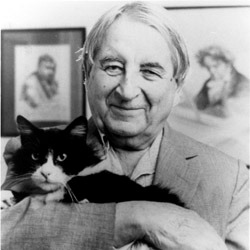
    PHOTO: Slonimsky with his cat, Grody-to-the-Max!

  • Slonimsky’s Wildest Musical Insults

    Slonimsky’s Wildest Musical Insults

    For the birthday of Nicolas Slonimsky (1894-1995), here a few favorites from his sidesplitting 1953 compendium of critical vitriol, “Lexicon of Musical Invective”:

    “We recoil in horror before this rotting odor which rushes into our nostrils from the disharmonies of this putrefactive counterpoint. His imagination is so incurably sick and warped that anything like regularity in chord progressions and period structure simply do not exist for him. Bruckner composes like a drunkard!”

    (Gustav Dompke, The German Times of Vienna, 1886)

    “Heartless sterility, obliteration of all melody, all tonal charm, all music… This reveling in the destruction of all tonal essence, raging satanic fury in the orchestra, this demoniacal, lewd caterwauling, scandal-mongering, gun-toting music, with an orchestral accompaniment slapping you in the face… Hence, the secret fascination that makes it the darling of feeble-minded royalty…of the court monkeys covered with reptilian slime, and of the blasé hysterical female court parasites who need this galvanic stimulation by massive instrumental treatment to throw their pleasure-weary frog-legs into violent convulsion…the diabolical din of this pig-headed man, stuffed with brass and sawdust, inflated, in an insanely destructive self-aggrandizement, by Mephistopheles’ mephitic and most venomous hellish miasma, into Beelzebub’s Court Composer and General Director of Hell’s Music — Wagner!”

    (J.L. Klein, “History of the Drama,” 1871)

    And of course, who could forget:

    “The violin is no longer played; it is pulled, torn, drubbed…. We see plainly the savage vulgar faces, we hear curses, we smell vodka.… Tchaikovsky’s Violin Concerto gives us for the first time the hideous notion that there can be music that stinks to the ear.”

    (Eduard Hanslick, New Free Press, Vienna, 1881)

    Tchaikovsky could recite from memory every word of Hanslick’s sustained screed, from which this is but an excerpt.

    The “Lexicon” is just the tip of the Slonimsky iceberg. Slonimsky conducted first performances of works by Ives and Varèse. His “Thesaurus of Scales and Melodic Patterns” influenced musicians from John Coltrane to Frank Zappa. His sly wit made him a favorite guest on radio and television programs, including “The Tonight Show.” It’s hardly surprising that he lived to be 101.

    Happy birthday, Nicholas Slonimsky.


    Slonimsky documentary on YouTube — narrated by Michael York!


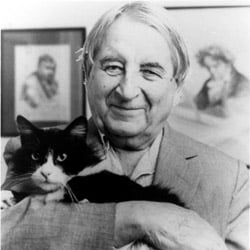
    PHOTO: Slonimsky with his cat, Grody-to-the-Max!

  • Hindemith Hot Weather and Hating the Octet

    Hindemith Hot Weather and Hating the Octet

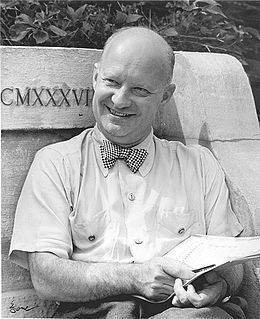
    There are certain pieces by Paul Hindemith that I really, really like. And let’s face it, the gent was extremely influential. But when I came to put together yesterday’s “Music from Marlboro,” it was so miserable hot that I just couldn’t bring myself to subject my listeners to his Octet for Winds and Strings.

    The piece is ugly, grey, cranky, and noodly – gebrauchsmusik at its worst. I’m sure there’s a time and a place for this kind of music (I have programmed it before), but at 27 minutes, let’s face it, it’s just too grating for too damn long. I’ll save it for a bleak – and at least cool – winter’s day.

    There are times when Hindemith can be glorious, thrilling, or transcendent, even. And then there are those when he just leaves your mouth tasting like gun metal on a too-long car trip.

    Here’s a humorous piece written a few years ago that just about nails it. Be forewarned, however, that the language can be a little rough, with the boldest of words in a bold headline. NSFW, then.

    Man Discovers Another Fucking Hindemith Sonata

    The next time you’re stuck in traffic on a hundred degree day, turn off the air conditioning, roll down the windows, and think of this:

    Movement I https://www.youtube.com/watch?v=F6oWa8lB_sY

    Movement II https://www.youtube.com/watch?v=iBxgSkwksU8

    Movement III https://www.youtube.com/watch?v=HcZAnNM5_cU

    Movement IV https://www.youtube.com/watch?v=oFnV8iBV08o

    Movement V https://www.youtube.com/watch?v=RaNx4faNUh4

    Music history would have been a lot different if only Hindemith had been hired as a replacement Stooge ahead of Curly Joe DeRita.

Tag Cloud

Aaron Copland (92) Beethoven (95) Composer (114) Film Music (119) Film Score (143) Film Scores (255) Halloween (94) John Williams (185) KWAX (229) Leonard Bernstein (99) Marlboro Music Festival (125) Movie Music (134) Opera (198) Philadelphia Orchestra (86) Picture Perfect (174) Princeton Symphony Orchestra (106) Radio (87) Ralph Vaughan Williams (85) Ross Amico (244) Roy's Tie-Dye Sci-Fi Corner (290) The Classical Network (101) The Lost Chord (268) Vaughan Williams (102) WPRB (396) WWFM (881)

DON’T MISS A BEAT

Receive a weekly digest every Sunday at noon by signing up here


RECENT POSTS