
Nikolai Rimsky-Korsakov was the composer of no fewer than 15 operas. But how many of them are known in the West?
This week on “The Lost Chord,” we’ll have a chance to sample one of them, as we welcome spring with selections from “The Snow Maiden.”
Based on an allegorical fairy tale of humans, quasi-mythological creatures, and the eternal forces of nature, it’s the story of a star-crossed love that brings about the end of a 15-year winter. The orchestral suite – which climaxes with the “Dance of the Tumblers” – is fairly popular, but the opera itself is seldom done, at least outside of Russia.
The recording we’ll sample, on the Capriccio label, features the Bulgarian Radio Symphony conducted by Stoyan Angelov. It may not hold a candle to the best Rimsky opera recordings by conductors like Nikolai Golovanov, but it’s enough to give a taste of what American opera lovers are missing.
I hope you’ll join me for “The Thaw of the Wild,” on “The Lost Chord,” now in syndication on KWAX Classical Oregon!
——–
Clip and save the start times for all three of my recorded shows:
PICTURE PERFECT, the movie music show – Friday at 8:00 PM EDT/5:00 PM PDT
SWEETNESS AND LIGHT, the light music program – Saturday at 11:00 AM EDT/8:00 AM PDT
THE LOST CHORD, unusual and neglected rep – Saturday at 7:00 PM EDT/4:00 PM PDT
Stream them, wherever you are, at the link!
https://kwax.uoregon.edu
Tag: Nikolai Rimsky-Korsakov
-
Rimsky-Korsakov Speaks Truth to Power
I know Russia isn’t exactly “in” right now. But on Rimsky-Korsakov’s birthday, I am reminded of how the last act of this most venerable of Russian nationalist composers was to give a great big middle finger to the Tsar.
With the completion of “The Invisible City of Kitezh” in 1905, Rimsky thought he was through with the operatic stage. He had composed 14 operas in all, and for “Kitezh” he brought the utmost in his artistry to bear. It would form the capstone in a kind of pantheon to a distinctly Russian national sound in music, the foundations of which were laid by Mikhail Glinka, beginning in the 1830s and ‘40s.
But political indignation stirred Rimsky to take up his pen for one final statement, a sardonic take-down of autocratic rule, Russian imperialism, and military incompetence during the Russo-Japanese War.
To say that the conflict, in which rival empires clashed for supremacy around the Yellow Sea, proved to be an enormous embarrassment for Russia would be an understatement. After a series of staggering defeats, Emperor Nicholas II remained headstrong in his determination to win. Even beyond the point of all hope for victory, he doubled-down to try to save face, rather than submit to a “humiliating peace.” He ignored an olive branch from Japan and rejected the idea of ending the war.
The inadequacy of the Russian military and Japan’s decisive victory stunned the world. It led to the decline of Russian prestige and influence abroad, and contributed to growing domestic unrest that culminated in the 1905 Russian Revolution.
It didn’t help that at home the Imperial Guard had fired on workers during an unarmed demonstration, a peaceful march to the Winter Palace. The actions of the Tsar’s soldiers resulted in the deaths of men, women, and children. Depending on who you believe, casualties were somewhere between 96 (according the official record) and 4,000. Ironically, the Tsar wasn’t even in residence at the time.
That was in January. The war finally ended in September with the Treaty of Portsmouth, mediated by Theodore Roosevelt.
Rimsky himself had earlier served as an officer in the Russian Imperial Navy and later as a civilian inspector of its bands. In 1905 he took to the ramparts, figuratively speaking, when he stood with student agitators at the St. Petersburg Conservatory. Rimsky was in his 60s at the time and a much-beloved presence. For his actions, he was dismissed from his professorship, approximately 100 students were expelled, and the conservatory was threatened with closure.
A second demonstration by students during a performance of one of Rimsky’s earlier operas, “Kashchey the Immortal,” led to a ban on his music. Widespread outrage rippled beyond Russia’s borders. 300 students staged a walkout at the conservatory until Rimsky was reinstated. Not long after, in 1906, Rimsky would resign to launch into work on his final opera, with a pen warmed up in hell.
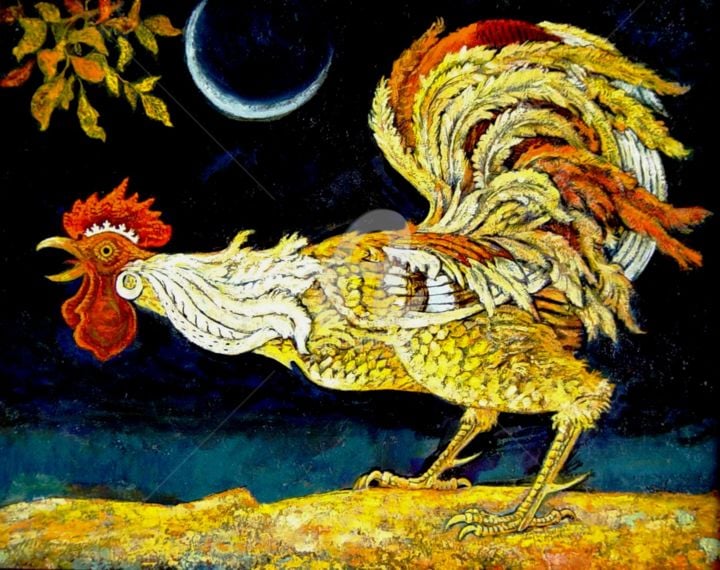
On its surface, “The Golden Cockerel,” after Pushkin, is a fairy tale. But like all the best fairy tales, it also serves as a thinly-veiled allegory. The Astrologer in the work’s prologue and epilogue tells us that the characters are all based on real persons and that the moral is valid and true. In between, we’re introduced to a paranoid ruler who reneges on his promises, commits criminal acts, makes war on a sovereign state, displays military ineptitude, and in the end has his jugular pecked out by a cockerel.
There’s no way the Russian censors were ever going to allow this work onstage. Rimsky, whose health was in decline, demanded that no changes be made, and suggested to a friend that he arrange for it to be performed in Paris. It got there eventually, staged as “Le coq d’or,” the title by which it has frequently been identified in the West ever since.
But the actual premiere took place in Moscow in 1909, the year after Rimsky’s death. And yes, the libretto was judiciously pruned and the staging carefully modified.
In his lifetime, Rimsky-Korsakov was one of the most prominent and respected musical figures in all of Russia. The St. Petersburg Conservatory, from which he was fired, now bears his name.
Ironies continue to pile upon ironies, as history ever looms, ready to repeat itself. In 2026, Rimsky’s barbed response to the events of 1905 seems uncannily prescient and sadly universal.
————
From a New York City Opera telecast, in English, with Beverly Sills in 1971. The Tsar (Norman Treigle) gets the big peck at 1:38:30.
There are plenty more legible productions on YouTube, but most are sung in Russian, and not many have subtitles.
Here’s a more vivid production, with no translations:
Perhaps the opera’s best-known number, “Hymn to the Sun”
Arthur Fielder conducts the orchestral suite: -
Reimagine Christmas with Folklore & Film
Only ten days into the month of December, and you’re already played-out on all the tinsel and consumerism? Reinvigorate your Christmas spirit with Nikolai Rimsky-Korsakov and Władysław Starewicz!
Rimsky-Korsakov’s “Christmas Eve” was given its first performance at St. Petersburg’s Mariinsky Theater on this date in 1895. The opera, based on a story from Nikolai Gogol’s collection “Evenings on a Farm Near Dikanka,” is part fairy tale and part farce. Gogol’s source material is steeped in Ukrainian folklore.
In Ukraine, Christmas Eve is a solemn occasion, marked by fasts and sacred services. Meatless dishes are served for Holy Night supper. But there are also carols. And the caroling is no simple singing of Christmas songs! Similar to the mumming traditions of the British Isles, there is also a fair amount of play involved, with ritualistic dancing and even the participation of a live goat. As in the West, pre-Christian symbols and rituals are embraced in the celebration of Christmas, to lend cheer to the shortest days and hope for a fertile spring.
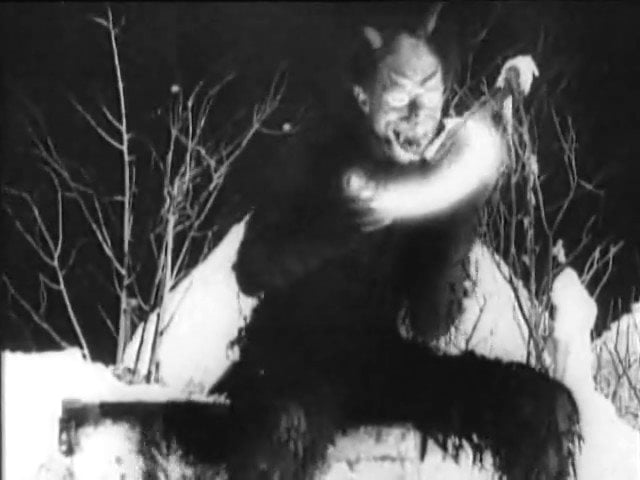
With this in mind, is it any surprise that Gogol’s story tells of the theft of the moon by the Devil, amorous peasants secreting themselves in burlap sacks, and a ride through the air, on the Devil’s back, to collect the Tsarina’s slippers?
My preferred recording of Rimsky-Korsakov’s “Christmas Eve” is still the one from 1948, conducted by Nikolai Golovanov:
In 1912, Starewicz, Polish-born Russian pioneer of stop-motion animation, directed a live-action adaptation of the tale, called “The Night Before Christmas.” Here it’s silent, so you’ll have to provide your own soundtrack. At least the intertitles are translated:
More wondrous still is Starewicz’s animated classic, “The Insects’ Christmas,” from 1911. It’s not Christmas until beetles skate to Tchaikovsky’s “The Seasons.” Watch it now and be astonished!
Starewicz directed a number of films on subjects that were also made into operas, by Rimsky, Tchaikovsky, Mussorgsky, and Glinka, including adaptations of “Russlan and Ludmilla” (1913), “The Snow Maiden” (1914), “The Sorotchninsk Fair” (1918), and “May Night” (1918).
With the holidays awash in silver and gold, I’ll be soaking in horilka for Christmas.
Z Rizdvom Khrystovym!
-

Mily Balakirev and Russia’s Mighty Five
Mily Balakirev was Russia’s musical kingmaker.
Balakirev, of course, was the founder of the “Mighty Handful,” or “The Russian Five,” that collective of Russian nationalist composers that also included Nikolai Rimsky-Korsakov, Modest Mussorgsky, Alexander Borodin, and Cesar Cui.
He had very strong ideas about what Russian music should be, and he was not at all bashful about telling other composers what to do. He essentially micromanaged the early careers of his acolytes, which included not only “The Five,” but on several occasions Peter Ilych Tchaikovsky.
In his later years, though Balakirev’s influence was on the wane, he made two final, important contributions. He was responsible for introducing the prodigy Alexander Glazunov to Rimsky-Korsakov, and he was blessed with one last, very talented disciple, Sergei Lyapunov.
This Sunday night on “The Lost Chord,” we’ll hear music by this last of the Russian nationalists, who was as much influenced by the keyboard prowess of Liszt as he was the patriotic zeal of his mentor. He also happens to be the composer of “The Lost Chord” signature music.
I hope you’ll join me for “One Past Five,” music of Sergei Lyapunov – one hour later than usual, due to the length of today’s opera broadcast – this Sunday night at 11:00 EDT, on WWFM – The Classical Network and wwfm.org.
WHEN BEARDS WERE IN: Top left, Mily Balakirev; bottom left (clockwise), Cesar Cui, Modest Mussorgsky, Alexander Borodin, Nikolai Rimsky-Korsakov; right, Sergei Lyapunov
Tag Cloud
Aaron Copland (92) Beethoven (94) Composer (114) Film Music (116) Film Score (143) Film Scores (255) Halloween (94) John Williams (185) KWAX (228) Leonard Bernstein (99) Marlboro Music Festival (125) Movie Music (131) Opera (197) Philadelphia Orchestra (86) Picture Perfect (174) Princeton Symphony Orchestra (106) Radio (86) Ralph Vaughan Williams (85) Ross Amico (244) Roy's Tie-Dye Sci-Fi Corner (290) The Classical Network (101) The Lost Chord (268) Vaughan Williams (99) WPRB (396) WWFM (881)