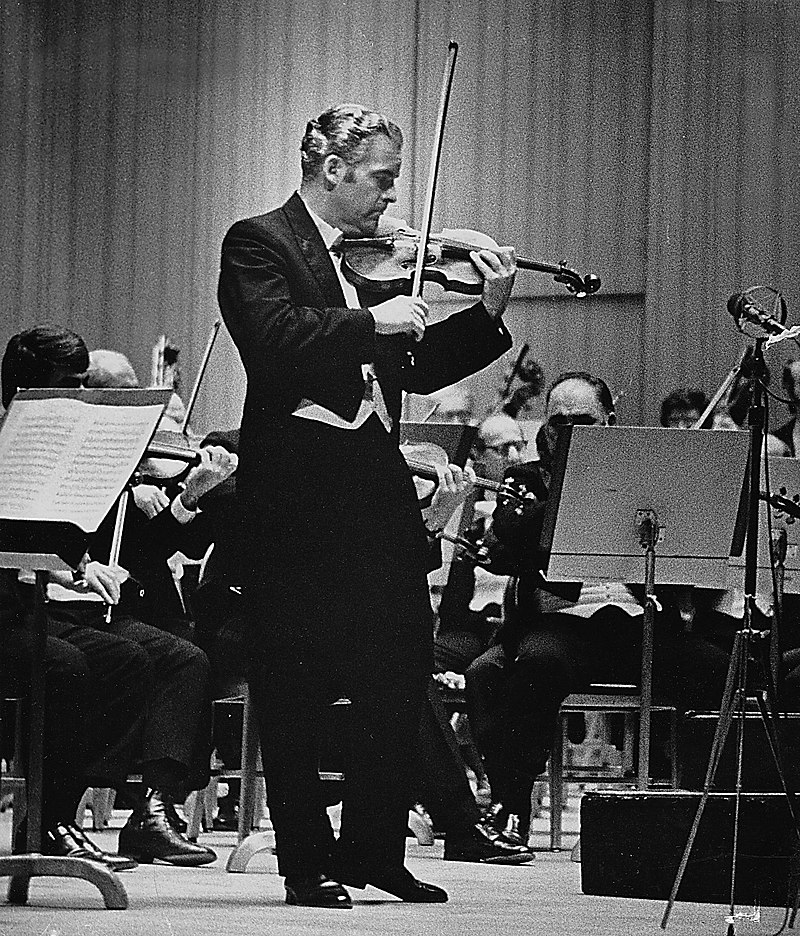
Last week, when writing my memorial to Norman Carol – longtime concertmaster of the Philadelphia Orchestra, who died on April 28 – I recollected reading an anecdote André Previn shared in his book “No Minor Chords” (Doubleday, 1991), an amusing memoir, largely about Previn’s experiences in Hollywood, where seemingly no one in charge knew anything about music (hence the mocking title, taken from a memo handed down by producer Irving Thalberg, “No music in an MGM film is to contain a minor chord”).
Previn was hired by Metro-Goldwyn-Mayer in 1946 while still in high school. MGM was “looking for somebody who was talented, fast, and cheap and, because I was a kid, I was all three,” he mused. He worked as a session musician, arranger, and composer, cutting his teeth supplying cues for Lassie movies. He would go on to write music for 50 films, was nominated for 11 Academy Awards, and won four. In 1960, he received three nominations in a single year! But Previn never took the movie biz too seriously and eventually he left it all behind to pursue a career in classical music.
He was drafted into the military during the Korean War, and beginning in 1951, while stationed with the Sixth Army Band in San Francisco, he began conducting lessons with Pierre Monteux, then music director of the San Francisco Symphony. The particular passage I was thinking of is about the time he and Carol served together at the Presidio. I’ve been wanting to look it up, so this morning I finally took the book down from the shelf, and of course there’s no index. Thankfully, it’s a lean and entertaining 148 pages, so it didn’t take long for me to find what I was looking for.
Sobering to think that both these gentlemen are gone now.
Beginning on page 47:
I made friends with Norman Carol, another musician stationed at the Presidio. He was even then a most remarkable violinist. Shortly after his discharge from the army he became concertmaster of the Philadelphia Orchestra, a distinguished position he has now held for thirty-odd years. But back in 1951, neither one of us could have laid claim to the adjective “distinguished” by the wildest stretch of the imagination. Whenever it was possible, we would commandeer a piano and play sonatas for our own pleasure, and I remember quite a few evenings at officers’ clubs, trying to make some Viennese bonbons audible over the hubbub.
Norman and I were summoned to appear at the office of the reigning two-star general one day. We absolutely could not figure out why. Our small transgressions of the rules were definitely not worthy of generals, and neither of us could come up with a reason to receive a medal. So we shined our boots, pressed our wrinkled ties, and polished our belt buckles, hoping that our smart appearance might lessen whatever blow was to be aimed at us. The general was feeling chatty. “I’m told you two can play the fiddle and the piano pretty good,” he said. “Well, in two weeks’ time there’s going to be a huge meeting of heads of state here in Frisco; Truman is coming, and so are the Russians, the English, the French, and everybody else. After the meetings are over, there’s gonna be a big blowout at the Palace Hotel, and I want you to play for a half hour or so. Understood?”
We nodded rapidly. Yes, we understood. We thank the general, sir. We’ll do our best, sir, yes indeed. We saluted and backed away from the desk, treading on each other’s feet and bumping into a map case. When we got to the door, the general said rather sharply, “Oh, there’s one thing I forgot. You mustn’t play anything recognizably national. Nothing American or Russian or French or English. Understood?”
We looked at one another. Obviously this request was both loony and impossible to fulfill. My misplaced compulsion for jokes surfaced. “If the general agrees,” I said winningly, “we could play a long Swiss medley.”
Not a blink, not a smile was forthcoming. That’ll be fine. See to it,” and the general turned away from us. Silently we went outside. Once we were on the street, Norman turned on me. “You moron,” he started, “you asshole, what are we going to do now? A Swiss medley, you jerk! Name me some Swiss composers except Bloch and Frank Martin! We’ll be court-martialed!”
I calmed him down. “Nobody’ll be listening, Norman,” I said with confidence, “and if by chance anyone does listen, what makes you think they’ll recognize the music? As it turned out, I was right. The ballroom of the Palace Hotel was live with bunting and flags, the guests were representative of the world’s power, and they were not interested in the two GIs on a small corner platform, assaying Brahms, Debussy, and Prokofiev. We ate a lot of very good food, drank a glass or two of wine, and ogled the great and powerful. Our general passed, retinue in tow. This was one night when he was outranked, but he was very scary to us. He gave us the briefest of glances and smiled a smile which never reached his eyes.
“Well done, boys,” he said. “Carry on.”
My post about Norman Carol here:
https://www.facebook.com/photo/?fbid=1297416914510702&set=a.883855802533484