This week on “The Lost Chord,” with my head full of Mozart from this year’s Bard Music Festival (“Mozart and His World,” at Bard College in Annandale-on-Hudson, NY, through tomorrow), I recall a show I put together in 2006 of music composed by a few of Mozart’s friends and associates.
The program includes a Trio in F major for three basset horns attributed to Anton Stadler, the clarinetist who inspired Mozart to write his great masterworks, the Clarinet Concerto and the Clarinet Quintet. Mozart regarded Stadler as an intimate friend. However, it’s been suggested Stadler may have betrayed that trust. In fact, there’s a letter from Mozart’s wife, Constanze, which reveals the clarinetist claimed to have lost some Mozart manuscripts when his suitcase stolen. Among them – some trios for basset horn! You connect the dots.
But what really reminded me of the show was music of Franz Xaver Süssmayr, who famously completed Mozart’s Requiem. Süssmayr’s “Sinfonia turchesca” will be featured on a Bard concert tonight at 7:00. (Concerts from the Fisher Center at Bard are available for livestream. I’ll include a link below.) The “Sinfonia turchesca” is tricked out with a battery of drums, cymbals, and triangles, to be played “in the Turkish style,” as was all the rage in those days. The Battle of Vienna of 1683 proved to be the beginning of the end of centuries of Turkish hostilities. Turkish percussion instruments were sent as diplomatic gifts to the various European courts. The Ottoman influence informed such works as Mozart’s “Turkish” Concerto, “The Abduction from the Seraglio” (to be heard complete at Bard tomorrow, with livestream option), Haydn’s “Military” Symphony, and the janissary interlude in the finale of Beethoven’s 9th.
Finally, we’ll hear selections from a rediscovered singspiel by the company that gave us “The Magic Flute,” including the first Tamino (composer Benedikt Schack), the first Sarastro (Franz Xaver Gerl), “Flute” conductor (Johann Baptist Henneberg), “Flute” impresario, librettist, and Papageno (Emanuel Schickaneder), and Mozart himself. The story shares in common with “Flute” a divided family – in this case, two brothers – representing the powers of good and evil; parallel romantic couples of contrasting dispositions – one spiritual, and the other of an earthier bent; temples and purification rituals; an enchanted weapon; and arcane Masonic and alchemical symbolism.
“The Philosopher’s Stone” was recorded in 1999 by Martin Pearlman and Boston Baroque for the Telarc label, and the work’s a blast. (I had the privilege to hear a few of the duets sung live at Bard last weekend.) We’ll have time for selections from Act I.
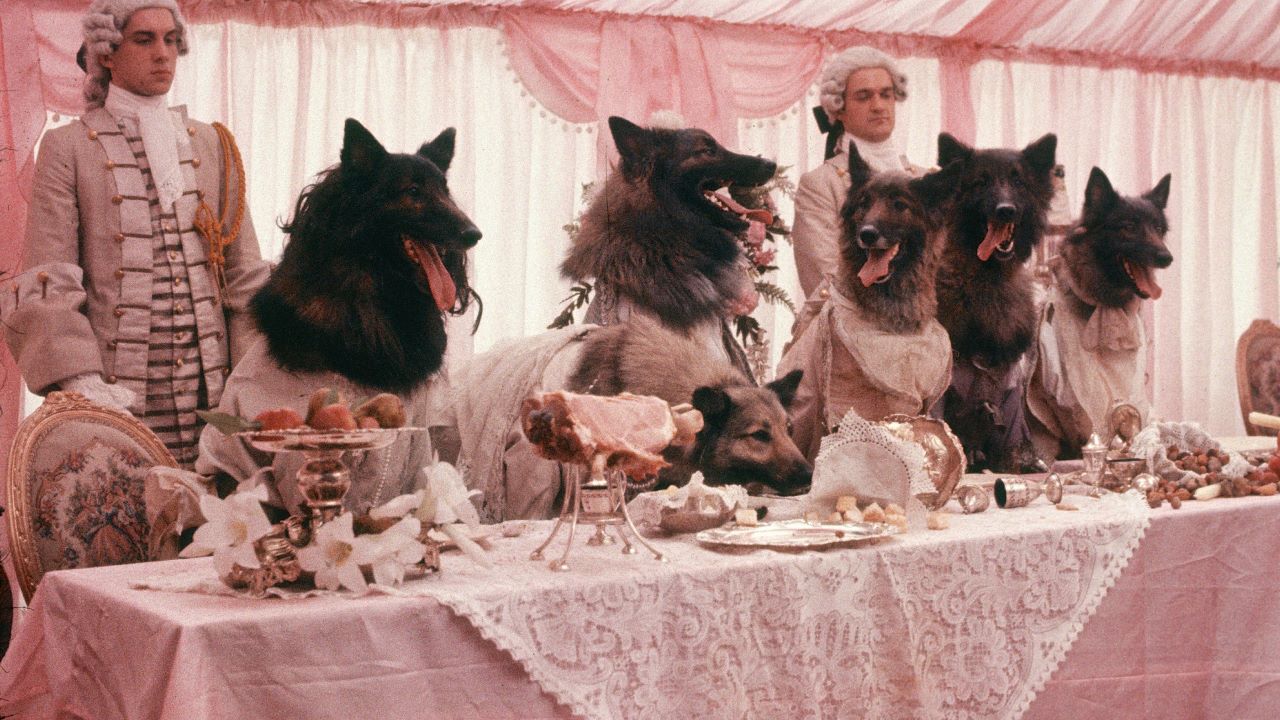
Aaa-OOOO! It’s an hour of music by those who ran wild with Wolfgang Amadeus Mozart. I hope you’ll join me for “Wolf Pack” on “The Lost Chord,” now in syndication on KWAX Classical Oregon!
——-
Clip and save the start times for all three of my recorded shows:
PICTURE PERFECT, the movie music show – Friday at 8:00 PM EDT/5:00 PM PDT
SWEETNESS AND LIGHT, the light music program – Saturday at 11:00 AM EDT/8:00 AM PDT
THE LOST CHORD, unusual and neglected rep – Saturday at 7:00 PM EDT/4:00 PM PDT
Stream them, wherever you are, at the link!
https://kwax.uoregon.edu
For livestreams of “Mozart and His World from the Fisher Center from Bard (concerts from Olin Hall, across campus, are unavailable), visit:
https://fishercenter.bard.edu/what-we-do/bard-music-festival/
——-
Still from “The Company of Wolves” (1984)
Wolf Pack: Friends and Associates of Wolfgang Amadeus Mozart on “The Lost Chord”
by
Tag Cloud
Aaron Copland (94) Beethoven (95) Composer (114) Film Music (148) Film Score (143) Film Scores (255) Halloween (97) John Williams (196) KWAX (232) Leonard Bernstein (105) Marlboro Music Festival (125) Movie Music (163) Mozart (91) Opera (215) Philadelphia Orchestra (90) Picture Perfect (174) Princeton Symphony Orchestra (110) Radio (90) Ross Amico (244) Roy's Tie-Dye Sci-Fi Corner (290) The Classical Network (101) The Lost Chord (269) Vaughan Williams (107) WPRB (397) WWFM (881)
Leave a Reply