This week on “Picture Perfect,” for the 70th anniversary of the release of Cecil B. DeMille’s “The Ten Commandments – and just in time for Passover – we’ll hear selections from Elmer Bernstein’s classic score.
From a 6-CD set on the Intrada label – that includes the complete 2 ½ hour score, three commercial soundtrack releases, and bonus material intriguing enough to curl Charlton Heston’s beard – we’ll hear lovingly remastered highlights from the 1960 Dot and 1966 United Artists soundtrack re-recordings, the Pillar of Fire and parting of the Red Sea sequence from the original score, as heard in the film, and rare demos, prepared for Mr. DeMille by the composer, who announces his themes as he plays them, from the piano.
So let it be written, so let it be done!
It’s the collector’s equivalent of stone tablets handed down from Mount Sinai. Join me for the definitive “The Ten Commandments,” on “Picture Perfect,” music for the movies, now in syndication on KWAX Classical Oregon!
——–
Clip and save the start times for all three of my recorded shows:
PICTURE PERFECT, the movie music show – Friday at 8:00 PM EDT/5:00 PM PDT
SWEETNESS AND LIGHT, the light music program – Saturday at 11:00 AM EDT/8:00 AM PDT
THE LOST CHORD, unusual and neglected rep – Saturday at 7:00 PM EDT/4:00 PM PDT
Stream them, wherever you are, at the link!
https://kwax.uoregon.edu
Tag: Passover
-
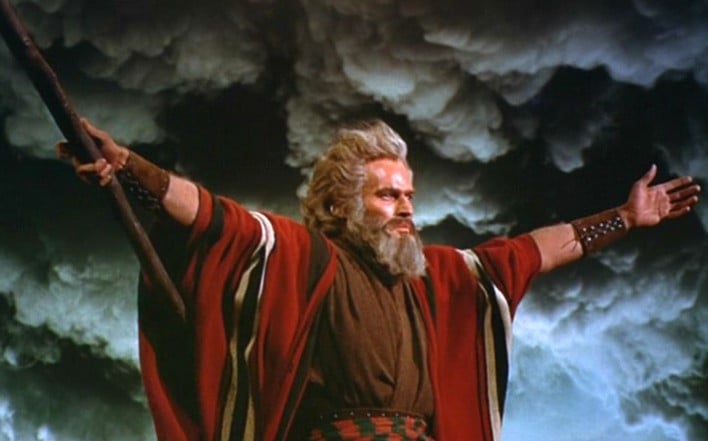
“The Ten Commandments” on “Picture Perfect”
-

Bruch’s Moses A Passover Oratorio Rediscovered
With Passover upon us, last week I was going through my collection, looking for something to listen to, and I was astonished by how many recordings I have of works inspired by Moses, the plagues, the Exodus, and the Ten Commandments. In the oratorio department alone, there’s Handel’s “Israel in Egypt,” Leopold Koželuch’s “Moise in Egitto,” Paul Dessau’s “Haggadah del Pesach,” and R. Nathaniel Dett’s “The Ordering of Moses.” I’m pretty sure somewhere I’ve also got a recording of Anton Rubinstein’s “Moses.”
Here’s another one I picked up from Princeton Record Exchange for $2 in 2022 and, like the Rubinstein, never got around to listening to it – until now. And it’s been in my player more or less all week. Max Bruch’s “Moses” is no Mendelssohn’s “Elijah,” but it’s agreeable enough, and it has its own rewards as entertainment, even if it never quite seems to achieve the lift – that level of transcendence – you experience when everything comes together in the greatest masterworks.
“Elijah” invites the most obvious comparison for several reasons. Aside from the fact that Elijah’s cup is present and filled at the Passover Seder, Mendelssohn’s dynamic, moving rendition of the prophet’s story was the most successful Biblical oratorio of the 19th century, and it’s the only one that still seems to get performed with any frequency.
Also, taking into account Bruch’s most popular works, most people I think would classify him as a composer of the Mendelssohnian variety, a conservative Romantic, as opposed to a radical, Wagnerian one. It’s not for no reason that in the glory days of the LP, Bruch’s evergreen Violin Concerto No. 1 was always on the flip side of recordings of Mendelssohn’s own masterpiece in the genre.
So imagine my surprise to discover that Bruch’s “Moses” contains at least as much Wagner as it does Mendelssohn. Perhaps even more so. The irony of classical music’s most notorious antisemite (i.e. Wagner) being mentioned in connection with an oratorio about the most revered of Jewish prophets is not lost on me. I hasten to add, I am speaking more of the Wagner of “Tannhäuser” and “Lohengrin” than of “The Ring” and “Tristan.” You won’t find any of the harmonic innovation, but you will find leitmotif and certainly a Wagnerian influence in the choral writing and in the dramatic vocal parts for Moses (bass), Aaron (tenor), and the Angel of the Lord (soprano).
All the soloists on this Orfeo recording from 1999, featuring the Bamberg Symphony conducted by Claus Peter Flor, do service to the material, with Michael Volle the standout in the title role.
Interestingly, another work it brings to mind is Josef Rheinberger’s “The Star of Bethlehem.” Different season, different faith, but something about Bruch’s handling of Moses’ inspirational leitmotif recalls – for me, anyway – Rheinberger’s Christmas cult classic, composed in 1890, five years before Bruch’s Passover oratorio. Again for this listener, Bruch’s “Moses” never achieves the same lift or touching sincerity.
Another widely-held assumption, of course, is that Bruch himself was Jewish. It’s easy to understand why, as his treatment of the Yom Kippur chant “Kol Nidre” for cello and orchestra is easily the most popular of the classical music settings. Bruch handles the tune with great sensitivity and evidently pours his heart into it. So it surprises many (as it did, later, the Nazis) to learn that Bruch was indeed Protestant. He did, however, recognize a good tune when he heard one, and clearly when he took up his pencil he was inspired.
It always knocks me off my pins to be reminded that Bruch was born in 1838 – five years after Brahms and three years before Dvořák – yet he died in 1920. Brahms checked-out in 1897 and Dvořák in 1904. Romanticism was still very much in its glorious twilight. What changes Bruch lived through! For someone who was clearly an heir of Mendelssohn to have experienced the era of “The Rite of Spring” boggles the mind.
Anyway, if you’re interested to hear what Bruch does with the Moses story, here’s a link. Just don’t go into it expecting anything special from the Golden Calf episode, which is nowhere near the level of that in Schoenberg’s “Moses und Aron.” It’s more like the Druid shenanigans of Mendelssohn’s “Die erste Walpurgisnacht” – more apt to amuse than to scandalize or to conjure any sense of genuine transgression or blasphemy.
A nice effort from Bruch, but unlikely to dislodge Elijah from his chariot. Still, someone might consider performing it sometime.
-

Passover Music Dessau & Koželuch
Chag Sameach!
For the first day of Passover, here’s a complete performance of the oratorio “Haggadah shel Pesach,” by German-Jewish composer Paul Dessau.
Dessau was a successful theatrical musician, who worked both in opera, as an assistant to Otto Klemperer and Bruno Walter, and with cinema orchestras. However, in 1933, with the appointment of Adolf Hitler as chancellor of Germany, living conditions became intolerable for Dessau, who fled to Paris, and then the United States. He settled in Hollywood in 1943. Later, in 1948, he returned to East Berlin, where he taught at the Staatliche Schauspielschule (Public Drama School) and became vice president of the Academy of Arts.
While in exile in Paris, Dessau composed “Haggadah del Pesach,” on a libretto by Max Brod. Brod is probably best known as the friend and biographer of Franz Kafka. Since neither Dessau nor Brod were fluent in Hebrew, they enlisted the help of Rabbi Mordecai Langer to assist with translation.
Read at the Passover Seder, the Haggadah relates the story of Exodus and explains the Passover rituals. Brod interpolates additional texts from the Torah, Talmud, and Midrash. The oratorio describes “The Feast of Passover,” “Moses Slays the Egyptian,” “The Girls by the Well,” “The Saving of the Girls,” “Chorus,” “The Entrance of Pharoah,” “The Plagues,” “The Slaying of the First-Born,” “Midnight Hymn,” and “Israel’s Departure from Bondage to Freedom.”
Whether your taste runs to maror or charoset, I hope you’ll find something in it to enjoy.
Not your cup of Manischewitz? Try Leopold Koželuch’s “Moisè in Egitto” (“Moses in Egypt”).
Koželuch, a very capable composer, probably would have enjoyed a more respected standing among his peers, if not for a markedly irascible personality. According to legend, he delighted in trash-talking both Haydn and Mozart, which didn’t sit well in certain circles. Is it true? Probably to the extent anything circulated about Salieri is true.
Regardless of what his colleagues may have thought of him, he never seemed to lack for patronage. He was offered the position of court organist in Salzburg, vacated by Mozart, but declined. Later, following Mozart’s death, he assumed the responsibilities of Kammer Kapellmeister (conductor) and Hofmusik Compositor (composer) at the Imperial Court in Vienna, at twice Mozart’s salary.
Yeah, he could be a little rough (Beethoven once described him as “Miserabilis”), but he was also a shrewd political operator.
There’s no questioning his talent. And face it, even Moses had his moments.
-
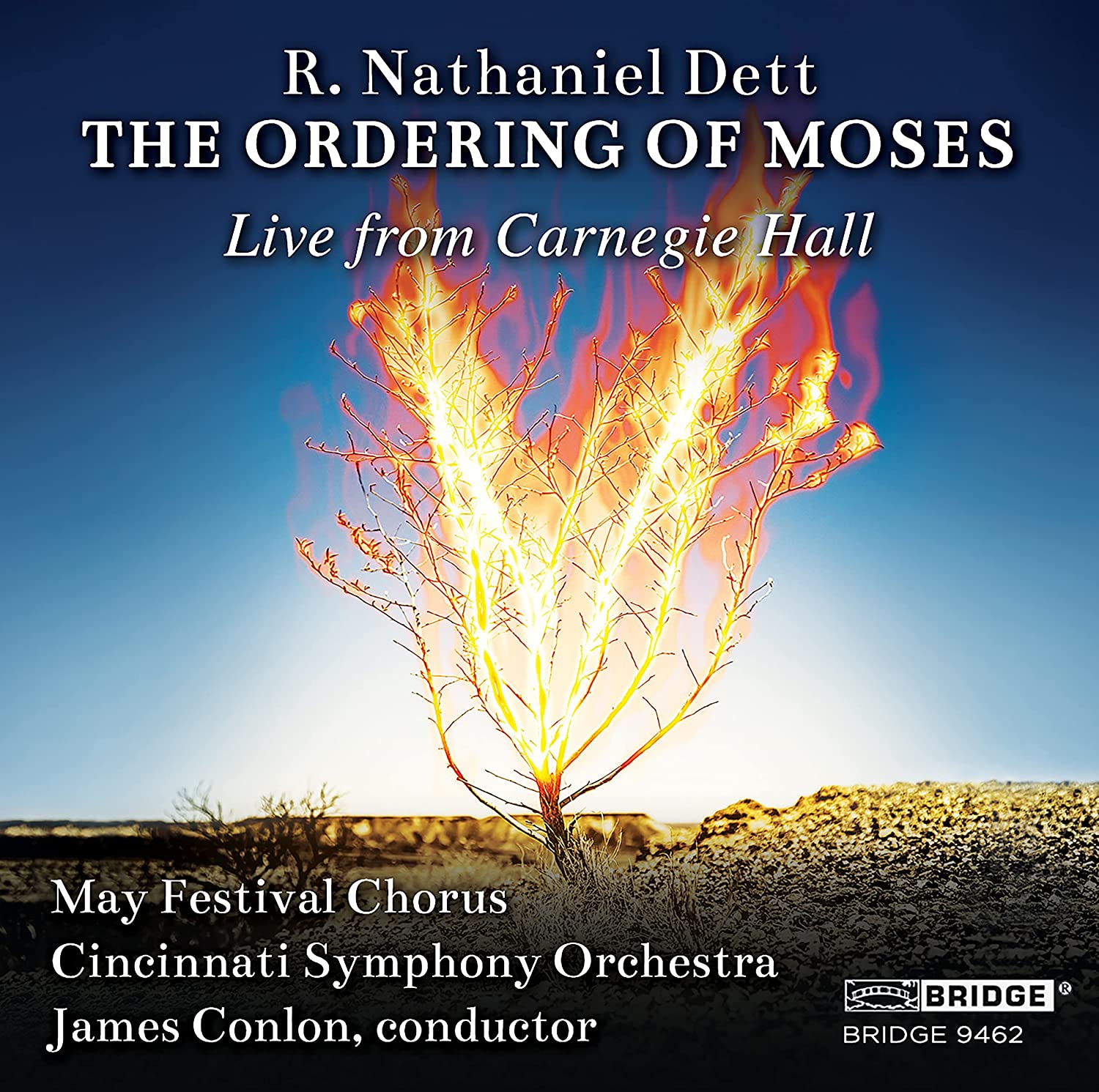
Rediscovering Dett’s “Ordering of Moses”
There have been innumerable musical treatments of Moses and the Exodus story, reaching back to at least the Renaissance. On this first day of Passover, it’s time to give “The Ordering of Moses” its due.
R. Nathaniel Dett was born in what is now Niagara Falls, Ontario, the grandson of a refugee who fled slavery on the Underground Railroad. He became an important figure in American music of his time, but it’s not until comparatively recently that we’ve had many opportunities to hear much beyond “Juba,” the last movement of one of his piano suites, “In the Bottoms,” championed by Percy Grainger and others.
Though he is remembered primarily, if at all, for his exquisite keyboard works, Dett also composed a handful of pieces for more ambitious forces, none of them more so than “The Ordering of Moses.” Scored for vocal soloists, chorus, and orchestra, the work was presented as his graduation thesis at the Eastman School of Music in 1932. It received its first public performance by the Cincinnati Symphony Orchestra, at the Cincinnati May Festival, on a concert broadcast over NBC radio, in 1937. Three quarters of the way through, the work was interrupted, allegedly because of a scheduling conflict.
In 1956, the piece was revived and recorded, also at the Cincinnati May Festival, with Leontyne Price and William Warfield.
More recently, in 2014, James Conlon conducted it in Cincinnati. A follow-up performance at Carnegie Hall was documented by Bridge Records, Inc., a superb account that finally brought the music some of the notice it deserves. Astonished critics asked the obvious question: how is it possible that such a powerful work could have languished for so long?
Did NBC indeed run into a scheduling conflict during that first concert broadcast, or did those in charge cave to listener complaints? After all, this was one of the first works of classical music by a Black composer ever to have been given that kind of exposure, broadcast as it was over a national radio network.
Whatever the truth, now is the time not to deny the past but also to look to the future. In this third decade of the 21st century, can “The Ordering of Moses” finally be appreciated on its own merits?
This performance, from 1968, was captured in Mobile, AL, conducted by William Levi Dawson.
Dawson was born in Anniston, AL. He himself proved to be a remarkable composer. With the current, belated wave of music by composers of color on our concert programs, Dawson’s “Negro Folk Symphony,” after decades of neglect, is popping up everywhere. You won’t hear any complaints from me. This symphony is the real deal.
The work was given its premiere by Leopold Stokowski and the Philadelphia Orchestra in 1934. Dawson revisited the piece after a visit to West Africa in 1952. It is in this form that Stokowski recorded it. I own three recordings of it so far (Neeme Järvi’s being my preference), but I never dreamed I would ever have the opportunity hear it live!
Likely due to lack of demand for his orchestral music, Dawson carved out a career as a choral music composer. In particular, he became a prominent arranger of spirituals.
A shame that he didn’t meet with more success in the concert hall. With a little encouragement, perhaps there would have been a Symphony No. 2.
William Levi Dawson’s superlative “Negro Folk Symphony”
One of the world’s foremost authorities on Dett happens to live and work in our area. Clipper Erickson, on the faculty of Temple University and Westminster Conservatory, was the first to record Dett’s complete piano works, for Navona Records. Clipper walks the walk, and has done so for decades, often including Dett’s music in his rich and varied recitals.
Clipper Erickson, piano, plays the “Barcarolle” from the suite “In the Bottoms.”
“In the Bottoms” concludes with Dett’s most famous music, “Juba.”
Here’s “The Ordering of Moses,” in more up-to-date sound, in the performance released on Bridge Records. The movements are posted separately, so you’ll have to let them play through, skipping any ads along the way.
Passover is a time to celebrate freedom. It reminds us of hope and elation at the prospect of a brighter future. It is for the benefit of all to learn from the wrongs of the past and endeavor to do better.
-
Ernst Toch’s Bitter Herbs: A Passover Gem
On a bad day, Ernst Toch’s music can be a bit like trying to chew through a dry brisket. But he wrote in a wide variety of styles, employing a broad range of musical expression, so if you search long enough, chances are that you’ll find the Toch for you.
Clearly he was “on” for the “Cantata of the Bitter Herbs,” a deeply personal piece, written in an accessible, even engaging idiom. While the primary inspiration is the Haggadah, the core of which is a telling of the Exodus story, read during the Seder on the first night of Passover, Toch strove for a more universal significance, no doubt influenced by the millions suffering from injustice and oppression under fascism in Europe.
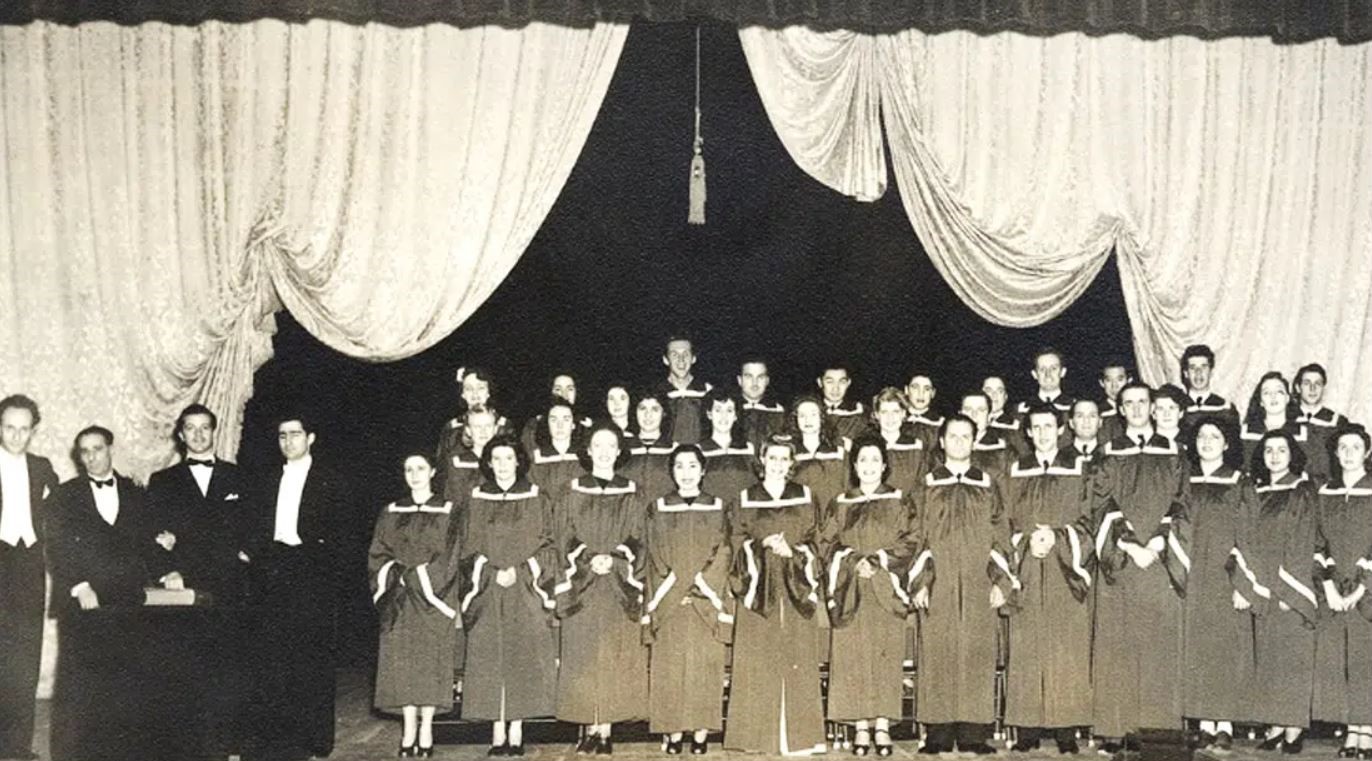
The genesis of the work was in a chance meeting in 1937 between the composer and Rabbi Jacob Sonderling of Fairfax Temple, a Reform congregation in Los Angeles, who did much to enrich Jewish music by providing commissions for European exiles like Arnold Schoenberg, Erich Wolfgang Korngold, and Erich Zeisl. Sonderling contributed to the text of Toch’s cantata, which was first performed as part of a service at Fairfax Temple in 1941. The official concert premiere took place at Los Angeles City College.
Interesting that Dana Andrews was the speaker. In this recording, from the Milken Archive of American Jewish Music, the narration is spoken by Theodore Bikel. It’s a multi-movement work, so be sure to let it play through (skipping ads as necessary).
You can learn more about the piece here:
https://www.milkenarchive.org/music/volumes/view/odes-and-epics/work/cantata-of-the-bitter-herbs/
A three-minute documentary about the recording:
A great deal more about Toch:
His Pulitzer Prize winning Symphony No. 3, which I always thought could use a little more horseradish:
But Toch could have fun, too. He composed a “Pinocchio” overture, a fantasy on “Peter Pan,” and this – perhaps his most frequently encountered work – a “Geographical Fugue,” which prefigures minimalism.
Passover begins at sunset. Chag Sameach!
PHOTO: At the Los Angeles City College premiere of “Cantata of the Bitter Herbs,” with the composer and Dana Andrews, center left
Tag Cloud
Aaron Copland (92) Beethoven (94) Composer (114) Film Music (116) Film Score (143) Film Scores (255) Halloween (94) John Williams (185) KWAX (228) Leonard Bernstein (99) Marlboro Music Festival (125) Movie Music (131) Opera (197) Philadelphia Orchestra (86) Picture Perfect (174) Princeton Symphony Orchestra (106) Radio (86) Ralph Vaughan Williams (85) Ross Amico (244) Roy's Tie-Dye Sci-Fi Corner (290) The Classical Network (101) The Lost Chord (268) Vaughan Williams (99) WPRB (396) WWFM (881)