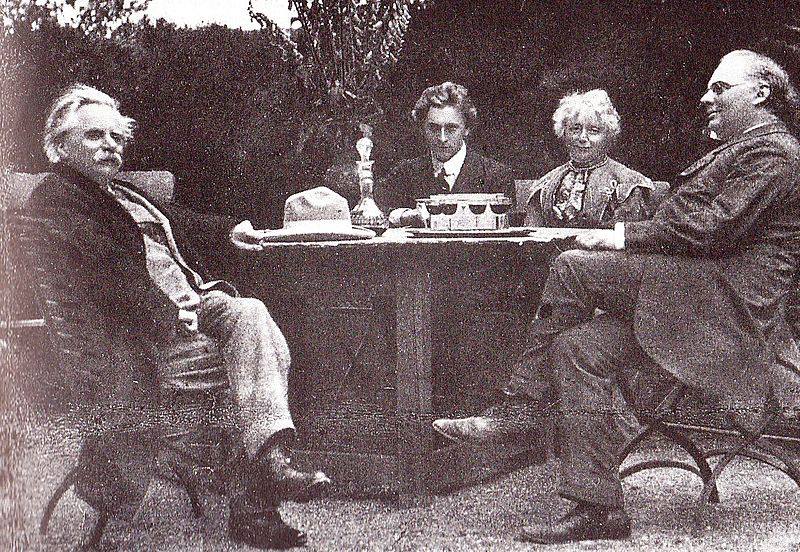
Edvard Grieg was a gentle, generous soul. But he was also something of a rebel-artist who established a personal and national identity outside the dominant Austro-German tradition. As Norway’s most important composer, he provided inspiration not only to Scandinavians, but to artists all over Europe and the United States.
His personality and achievements engendered much affection and loyalty. Tchaikovsky dedicated his “Hamlet Fantasy Overture” to him. Liszt performed his piano concerto. Antonin Dvořák was a friend, and Frederick Delius worshiped him.
This week on “The Lost Chord,” we’ll hear works dedicated to Grieg by some of his composer friends and admirers.
The American composer Edward MacDowell never actually met Grieg, though they shared a certain musical affinity. He contacted the Norwegian to ask permission to dedicate to him his Piano Sonata No. 3, which he subtitled the “Norse.” Grieg was full of compliments about the piece, and he enthusiastically accepted. The two men enjoyed an admiring, though unfortunately short-lived correspondence, since both were already nearing the end of their lives. MacDowell died in 1908, at the age of 47; he was already in the throes of the illness that would claim him at the time Grieg passed in 1907, at the age of 64.
Though Julius Röntgen was born in Leipzig, by his early 20s he had settled in Amsterdam. He went on to become one of the most important figures in Dutch music, establishing the city’s music conservatory and participating in the founding of the Concertgebouw. Röntgen was successful in becoming a good friend not only of Johannes Brahms (no mean feat), but also Grieg, whom he visited in Norway 14 times. The result was a number of works he composed on Norwegian themes. Röntgen dedicated his suite “Aus Jotunheim,” inspired by a hike he had taken with the composer through the Norwegian mountains, to Grieg and his wife, Nina, on the occasion of their 25th wedding anniversary.
Finally, Grieg encountered the tireless Australian pianist Percy Grainger only toward the end of his life, but he was convinced he had found his ideal interpreter. He invited Grainger to perform his Piano Concerto in A Minor under his own direction. Sadly, Grieg died before it could come to pass. Nevertheless, Grainger continued to champion Grieg’s music for the rest of his life. Also, he dedicated a number of folk-inspired works to the memory of the Norwegian master. We’ll hear two historical recordings: one of Grainger playing music of Grieg and then another of the pianist playing one of his own such works.
I hope you’ll join me in celebrating Edvard Grieg with music written for him by composer friends and admirers. That’s “Griegarious,” on “The Lost Chord,” now in syndication on KWAX Classical Oregon!
——-
Clip and save the start times for all three of my recorded shows:
PICTURE PERFECT, the movie music show – Friday at 8:00 PM EDT/5:00 PM PDT
SWEETNESS AND LIGHT, the light music program – Saturday at 11:00 AM EDT/8:00 AM PDT
THE LOST CHORD, unusual and neglected rep – Saturday at 7:00 PM EDT/4:00 PM PDT
Stream them, wherever you are, at the link!
——-
PHOTO: (left to right) Grieg, Grainger, Nina Grieg & Röntgen at Grieg’s home, Troldhaugen, in 1907
Tag: Percy Grainger
-

Northern Exposure on “Sweetness and Light”
This week on “Sweetness and Light,” it’s a program of lighter music from the northern countries.
We’ll give poor overworked Edvard Grieg a break, with Norway represented by Johan Halvorsen and the now lesser-known pianist-composer Agathe Backer Grøndahl, a pupil of Franz Liszt.
From Sweden, we’ll enjoy two versions of Hugo Alfvén’s evergreen “Swedish Rhapsody No. 1” – first, Mantovani’s popular hit from 1953, then with the composer himself conducting, from the very next year, in the first stereo recording ever made in Sweden.
Speaking of popular hits, we’ll also hear Arthur Fiedler’s bestselling recording of “Jalousie,” by Danish composer Jacob Gade (no relation to Niels Wilhelm Gade), from 1935. Fiedler remade it in stereo, but it’s my show, so I’m keeping it hardcore.
Also from Denmark, we’ll have a folk-music suite by Percy Grainger. Ah! But Grainger was not from the north, you say. He was born in Australia. Quite true. However, as an energetic pianist and composer of insatiable curiosity, he traveled seemingly everywhere, with a particular fondness for the Scandinavian countries. (His wife was Swedish.)
But if authentic Danish composers are more your thing, not to worry, we’ll round out the hour with a galop by Hans Christian Lumbye.
All eyes and ears face north this week on “Sweetness and Light.” I hope you’ll join me for this hour of northern “lights,” this Saturday morning at 11:00 EST/8:00 PST, exclusively on KWAX Classical Oregon!
Stream it wherever you are at the link:
https://kwax.uoregon.edu/ -
Classical Music’s Wackiest Composers
If you’re in search of loony tunesmiths, you need look no further than July 8. Today marks the birthday anniversaries of two of classical music’s wackiest pianist-composers.
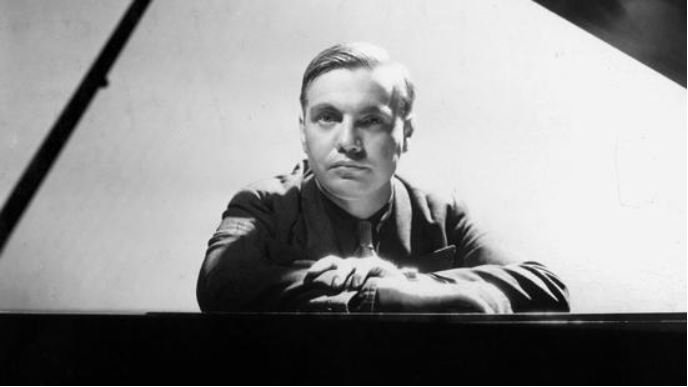
George Antheil, self-proclaimed “Bad Boy of Music,” was born in Trenton, NJ on this date in 1900. His “Ballet Mécanique,” scored for synchronized player pianos, airplane propellers, siren and electric bells, provoked one of the great classical music riots at its Paris premiere in 1926.
Antheil would practice the piano with such ferocity that he would have to pause, periodically, to thrust his hands into two fish bowls filled with ice water. Before the start of a recital, he would ostentatiously remove a pistol from a silk holster sewn into his jacket and place it atop the piano, to telegraph the message that he would brook no nonsense.
Later, he became a Hollywood film composer, a war correspondent, the author of a column of advice to the lovelorn, an expert in endocrinology, and co-inventor, with actress Hedy Lamarr, of a frequency-hopping system for the guidance of Allied torpedoes that would become the basis for modern spread-spectrum communications technology. Neither Antheil nor Lamarr would ever see a dime for their invention.
In 1944, he scored a notable success with his Symphony No. 4, after it was taken up by Leopold Stokowski and later Sir Eugene Goossens, who recorded it. Antheil was also the author of a bestselling autobiography, “Bad Boy of Music.” He died of a heart attack at the age of 59. A third recorded cycle of his symphonies was recently completed for the Chandos label. Not bad for a boy from Trenton.
Wouldn’t you know, Percy Aldridge Grainger was also born on this date, outside Melbourne, Australia, in 1882. Another one of classical music’s great eccentrics, Grainger was obsessed with physical fitness. Rather than drive or take the train between towns and recitals, it was his preference to jog. He was also known to throw a ball over one side of a house, and then race through to the other side to catch it.
Enamored with Nordic culture, he went out of his way to use only Anglo-Saxon words, avoiding in his letters anything of Norman or Latin origin. This extended to his scores, in which he eschewed Italian musical terms in favor of faux “Anglo-Saxon” equivalents (“middle fiddle” for viola, “tone-wright” for composer, “louden” for crescendo). In 1928, he married Ella Ström, from Sweden, during a concert at the Hollywood Bowl. On the program was his new work, “To a Nordic Princess.”
Lest his cultural quirks be misconstrued in an increasingly black-and-white world, Grainger’s embrace of “blue-eyed English” was as idiosyncratic as everything else in his character. He bristled against the dominance of German music, he served in the U.S. Army against Germany in WWI, he embraced music from a wide diversity of cultures, all the way to Bali, he championed works by African-Canadian-American composer R. Nathaniel Dett, and he adored Duke Ellington and George Gershwin.
Grainger was unusually close to his mother and exhibited sadomasochistic tendencies. He donated whips and blood-stained clothes to the Grainger Museum, which he founded in 1932. His request to have his skeleton displayed – posthumously, of course – was denied.
Later, while living in White Plains, NY, he experimented with electronics and “machine music,” in a sense paralleling an obsession of Antheil, who besides “Ballet Mécanique,” wrote such works as “Airplane Sonata” and “Death of Machines.”
Sadly, only the tiniest portion of Grainger’s output is known by the general public, and he is celebrated as the composer of such folksy trifles as “Country Gardens,” “Molly on the Shore,” and “Shepherd’s Hey.” But Grainger’s treatment of harmony and rhythm could be highly original. He was a brilliant musician, and wholly unconventional in more ways than one.
Grainger died in White Plains in 1961 at the age of 78. His remains, including his skeleton, rest in Adelaide.
Happy birthday, you wacky, wacky boys.
Grainger, “Scotch Strathspey and Reel”
Grainger orchestration of Debussy’s “Pagodes”
His imaginary ballet, “The Warriors”
Grainger plays “Molly on the Shore”
R. Nathaniel Dett’s “Juba”
Antheil, “Ballet Mécanique” – presumably in its revision, because of the use of live pianists – with the annoying Fernand Léger film
Antheil, “Jazz Symphony”
Antheil, Symphony No. 4 “1942”
Antheil, “Specter of the Rose” (from the film score, 1946)
Antheil speaks!
PHOTOS: Antheil packing heat (top), and the multifaceted Grainger
-
Herrmann’s Mentor: Percy Grainger
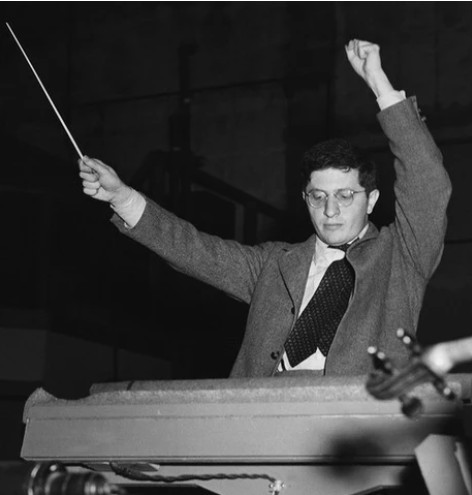
Bernard Herrmann may be best-recognized as the greatest film composer the United States ever produced, but he was also a passionate Anglophile. I’ve written a lot about Herrmann over the years, from many different perspectives, but in light of my recent visit to the Percy Grainger Home & Studio in White Plains, NY (where Grainger lived for 40 years), I thought I’d share a little bit about the relationship of these two artists today, for the anniversary of Herrmann’s birth.
Herrmann studied composition with Grainger at New York University in the early 1930s. Even in untested youth, his extensive knowledge and passion for English music (and music in general) endeared him to his mentor – they also shared an ear for unusual orchestration – and a genuine affection sprang up between them. In particular, they both adored Frederick Delius, whom Grainger got to know fairly well in the early years of the 20th century. (Grainger, born in Melbourne, lived in England from 1901-14.)
For Herrmann, Grainger was like a magic fountain of information about many of the living composers he so admired. Herrmann himself would later get to know some of them himself during guest conducting engagements with the BBC Symphony, the Halle Orchestra, and the London Symphony Orchestra.
Here’s a little more about Grainger and Herrmann, largely drawn from Steven C. Smith’s Herrmann biography, “A Heart at Fire’s Center.” I’ve read Smith’s book, of course, but for convenience’s sake, I am cutting and pasting this excerpt from an article about Herrmann’s Anglophilia compiled by Ian Lace for the MusicWeb International website. To access the complete article, which would certainly be worth your while, if it’s a topic that interests you, look for the link below.
From Lace’s piece:
Also in 1932 Herrmann attended a bi-weekly course in advanced composition and orchestration led by the brilliant but wildly unorthodox Percy Grainger.
‘Percy Grainger was Australia’s most innovative advocate of music past and present, from his childhood days as “the flaxen-haired phenomenon” of Melbourne to his years of international fame as folk song collector, composer, and recitalist. At the heart of Grainger’s unstable, erratic character was a fixation on truth, contempt for tradition and a passion for the outrageous.
‘Since becoming head of NYU’s music department in 1931, Grainger had offered a syllabus of musical eccentricity and frequent brilliance that left many students puzzled and unimpressed. The class of 1932, however, had one exception. In Grainger, Herrmann saw qualities he himself was cultivating: individualism and dedication to one’s craft and beliefs, however unpopular and unfashionable.
‘The relationship between the fifty-year-old teacher and the twenty-one year old student was one of mutual respect. “Grainger did not place orchestration examples before [his students],” Grainger biographer John Bird wrote, “Instead, he allowed them to choose their pieces and gave them advice when and where needed. Herrmann for instance, decided to orchestrate MacDowell’s Celtic Sonata and felt the need to employ the sonorities of a tenor tuba. The Australian knew little of this unusual piece of plumbing, so together, they familiarised themselves with the instrument and found suitable moments to include it.”
‘Herrmann and Grainger also discovered a shared love of Whitman and the music of Delius. One of Herrmann’s favourite NYU memories peripherally involved the latter: one morning the gaunt, sprightly Grainger leapt onto the lecture stage and announced, “The three greatest composers who ever lived are Bach, Delius and Duke Ellington. Unfortunately Bach is dead, Delius is very ill – but we are happy to have with us today the Duke!” Ellington and his band then mounted the stage and played for the next two hours.
‘If other Grainger lectures were less dramatic, they were no less influential to Herrmann: ancient monophony, folk music, atonality, polyphony, the indigenous rhythms of Africa, Asia, and the South Seas – each was examined by Grainger with alternating lucidity and jumbled mysticism. When the scholastic year ended in mid-August 1933, Grainger considered his work a failure, as few students had been as responsive as Herrmann; but it cemented a friendship between him and his intense young pupil that affected Herrmann for the rest of his life.’
For more about Grainger and Herrmann (and Herrmann’s chum Jerome Moross), there’s also this entry on the Percy Grainger Society website.
https://percygrainger.org/blog/8103609
Happy birthday, Bernard Herrmann!
PHOTOS (clockwise from upper left): Herrmann conducting at CBS radio in the 1930s; Grainger conducting the National High School Orchestra at Interlochen in 1937; Grainger with Duke Ellington at New York University in 1932; Herrmann and Orson Welles at CBS
-

Grainger Plays Grieg Rare Footage Surfaces
This rare footage turned up online within the past week or so of Percy Grainger playing music by his friend, Edvard Grieg. Since it’s Father’s Day and I’ve got to be out the door to meet my stepdad for brunch, and since it also happens to be Grieg’s birthday, I thought it would be an easy post, and a fascinating one, if you should choose to follow the link.
If you are ever in the vicinity of White Plains, NY, I highly recommend a visit to the Percy Grainger Home & Studio, the house in which Grainger lived for 40 years. Be sure to contact them in advance, as the house is open only on certain days and by appointment.
I went into great detail about my own highly enjoyable visit on the last of April. If you missed it, hopefully this link will take you to the May 1 post, in which I share my impressions.
Happy birthday, Edvard Grieg!
IMAGES: (left) detail from screenshot of Grainger playing Grieg’s “To Spring,” from the Lyric Pieces, Op. 43; photo of Grieg inscribed to his friend, one of the many treasures on display at the Percy Grainger house
Tag Cloud
Aaron Copland (94) Beethoven (95) Composer (114) Film Music (150) Film Score (143) Film Scores (255) Halloween (102) John Williams (198) KWAX (233) Leonard Bernstein (105) Marlboro Music Festival (125) Movie Music (165) Mozart (91) Opera (215) Philadelphia Orchestra (90) Picture Perfect (174) Princeton Symphony Orchestra (110) Radio (90) Ross Amico (244) Roy's Tie-Dye Sci-Fi Corner (290) The Classical Network (101) The Lost Chord (269) Vaughan Williams (107) WPRB (397) WWFM (881)