July 8 is classical music’s birth date of wacky. Were there two more eccentric characters than Percy Grainger and George Antheil? Undoubtedly, there were some who would give them a run for the money, but few could win the race.
Antheil, the self-proclaimed “Bad Boy of Music,” was born in Trenton, NJ, in 1900. His “Ballet Mécanique,” for synchronized player pianos, siren, electronic bells, xylophones and airplane propellers, caused a riot at its Paris premiere in 1926.
At the time, he and his wife lived in a one-bedroom apartment above Sylvia Beach’s Shakespeare & Company bookshop, a favorite haunt of Ezra Pound, Ernest Hemingway and James Joyce. Relishing his notoriety, Antheil carried a pistol in a silk holster sewn into his jacket, which he ostentatiously would place on the piano prior to commencing a recital.
Later, he was co-holder of a patent with actress Hedy Lamarr for a communications system based on frequency-hopping, as applied to radio-controlled torpedoes. Though the idea of spread spectrum became the basis for modern cell phone technology, neither Antheil nor Lamarr ever saw a dime for their invention.
In his spare time, Antheil wrote a column of advice to the lovelorn for Esquire magazine, a couple of murder mysteries and a book on criminal endocrinology.
Grainger, born in Australia in 1882, was an outstanding pianist and an innovative composer. He was also obsessed with physical fitness and the idea of racial superiority. Rather than drive or take the train, he preferred to jog across country from engagement to engagement. He would throw a ball over one side of a house, and then race around the other side to catch it.
Enamored of Nordic culture, he went out of his way to use only Anglo-Saxon words, avoiding in his letters anything of Norman or Latin origin. However, the dominance of German music rankled him.
He was unusually close to his mother and developed sadomasochistic tendencies. He donated whips and blood-stained clothes to the Grainger Museum, which he founded in 1932. (His request to have his skeleton displayed – posthumously, of course – was denied.)
Late in life, he experimented with electronics and “machine music,” in a sense paralleling an obsession of Antheil, who besides the “Ballet Mécanique,” wrote works like the “Airplane Sonata” and “Death of Machines.”
Sadly, only the smallest portion of Grainger’s output (“Country Gardens,” “Molly on the Shore,” “Shepherd’s Hey”) is known by the general public, and generally celebrated for the wrong reasons. Grainger’s treatment of harmony and rhythm could be highly original. He was a brilliant musician, and wholly unconventional in more ways than one.
Happy birthday, you wacky, wacky boys.
Here’s Antheil’s “Ballet Mécanique” – presumably in its revision, because of the use of live pianists – with the annoying Fernand Léger film: https://www.youtube.com/watch?v=kX9SZ21OmYU
And Grainger’s setting of a text from the Faroe Islands, “Father and Daughter”: https://www.youtube.com/watch?v=iPAVUlmL0sk
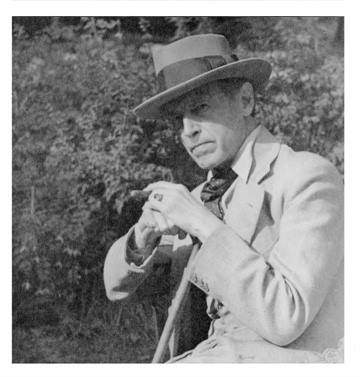
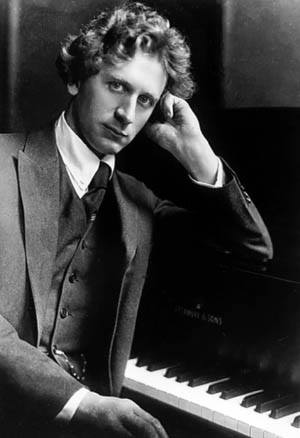
PHOTOS: Grainger (left) and Antheil, both very bad