Tag: Percy Grainger

  • Percy Grainger: Eccentric Genius Revealed

    Percy Grainger: Eccentric Genius Revealed

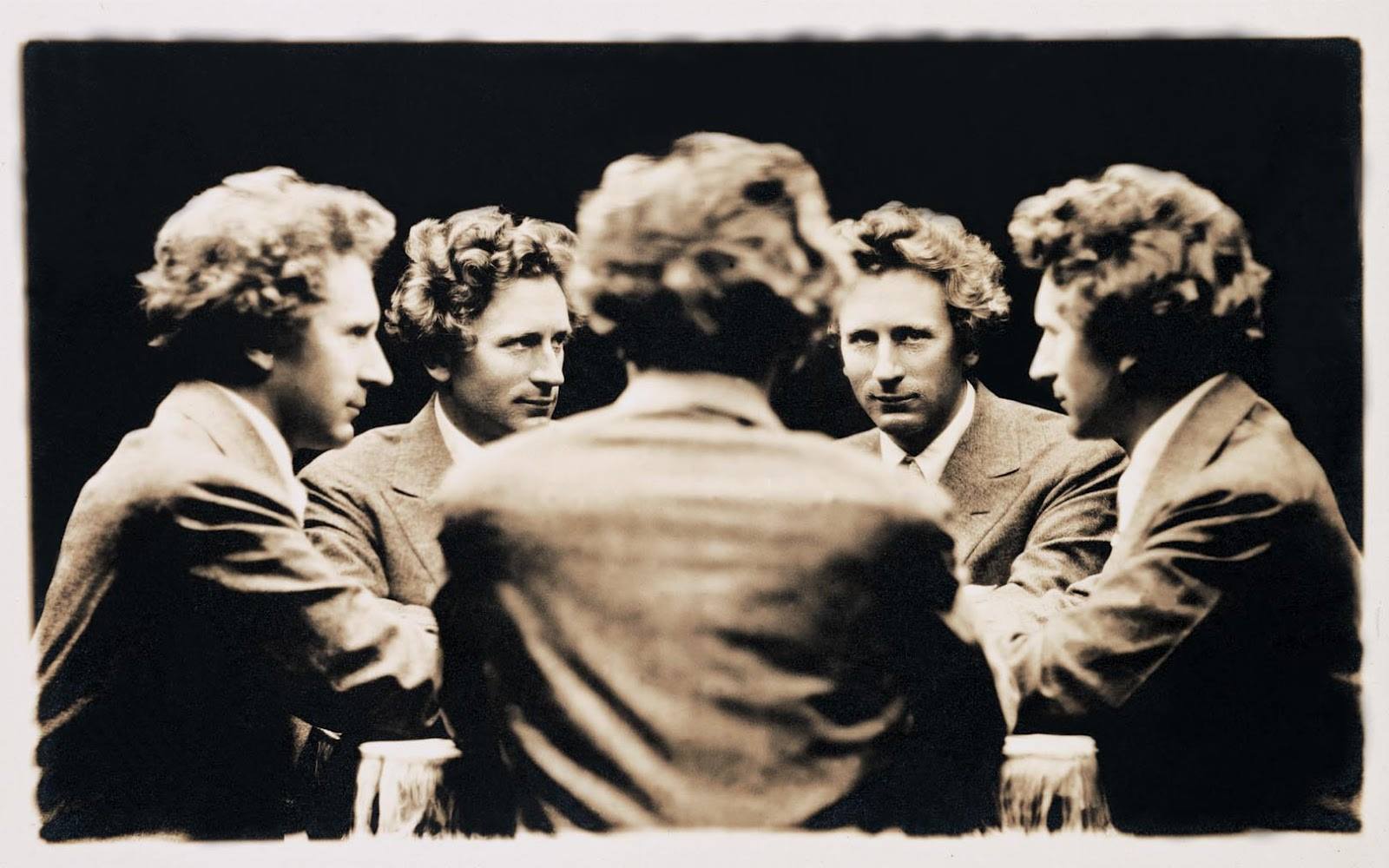
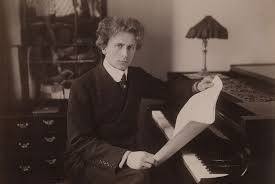
    In the course of working so much with Australian music over the past week, I happened to come across some interesting photos of Percy Grainger. Grainger, in addition to being an extraordinary pianist, was a visionary composer, whose music has frequently been undersold. He’s remembered largely as a collector and arranger of folk songs, especially those from the British Isles (“Country Gardens,” “Shepherd’s Hey,” “Molly on the Shore,” “Irish Tune from County Derry,” etc.).

    But it’s clear he was not afraid to think outside the box, either in his life or in his music. Even in these overexposed sweetmeats, which he arranged multiple times, he plays with rhythm and harmony, and in the case of “Shepherd’s Hey,” completely alters the original mood. Some of his orchestrations can only be described as “out there.” Part of the reason so little of his music is known is that he’ll decide to drop in a bass concertina or a detuned guitar for a piece that lasts only a couple of minutes.

    In life, of course, he was a force of nature. A physical fitness nut, he would throw a ball over the top of a house and run around the other side in time to catch it. He preferred to jog from engagement to engagement, sometimes with his favorite piano bench in a wheel barrow. It was not uncommon for him to take the concert stage with a running leap.

    He also had his dark or queasy side. He was unusually close to his mother (who didn’t touch him until he was five years-old, for fear that she would pass on her syphilis). He held contradictory views about the superiority of the Anglo-Saxon race (he married a “Nordic princess” before a crowd of 20,000 at the Hollywood Bowl), yet was enthralled by music of non-Western cultures and loved jazz (he was a friend of Duke Ellington). He endowed a museum in his birthplace of Melbourne with his collection of whips, bloodied clothes, and even his own skeleton. (As far as I know, the latter was not accepted.)

    Later in life, while living in White Plains, NY, he devoted himself to the construction of machines that would help him realize his dream of what he termed “Free Music,” a music liberated from what he saw as the “goose-stepping” rigidity of Western tradition. These cumbersome beasts were, in some respects, precursors of the modern synthesizer.

    Clearly so much can be written about this eccentric and his freewheeling genius, but for today my purpose is to share with you something new to me. On top of everything else, Grainger designed what he called “toweling outfits.” Here’s a link to some photos, with the composer’s own comments at the bottom of the page.

    http://collectedphotographs.blogspot.com/2012/04/percy-grainger-towel-clothes-and.html

    More about Grainger’s Free Music Machine here:

    The ‘Free Music Machine’. Percy Grainger & Burnett Cross, USA/Australia , 1948


    The multifaceted Percy Grainger

  • The Frankfurt Group: English Music Pioneers

    The Frankfurt Group: English Music Pioneers

    The Frankfurt Group, sometimes called the Frankfurt Gang, met at the Hoch Conservatory in Frankfurt-am-Main in the 1890s. The group included Balfour Gardiner, Roger Quilter, Norman O’Neill, Cyril Scott, and the youngest of the bunch, the piano prodigy Percy Grainger.

    Later, though never officially part of the group, other figures became closely associated, including Frederic Delius, Sir Thomas Beecham, and the composer Frederic Austin.

    The Hoch Conservatory of the day had the reputation of being one of the very finest in Europe. Clara Schumann had been on the faculty there until 1892 – within a few years of the Frankfurt Group’s arrival. In fact, at least one of them, Cyril Scott had already been there.

    Scott arrived at the school early, at the age of 12, and then later returned for a second stint. Balfour Gardiner was also there twice, taking a break to attend Oxford. Grainger was 13 at the time he was admitted. He was to remain at the Hoch Conservatory for four-and-a-half years.

    What united this brilliant array of young talent in a foreign land? Well, there was shared language and culture, of course, but also a determination to break away from the dominant, Teutonic musical thinking of the time, and especially the place, to create a fresh English art.

    I hope you’ll join me for “Hochschule Musical,” sampling works by members of the Frankfurt Group, this Sunday night at 10:00 EST on “The Lost Chord,” on WWFM – The Classical Network and at wwfm.org.


    PHOTOS: Former classmates (clockwise from top) Percy Grainger, Cyril Scott, and Roger Quilter

  • Grieg’s Circle: Friends & Admirers

    Grieg’s Circle: Friends & Admirers

    By all accounts, Edvard Grieg was a gentle-though-principled, generous soul. He was certainly Norway’s most important composer, and his example provided an inspiration not only to Scandinavians, but also to musicians worldwide seeking to find a way around an Austro-German stranglehold on music.

    Is it any wonder that he attracted such a devoted following? Tchaikovsky dedicated his “Hamlet Fantasy Overture” to Grieg. Liszt performed his piano concerto. Antonin Dvořák was a friend. Frederick Delius worshipped him.

    This Sunday night on “The Lost Chord,” we’ll listen to an hour of music dedicated to Grieg by his friends and admirers.

    The American composer Edward MacDowell never actually met Grieg, though they shared a certain musical affinity. He contacted the Norwegian to ask permission to dedicate to him his Piano Sonata No. 3, which he subtitled the “Norse.” Grieg was full of compliments about the piece, and he enthusiastically accepted. The two men enjoyed an admiring, though unfortunately short-lived correspondence, since both were already nearing the end of their lives. MacDowell died in 1908, at the age of 47; he was already in the throes of the illness that would claim him at the time Grieg passed in 1907, at the age of 64.

    Though Julius Röntgen was born in Leipzig, by his early 20s he had settled in Amsterdam. He went on to become one of the most important figures in Dutch music, establishing the city’s music conservatory and participating in the founding of the Concertgebouw. Röntgen was successful in becoming a good friend not only of Johannes Brahms (no mean feat), but also Grieg, whom he visited in Norway 14 times. The result was a number of works he composed on Norwegian themes. Röntgen dedicated his suite “Aus Jotunheim,” inspired by a hike he had taken with the composer through the Norwegian mountains, to Grieg and his wife, on the occasion of their 25th wedding anniversary.

    Finally, Grieg encountered the tireless Australian pianist Percy Grainger only toward the end of his life, but he was convinced he had found his ideal interpreter. He invited Grainger to perform his Piano Concerto in A Minor under his own direction. Sadly, Grieg died before it could come to pass. Nevertheless, Grainger continued to champion Grieg’s music for the rest of his life. Also, he dedicated a number of folk-inspired works to the memory of the Norwegian master. We’ll hear two historical recordings: one of Grainger playing music of Grieg and then another of the pianist playing one of his own such works.

    I hope you’ll join me for “Grieg-arious,” music by Grieg’s dedicated friends. You can enjoy it tonight at 10 ET on WWFM – The Classical Network, or listen to it later as a webcast at wwfm.org.


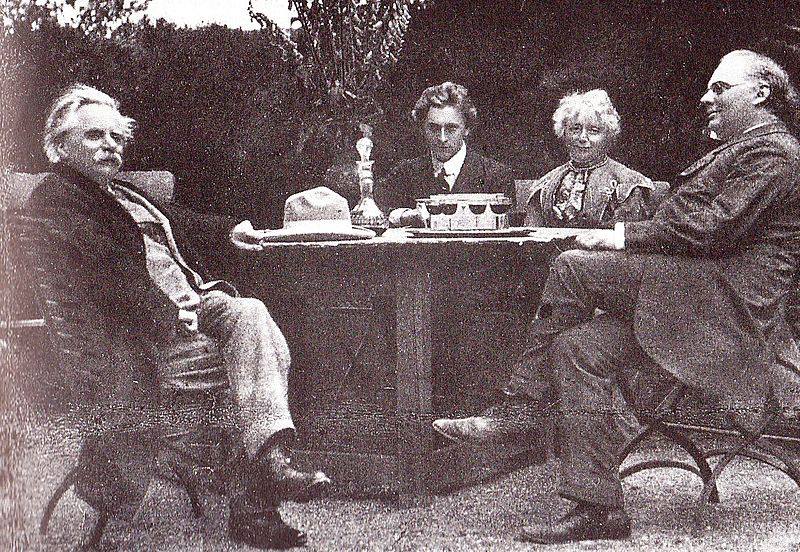
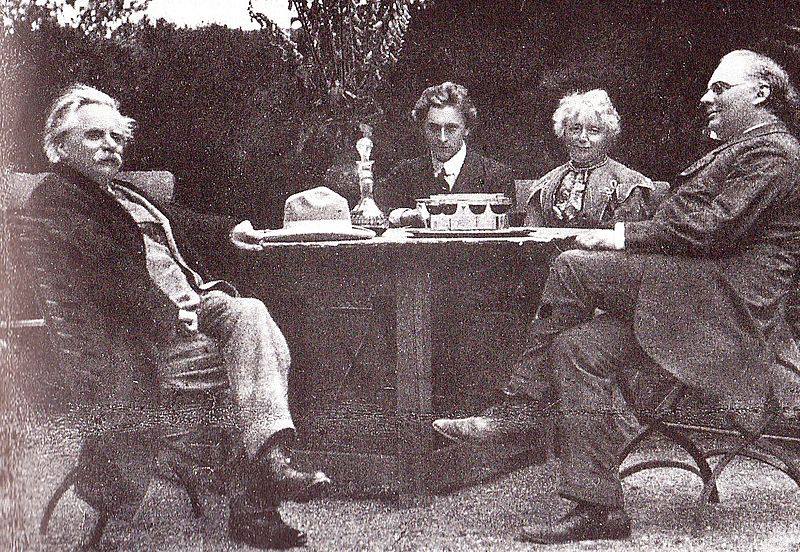
    PHOTO: (left to right) Grieg, Grainger, Nina Grieg & Röntgen at Grieg’s home, Troldhaugen, in 1907
  • Clipper Erickson Rediscovering Lost Piano Gems

    Clipper Erickson Rediscovering Lost Piano Gems

    While the rest of the world is looking ahead to a new year, Clipper Erickson, piano is on the look-out for new repertoire.

    Erickson, who is on the faculty of Westminster Conservatory of Music, Rider University, in Princeton, and Boyer College of Music and Dance – Temple University, in Philadelphia, has two new releases of rediscovered works which have languished in obscurity for decades.

    These include world premiere recordings of pieces by R. Nathaniel Dett, the grandson of fugitive slaves who became an important figure in American music, and Cyril Scott, in his day a frontrunner of the English avant-garde, whose reputation faded over the decades until he was remembered, if at all, as the composer of one or two innocuous miniatures in Grandma’s piano bench.

    Interestingly, there was a creative exchange between the two by way of eccentric Australian pianist Percy Grainger, who championed works of both composers. You can read all about it in my article in today’s Trenton Times.

    http://www.nj.com/times-entertainment/index.ssf/2015/12/classical_music_local_pianist.html

  • Neo Baroque Music on WPRB

    Neo Baroque Music on WPRB

    Old is the new “new.” This is no reflection on retired Princeton University professor Paul Lansky, beyond the fact that later on in this hour we’ll be listening to his delightful work for guitar, the “Semi-Suite,” the movements of which take their names from Baroque dance forms. We’ll also have a Baroque-inflected suite for violin and piano by Henry Cowell, and a charming reworking of a favorite piece of Bach by Percy Grainger.

    It’s music of the Neo-Baroque – as 20th and 21st century composers look back to the 18th century – this morning until 11 ET, at WPRB 103.3 FM or online at wprb.com.

Tag Cloud

Aaron Copland (92) Beethoven (95) Composer (114) Film Music (119) Film Score (143) Film Scores (255) Halloween (94) John Williams (185) KWAX (229) Leonard Bernstein (99) Marlboro Music Festival (125) Movie Music (134) Opera (198) Philadelphia Orchestra (86) Picture Perfect (174) Princeton Symphony Orchestra (106) Radio (87) Ralph Vaughan Williams (85) Ross Amico (244) Roy's Tie-Dye Sci-Fi Corner (290) The Classical Network (101) The Lost Chord (268) Vaughan Williams (102) WPRB (396) WWFM (881)

DON’T MISS A BEAT

Receive a weekly digest every Sunday at noon by signing up here


RECENT POSTS