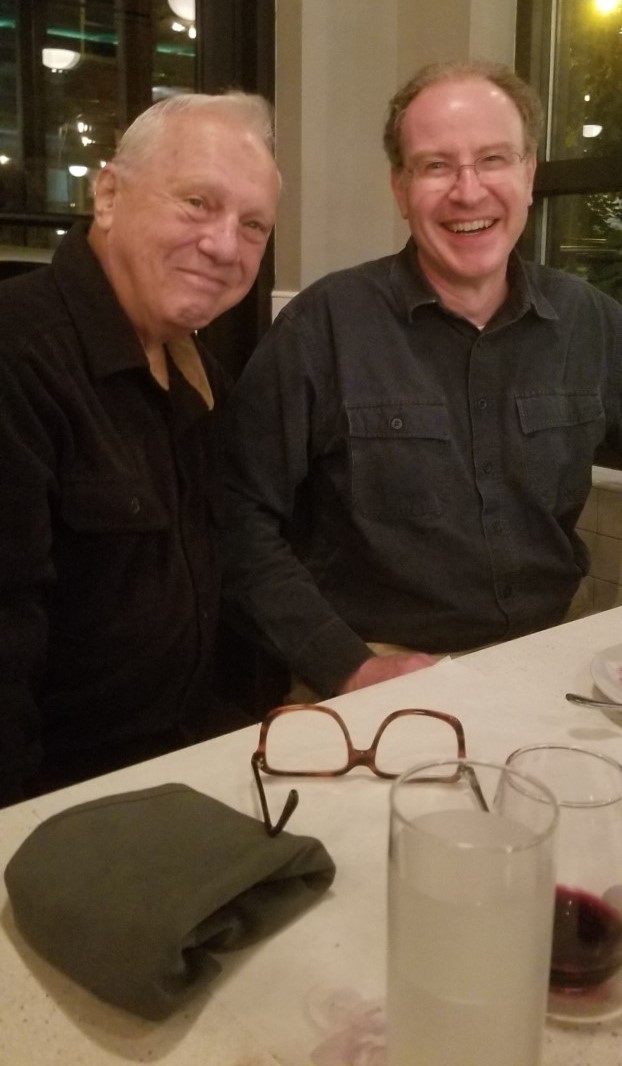
Today is the birthday of my good friend and steadfast companion for Mahler concerts at the Philadelphia Orchestra, composer Robert Moran. A pupil of Darius Milhaud, Luciano Berio, and Hans Erich Apostel, Bob’s experimented with all kinds music, from city-encompassing performance art “happenings,” to collaborations with Philip Glass, to commissions from Houston Grand Opera, Scottish Ballet, and Trinity Wall Street. Throughout his career, he’s often been fascinated by spatial effects in music. This is one of his more recent works, “Solenga,” from 2023:
Bob, if you see this, I’ve been trying to contact you. My computer died the other week and my email account is now over the storage limit, so I can’t write. I’ve been trying to phone, but of course you don’t have voice mail. (Come to think of it, neither do I!) But you can call me, text, or private message me on Facebook, if you are so moved. There’s a dinner invitation in it for you. Happy birthday!
An aria from Bob’s Beauty and the Beast opera, “Desert of Roses”
Selections from “Trinity Requiem,” for the tenth anniversary of 9/11
Flying high over Albania
“Alice” for Scottish Ballet
Looking groovy and introducing his “Lunchbag Opera” for the BBC
“Buddha Goes to Bayreuth,” Part 1
“Buddha Goes to Bayreuth,” Part 2
“Modern Love Waltz” by Philip Glass, arranged by Robert Moran for accordion and cello
WOWZERS! If you can wrangle a ticket – and hit a restroom beforehand (since the performance runs 90 minutes without break) – do not miss the Verdi Requiem with The Philadelphia Orchestra this weekend. Last night’s performance was nothing short of sublime. Chorus and orchestra were impeccable and the execution riveting. Riccardo Muti, Philadelphia’s former music director (from 1980 to 1992), returned after many years to remind everyone just how thrilling he could be in the right repertoire. Muti brought an authority to the podium that, for good or bad, seems to be notably lacking in these days of chummy, everyman conductors. The audience welcomed him with a standing ovation and was unusually attentive throughout. Cell phones remained silent, perhaps for the fear of God (both literally and metaphorically). The last time Muti conducted in Philadelphia was in 2005. Speaking as someone who’s already cleared the bar on monumental, bladder-challenging concerts of both Bruckner and Mahler in Philadelphia this season, I have to say that this one was on another level entirely. An absorbing, at times overwhelming experience.
HOLY SH*T, WHAT A CONCERT!!! (I hope I didn’t steal that from Bernard Shaw.)
I’m elated to report The Philadelphia Orchestra was in fine fettle on Friday afternoon, under the baton of guest conductor Roderick Cox.
I venture to guess, the big draw for most was Camille Saint-Saëns’ “Organ” Symphony, but for me, what really ensured a fool and his money would soon be parted was the inclusion on the program of Bohuslav Martinu’s Rhapsody-Concerto for Viola and Orchestra, a work I had not heard in concert for 36 years. The last time, also in Philadelphia, was with Joseph de Pasquale, the soloist, and Riccardo Muti on the podium. Of course, now I own at least three recordings. Back then, De Pasquale was Philly’s principal violist. Today the work was played by the orchestra’s current principal, Choong-Jin Chang.
If you don’t know anything about Martinu, and you’re at all squeamish about 20th century music, there is no better place to start. A few mildly anxious passages aside, the Rhapsody-Concerto is pure Dvořák in Iowa. Incidentally, this sleeping giant of Czech music will also be the focus of next summer’s Bard Music Festival. Fight me!
I showed up with the expectation of the Saint-Saëns being mere icing on the cake. The “Organ” Symphony has always been a Philadelphia Orchestra specialty. The musicians could probably play it in their sleep. Today, they were a good deal more committed than that. Raphael Attila Vogl was at the console of the Fred J. Cooper Memorial Organ. The organ part of Saint-Saëns’ symphony is not a virtuosic one, but it sure does make an impression! There’s a reason certain pieces become warhorses. The last movement was one sustained goosebump – positively spinetingling! That Saint-Saëns really knew how to give an audience its money’s worth.
The program opened with a suite from Béla Bartók’s feel-good ballet, “The Miraculous Mandarin.” The scenario is about a prostitute who lures unsuspecting men to her room so that three desperate characters can rough them up and steal their money. The most peculiar of her would-be clients is the titular mandarin, who the desperados attempt to murder, but he turns out to be more resilient than Rasputin.
Unfortunately, I was stuck in traffic on I-95 South, so I can’t tell you anything about the performance. I blew into the Kimmel Center for the Performing Arts and took the elevator to the third tier with just enough time only to catch the last minute or two on a monitor. But having experienced the rest of the concert, I can say with confidence that, under the circumstances, it could well have been Bartók, and not Saint-Saëns, who wound up being the icing.
The program will be repeated at the Kimmel on Sunday afternoon at 2:00. No concert tomorrow, presumably because of Yom Kippur.
So depressing is this email I received from the Philadelphia Orchestra yesterday. In the subject line, “A music-filled summer awaits!” Then I open it, and I see a photo of the Mann Music Center with more bodies strewn about the lawn than at the railroad station converted into a makeshift hospital in “Gone with the Wind.”
Scrolling down, there are capsules promoting the season-ending concert performances of “La bohème” at the Kimmel, the free neighborhood concerts, consisting mostly of excerpts from larger works (interesting repertoire admittedly – neglected Black composers – but why not show them the respect to play the music complete?), the summer festivals in Vail, Colorado, and Saratoga, New York, and a “summer residency” at the Mann.
What exactly does the summer residency entail? “…[C]lassical favorites by Gershwin and Tchaikovsky as well as hits by indie/roots band DISPATCH and Grammy Award-winner Beck. Plus… the first Philadelphia Orchestra live-score performances of two iconic films: ‘Batman’ and Disney’s ‘Aladdin.’”
Honey, bring me the smelling salts!
I know I posted about this last year, but this email is such a sad reminder. TWO orchestral concerts at the Mann – all summer – by the Philadelphia Orchestra. And they’re pitched right down the middle. I understand they want to appeal to as broad an audience as possible, but really? Is this what the orchestra now perceives as a music-filled summer?
But what are they going to do, say they know it isn’t much, but it’s what we’ve got, so enjoy it? Whoever wrote the press release probably wasn’t even born back when the orchestra really was offering a music-filled summer.
I hate to come across as the guy sitting in the back of his Rolls eating Grey Poupon out of the glove compartment, but time was when the orchestra used to play the Mann multiple nights a week (with the weekends reserved for popular bands). It looks like my description from last year (triggered by the death of André Watts) pretty much holds: “Now you’re lucky if they appear there three times in a summer, and then it’s usually to accompany a film or play the ‘1812 Overture.’”
Nobody had cell phones back in the day, either. But come to think of it, there always were some who treated the music as background to their inane picnic conversation. I guess people always were pretty much insufferable.
But in terms of the musical offerings, we never knew how good we had it. Or maybe we did, but we never thought it would go away.
It was a dreary day last Thursday, but a great pleasure to finally meet up with sportswriter Brad Wilson for the first time at Philadelphia’s Kimmel Center for the Performing Arts. Brad’s beat is my old stomping grounds of the Lehigh Valley and across the river in Warren and Hunterdon Counties.
I wish I could say I derived as much pleasure from Esa-Pekka Salonen’s performance of Sibelius’ Symphony No. 5 with the Philadelphia Orchestra.
Sadly, as someone who loves this symphony very much and who has heard it performed many times, I thought Salonen really missed the ball on this one (I promise, my only sports analogy in this write-up). At no point did I feel moved or inspired, nor did I get any sense of the conductor’s understanding of the tectonic movement or spatial relationships in the piece. I didn’t think it possible not to be cheered by the opening “sunrise” of French horns and flutes, nor do I think I have ever heard the plangent woodwinds in the third movement (if we regard it as a four-movement symphony), like forlorn waterfowl, without them tugging at my heartstrings.
There should be a sense of mounting suspense, dread even, as the ground begins to shift into the inexorable accelerando between the first two movements (which are connected). Ideally, it should carry all the thrill and terror of the sublime, but here I did not sense that it was undertaken with any great care. Rather, like most of the performance, it was simply tossed off, blithely and unconvincingly.
Even in the magnificent last movement, it was like stuff just happened. In more satisfying performances (which is to say, probably just about every other performance I’ve ever heard), everything comes together in its rough-hewn way and conductors succeed in making it sound as if every component belongs, relates, and makes some kind of coherent sense. Despite his vast experience with this composer, Salonen did not – at least for me. Maybe it was just I who was having an off-night, but I did not like it, and nothing is as depressing as having a piece of music you love and know very well not take flight.
I hasten to add, I realize the performance may not have impressed everyone the same way. At the end of the six monolithic chords that bring the symphony to a close, people around me burst into wild applause and the guy in front of me actually whooped, even as it took everything in my power to conjure a golf-clap. I didn’t want it to come across as if I don’t love the composer or don’t appreciate the orchestra’s efforts. But Salonen. Oy vey. I don’t know what people want from their Sibelius, but I expect more.
I searched for some online reviews, to make sure I wasn’t taking crazy pills, and I came across this one in which every one of the reviewer’s impressions run counter to my own. The stuff he dismisses about the concert, I enjoyed, and the stuff I disliked, he lauded to Pohjola and back. Believe me, I would have settled for “majestic stateliness.”
If there was a Philadelphia Inquirer review, I could not find it and wouldn’t be able to read it anyway, unless forwarded to me, because it would be paywalled (and in any case probably mostly worthless).
It’s unusual for Philadelphia to program the same piece two years in a row, but they did so with the Sibelius 5th. Frankly, I thought Dalia Stasevska’s performance last year was head and shoulders over what I heard Thursday night – nimble, thrilling, and intelligently judged. Even Don Liuzzi was more electrifying on the timpani. This is not a reflection on his playing on Thursday, but a musician has to work within the overall design of a conductor’s interpretation, such that it is. Salonen’s brass had some good moments with the big tune (Sibelius’ “swan theme”) in the last movement, but nothing seemed to fit together or flow organically – unusual for a conductor of his experience with this most organic of composers – or, at the very least, generate some tension and release.
Salonen is often characterized as “a modernist.” I don’t care about that. The mature Sibelius is not exactly the most sentimental composer. I would be perfectly satisfied if he had allowed the architecture of the music to simply speak for itself. But it was as if he had no idea of its magnificent layout. Rather, it was like he was flipping through a magazine (Architectural Digest?) in the waiting room at the doctor’s office. The performance, to me, just felt uninvolved, and by extension uninvolving. Maybe he’s just conducted it too many times.
Steven Stucky’s “Radical Light,” which opened the program, was also just kind of there. Salonen commissioned the work, back during his days as music director of the Los Angeles Philharmonic, to be included on a program between Sibelius’ 4th and 7th Symphonies. On Thursday, it just came off as a time-killer. Sure, it paid tribute to Sibelius by aping some of his mannerisms and textures, but I couldn’t help but think how much more satisfying it would have been had the concert just opened with the 7th Symphony or “Tapiola.”
The highlight of the evening was Salonen’s own “kínēma” (all lower case) for clarinet and orchestra, which even at 30 minutes I found engaging and wonderfully played. Ricardo Morales, the orchestra’s charismatic principal clarinet, was the soloist. I confess I was pleasantly surprised, as I own a few recordings of Salonen’s own music, and while I find it agreeable enough to just go with it if I’m in the right mood, this piece was by far the most immediately ingratiating of anything of his I have ever heard.
I want to make it clear that I don’t dislike Salonen, and I wish him all the best in conducting “Daphnis and Chloe” in Philadelphia this week. Even Pierre Boulez knew how to pull off a good performance of Ravel.
Likewise, none of this is intended as a reflection on Brad, who was kind enough to secure our tickets. He and I have enjoyed a kind of radio and Facebook messaging friendship for a good number of years now. His musical knowledge is vast and his tastes are diverse (ranging from Bach to Elliot Carter), and his observations and recommendations are always valued. From his comments that night, I gather he liked the Sibelius. I don’t have the gift of diplomacy, so I was hesitant to start in, knowing that whatever I had to say would likely blossom into a rant.
And what do I know? Salonen is Finnish (like the composer) and he has decades of experience interpreting this music. Me? I’m just a grouch. Maybe I should have eaten something closer to the start of the concert. But I love Sibelius and I love this symphony, and I have a pretty good idea of when somebody gets it right. Even Simon Rattle, with his bewildering obsession with whispered pianissimos, got it when he conducted it in Philly in 1999. Salonen was like Väinämöinen, the star-crossed wizard of the Kalevala, on one of his terrible, horrible, no good, very bad days.
And dammit, the program notes were weak too!
This amused me: Dave Hurwitz’s recollection of three terrible concerts. Hurwitz can be an acquired taste, but once you acquire it, he’s like an amusing, outspoken friend. I agree with him that live music concerts, even at their worst, can be wonderful. Also that there can be a certain satisfaction to be found in tearing the bad ones apart.
I would have had this posted days ago, but I was interrupted by a phone call, like the poet Coleridge, distracted by a knock at the door in the middle of setting down the lines for “Kubla Khan,” which had come to him in a dream; and then when he returned, he found he couldn’t pick up the thread. However, unlike Coleridge, this humble review is unlikely to be included in anthologies of English literature in 200 years, even as society inevitably continues to deteriorate.